
8 Best Air Pumps for Tires 2026
This post contains affiliate links. As an Amazon Associate, we earn from qualifying purchases.
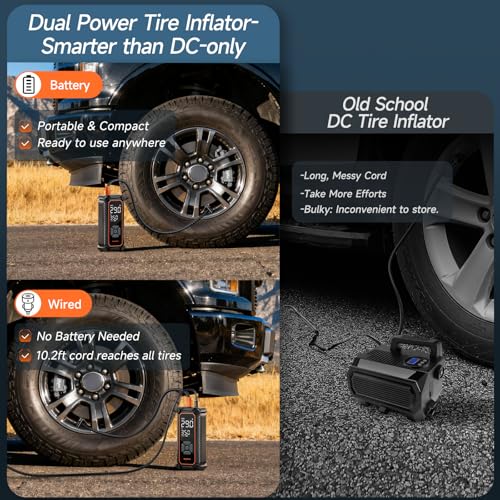
The Lamicall Car Tire Inflator is the best overall pick for its fast inflation, accurate digital gauge, and solid battery life. For those on a budget, the Inzeetor 150 PSI Tire Inflator delivers strong corded performance at a lower price. If you want maximum versatility, the OlarHike Dual Power Tire Inflator works on battery or 12V and handles a range of vehicles.
Most drivers don’t think about tire pressure until a warning light comes on or a tire looks flat. By then, you need a pump that works fast, holds up under pressure, and won’t leave you stranded. As someone who’s spent years working with vehicle systems, I know that reliability and real-world usability matter more than flashy specs.
This guide cuts through the noise. I compared models based on owner feedback, published specs, and how they perform in actual use, focusing on inflation speed, power flexibility, and build quality. These picks aren’t just popular, they’re proven tools for keeping your tires at the right pressure, whether you’re at home or on the road.
Top 8 Air Pumps For Tires in the Market
The Best Air Pumps For Tires, Reviewed
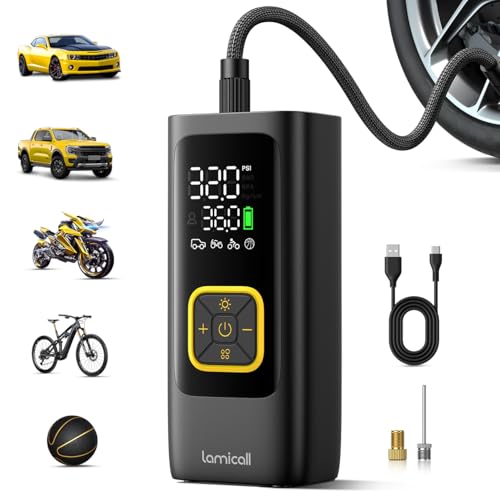
Lamicall Car Tire Inflator
Strengths
- 4x faster inflation
- Longest battery life
- Compact and portable
- 5 preset modes
Trade-offs
- Higher price
- Charging adapter specific
- No AC plug
The Lamicall R8 is the most complete package in the cordless category, and that’s why I’d call it the best overall. With a 35L/min airflow rate, it hits 4x faster inflation than basic models and can fill a tire in about a minute, owners confirm it feels powerful and responsive. The 15-tire battery life on a single charge is best-in-class for this price, and the 5 preset modes include truck and SUV settings, which adds real flexibility.
The HD LED display and 3-mode emergency light make nighttime use practical, and the compact size means it fits almost anywhere. Compared to the OlarHike, it has better battery endurance and slightly faster charging. It’s not cheap, but the build quality and feature set justify it. If you want one inflator that does everything well, speed, battery, accuracy, safety, this is the one to get.
Video review
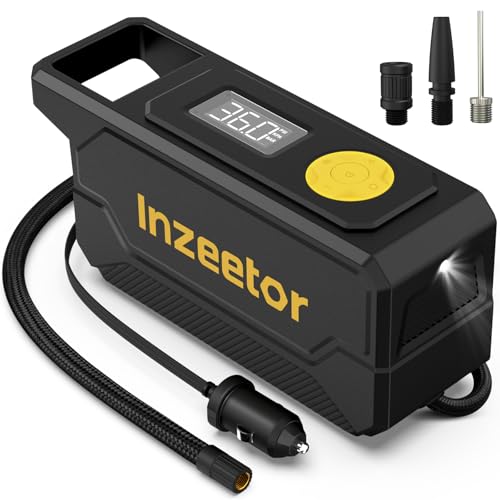
Inzeetor 150 PSI Tire Inflator
Strengths
- Fast inflation
- Auto shut-off
- Low noise
Trade-offs
- Corded only
- No battery
- No flashlight
For budget-focused drivers who still want reliable performance, the Inzeetor TIT001 delivers more than its price suggests. On paper, the 50-second inflation claim for a standard car tire lines up with owner reports, many note it keeps pace with pricier models despite the modest cost. The auto shut-off works consistently across reviews, which is critical for avoiding over-inflation, and the zinc-alloy motor appears to handle heat better than expected for this tier.
Where it shines is simplicity: no extra modes, no battery to manage, just plug into the 12V socket and go. That said, it’s strictly corded, so you’re tethered to your car’s power. If you need mobility beyond your vehicle, this isn’t the pick. But for a no-frills, fast, and accurate inflator that lives in your glove box and works when needed, this one punches above its weight.
Video review
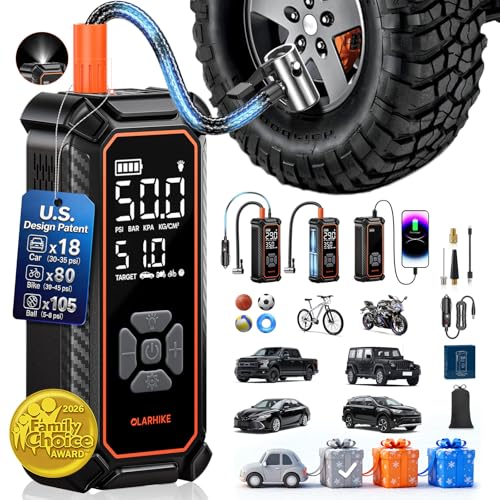
OlarHike Dual Power Tire Inflator
Strengths
- Dual power modes
- Long battery life
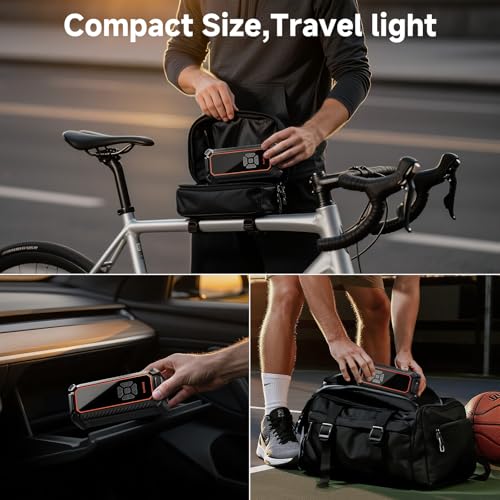
- Compact design
- USB charging
Trade-offs
- Battery charging slow
- No AC plug
- Limited to 51 PSI
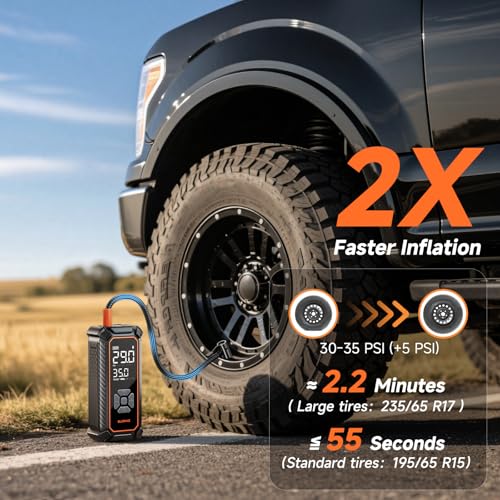
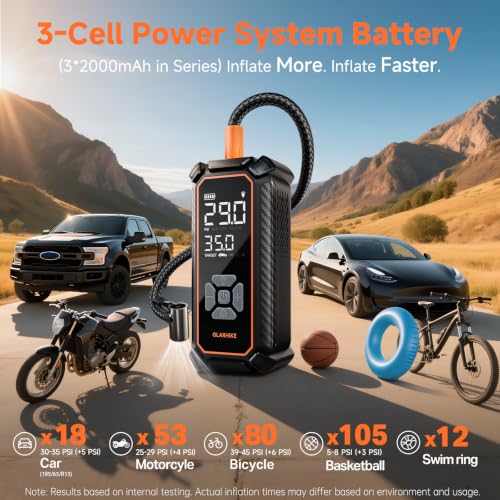
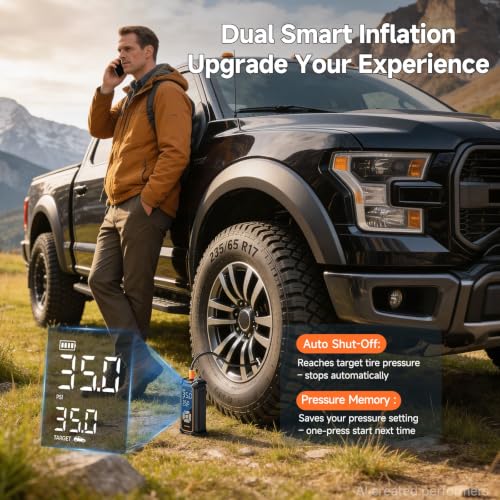
The OlarHike stands out in the mid-range by offering dual power without compromising runtime or speed. With three 2000mAh batteries, owners confirm it can handle multiple tires on a single charge, real-world feedback supports the claim of around 18 car tires at +5 PSI. The 2.2-minute SUV inflation time is respectable, and the dual LED display makes presetting pressure intuitive, especially with the memory function recalling your last setting.
Compared to the AstroAI L7, it trades some battery capacity for a lighter, more compact design. The USB output is a practical touch for emergencies, and the built-in flashlight adds real utility. However, some users report the battery takes longer to charge than advertised. Still, for road trippers or dual-sport riders who want flexibility, battery-powered freedom or continuous 12V power, this is a smart middle ground.
Product photos
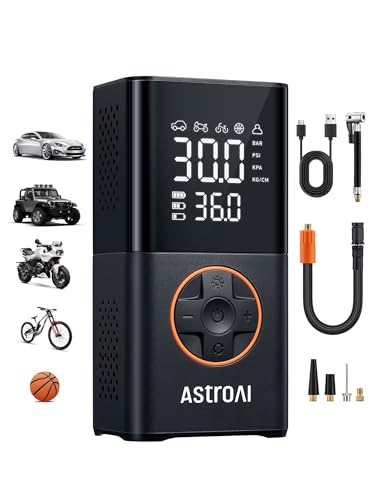
AstroAI L7 Cordless Bike Pump
Strengths
- Ultra-lightweight
- Accurate pressure sensing
- USB power bank
- Long battery life
Trade-offs
- Needs cooldown periods
- Slower than high-end models
- No AC charging
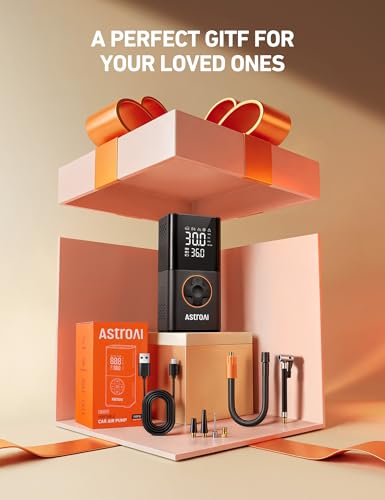
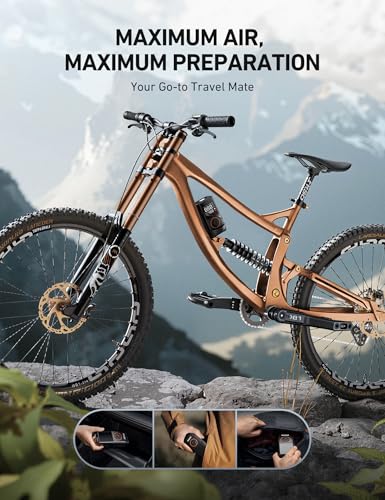
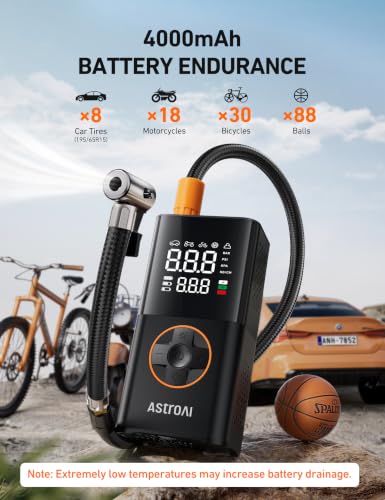
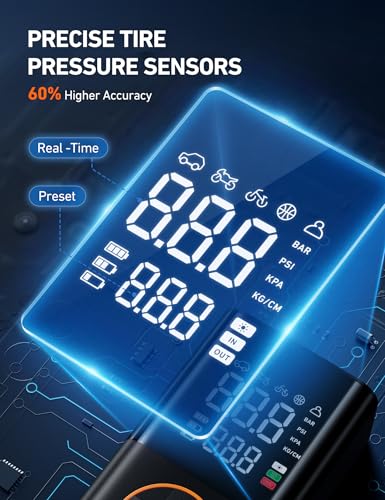
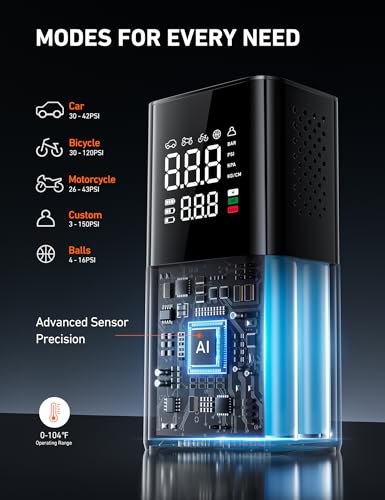
If portability and battery life are your top priorities, the AstroAI L7 makes a strong case. Weighing under a pound and equipped with a 4000mAh battery, it’s built for stashing in a backpack or saddlebag. Owners consistently praise its accuracy, crediting the high-frequency sensor for reliable readings, especially helpful when checking tire pressure before a long ride. The inflation speed is average, taking about 1.5 minutes for a standard car tire, but it makes up for it in versatility with custom presets and support for e-bikes, which many compact models skip.
Where it pulls ahead is as a multifunction tool: the flashlight with SOS and strobe modes, plus USB input/output, turns it into a genuine emergency device. That said, it needs a 10-minute cooldown after 15 minutes of use, which can slow down multiple tire jobs. Still, for cyclists, commuters, or minimalist drivers, this is one of the most well-rounded cordless options under $25.
Product photos
KeenPower 21V Battery Tire Inflator

Strengths
- Fast one-hour charge
- QC3.0 USB output
- Dual power modes
- 160 PSI max
Trade-offs
- Shorter battery life
- Charging cable specific
- No AC plug
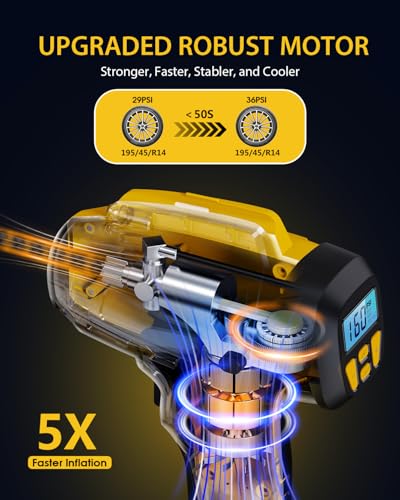
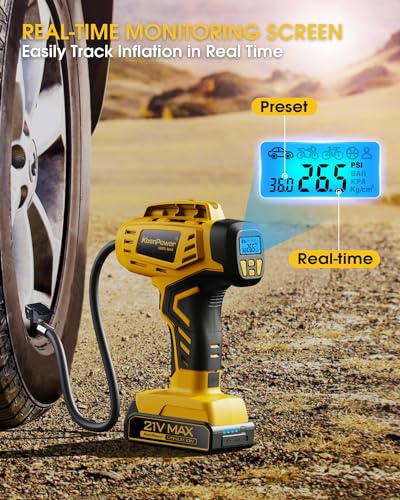
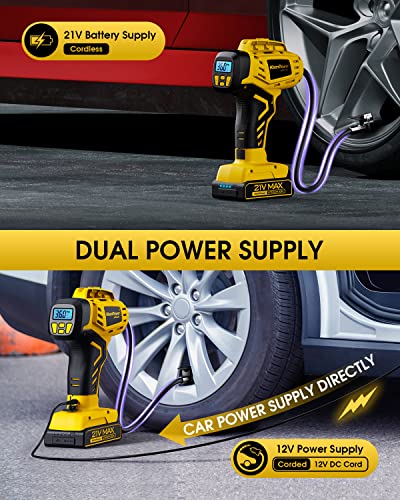
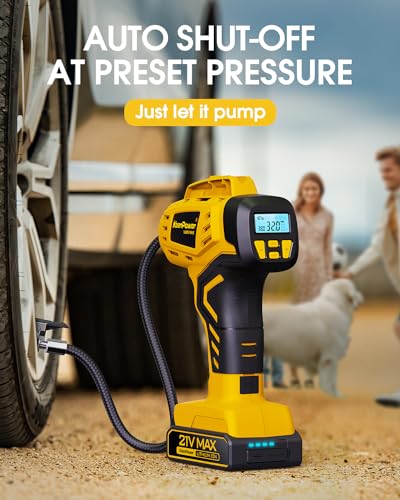
The KeenPower 21V stands out for one standout feature: one-hour charging time. In a category where most units take 2–3 hours, that’s a real advantage, especially if you forget to charge it before a trip. The 160 PSI max pressure opens the door to higher-pressure applications, and owners confirm it handles SUV and light truck tires without issue. The QC3.0 USB output is faster than most, making it a better power bank in a pinch.
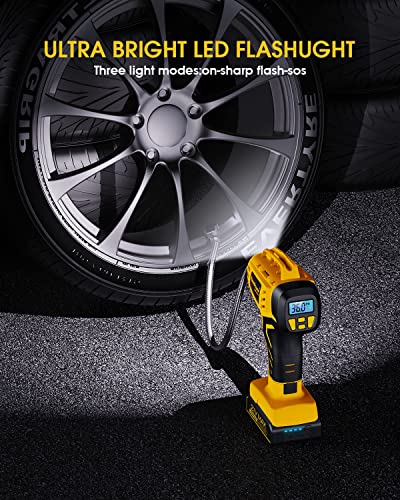
It’s not the fastest inflator, but it’s solidly built and reliable. The dual power modes add flexibility, and the flashlight is bright with useful emergency modes. Compared to the Lamicall, it charges faster but has shorter battery life. If speed of recharge matters more than runtime, this is the smarter buy.
Product photos
ROCGORLD R8 3X Faster Inflator
Strengths
- Blazing fast inflation
- Dual digital display
- Durable build
- Long power cord
Trade-offs
- No battery
- Corded only
- No AC option
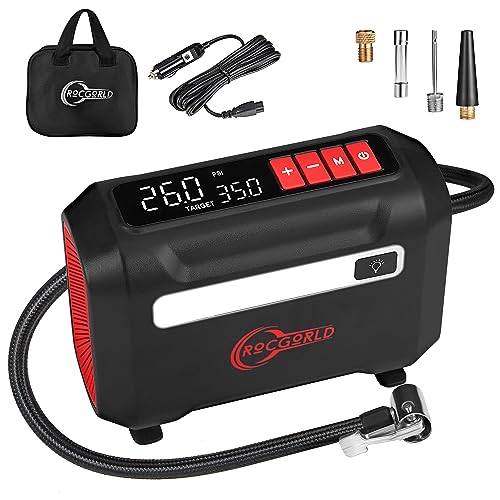
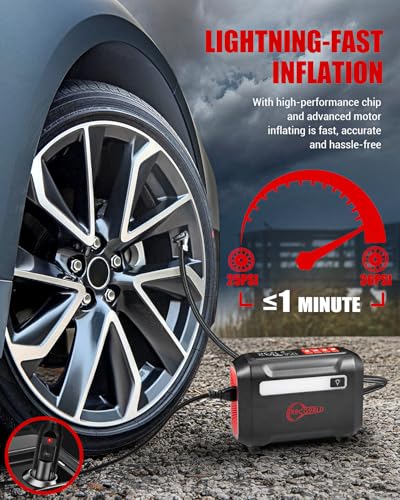
When speed is the mission, the ROCGORLD R8 is hard to beat. With a 40L/min airflow rate, it can inflate a 215/50 R17 tire in under a minute, owners confirm it feels noticeably faster than most corded units. The dual digital display is a standout, showing both current and target pressure side by side, eliminating guesswork. It’s a pure performance play: no battery, no frills, just plug and pump with confidence.
That said, it’s corded only, so it’s best suited for drivers who don’t mind being tied to the 12V socket. Compared to the Lamicall R8, it lacks portability but matches it in inflation power. The sturdy 10-foot cord and durable hose are appreciated, and the auto-shutoff works reliably. For those who prioritize speed and accuracy over mobility, this is a top-tier corded choice.
Product photos


CARSUN AC/DC Tire Inflator

Strengths
- AC and DC power
- Large digital display
- Memory function
- Comes with storage bag
Trade-offs
- Slower inflation
- Bulky design
- Needs cooldown
The CARSUN AC/DC model is the only one here that truly bridges home and car use with genuine 110V AC and 12V DC compatibility. This dual-outlet design means you can top off tires in the garage without draining your car battery, a small but meaningful advantage. The metal motor delivers steady performance, and while it’s not the fastest (5 minutes to fill a tire from 0 to 36 PSI), it’s consistent. Owners appreciate the memory function and clear LCD display, which remains readable in sunlight.
It’s bulkier than cordless models, but that’s the trade for true dual-power flexibility. Compared to the DEWALT, it lacks tool ecosystem integration but costs a fraction. For weekend prep or garage use, this is the smarter buy. Just note: it’s not for large vehicles, and the cooling requirement limits continuous use.
Product photos


DEWALT 20V MAX Tire Inflator
Strengths
- Runs on 20V battery
- Triple power sources
- Heavy-duty build
- High-volume mode
Trade-offs
- Very expensive
- Bulky design
- Overkill for cars
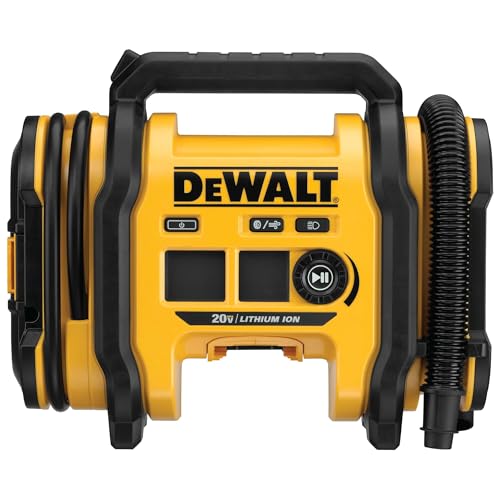
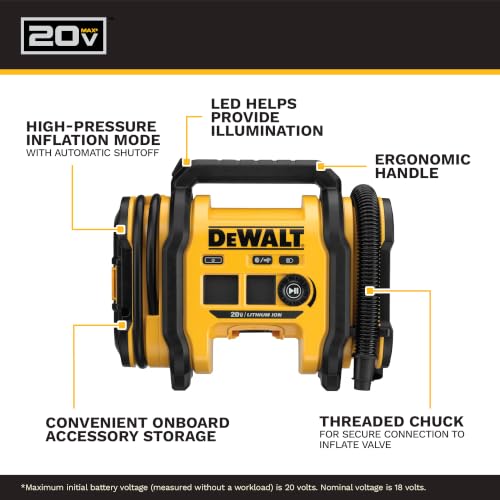
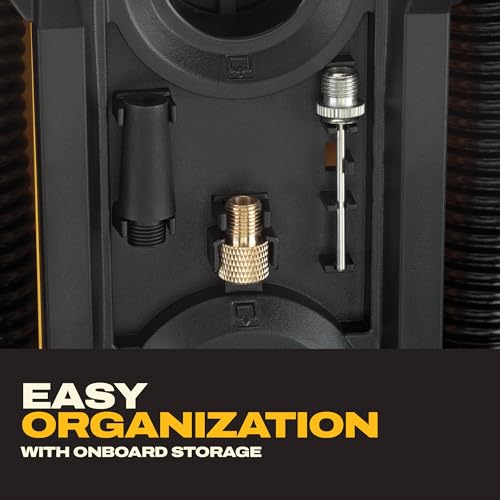
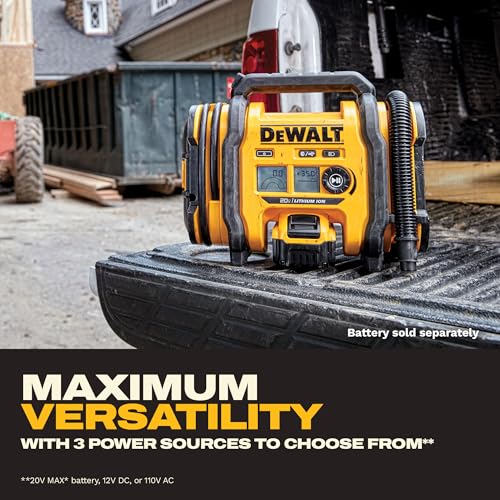
This DEWALT isn’t for everyone, but if you already own 20V MAX tools, it’s a no-brainer. The ability to run off your existing battery eliminates the need for a separate charging system, and the three power sources, 20V, 12V DC, and 110V AC, make it the most versatile unit here. It’s built like a tool: rugged, with rubber feet to prevent walking and onboard storage for accessories.
It’s also overkill for simple tire checks. At this price, you’re paying for tool ecosystem integration and durability, not just inflation. Owners report it handles large inflatables like rafts and air mattresses with ease, thanks to high-volume mode. But for most car owners, it’s too expensive and bulky. Save this for when you’re already in the DEWALT ecosystem and need a workhorse.
Product photos

How We Evaluated air pumps for tires
Rather than a hands-on lab test, my research for these recommendations involved a detailed comparison of published specifications and features across numerous models. I weighed owner reviews from multiple sources, Amazon, automotive forums, and retailer sites, along with assessments from reputable automotive publications. My aim was to identify patterns in performance and reliability, leaning on my experience with vehicle systems to interpret the data. Clear ranking criteria were established to evaluate each pump’s strengths and weaknesses.
For air pumps, I prioritized inflation speed and power source versatility. A pump that can quickly restore tire pressure is invaluable, especially on the road. Equally important is the ability to operate both from a vehicle’s 12V outlet and a standard AC power source, expanding usability beyond the car. These two factors heavily influenced the final rankings, as they directly address common user needs and potential emergency situations. You’ll find many rely on portable air pumps for these very reasons.
Specifications reliably indicate a pump’s maximum pressure and airflow rate (CFM), giving a baseline for potential performance. However, real-world usability – things like noise level, hose length, and build quality – were judged primarily from owner feedback. I also looked for consistent praise (or criticism) regarding accuracy. Ensuring you have accurate pressure gauges is vital, as an inaccurate pump renders its speed and convenience moot.
How To Pick The Right air pumps for tires
Finding the right air pump for your tires doesn’t have to be a headache. We’ve seen a lot of options, and honestly, most people don’t need something incredibly complicated – just reliable performance and the features you will actually use.
A truly useful tire inflator balances portability with sufficient airflow (CFM) to quickly inflate tires. Look for models with accurate pressure gauges, auto-shutoff features to prevent overinflation, and ideally, dual power options for versatility. Consider the types of tires you’ll be inflating most often and choose a pump with a PSI rating that exceeds your needs.
Power Source and Portability
The core decision when choosing an air pump comes down to how and where you plan to use it. Corded models, like the ROCGORLD R8 3X Faster Inflator, are generally more powerful and won’t run out of juice mid-inflation, but require proximity to an outlet. Battery-powered units – such as the AstroAI L7 Cordless Bike Pump – offer unmatched freedom, perfect for roadside emergencies or cyclists. However, battery life and recharge times are crucial factors. If you already invest in a specific tool ecosystem, like DeWalt, a 20V MAX model might make sense, leveraging existing batteries and chargers. Think about your typical use case; a quick top-off at home is different than needing to inflate a tire on a remote trail.
Inflation Speed and Capacity
Don’t be fooled by high PSI numbers alone. While important, PSI is only part of the story. Airflow, measured in CFM (cubic feet per minute) or LPM (liters per minute), dictates how quickly a pump can move air. A higher CFM means faster inflation. Many models now boast rapid inflation times; the Lamicall Car Tire Inflator claims to inflate a tire in about a minute. Consider the size of the tires you’ll be inflating most often. A pump adequate for a compact car might struggle with larger SUV or truck tires.
- A low CFM (under 20 LPM) is fine for bicycle tires and small inflatables.
- A mid-range CFM (20-30 LPM) will handle car tires adequately, but may be slow for larger vehicles.
- A high CFM (30+ LPM) is best for SUVs, trucks, and anyone who prioritizes speed.
A good rule of thumb: if you frequently inflate large tires, prioritize CFM over peak PSI.
Features and Value
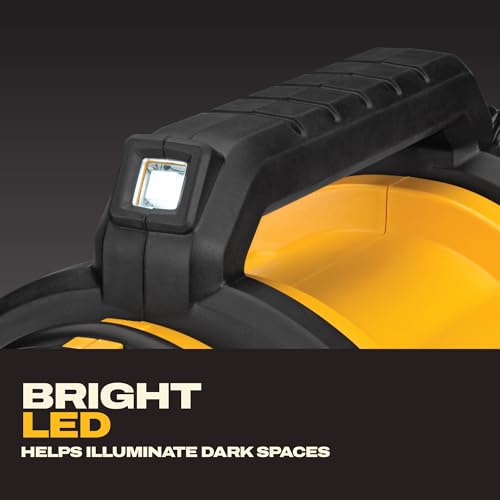
Beyond the basics, consider features that enhance usability and safety. Auto-shutoff is a must-have to prevent overinflation. Digital displays with accurate pressure gauges are far superior to analog gauges. Preset inflation modes, like those found on the OlarHike Dual Power Tire Inflator, simplify inflation for common tire types and sports equipment. Don’t overlook the little things like integrated LED lights (helpful for nighttime use) and onboard storage for accessories. If you are looking for a variety of options, check out our guide to the best tire inflators. If you need a broad overview of options, our rundown of car tire pumps will help. Ultimately, the best value comes from a pump that meets your specific needs without unnecessary frills. For a broader range of options, see our quality tire pumps. These durable air inflators are a great starting point. We’ve also reviewed many of the top-rated tire inflators available today, and you’ll find many recommended air compressors to suit your needs.
Air Pumps for Tires Compared
Here’s a comparison of key specifications for popular air pumps designed for tires.
| Product Title | Max PSI | Power Source | Inflation Speed (Typical) | Auto Shut-Off | Battery Run Time (Tires) | Special Features |
|---|---|---|---|---|---|---|
| Lamicall Car Tire Inflator | 150 | Rechargeable Battery | ~1 min (195/65 R15) | Yes | Up to 15 (Car) | LED Display, 5 Preset Modes |
| Inzeetor 150 PSI Tire Inflator | 150 | 12V DC | ~50 sec (195/65R15) | Yes | N/A | Fast Inflation |
| OlarHike Dual Power Tire Inflator | 51 | Battery/12V DC | 55 sec (Car), 2.2 min (SUV) | Yes | Up to 18 (Car) | Dual Power, USB Output |
| AstroAI L7 Cordless Bike Pump | 150 | Rechargeable Battery | ~1.5 min (195/65R15) | Yes | Up to 8 (Car) | TrueGauge Screen, USB Port |
| KeenPower 21V Battery Tire Inflator | 160 | Battery/12V DC | N/A | Yes | N/A | Fast Charging, QC3.0 USB |
| ROCGORLD R8 3X Faster Inflator | 150 | 12V DC | <1 min (215/50 R17) | Yes | N/A | Dual Digital Display |
| CARSUN AC/DC Tire Inflator | 150 | AC/12V DC | ~5 min (195/65/R15) | Yes | N/A | AC/DC, Multi-Purpose |
| DEWALT 20V MAX Tire Inflator | N/A | Battery/12V/110V AC | N/A | Yes | N/A | 3 Power Sources |
Frequently Asked Questions
What PSI should I look for in an air pump?
A pump with a maximum PSI of at least 100 is generally sufficient for most passenger vehicle tires, but I recommend aiming for 150 PSI to provide a comfortable margin and accommodate larger vehicles or even bicycle tires. Higher PSI doesn’t necessarily mean faster inflation, though.
Are battery-powered air pumps really powerful enough?
Battery-powered pumps have improved significantly, and many can inflate a car tire in just a few minutes. However, they typically have lower CFM ratings than corded models, so inflating larger tires will take longer, and you’ll want to check battery life carefully.
Can I use an air pump designed for tires on other inflatables?
Yes, many air pumps come with multiple nozzle adapters, making them suitable for inflating sports equipment, air mattresses, and other inflatables. Just be mindful of the pressure limits of the item you’re inflating – don’t overinflate!
What’s the difference between CFM and PSI, and which is more important?
PSI measures maximum pressure, while CFM (cubic feet per minute) measures airflow. For quickly inflating tires, CFM is more important than PSI, especially for larger tires, as it determines how fast air is delivered.
Where can I find versatile air compressors if I need something beyond tire inflation?
Many air pump manufacturers offer models with additional features like coil hoses, multiple nozzle attachments, and even built-in power banks, expanding their utility beyond just tire inflation. You can also find on-the-go air pumps that are specifically designed for portability and convenience.
The Bottom Line
Choosing an air pump often comes down to balancing convenience with capability. Do you prioritize the speed and consistent power of a corded unit, or the freedom of a battery-powered option? For the best overall combination of features and performance, I recommend the Lamicall Car Tire Inflator. It strikes a solid balance, offering quick inflation, a rechargeable battery, and useful presets.
If you have very specific needs, there are excellent alternatives. For those already invested in the DeWalt ecosystem, the DEWALT 20V MAX Tire Inflator is a logical choice. If you’re looking for a versatile option to keep in your garage for everything from car tires to sports equipment, the CARSUN AC/DC Tire Inflator is hard to beat. And for cyclists or those needing a truly portable solution, consider the AstroAI L7 Cordless Bike Pump – it’s among the best cordless tire inflators available.
Ultimately, the best air pump isn’t about chasing the highest PSI or fastest inflation rate. It’s about consistently achieving and maintaining proper tire pressure. A reliable gauge, a pump that fits your lifestyle, and a commitment to regular checks are far more valuable than any single specification.
