
Are Tire Chains Legal | The 4 Rules That Actually Matter
This post contains affiliate links. As an Amazon Associate, we earn from qualifying purchases.
Tire chains are legal for winter traction across most of the United States, but their legality hinges entirely on following four state-specific rules: using the right type (cable vs. Link chains), obeying posted chain control signs, restricting use to designated seasons, and meeting your vehicle’s gross weight rating (GVWR). For example, a 2WD vehicle under 16,000 lbs on a Colorado “must carry” route requires chains physically affixed when the law is active, while the same vehicle in California needs them only when an R-1/R-2 sign is posted.
That distinction between “must carry” and “must use” is the line that gets drivers fined. Most assume if they see a “Chains Required” sign, they can drive through with winter tires and no chains in the trunk. In Colorado after September 1, that’s a $50 ticket on Interstate 70 west of Morrison, no questions asked. The rest of this guide walks through the official state codes—California, Colorado, Washington, Maryland, Oregon—and the specific equipment they require. You’ll leave knowing exactly what the signs mean and which rulebook your next mountain pass follows.
What follows: the four core rules broken down by state, the penalties for getting them wrong, and the exact specs for the gear that keeps you legal.
Key Takeaways
- Legality is conditional, not universal. Chains are only legal for use when road conditions require them for safety, as posted by official chain control signs.
- Vehicle weight is the primary decider. Commercial vehicles over 6,500 lbs in California or 10,000 lbs GVWR in Washington follow stricter, year-round chain mandates on specific mountain routes.
- “Tire traction device” is the legal term. This includes link chains, cable chains, textile snow socks, and automatic systems—all must meet SAE or state specifications.
- Passenger cars face two separate rules: “carry” and “use.” In many states, you must carry chains in the trunk during winter months, but are only required to install them when chain control signs are actively posted.
- Studded snow tires are not a legal substitute for chains in chain control areas. They are regulated under separate seasonal statutes.
The Answer Depends on Your State (and Your Vehicle)
Tire chain legality isn’t a simple yes or no. It’s a patchwork of state traffic codes, department of transportation mandates, and seasonal statutes. The controlling document is your state’s vehicle code, which defines what constitutes a legal “tire traction device.” California’s definition under California Vehicle Code (VC) Section 605 is typical: a device with the structural integrity to improve traction on snow or ice that bears the manufacturer’s mark.
But that definition is just the start. Where you can use them, when you must use them, and what type you need depends on three things: your state, your vehicle’s weight class, and the current road condition signage. A recreational vehicle under 6,500 lbs follows a different rulebook than a commercial straight truck.
Common mistake: Assuming winter or all-terrain tires exempt you from chain laws. In California under an R-1 chain control, they do. Under an R-2, only 4WD/AWD vehicles with snow tires on all four wheels are exempt. Under an R-3, there are no exemptions. Getting this wrong means a citation from the highway patrol.
The real question isn’t “are they legal,” but “under what specific conditions are they legally required, and what exact type meets the code?” The following tables break down the two major rule categories: commercial/heavy vehicles and passenger vehicles.
| State | Key Agency / Code | Primary Rule for Commercial Vehicles | Seasonal Restriction |
|---|---|---|---|
| California | Caltrans / CVC 605 | Over 6,500 lbs GVWR must install chains when signs posted. Specific requirements for bus, truck, and combination axle types. | No fixed season; active when chain controls posted. |
| Colorado | Colorado State Patrol | Over 16,000 lbs GCWR/GVWR must carry chains Sep 1–May 31 on 7 specified mountain corridors. Must use when Passenger Vehicle Traction Law active. | September 1 to May 31 (carry). Use when signs active. |
| Washington | WSP / WAC 204-24-050 | Over 10,000 lbs GVWR must carry 2 extra chains Nov 1–Apr 1 on specified mountain passes. Must use when “Chains Required” posted. | November 1 to April 1 (carry on specified passes). |
| Maryland | Transportation Code §22-405.2 | Prohibits metal tires/protuberances on highways except for chains “of reasonable proportions” when required for safety. No specific weight trigger. | No seasonal restriction for chains (studded tires allowed Nov 1–Mar 31 in 5 western counties). |
| Vehicle Type (Under 16,000 lbs) | California (R-2 Control) | Colorado (Traction Law Active) | General Rule of Thumb |
|---|---|---|---|
| 2WD Passenger Car/Truck | Chains required on drive axle. | Chains or approved ATD required on 2+ drive tires. No tire-only option. | If you have 2WD, assume you need chains installed when signs are up. |
| 4WD/AWD with Snow Tires | Exempt if snow tires on all four wheels. Must carry chains. | Exempt if tires have 3/16″ tread and M+S or 3PMSF rating. Must carry chains/ATD. | 4WD doesn’t mean invincible. You still must carry traction equipment. |
| Vehicle Towing a Trailer | Chains required on one drive axle of tow vehicle. Trailer with brakes needs chains on one axle. | Follows commercial vehicle rules if GCWR > 16,000 lbs. Otherwise, passenger rules apply. | Adding a trailer changes your weight class. Re-check your GCWR. |
State-by-State Breakdown of Traction Laws
Every state with significant mountain passes has codified its chain requirements. These are not suggestions. They are enforceable traffic codes with attached fines, and highway patrol officers monitor compliance at checkpoints.
California: The Chain Control System
California uses a three-tiered chain control system, managed by Caltrans and enforced by the CHP. The system is based on road conditions, not dates.
R-1 (Requirement 1): Chains are required on all vehicles except passenger vehicles and light-duty trucks under 6,000 pounds gross weight equipped with snow tires on at least two drive wheels. Vehicles using snow tires must still carry chains.
R-2 (Requirement 2): Chains or traction devices are required on all vehicles except four-wheel/all-wheel drive vehicles with snow-tread tires on all four wheels. Those 4WD/AWD vehicles must carry chains.
R-3 (Requirement 3): Chains or traction devices are required on all vehicles, no exceptions.
The Caltrans chain control procedures are clear: you must stop and install chains when signs indicate. The speed limit when chains are installed is 25 or 30 mph. Failure to comply can result in a citation. For heavy commercial vehicles, the California chain requirements guide details exact configurations for everything from buses to tractor-trailer combinations.
Colorado: The “Must Carry” Mandate
Colorado’s law, updated in 2024, is particularly strict for its mountain corridors like I-70. The Colorado State Patrol chain law draws a bright line based on weight and drive type.
For commercial vehicles over 16,000 lbs, chains must be carried from September 1 through May 31 on seven specified routes, regardless of weather. For passenger vehicles under 16,000 lbs, the Passenger Vehicle Traction Law applies when activated on overhead signs.
Where this goes sideways: Drivers assuming their all-season M+S tires are enough for a 2WD vehicle. Under Colorado’s updated law, 2WD vehicles have no tire-only compliance option. When the traction law is active, you must have chains or an approved Alternate Traction Device (ATD) like AutoSocks physically installed on two or more drive tires. Simply having them in the trunk is not compliance.
This makes choosing the right chains for snow and ice critical for Colorado travel.
Washington: Heavy Focus on Commercial Traffic
Washington State Patrol regulations focus heavily on commercial safety. Washington State Patrol chaining requirements mandate that vehicles over 10,000 lbs GVWR carry a minimum of two extra chains from November 1 to April 1 on specified mountain passes.
The rules are technical: approved chains must have at least two side chains with sufficient hardened metal cross chains so that at least one cross chain contacts the road at all times. Plastic chains are explicitly prohibited for vehicles over 10,000 lbs GVWR.
Oregon and Maryland: Specific Exemptions
While Oregon’s Oregon DOT chain regulations follow a similar pattern to California and Washington, Maryland presents a unique case. The Maryland vehicle equipment statute (§22–405.2) prohibits tires with studs or protuberances on highways, but explicitly permits “tire chains of reasonable proportions” when required for safety due to snow or ice.
Maryland also grants a seasonal exemption from November 1 through March 31 for studded tires in five western counties (Allegany, Carroll, Frederick, Garrett, Washington). This highlights a crucial point: studded snow tires are governed by separate laws and are not considered a substitute for chains in chain control areas elsewhere.
What Qualifies as a Legal “Tire Traction Device”?
Not all products marketed as “snow chains” meet state legal definitions. The term “tire traction device” is broader, encompassing several technologies, each with pros, cons, and specific legal standing.
Conventional Link Chains (SAE Class S): These are the classic, heavy-duty chains made of hardened steel links. They offer the best traction and durability, especially for commercial use. States like Washington specify they must be of “hardened metal.” They are universally accepted but can be challenging to install and are not recommended for vehicles with limited clearance.
Cable Chains: These use steel cables reinforced with cross-links. They are lighter, easier to install, and fit vehicles with tight wheel well clearance. California law explicitly includes cable chains as legal tire traction devices. However, Colorado’s commercial rules specify a minimum cable diameter of 0.415 inches for them to count as a valid alternative to link chains on certain axles.
Textile-Based Devices (AutoSocks): These are fabric covers that slip over the tire. They are approved as Alternate Traction Devices (ATDs) in many states, including Colorado and California (where approved). They are easy to install and store but are for temporary, low-speed use on snow and can be damaged on dry pavement.
Automatic Traction Devices (ATDs): These are mounted under the vehicle and deploy chain segments automatically. They are legal in California as a one-to-one replacement for conventional chains, primarily on commercial and emergency vehicles.
The part nobody mentions: Your vehicle’s owner’s manual might say “Do not use tire chains.” This does not exempt you from the law. Caltrans notes that if a vehicle cannot accommodate conventional link chains, it may still fit cable chains or a device like the “Spikes Spider.” If you cannot equip any legal traction device, you cannot legally enter the chain control area.
Choosing the right device means matching it to your state’s law, your vehicle’s specifications, and the typical conditions you face. For most passenger vehicles navigating occasional mountain passes, a set of high-quality cable chains is the practical choice. For heavy-duty use or frequent travel in places with strict commercial codes like Colorado or Washington, investing in proper SAE Class S link chains is non-negotiable.
Rules for Passenger Vehicles
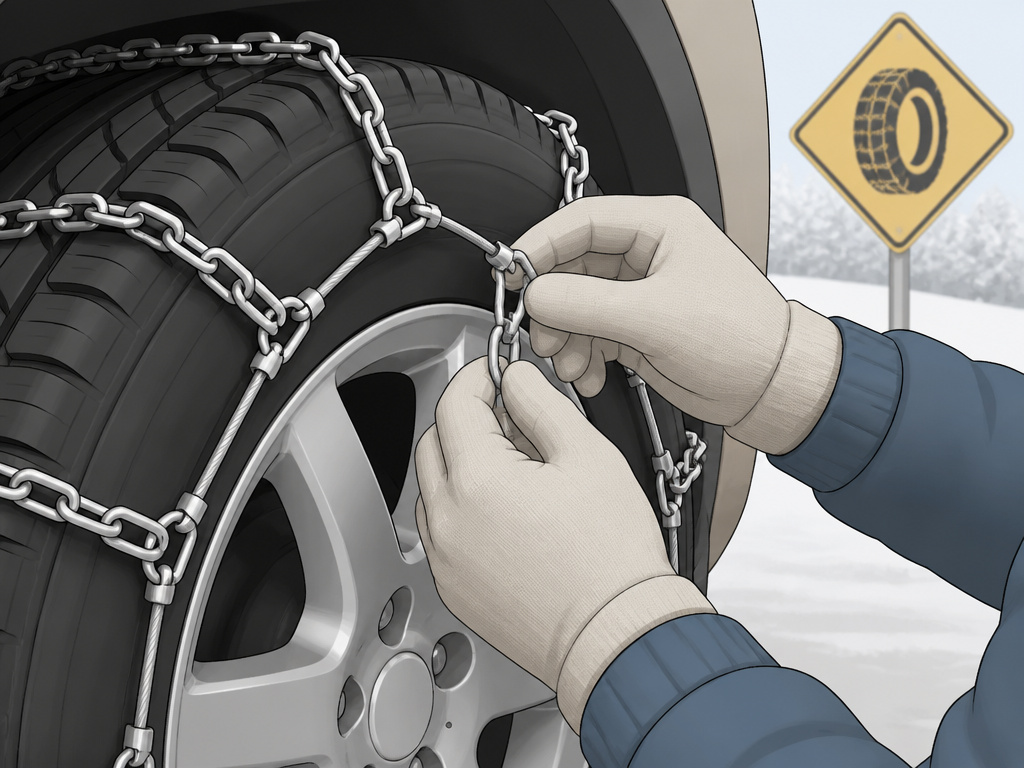
For drivers of cars, SUVs, and light trucks, the rules simplify into two buckets: what you must carry and when you must install.
The Carry Law: Several states mandate that you simply have chains in your vehicle during winter months, regardless of immediate weather. This is a “must carry” rule. * California: All vehicles, including 4WD/AWD, must carry chains upon entering a chain control area. * Colorado: 2WD vehicles must carry chains or ATDs from Sep 1–May 31 on specified routes. 4WD/AWD must carry them when the traction law is active.
The Use Law: This requires you to physically install chains on your tires when regulatory signs are posted. * California: Install when R-1, R-2, or R-3 signs are posted, following the exemptions noted. * Colorado: Install when the Passenger Vehicle Traction Law is active on overhead signs. * Washington/Others: Install when “Chains Required” or similar signs are posted.
The most common penalty is a fine. In Colorado, it’s $50 plus a surcharge for violating the traction law. In California, you can be cited by the CHP and fined. In extreme cases, or if you block traffic because you’re unprepared, you may be turned back or required to pay a towing fee.
Your Quick Compliance Checklist:
- Know your state’s active season (if any) for carry laws.
- Know your vehicle’s GVWR and drive type (2WD vs. 4WD/AWD).
- Purchase approved traction devices that fit your wheels and have clearance.
- Practice installation in your driveway, not on a snowy roadside.
- Carry them in the passenger compartment for easy access, not buried in the trunk.
For those in 2WD vehicles, the safest path is to assume you’ll need to install chains in severe conditions and buy a set you’re confident you can mount. The best snow chains balance ease of use with proven traction.
Commercial Vehicle Requirements Are a Different World
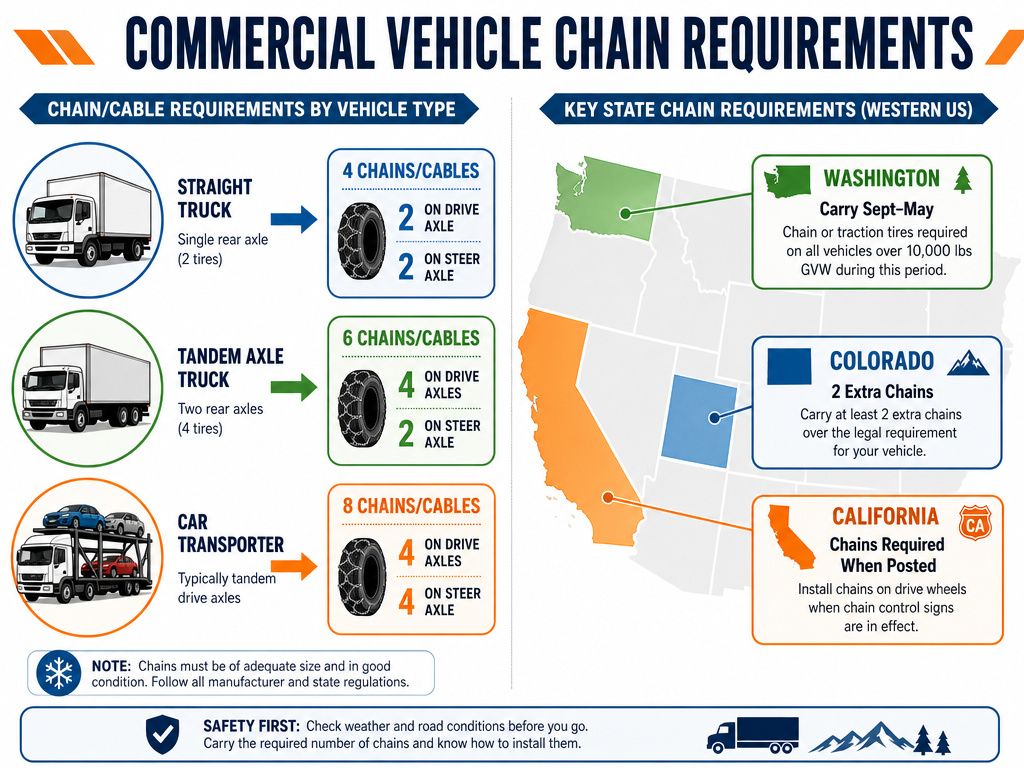
If you drive a vehicle over 10,000 lbs GVWR, you operate under a separate, more stringent legal framework. The rules are specific, numeric, and non-negotiable.
Colorado’s commercial rules, effective August 2024, are a prime example. They require chains to be carried from September 1 to May 31 on major mountain routes. The type and number required vary by configuration:
- Straight Trucks: 4 tire chains, 4 AutoSocks, or a combo of 2 tire chains and 2 tire cables (≥0.415″ diameter).
- Tandem Drive Axle Combos: Cables are only permitted if the outer tires on both ends of one drive axle have chains, and at least four traction devices are used total.
- Auto Transporters: May use Alternative Traction Devices if chains risk damaging hydraulic lines, but travel may be restricted if chaining is impossible.
Washington requires vehicles over 10,000 lbs GVWR to carry two extra chains on specified mountain passes from November 1 to April 1. California requires chains on commercial vehicles over 6,500 lbs whenever chain controls are posted, with detailed charts showing exactly which axles need chaining for everything from buses to multi-trailer rigs.
Worth knowing before you start: Plastic chains are explicitly banned for vehicles over 10,000 lbs GVWR in Washington. Using them is a violation.
The penalty for commercial non-compliance isn’t just a fine; it’s being ordered to stop and chain up on the spot, potentially blocking traffic and incurring delays. In severe cases, a vehicle may be prohibited from proceeding, requiring a tow. This makes understanding the Oregon traction device requirements and other state codes as vital as maintaining your brakes.
Studded Tires Are Not Chains
A critical and often misunderstood distinction: studded snow tires are not a legal substitute for chains in chain control areas. They are regulated under separate statutes.
California law is explicit: “Studded snow tires are not considered tire traction devices and may not be used in lieu of chains.” You can use studded tires in California from November 1 to April 30, but if you enter an R-2 chain control area in a 2WD vehicle with studded tires, you are still required to install chains.
Maryland law reflects this separation perfectly. Its statute permits chains for safety, while also granting a seasonal window (Nov 1–Mar 31) for studded tires in five specific counties. They are two different tools governed by two different rules.
If you rely on studded snow tires for winter driving, you still need to carry and be prepared to install chains when entering a chain control area in states like California, Colorado, Oregon, or Washington. The traction law does not see them as equivalent.
Frequently Asked Questions
Are tire chains legal year-round?
No. Their legal use is almost always conditional. They are only legally permitted when road conditions (snow, ice) necessitate them for safety, as indicated by official “Chains Required” or chain control signs. Some states also have seasonal “must carry” periods where you must have them in your vehicle.
Can I use tire chains on dry pavement?
You should not. Driving on dry pavement with chains installed is illegal in most jurisdictions, damages the road surface, and causes rapid wear and potential failure of the chains themselves. Remove chains as soon as you pass the “End Chain Control” signs.
Do I need chains if I have 4-wheel drive?
Yes, often. While 4WD/AWD with proper snow tires may exempt you from installing chains under certain chain control levels (like California’s R-2), you are almost always still required to carry chains in the vehicle. In Colorado when the traction law is active, 4WD must have either chains/ATD installed OR specific winter-rated tires with adequate tread.
What’s the fine for not using chains when required?
Fines vary by state and circumstance. In Colorado, violating the Passenger Vehicle Traction Law is a $50 fine plus a $17 surcharge. In California, you can be cited by the CHP, with fines typically starting over $100. For commercial vehicles, fines can be significantly higher, and you may be forced to stop and install chains immediately.
Are cable chains as good as link chains?
They are legal and effective for passenger vehicle use where specified. Cable chains provide sufficient traction for most passenger vehicles on packed snow and ice and are easier to install. However, for deep snow, extreme conditions, or commercial vehicle compliance, traditional link chains (SAE Class S) provide superior durability and traction.
The Bottom Line
Tire chains are legal tools, but their use is a regulated privilege, not a right. The law isn’t concerned with what’s convenient for your trip; it’s concerned with keeping the road passable and safe for everyone. Legality boils down to four yes/no questions: Is your traction device type approved by the state? Are you using it only under posted conditions that require it? Does your vehicle’s weight class allow it? Are you following the seasonal “carry” mandate?
Get one wrong, and the penalty is a fine and a roadside delay. Get all four right, and you’ve transformed a potential hazard into a controlled, safe passage. Your next step is to look up your state’s specific vehicle code section on traction devices, check your owner’s manual for clearance, and buy a set of chains you’ve practiced putting on. Then the mountains are yours, legally.
