
Are RV Water Filters Necessary? Uncovering the Real Need
This post contains affiliate links. As an Amazon Associate, we earn from qualifying purchases.
An RV water filter is necessary if you drink from your rig’s taps, but not as a magic safety shield. Most common filters are certified only for aesthetic improvements (taste, odor, chlorine) or specific health-effect reductions like lead. They do not make microbiologically unsafe water safe to drink. The critical choice isn’t filter vs. No filter; it’s matching the filter’s certified capabilities to the actual contaminants in your water source.
That gap between marketing claims and certified performance is where most owners buy the wrong thing. A filter rated for taste doesn’t touch bacteria. One certified for lead doesn’t soften water. And a label that says “bacteriostatic” definitely doesn’t mean “purified.”
What follows: a breakdown of what the common certifications actually cover, the one factory installation mistake that leaves your tank water unfiltered, and a direct comparison of inline canister versus under-sink systems. By the end, you’ll be able to read any product’s spec sheet in ten seconds and know exactly what job it’s hired to do.
Key Takeaways
- “Bacteriostatic” is not “bactericidal.” A bacteriostatic filter limits bacterial growth within the media but does not kill or remove all bacteria, meaning the output water is not necessarily safer than the input.
- Check for NSF/ANSI certifications. Standard 42 covers aesthetic effects (chlorine, taste, odor); Standard 53 covers health effects (lead, cysts, VOCs). Most basic inline filters only carry Standard 42.
- Factory filter placement often misses tank water. Many rigs have the whole-house filter installed only on the city-water inlet line, meaning water drawn from your fresh tank bypasses filtration entirely.
- Filter life is a guess without a flow meter. A cartridge rated for 1,000 gallons might exhaust in 300 if your source water is silty. Tracking gallons used is the only way to know.
- You need different tools for different problems. Sediment filters catch dirt, carbon blocks improve taste, and only filters with an absolute micron rating of 0.2 or smaller tackle bacteria effectively.
What Does “Bacteriostatic” Actually Mean?
You see it on product boxes and manuals: “bacteriostatic device.” It sounds medical, definitive. In reality, it’s a specific and limited claim.
The Hydro Life HL-200 series water filter is a bacteriostatic device that utilizes KDF® media in conjunction with activated carbon… The term ‘bacteriostatic’ indicates that the system limits the passage or growth of bacteria that may already exist in the incoming water. It does not mean that the water leaving the system is safer to drink than the water entering the system.
This is not a disclaimer. It’s the operational definition from the manufacturer’s manual. Bacteriostatic media, often a blend like KDF and carbon, creates an environment that inhibits bacterial multiplication. It doesn’t necessarily kill bacteria, and it certainly doesn’t remove them all. Think of it as a traffic jam for microbes, not a roadblock.
The consequence of misunderstanding this term is direct. You might assume your filter is protecting you from bacterial contamination at a questionable campground fill station. The filter is merely slowing things down, not eliminating the threat. For true biological safety, you need a purifier, not a filter with bacteriostatic properties.
Where this goes sideways: Relying on a bacteriostatic filter when filling from a source under a boil-water advisory. The filter does not override that notice. You are drinking under-treated water.
The Certification Decoder: NSF/ANSI 42 vs. 53
Certifications are your cheat sheet. They tell you exactly what a filter has been independently tested to do.
| Standard | What It Covers | Example Contaminants | Common Filter Type |
|---|---|---|---|
| NSF/ANSI 42 | Aesthetic Effects | Chlorine, taste, odor, particulates | Basic inline carbon filters |
| NSF/ANSI 53 | Health Effects | Lead, cysts (Giardia), VOCs, mercury | Higher-grade carbon block, multi-stage systems |
A filter can have one, both, or neither. The Hydro Life HLFS-3 model is certified by TEI Analytical Laboratories against both Standard 42 for chlorine/taste/odor and Standard 53 for lead. The NuvoH2O system is certified by IAPMO R&T against Standard 42. The Fresh Water Systems RV-EZ-4 is certified by NSF International against Standard 42 for chlorine/chloramines and Standard 53 for cysts, lead, mercury, and VOCs.
If your goal is simply better-tasting water at established campgrounds, a Standard 42 filter like the common Camco inline unit is sufficient. If you’re concerned about heavy metals or parasitic cysts, you must see Standard 53 on the box. Never assume.
The Factory Installation Flaw: Does It Filter Tank Water?
Here’s a design quirk that surprises many new owners. On some RVs, the factory-installed “whole-house” water filter is plumbed only into the city-water inlet line. When you connect to a campground pedestal, water flows through the filter and into your rig’s plumbing. When you pump water from your onboard fresh tank, the flow takes a different path—completely bypassing the filter.
This isn’t a defect in every rig, but it’s a documented point of confusion. An owner on Forest River Forums pointed out this exact setup in their Isata 3, calling it a health risk. Another owner countered that their factory filter does process tank water. You must check your own rig.
How to check: Turn off the city water connection. Switch your water source to the fresh tank. Run a faucet and check the filter housing. If it’s dry and water still flows, your tank water is unfiltered. If the housing is under pressure and water flows, it’s filtering.
Why does this matter? Your fresh tank is a potential breeding ground for biofilm and bacteria, especially if it’s not sanitized regularly. A filter that doesn’t process this water gives you a false sense of security every time you drink off-grid. This design makes a strong case for adding a secondary, dedicated under-sink drinking water filter that treats water from any source right at the point of use.
Choosing Your Defense: Inline vs. Under-Sink Systems

Your RV water strategy needs to match your travel style. The two main approaches serve different masters.
The Inline Canister Filter
This is the classic blue cylinder that threads between the campground faucet and your RV’s city-water inlet. It’s the first layer of defense for the entire rig.
Pros: Simple, cheap, protects appliances from sediment, improves taste for all faucets. A model like the Camco 40053 (the consumer version of the OEM Camco #40621 cartridge) is the industry standard.
Cons: Limited contact time with water means limited chemical reduction. It does not filter tank water in many installations. Exhausted cartridges provide zero protection.
These filters are workhorses for sediment and chlorine taste. Their real weakness is the replacement schedule. The manual says “replace when taste or flow changes.” That’s too late. By the time you notice a flow drop, the carbon is saturated and you’ve been drinking unfiltered water for days.
The fix: Use a cheap garden-hose flow meter. Know your cartridge’s gallon rating (often 1,000 gallons), and replace when you hit 80% of that. This turns a guessing game into a maintenance procedure.
Under-Sink Point-of-Use Systems
These are installed under your kitchen sink, treating only the water from that specific faucet. They are the upgrade path for serious water quality.
Pros: Can house multi-stage filters (sediment, carbon block, specialty media) for far greater reduction of contaminants. Filters water from both city and tank sources. Provides the best water for drinking and cooking.
Cons: More expensive upfront, requires installation, only treats one faucet.
A system like the Fresh Water Systems RV-EZ series illustrates the capability jump. The RV-EZ-1 is a basic taste-and-sediment filter. The RV-EZ-4 adds a carbon block certified to reduce cysts, lead, mercury, and VOCs. You’re not just polishing water; you’re removing specific health threats.
This is where you graduate from convenience to targeted protection. If you dry camp often and source water from varied wells or springs, a multi-stage point-of-use system is a necessary investment. It pairs perfectly with a simple inline sediment pre-filter at the hose bib.
Maintenance: The Schedule You Can’t Ignore
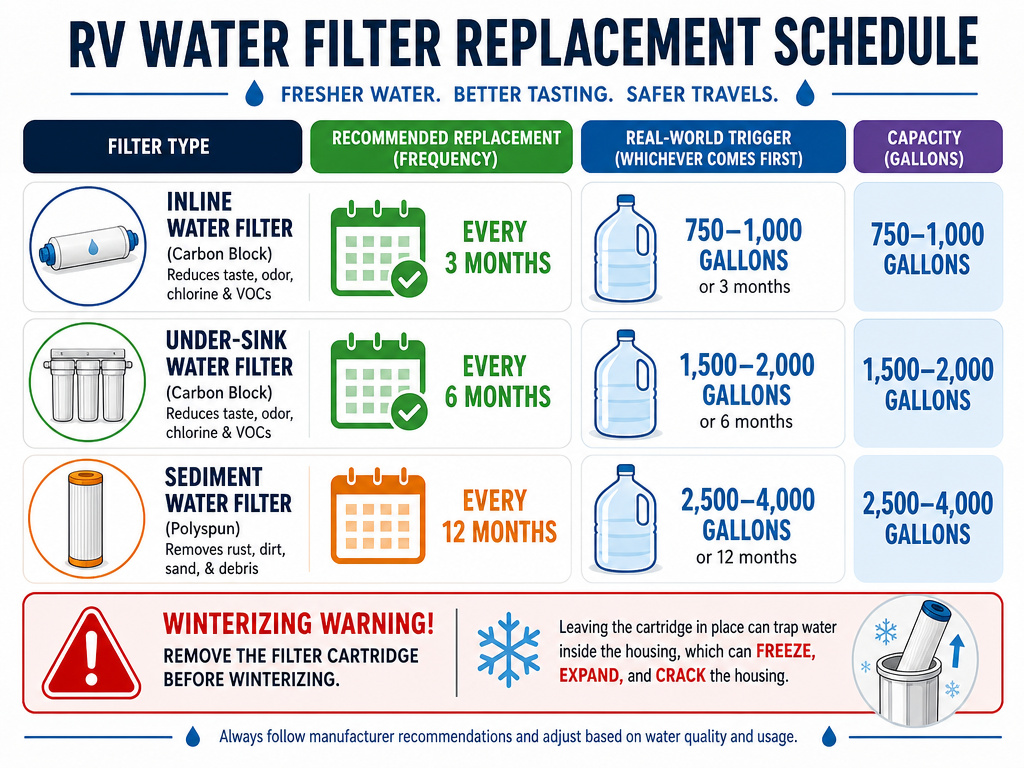
A filter is a consumable part. Its effectiveness has a hard expiration date.
| Filter Type | Manufacturer’s Replacement Guideline | Real-World Trigger |
|---|---|---|
| Inline Carbon (e.g., Camco) | When taste/odor/flow changes | Every 1,000 gallons OR 3 months, whichever comes first |
| Under-Sink Carbon Block (Standard 42) | 6 months or per gallon rating | 6-month calendar mark; carbon supports bacterial growth when stagnant |
| Under-Sink Carbon Block (Standard 53) | 6 months or per gallon rating | 6-month calendar mark; performance against health contaminants degrades |
| Sediment Pre-filter | When visibly discolored | Every 3 months, or more often with silty water |
The Fresh Water Systems RV-EZ-1 has a 3,000-gallon capacity but still calls for annual replacement. The RV-EZ-3 and EZ-4 have a 500-gallon capacity and a 6-month replacement rule. Why the short timeline? Advanced media targeting specific chemicals becomes exhausted or can harbor bacteria.
Never block a wool-acrylic blend above 60°C. By 70°C the acrylic deforms permanently and the garment will not recover its shape, even after re-blocking.
Winterizing is a non-negotiable filter killer. You must remove the cartridge and install a bypass plug before pumping antifreeze through your lines. Antifreeze destroys filter media, and a saturated cartridge can freeze and crack the housing. This is a core step in winterizing an RV. Come spring, when dewinterizing your RV, you install a fresh cartridge.
When an RV Water Filter Is Not Necessary
There are a few scenarios where the hassle and cost don’t match the benefit.
- You exclusively use bottled water for drinking/cooking. If you never consume water from your RV taps, a filter’s primary job is moot. A simple sediment filter at the inlet might still protect your plumbing and water heater, but it’s not a health necessity.
- You only camp at full-hookup sites with known, treated municipal water. The water already meets Safe Drinking Water Act standards. A filter here is purely for taste preference, not safety.
- Your rig is a weekend toy with minimal water use. If you go through a tank of water every few months, maintaining a filter system that requires regular flushing and cartridge changes might be more trouble than it’s worth.
For everyone else—especially full-timers, seasonal travelers, and those who boondock—a filter isn’t just necessary; it’s a core component of your rig’s utility system, as fundamental as your RV batteries.
Frequently Asked Questions
Do I need a water filter if my RV has a fresh water tank?
Yes, but for a different reason. A filter protects your tank and plumbing from incoming sediment and chlorine, which can damage pumps and fixtures. It does not sanitize an already contaminated tank. You still need to sanitize the tank itself periodically.
Can an RV water filter remove bacteria?
Most standard carbon filters cannot. Removal requires a filter with an absolute micron rating of 0.2 or smaller, or a dedicated UV purification stage. Look for NSF/ANSI Standard 53 certification for “cyst reduction,” which covers parasite-sized organisms.
How often should I change my RV water filter?
Follow the manufacturer’s gallon capacity or time interval, whichever comes first. For common inline filters, this is typically every 1,000 gallons or 3-6 months. For under-sink carbon block filters, every 6 months is standard. Always change it after winterizing your RV.
What’s the difference between a water filter and a water softener?
Filter removes contaminants. A softener removes minerals (calcium, magnesium) that cause scale buildup. They are different devices. Some combo units, like the NuvoH2O system, include both softening and filtration media in one cartridge.
The Bottom Line
An RV water filter is a necessary tool for managing water quality, not a magic wand for safety. Its job is defined by its certifications: NSF/ANSI 42 for taste, NSF/ANSI 53 for specific health threats. The label “bacteriostatic” is a warning, not a promise.
Start with a simple inline sediment filter to protect your plumbing. If you drink from your taps, add a certified carbon filter. For serious, multi-source travel, invest in a multi-stage under-sink system with Standard 53 certification. Track your gallons with a meter, replace cartridges on schedule, and never assume a filter makes unsafe water safe. Your rig’s water system deserves that clarity.
