
Are Mud Tires Good for Snow? The Definitive Traction Guide
This post contains affiliate links. As an Amazon Associate, we earn from qualifying purchases.
Mud tires are not good for snow on plowed roads or ice. Their large, widely spaced tread blocks and hard rubber compounds reduce traction, increase stopping distances, and make handling unpredictable on slick surfaces. They only perform adequately in deep, unpacked powder where they can dig down.
That verdict isn’t opinion. It’s the result of instrumented vehicle tests from a 1987 Cold Regions Research and Engineering Laboratory study, which found tread design had a negligible effect on ice traction, the compound is what matters. An aggressive mud-terrain pattern can’t claw its way out of that fact.
The rest of this guide pulls data from that study, the U.S. Tire Manufacturers Association (USTMA), and the National Highway Traffic Safety Administration (NHTSA). We’ll break down the two symbols on a tire sidewall that decide your winter safety, the specific conditions where mud tires actually work, and the one compound-based reason all-season tires sometimes beat dedicated mud-and-snow patterns on ice.
Key Takeaways
- The “M+S” (Mud and Snow) marking is a visual designation with no performance standard, it’s meaningless for winter safety.
- A 1987 ice traction study concluded tread pattern had a negligible impact on ice grip; rubber compound was the primary factor, with some all-season tires outperforming mud-and-snow designs.
- Lowering tire pressure, a common off-road trick for snow, decreases traction on ice according to the same research.
- Mixing radial and non-radial winter tires on the same vehicle is explicitly warned against by the USTMA.
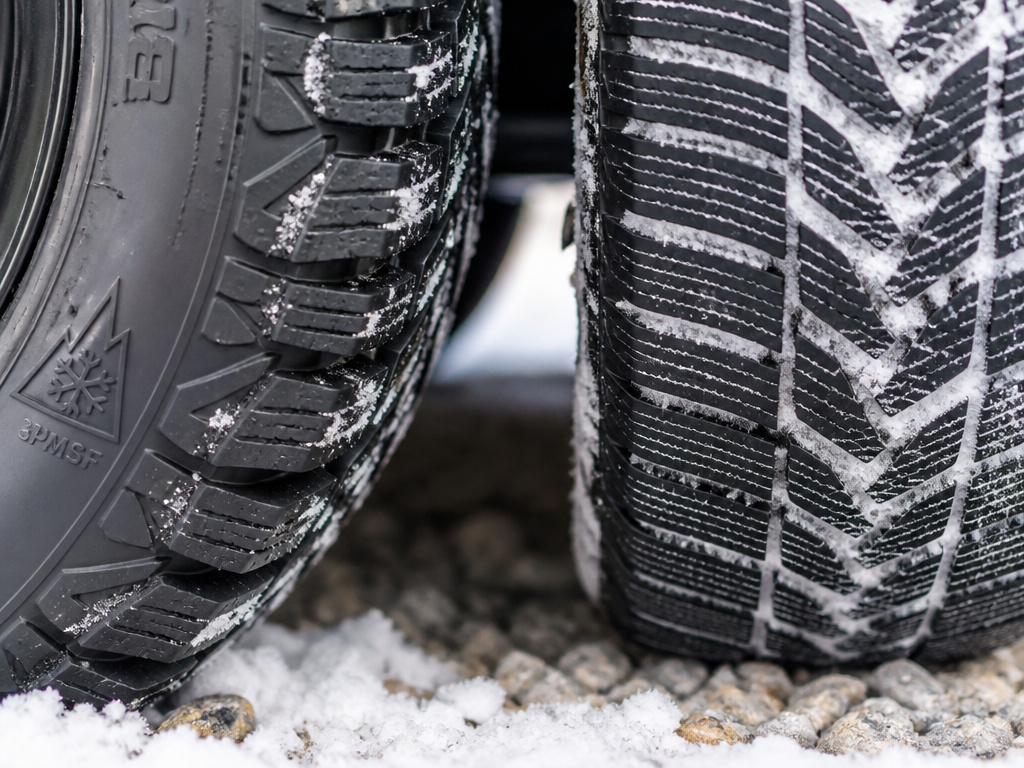
- For reliable winter performance, look for the Three-Peak Mountain Snowflake (3PMSF) symbol, which signifies passing a standardized snow traction test.
The M+S vs. 3PMSF Deception
You see “M+S” stamped on the sidewall of your mud-terrains and assume it’s a government stamp of approval for snow. It’s not. The National Highway Traffic Safety Administration (NHTSA) has stated it does not regulate how or if a tire is labeled as a mud and snow tire. The “M+S” designation is purely a visual cue about tread pattern features like block orientation and void percentage.
Common mistake: Relying on the M+S symbol for winter driving. That marking is about tread shape, not verified grip, and your stopping distance on an icy road will be significantly longer than with a proper winter tire.
The real stamp to look for is the Three-Peak Mountain Snowflake (3PMSF). This means the tire model has passed an American Society for Testing and Materials (ASTM) third-party test for acceleration, braking, and cornering on snow, measured against a control tire. A manufacturer can choose an all-terrain tires for mud design and still earn the 3PMSF if its compound and siping meet the threshold. The mud tires for trucks that lack this symbol haven’t proven they can stop safely.
| Symbol | What It Means | Is It a Performance Standard? |
|---|---|---|
| M+S (Mud and Snow) | Tread pattern has design cues intended for mud and snow. | No. Purely a visual, self-reported designation. |
| 3PMSF (Three-Peak Mountain Snowflake) | Tire passed specific ASTM snow traction tests for acceleration, braking, and cornering. | Yes. Third-party verified performance standard. |
The Physics of Failure on Ice
On loose snow, a tire needs to dig and eject material. On ice, it needs to adhere. This is where mud tires fall apart. Their stiff, durable compounds, designed to resist rock cuts and heat, become hard and glassy below 45°F. The wide gaps between tread blocks minimize the rubber actually touching the ice. They lack the thousands of tiny sipes, the hairline slits in the tread, that flex and create biting edges on hardpack.
The consequences are measurable. In a MotorTrend test comparing tire categories on snow, a Firestone Destination M/T mud-terrain finished last. It stopped in nearly double the distance of the winning Bridgestone Blizzak DM-V2 winter tire. The testers noted that snow traction relies on the tire packing and retaining snow in its tread (snow sticks to snow), but mud-terrain patterns are designed to eject everything.
An older OE highway tire with about 25,000 miles performed poorly in the 1987 ice study, with researchers attributing it partly to tread compound deterioration from age and use.
Why Lowering Pressure Backfires
Here’s a counterintuitive finding from the 1987 research: reducing inflation pressure decreased tractive performance on ice. In snow, lower pressure increases the contact patch and flotation. On ice, a larger contact patch doesn’t help because tread voids are ineffective; you’re just softening the tire’s shoulder and reducing its structural grip. So that off-road trick you use in deep powder? It makes you slide more on the icy road home.
When Mud Tires Can Work in Snow
There is one specific, narrow scenario where mud-terrains are acceptable: deep, unpacked powder on trails where you never encounter plowed pavement or ice. Here, the large, paddle-like lugs can dig down to the ground underneath, and the self-cleaning voids prevent clogging. If your winter driving is exclusively on remote, unplowed forest roads and you have four-wheel drive, a mud-terrain tire performance in snow might get you through.
But the moment that snow gets packed down by a plow or freezes into ice, the advantage vanishes. The limitations of off-road tires in snow become stark, turning your vehicle into a heavy sled with poor directional control.
| Scenario | Mud Tire Performance | Why? |
|---|---|---|
| Deep, unpacked powder (off-road) | Good | Lugs dig down; voids self-clean. |
| Packed snow on roads | Poor | Reduced contact area; stiff compound; lack of sipes. |
| Ice | Dangerous | Minimal adhesion; long stopping distances. |
| Slush & wet snow | Unpredictable | Can hydroplane; poor braking response. |
What Should You Buy Instead?
 Your choice depends on how much winter you actually drive in and what your summer needs are. Never mix radial and non-radial tires across axles, as warned in the USTMA tire information bulletin.
For Occasional Snow & Year-Round Use
Get an all-terrain tire with the 3PMSF symbol. Models like the BFGoodrich All-Terrain T/A KO2 or the Yokohama Geolandar A/T4 blend off-road toughness with tested snow capability. They have more sipes and a more winter-adaptive compound than a mud-terrain. This is the best single-set solution for most truck owners who see periodic storms. It bridges the gap between the all-terrain tires vs snow tires debate.
For Frequent Snow & Ice
Buy dedicated winter tires. Full stop. The Bridgestone Blizzak DM-V2 isn’t just better, it stopped in half the distance of a mud tire in controlled tests. Winter tires use compounds that stay pliable in freezing temps and have treads packed with sipes to grip ice. If you live where winter lasts months, a second set of wheels is the only safe and sane choice. Check the legality of studded tires in your area if ice is a constant concern.
Where this goes sideways: Installing winter tires only on the drive axle. The USTMA states that if winter tires go on the front, they must also go on the rear to maintain vehicle control and prevent spin-outs. Front-only installation is dangerously unstable.
The 1987 Ice Test That Reframes Everything
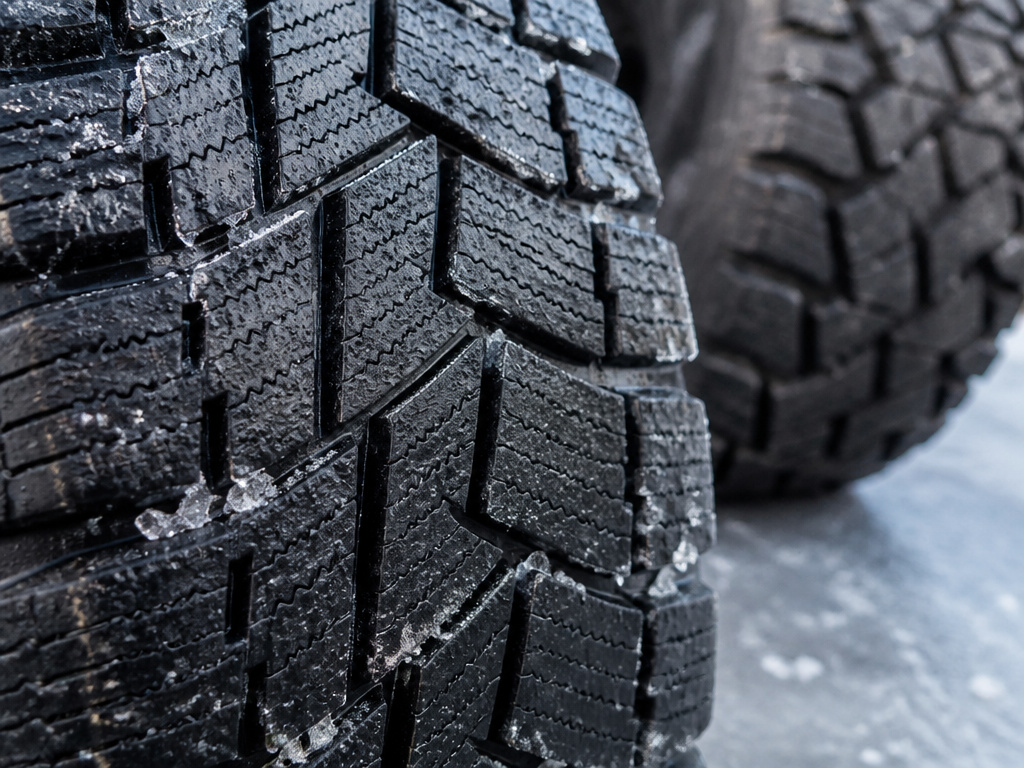 We keep citing it because its conclusions upend conventional marketing. The “Driving Traction on Ice with All-Season and Mud-and-Snow Radial Tires” study tested multiple tire designs on ice at -5°C and -12°C. The key finding: “The effect of tire tread on ice traction was found to be negligible.” Performance differences came down to the rubber compound’s adhesion properties.
In fact, three of the top four performers in the combined rankings were all-season tires. One mud-and-snow tire did top the chart, but the next three were all-seasons. The study also noted that most tires gained traction as temperatures dropped, but a few specific models lost it, a compound-specific quirk. You won’t find in a sales brochure: on ice, your tread pattern is just for show. The rubber is the whole game.
Frequently Asked Questions
Can I use my mud tires if I just drive slower?
Slower helps, but it doesn’t fix the underlying physics. Your braking distance will still be significantly longer, and emergency maneuvers become riskier. Reduced grip affects cornering and stability, not just straight-line speed.
Do tire sipes make a big difference?
Yes. Sipes are the small slits in the tread blocks that flex and create thousands of extra biting edges on ice and packed snow. Mud tires have very few, if any, which is a primary reason for their poor on-road winter performance.
Are all-terrain tires good enough for snow?
Some are, but only if they carry the 3PMSF symbol. Without it, an all-terrain is just an M+S tire with slightly tighter tread blocks. The capabilities of all-terrain tires in winter are directly tied to that certification.
How does tire width affect snow performance?
Wider tires, common on many mud tires for daily driving, can float better on top of deep powder but often perform worse on packed snow and ice due to higher surface pressure and a tendency to ride on top of the snowpack rather than cut through it. The winter performance of wider tires is a trade-off.
What’s the law on winter tires?
Laws vary by state and province. Some mandate winter tires or chains on certain routes during winter months, and many specify that the M+S symbol satisfies the requirement. However, as you now know, that’s a legal loophole, not a safety guarantee.
Before You Go
Mud tires are tools for a specific job, extreme off-roading in soft terrain. Snow and ice on roads are a different job entirely, one where they are dangerously unqualified. The evidence isn’t just in parking lot anecdotes; it’s in cold-weather lab tests and industry service bulletins.
If you face real winter, get real winter tires. If you need a compromise, choose a 3PMSF-rated all-terrain. And whatever you do, understand that the M+S symbol on your sidewall is a pattern description, not a permission slip. Your safety depends on the compound, the sipes, and the certification, not the aggressive look of the tread.
