
Are Loud Pipes Safer on Motorcycles? What Research Proves
This post contains affiliate links. As an Amazon Associate, we earn from qualifying purchases.
Loud motorcycle exhaust pipes are not a significant safety feature. The sound projects behind the bike, is absorbed by modern car cabins, and is inaudible to drivers at critical distances. A 2024 Romanian study found motorcycles over 110dB were unheard inside a car at 50 feet. Safety comes from visibility, positioning, and defensive riding, not decibels.
The 15-meter distance is where the argument falls apart. If a driver can’t hear you until you’re beside their door, they have no time to react to your presence. The physics of sound direction and cabin insulation make “loud pipes save lives” a claim that doesn’t survive a controlled test.
What follows is a breakdown of the acoustic evidence, the legal landscape, and the proven strategies that actually reduce your risk on the road. We’ll name the specific studies, the decibel thresholds, and the one modification that beats any aftermarket exhaust for collision prevention.
Key Takeaways
- Even a 110dB exhaust is inaudible inside a closed car at 50 feet; a bike would need an impossible 135dB to be heard at 15 meters.
- Exhaust sound is directional, projecting backward away from the traffic you most need to alert.
- Chronic exposure to exhaust noise above 85dB causes irreversible hearing damage for the rider.
- Modifying a stock exhaust to be louder often violates vehicle type-approval regulations, making the bike illegal for road use.
- A single bright, pulsing headlight does more for daytime conspicuity than the loudest pipe.
How Sound Actually Travels from Your Bike
Your exhaust points rearward. The sound energy follows it.
This minor detail is actually the core mechanical flaw in the ‘loud pipes save lives’ argument. The most common multi-vehicle motorcycle crash involves a car turning left across the motorcycle’s path.Your exhaust is blasting noise away from that driver, not toward them. The Doppler Effect further complicates this; as you approach, the sound frequency shifts, and by the time you’re close enough for the pitch to carry forward, you’re already in the collision zone.
A motorcycle’s sound measured directly in front of it is 5dB(A) lower than the sound measured behind it. For a quiet bike, the engine noise up front can actually be louder than the exhaust noise.
Think of it like a speaker. You don’t point the speaker away from the audience and expect them to hear the music clearly. You’re asking drivers in front of you to hear a muffled, attenuated version of a sound that’s already being swallowed by road noise, their car’s insulation, and their stereo.
The 15-Meter Rule That Shatters the Myth
The Romanian Association for the Development of Motorcycling, working with the Polytechnic University of Bucharest and noise specialists Enviro Consult, put numbers to the problem. Using professional Bruel & Kjaer sound level meters, they measured what reaches a driver’s ears.
| Motorcycle Position Relative to Car | Can the driver hear the bike? | Critical Detail |
|---|---|---|
| 50 feet (15m) behind | No | Even bikes over 110dB(A) are inaudible. |
| 33 feet (10m) behind | Barely | Loudest bikes might be heard, but sound is low-frequency and hard to locate. |
| Adjacent to the car | Yes | By this point, it’s too late for the driver to react safely. |
| In front of the car | No | Forward cabin insulation is even better. |
The study’s conclusion is blunt. To be heard inside a car 15 meters away, a motorcycle would need to produce over 135dB(A) at the exhaust pipe. For reference, a gunshot is 140-150dB. That’s not a realistic or legal output for any street-legal machine.
The sound that does get through at shorter distances sits in the 200-400Hz range. The human ear is poor at locating low-frequency sounds. A driver might hear something, but they won’t know if it’s beside them, behind them, or one lane over. That ambiguity is useless for crash avoidance.
Legal Noise Limits and the Tampering Problem
UN Regulation No. 41 governs motorcycle noise emissions. It sets test procedures for stationary (Lurban) and wide-open-throttle (Lwot) measurements. The rules are strict for a reason: noise pollution is a public health issue. The regulation explicitly states that exhaust systems must be constructed to prevent easy removal of baffles or silencing components.
If you install an aftermarket exhaust that pushes your bike’s noise output past its original type-approval limits, you have likely made the vehicle illegal for road use. Enforcement varies, but the technical violation is clear. You’re trading a perceived, unproven safety benefit for a guaranteed legal liability.
Where this goes sideways: Buying a “for off-road use only” slip-on exhaust and running it on the street. This voids the bike’s compliance with the noise standards it was certified under. In a serious incident, an insurer could deny a claim based on this unauthorized modification.
This point concerns understanding that vehicle regulations are a package. The engineers who designed your bike balanced performance, noise, emissions, and durability.Yanking one piece out of that equation has consequences.
What the Crash Data Actually Shows

The iconic 1981 Hurt Report found that motorcycles with modified, louder exhaust systems were overrepresented in crash data. The correlation wasn’t overwhelming, but the signal was there: louder bikes weren’t safer bikes.
Modern research continues this trend. The American Motorcyclist Association (AMA) has stated it finds no data supporting the idea that loud pipes reduce crash rates. The National Highway Traffic Safety Administration (NHTSA) focuses its motorcycle safety recommendations on visibility and training, not noise.
The Insurance Institute for Highway Safety (IIHS) notes that crash avoidance technologies and rider gear are effective; noise modifications are not. When you look for a study that conclusively proves loud pipes save lives, you won’t find it. The burden of proof is on the claim, and the evidence hasn’t materialized.
The Real Consequences for Riders
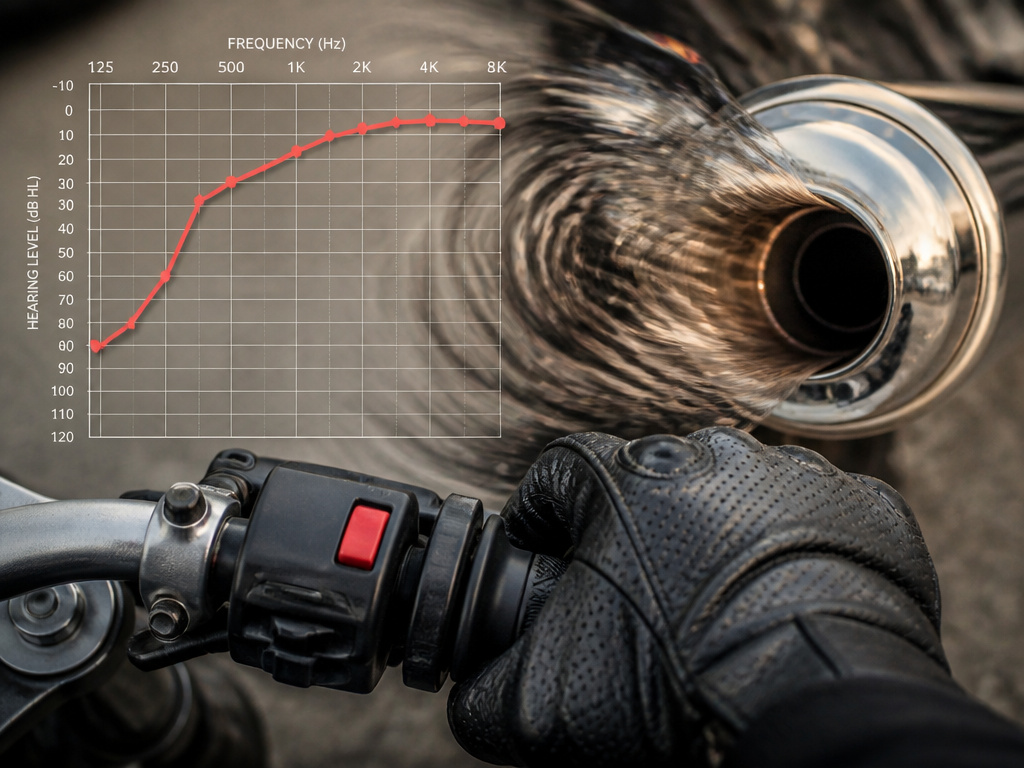
You are the person closest to the noise. A ride longer than four hours with a loud exhaust can trigger headaches and dizziness. The long-term effect is worse.
Medical sound trauma categories are clear. Chronic exposure to noise levels between 80-85dB(A) causes irreversible hearing damage. You are sitting on top of a source that can easily exceed 100dB. Your helmet does little to dampen low-frequency exhaust rumble transmitted through your body. Over years, that constant assault degrades your hearing long before old age would. Tinnitus isn’t a cool badge of honor; it’s a ringing prison.
Then there’s the social cost. Noise pollution creates resentment toward all riders. It fuels calls for stricter bans and gives authorities a reason to target motorcyclists. You become “that guy” who wakes up the neighborhood at 6 a.m., which does zero for the public image of motorcycling.
Proven Safety Strategies That Actually Work
If loud pipes are a dead end, what moves the needle? These are the tools with data behind them.
- Conspicuity Lighting: This is your highest-return modification. A single, bright LED headlight on a pulse or modulation setting during daylight is vastly more effective than a loud pipe. The human eye is drawn to movement and light. The Denali D4 2.0 or Clearwater LED driving lights are purpose-built for this. Install them and run them day and night.
- Lane Positioning: Never hover in a car’s blind spot. Use the left or right third of the lane to maximize your mirror sightlines. This simple, free technique is a cornerstone of the Motorcycle Safety Foundation (MSF) curriculum.
- High-Visibility Gear: Colors matter. A fluorescent helmet and jacket serve to create contrast against the gray road backdrop. The Rev’it!Horizon 2 jacket in hi-viz yellow is a top performer.
- Advanced Rider Training: Take a course beyond the basic license test. The California Superbike School or an Lee Parks’ Total Control Advanced Riding Clinic teaches collision avoidance, threshold braking, and proper cornering. Skill beats noise every time.
- Vehicle Maintenance: A bike that runs right is a bike you can control. Regular checks of your tires, brakes, and motorcycle chain tension are fundamental. Using a high-quality motorcycle oil like Motul 7100 4T ensures your engine responds predictably when you need it.
These strategies address the actual causes of crashes: drivers who don’t see you, and riders who aren’t prepared to react. They work with the physics of perception, not against them.
The Bottom Line
The myth of loud pipes is emotionally satisfying. It ties into a rebellious, visceral identity. But the job of a rider is to separate feeling from fact.
The fact is your exhaust points the wrong way. The fact is a modern car cabin is a soundproofed bubble. The fact is by the time your noise penetrates that bubble, you’re out of time. Investing in a loud pipe is investing in a solution to a problem that doesn’t work, while ignoring the solutions that do.
Put your money and effort into being seen. Upgrade your lights. Wear bright colors. Take a class. That’s the path to a longer, healthier riding life, with your hearing intact.
Frequently Asked Questions
Does a louder motorcycle make drivers more aware of you?
Only when you are extremely close, and often too late for them to take safe action. Research shows that at any meaningful safety margin, like 50 feet, drivers cannot hear even very loud motorcycles inside their cars. Awareness depends overwhelmingly on visual cues, not auditory ones.
What is the legal noise limit for motorcycles?
Legal limits are set by regulations like UN Regulation No. 41 and vary by region and vehicle age. They are measured using specific stationary and wide-open-throttle tests. Modifying your exhaust to exceed the limit set during your bike’s original type-approval typically makes it illegal for road use.
Can loud pipes damage your hearing?
Yes, absolutely. Chronic exposure to noise levels above 85dB(A), easily exceeded by a loud exhaust, causes permanent, irreversible hearing loss. The rider is the person most exposed to the noise, suffering hearing damage long before any hypothetical safety benefit could be realized.
What’s the most effective safety upgrade for a motorcycle?
High-output, pulsating LED headlight or auxiliary driving light system. The human visual system is far more sensitive to light and motion than to sound, especially during the day. This single upgrade dramatically increases your daytime conspicuity to oncoming and cross-traffic drivers.
Did the Hurt Report support the “loud pipes” claim?
No. The 1981 Hurt Report found that motorcycles with modified exhausts were overrepresented in its accident data. It did not find evidence that louder pipes reduced crash likelihood. This early data pointed in the opposite direction of the popular slogan.
