
The Truth About Driving: Are Lifted Trucks Harder to Drive?
This post contains affiliate links. As an Amazon Associate, we earn from qualifying purchases.
Driving a lifted truck requires adjusting to three main changes: a higher center of gravity that increases rollover risk, larger tires that extend braking distances, and altered suspension geometry that demands proactive maintenance and more steering input at highway speeds.
That mechanical reality is the physics printed in OEM service bulletins and tire manufacturer safety warnings. The truck you knew is gone, replaced by a machine with different limits.
What follows: the measurable shifts in center of gravity and braking, the new blind spot that forms at your front bumper, and the specific suspension parts, like upper control arms, that must be upgraded to even approach factory stability.
Key Takeaways
- A lift raises your truck’s center of gravity, making it more prone to rollover in sudden maneuvers. The Toyo Tire safety statement calls this out specifically.
- Larger, heavier tires increase rotational inertia. Your stock brakes now work harder and will fade sooner, increasing stopping distances.
- A lift changes your suspension’s caster angle, causing highway-speed wander. A standard “green box” alignment isn’t enough; you need targeted caster correction.
- New front-end blind zones, called “frontover risk,” can hide objects within 15 feet of your bumper.
- Post-installation maintenance is not optional. Kits like the Rough Country 3.5″ Lift require retorquing all fasteners after 500 miles, then every 1000 miles.
The Physics Every Driver Must Respect (Center of Gravity)
The installation of larger diameter tires, combined with modified suspensions (lift kits) for increased off-road ground clearance will adversely affect the handling and maneuverability characteristics of the vehicle compared to the factory-equipped vehicle. When vehicles, especially light trucks, are lifted the center of gravity is heightened, thus making them more prone to rollover. . Toyo Tire U.S.A. Corp. Rollover Propensity Statement
That warning is a primary-source confirmation, not web speculation. Raising the truck’s mass further from the ground creates a longer lever arm, or moment arm, during a turn. Physics does the rest. The truck wants to keep pivoting around that high center point once the motion starts, which is why a sharp evasive swerve feels tippier than it did before the lift. Load the bed with cargo or passengers, and that pivot point climbs even higher. The margin for error shrinks.
Rollover propensity is a function of this geometry, not a guarantee. It means your driving inputs now have a larger effect on the truck’s stability. You must drive with more anticipation. Sudden steering corrections that a stock truck could absorb will now push the suspension closer to its two-wheel lift threshold.
This change also directly impacts your anti-lock braking system (ABS). Larger tires change the effective gear ratio between the wheel speed sensors and the brake control module. The ABS can’t react as quickly or accurately, and stopping distances increase. The Toyo statement notes this explicitly: “The installation of larger tire and wheel combinations will reduce the effectiveness of anti-lock braking systems and increase stopping distance.”
Where this goes sideways: Assuming your new truck-sized tires stop like the old ones. They don’t. They stop later, especially in wet conditions or on a downgrade. Drive like they do, and you’ll find yourself running through an intersection or into a trailer hitch.
| Tire Size Increase | Primary Effect | Driver Adjustment Required |
|---|---|---|
| +2 inches (e.g., 31″ to 33″) | Moderate increase in braking distance, slight change in steering feel. | Leave more following distance, anticipate stops earlier. |
| +4 inches or more (e.g., 31″ to 35″) | Significant brake fade under load, ABS effectiveness reduced, major steering geometry changes. | Consider a brake upgrade, practice controlled braking, relearn turn-in speed. |
The Blind Spot You Can’t See (Frontover Risk)
A lifted truck’s front-end rises, creating a massive blind zone directly in front of the bumper. This “frontover risk” area can extend 10 to 15 feet forward, completely hiding a small child, a pet, or a low curb. Your elevated sightline gives a false sense of omniscience while actually obscuring the ground immediately around you.
The problem compounds at intersections. The A-pillar and side mirror assembly now sit at an angle that can completely obscure a pedestrian in a crosswalk. You must physically lean forward and look around these structures, a motion that feels unnatural until it becomes a drilled habit. It’s a visual trade-off: you see farther ahead, but you’ve lost the ground directly in your path.
Common mistake: Relying on parking sensors or a camera to mitigate frontover risk. Most factory systems are tuned for stock bumper height and may not detect a slender object like a bike rack or a child until you’re inches away. The sensor’s cone of detection angles downward from its mounting point; lift the truck and that cone now starts a foot farther forward, missing objects directly below the fascia.
The fix is behavioral, not technological. Walk around the truck before moving. When in doubt, get out and look. Assume the space in front of you is occupied until proven otherwise. This is non-negotiable for urban driving or anywhere pedestrians are present.
Why Your Truck Wanders at Highway Speed (Caster & Geometry)
Lift the front suspension, and the geometry designed by the factory engineers falls apart. The most critical casualty is caster angle, the forward or backward tilt of the steering axis. Positive caster is what makes the steering wheel want to return to center and provides high-speed stability. A lift rotates the suspension downward, reducing positive caster.
The result is a truck that feels “light” in the hands, wanders across lanes, and requires constant minor steering corrections. This is a geometry issue rather than a traditional alignment issue.
A “green box” alignment isn’t enough. Lifted trucks need targeted caster, not just “within spec.” . Obsidian Forged Auto Supply, “Caster Angle: Why Lifted Trucks Wander”
A standard alignment aims to get all measurements into the factory’s acceptable range (the green boxes on the printout). For a lifted truck, that’s failure. You need the alignment tech to push the caster setting to the maximum possible positive value within that range, or even slightly beyond if aftermarket parts allow it. This often requires aftermarket control arms with adjustable bushings or ball joint pivots to physically restore the lost angle.
Without proper caster correction via adjustable control arms or cam bolts, the truck will wander across the lane, requiring constant driver input. This driver fatigue increases the likelihood of an accident during long trips. It’s also a primary contributor to the terrifying “Death Wobble” in solid-axle trucks, where a bump triggers a harmonic oscillation that shakes the entire front end violently.
Installing a complete, vehicle-specific lift kit is the first step to managing geometry. Mixing component brands, as warned against in the Rough Country instructions, invites mismatched angles that no alignment can fix.
The Maintenance Schedule Nobody Follows (But Should)
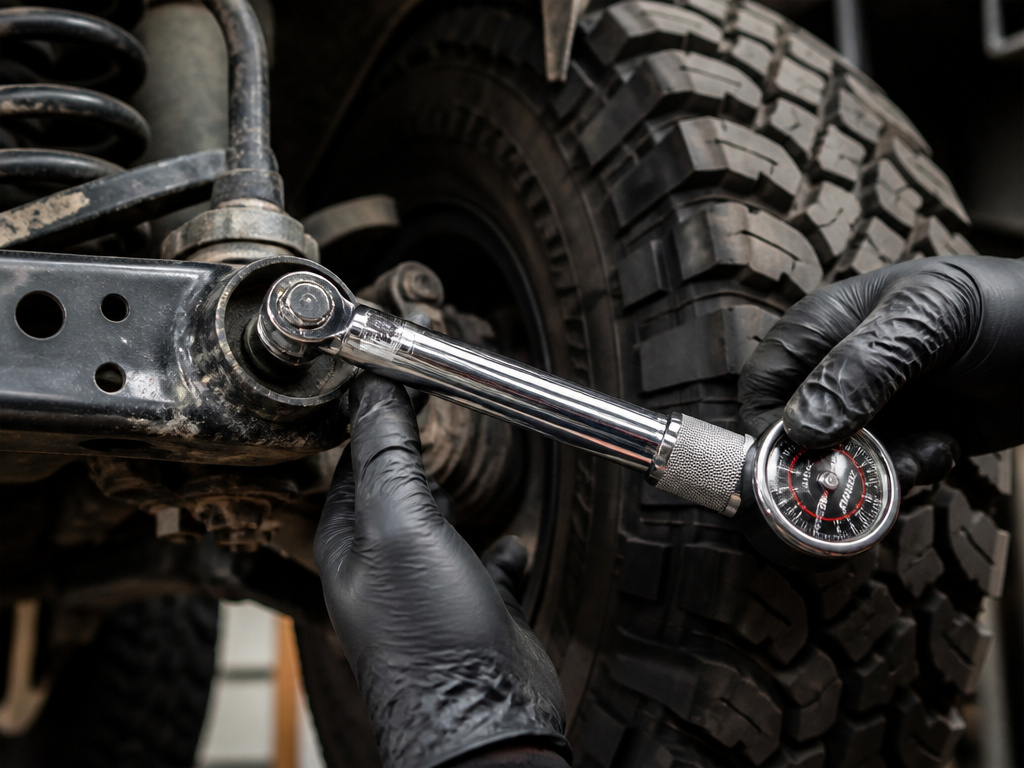
A lift kit is a new mechanical system that settles, wears, and requires vigilant inspection. The instructions for the Rough Country 3.5″ Lift Kit for a 2024 Toyota Tacoma are brutally clear on this point.
It is the ultimate buyers responsibility to have all bolts/nuts checked for tightness after the first 500 miles and then every 1000 miles. Wheel alignment steering system, suspension and driveline systems must be inspected by a qualified professional mechanic at least every 3000 miles.
Let that timeline sink in. Retorque every fastener after your first long drive. Then do it again every other oil change. Have a pro inspect the entire steering, suspension, and driveline every 3000 miles. This is the cost of admission for a stable lifted truck.
Most owners do the initial install and the first alignment, then treat it like a factory vehicle. That’s how you get loose control arm bolts, elongated mounting holes, and sudden, catastrophic failures. The forces on those components are now different and higher. The hardware must stay tight.
The part nobody mentions: This inspection is for both safety and your wallet. A loose suspension part wears out tires at an alarming rate.A single missed 3000-mile check could cost you a set of truck tires in a season. Which brings us to the next point.
Can You Just Upgrade Parts as You Go?
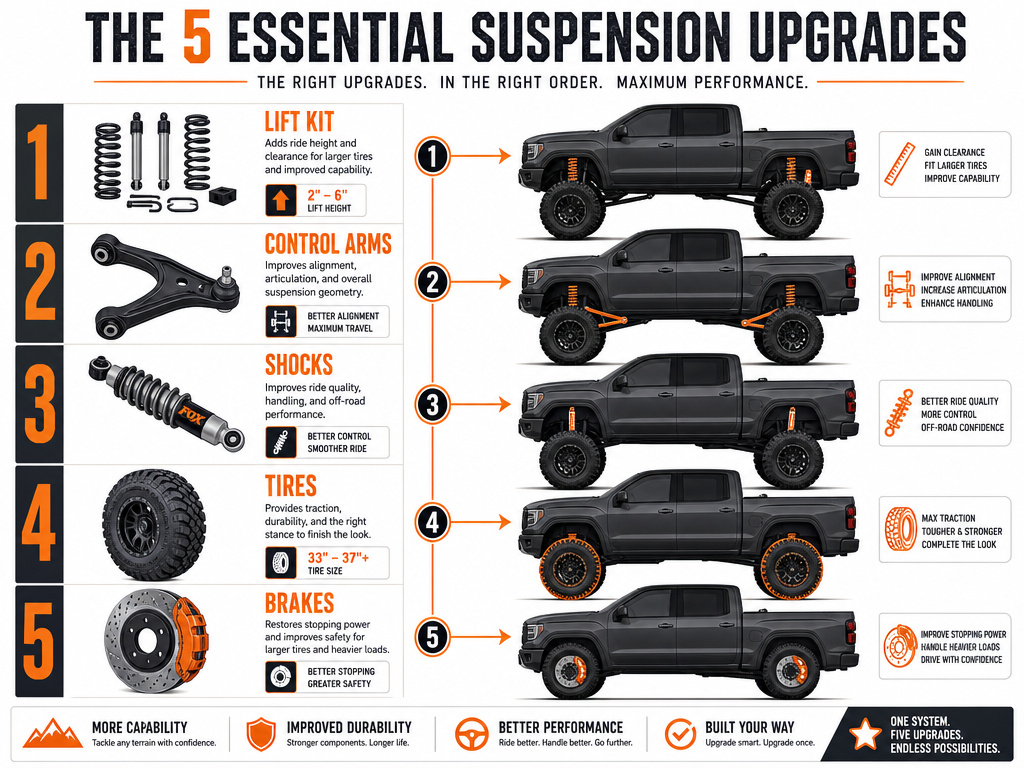
Yes, but with a critical caveat. Throwing a set of lifted truck shocks at a problem might improve ride quality, but it won’t fix geometry. Upgrades must follow a hierarchy that addresses root causes, not just symptoms.
- Foundation First: Install a complete, quality lift kit designed for your specific year, make, and model. This ensures all components are engineered to work together.
- Steering Stability: If you have an independent front suspension (IFS), install upgraded upper control arms for lifted trucks to restore caster and correct ball joint angles. This is not optional for lifts over 2 inches.
- Control and Damping: Upgrade to high-performance shock absorbers for lifted trucks valved for your new spring rates and increased weight. Factory shocks are overwhelmed.
- Traction and Safety: Match your lift kits with appropriate tires for trucks. A mild all-terrain works for a daily driver; for serious mud or snow, you’ll need dedicated mud-terrain tires or truck snow tires.
- Stopping Power: Consider a brake upgrade, larger rotors, performance pads, especially if you’ve increased tire size significantly.
Mixing and matching brands or skipping steps creates a truck that looks lifted but drives unpredictably. The safety of wheel adapters on trucks, for instance, is heavily debated; they introduce another failure point and can exacerbate steering wander. Every added component changes the system.
Frequently Asked Questions
Do lift kits void my warranty?
It can. General Motors’ PIT5403E service bulletin states that concerns or damage resulting from suspension modifications “may not be covered under the Terms of the New Vehicle Limited Warranty.” Dealers must prove the modification caused the failure, but the burden often falls on you. Always discuss major mods with your dealer’s service manager beforehand.
Is a lifted truck good in the snow?
Lifted truck can be capable in deep snow due to increased ground clearance, but its higher center of gravity makes it more prone to sliding and harder to stop. Four-wheel drive helps you move, but it doesn’t help you stop or corner. You must pair 4WD with dedicated winter tires for trucks and a much more cautious driving style. The best trucks for snow are often stock-height with quality tires, not lifted ones.
How much harder is it to drive a lifted truck daily?
It requires constant mental adjustment. You must leave double the following distance for braking, take corners and ramps 20% slower, scan farther ahead for sudden traffic changes, and be hyper-aware of your front-end blind spots in parking lots. It’s fatiguing until these habits become automatic.
Can a proper alignment fix all the handling issues?
No. An alignment can optimize the settings within the new physical limits created by the lift. It cannot restore the original, factory-engineered geometry. That’s why component upgrades like upper control arms are critical, they physically change the suspension’s starting point so the alignment has a chance to work.
Are some lift kits safer than others?
Yes. A complete, vehicle-specific kit from a reputable manufacturer (like Rough Country, BDS, or Icon) that includes all necessary brackets, hardware, and geometry-correction components is inherently safer than a budget spacer lift or mixing parts from different brands. Safety is in the engineering details.
Before You Go
Driving a lifted truck is a trade. You gain ground clearance and off-road presence. In exchange, you accept increased physical risk, a mandatory maintenance schedule, and the responsibility to drive with heightened precision. The physics don’t care about your intentions.
Respect the three pillars: the higher center of gravity, the longer braking distance, and the altered steering geometry. Upgrade the parts that address these changes directly, control arms, brakes, tires. Follow the torque specs and inspection intervals like your safety depends on it, because it does.
The truck is different now. Your driving must be, too.
