
Are Costco Tires Any Good? Warranty & Selection Trade-Offs
This post contains affiliate links. As an Amazon Associate, we earn from qualifying purchases.
Costco tires are good for drivers who value bundled, predictable pricing and strong warranty coverage over immediate service and maximum choice. The tires are name-brand, but the real value lies in Costco’s five-year Road Hazard Warranty and lifetime services like free nitrogen inflation, rotations, and balancing, so long as you can navigate wait times and their policy of installing only Original Equipment-approved tire sizes.
That bundled warranty is the main lever. The warranty runs for 60 months or until the tread reaches 1.6 mm (2/32 of an inch) of depth, whichever happens first. Coverage kicks in for road hazards that most manufacturers exclude, and credits are prorated based on the tread you have left.
What follows: a walk-through of the warranty’s fine print, the exclusions that catch owners off guard, and a clear look at the day-to-day service experience, from ordering online to waiting at the Tire Center.
Key Takeaways
- The five-year Road Hazard Warranty covers non-repairable damage, but it voids if you use sealant, inflate with anything but air or nitrogen, or drive on run-flat tires after a puncture without respecting their low-pressure limits.
- Tires ordered online arrive at the warehouse in 5–10 business days, and you have a tight 14-day window to schedule the included installation.
- Costco Tire Centers will only install tires that meet your vehicle manufacturer’s Original Equipment (OE) specifications for size, speed rating, and load index, which severely limits performance or off-road tire options.
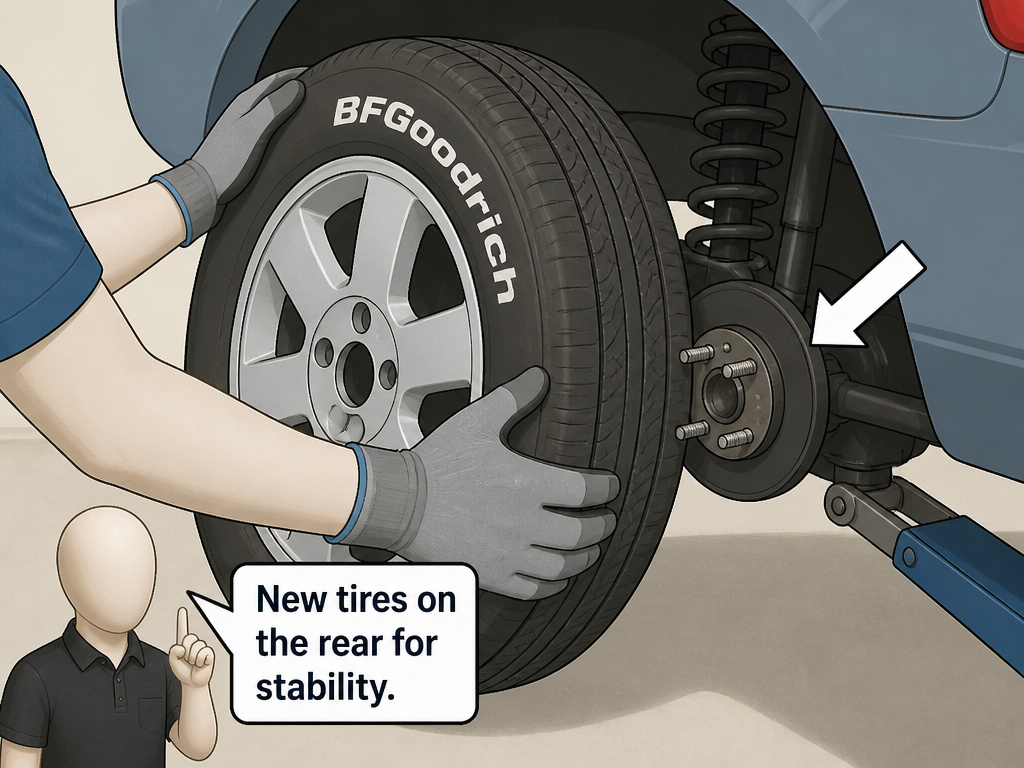
- If you buy fewer than four tires, Costco’s policy is to mount the new or least-worn tires on the rear axle of your vehicle for stability, regardless of whether your car is front- or rear-wheel drive.
- The convenience of bundled pricing comes with a trade-off: appointment backlogs are common, and walk-in repairs can turn into an all-day affair, especially during promotional periods.
The Core Value: Bundled Price vs. Brand Name
The first thing to understand is that Costco doesn’t sell special, lower-quality tires. The Michelin Defender T+H, the Bridgestone WeatherPeak, and the BFGoodrich Advantage T/A Sport you see on the rack are the same models you’d find at a dedicated tire shop.
The value comes from what’s rolled into the price. When you buy a set, the posted cost per tire typically includes mounting, new valve stems, balancing, nitrogen inflation, old tire disposal, and a lifetime of rotations and balancing at any Costco Tire Center. At a specialty shop, each of those is a line item that can add 25-30 percent to the bill.
The part nobody mentions: This bundled approach works because Costco carries a tight, predictable inventory. They stock what fits 90 percent of the passenger cars, crossovers, and light trucks on the road today. If you need a specific high-performance or all-terrain pattern, you’re often out of luck. The trade is efficiency for selection.
This is why reviews of the actual tire performance are almost always positive, people are rating a Michelin or a Bridgestone, not a “Costco” tire. The negative feedback clusters around the service experience: wait times, scheduling friction, and the rigidity of their installation policies. For everyday drivers who plan ahead, the math works. For someone who needs a tire today for a lifted Jeep or a sports car, it doesn’t.
How Does the Costco Road Hazard Warranty Work?
This is the centerpiece of the deal, and it’s more specific than the “five years of coverage” headline suggests. The warranty protects against “road hazard failure”, defined as a tire becoming unserviceable due to cuts, non-repairable punctures, or impact damage.
The coverage lasts for 60 months from the date of purchase, or until the tread depth reaches 1.6 mm (2/32 of an inch), whichever comes first. Age doesn’t matter; a four-year-old tire with 3 mm of tread is covered, but a one-year-old tire worn down to 1.5 mm is not. If a covered tire fails, Costco provides a credit based on the remaining usable tread, applied toward a new tire of the same brand and line.
| Warranty Element | Costco’s Specifics | Common Competitor Comparison |
|---|---|---|
| Coverage Period | 60 months OR until tread depth ≤ 1.6 mm | Often 12-36 months, sometimes mileage-based |
| Tread Depth Floor | 1.6 mm (2/32″) | Varies; some prorate down to zero |
| Repair Standard | Follows USTMA guidelines for tread-face injuries | May follow RMA or independent shop standards |
| Claim Requirement | Original receipt, tire presented at Costco Tire Center | Receipt, sometimes require original purchase proof |
Technical Snippet: The United States Tire Manufacturers Association (USTMA) standards dictate a two-piece plug-and-patch repair for tread-face injuries. Costco adheres to this, which is a solid, industry-accepted method. They will not repair a puncture within 1 inch of the sidewall or one larger than 1/4 inch in diameter.
Where this goes sideways: The warranty has a list of exclusions that can void it instantly. According to their official terms, using a fix-a-flat sealant “can make a tire non-repairable.” Inflating with anything other than air or nitrogen (like pure CO2) is not covered. For run-flat tires, driving beyond the manufacturer’s stated low-pressure distance or speed limits invalidates the warranty. These aren’t theoretical, they are printed in the Bridgestone/Firestone warranty manual distributed by Costco.
The why-layer: Tire sealants can gum up the internal sensors and the tire’s inner liner, making a proper USTMA repair impossible. Non-air gases can cause unpredictable pressure changes with temperature. And running a deflated run-flat tire destroys its internal structure. Costco’s exclusions aren’t arbitrary; they’re tied directly to conditions that compromise repairability or prove owner misuse.
What Are the Trade-Offs and Inconveniences?
You are paying for value and warranty with your time and flexibility. This isn’t a secret, but the degree of inconvenience is location- and timing-dependent.
First, selection is limited. The Tire Center will only install tires that match your vehicle’s Original Equipment (OE) specifications for size, speed rating, and load index. You cannot upsize for looks or switch to an aggressive all-terrain pattern unless it’s a factory-approved fitment for your make and model. This is a firm safety policy. If you want to modify, you go elsewhere.
Second, the service bottleneck is real. Even with an appointment booked online, the one-hour job often stretches to two. Walk-in service for a flat repair? During a sale, you might see members “running to the tire center when they opened the doors,” as one Reddit reviewer put it, and spending the whole day waiting. Costco’s model relies on high volume and lean staffing; patience is part of the package.
Third, the process for online orders adds steps. Tires ship to your selected warehouse in 5–10 business days. You then get a notification and have 14 days to schedule and complete the installation. Miss that window, and you may face restocking fees or lose the installation bundle. It’s not a “buy today, install tomorrow” system.
The Step-by-Step Process: From Order to Installation
If you decide to proceed, here’s what the actual journey looks like. Skipping a step usually means more waiting or a forfeited benefit.
Step 1: Find and Order Your Tires
Use the vehicle selector on Costco.com. It will only show tires that are OE-approved for your car. This is where you’ll see if your desired Bridgestone WeatherPeak or BFGoodrich model is available. Select your local warehouse for installation.
Step 2: Wait for Arrival and Schedule
Your order confirmation will give an estimated arrival window of 5-10 business days. Once you receive the call or email that your tires are in, go to CostcoTireAppointments.com immediately. Slots fill fast. Select “Costco Purchased New Tire Installation” and enter your purchase date.
Step 3: Drop-off and The Wait
Arrive on time for your appointment. Be prepared to leave the vehicle for at least 90 minutes, even for a simple four-tire swap. This is when most people do their warehouse shopping. Communicate clearly if you have a spare key or specific requests.
Step 4: Understand the Installation Rules
When you pick up the car, know that the technician followed two key policies. If you bought four tires, they’re installed. If you bought only two, or a single replacement, those new tires were mounted on the rear axle. This is a Costco rule based on tire manufacturer guidelines for stability, especially in wet conditions. It applies regardless of your car’s drive wheels.
Common mistake: Assuming front-wheel drive cars need new tires on the front. On a front-wheel-drive car, putting the fresh rubber on the rear prevents oversteer and maintains directional stability during emergency maneuvers or in the rain. Costco enforces this uniformly.
Step 5: Activate the Warranty
Before you drive off, ensure you have the paper receipt and the DOT card provided at installation. You must register the tires using that DOT card to fully activate the manufacturer’s warranty and the Costco road hazard coverage. Lose that card, and you’ll have a harder time proving purchase date if you need a warranty claim later.
Critical Exclusions and Fine Print You Must Read
The warranty booklet isn’t just a formality. Specific clauses turn a seemingly covered failure into a denied claim.
Sealants and Fillers: The Bridgestone warranty manual for Costco explicitly states it does not cover tires with “sealant, balance, or other filler material that was not originally applied or inserted by the tire manufacturer.” A single use of a can of fix-a-flat can void the warranty on that tire.
Run-Flat and Extended Mobility Tires: These tires have strict limitations on how far and how fast you can drive them after a puncture. The warranty excludes damage from “exceeding speed, distance, or other run-flat/low-pressure operation limitations.” Ignoring the yellow sticker on your door jamb or the manual means you pay for the new tire.
Commercial Use, Racing, Off-Road: The warranty is for standard legal vehicle operation. Any evidence of delivery miles, track days, or rock crawling will end a claim. They look for abnormal wear patterns and sidewall damage.
Vehicle Mechanical Neglect: A tire failure caused by a worn suspension component, like a bad strut causing cupped wear, is not covered. The warranty terms require you to “keep all mechanical parts that affect tires in proper working condition.”
| Scenario | Is It Covered? | Reason / Fine Print |
|---|---|---|
| A nail puncture in the tread shoulder, repaired with a USTMA plug/patch. | Yes | Standard repairable road hazard. |
| The same puncture, but you used a can of sealant to get to the shop. | No | Sealant contaminates tire, voids warranty per Bridgestone manual. |
| A pothole blowout on a run-flat tire, driven 20 miles at 55 mph after losing pressure. | Maybe | Covered only if you stayed within the tire’s published run-flat limits (e.g., 50 miles at 50 mph). |
| Rapid edge wear from a misaligned suspension. | No | Failure due to “wear from worn or improperly maintained mechanical components.” |
| A sidewall cut from light off-roading. | No | Warranty excludes “off-road use.” |
Costco Tires vs. The Competition: When To Go Elsewhere
This isn’t about which is universally better. It’s about which is better for your specific situation.
Choose Costco Tires If:
- You drive a common vehicle (sedan, crossover, pickup) and want a predictable, all-in price.
- You plan to keep the car for years and will use the free lifetime rotations and balancing.
- You value the structured, five-year road hazard warranty and understand its limits.
- You are a patient planner who can schedule service around warehouse trips.
Choose a Specialty Tire Shop or Dealer If:
- You need a tire not listed in your vehicle’s OE fitment guide (performance, oversized, all-terrain).
- You require same-day service or cannot afford long wait times.
- Your vehicle needs complementary service like an alignment, brake check, or oil change during the tire installation.
- You want financing options or a broader brand selection beyond Michelin, Bridgestone, and BFGoodrich.
For the average commuter, Costco is a strong default. The bundled price, warranty, and services create a compelling package. But it’s a package with walls, you play by their rules on fitment, service timing, and warranty compliance.
The bottom line: The question “Are Costco tires any good?” is really “Is the Costco tire system good for me?” The tires themselves are fine. The system demands patience and adherence to policy in exchange for cost certainty and long-term coverage.
Frequently Asked Questions
Can I buy Costco tires without a membership?
No. You must be an active Costco member to purchase tires, schedule installation, and access the lifetime services or warranty claims. Your membership number is linked to everything.
Does Costco offer an alignment service with tire installation?
No. Costco Tire Centers do not perform wheel alignments. They will recommend you get an alignment done elsewhere, especially after new tire installation, to prevent uneven wear. This is a significant gap compared to full-service shops.
What happens if I get a flat tire and I’m far from a Costco?
You can have the tire repaired at any shop using USTMA standards. However, if the tire is non-repairable and needs a warranty claim, you must bring the tire and your original receipt to a Costco Tire Center. They do not have a network of authorized repair shops.
Are the tire prices at Costco really the lowest?
Usually, but not always. The bundled price is often very competitive. However, during major holiday sales, you might find a lower per-tire price at an online retailer. You must then add the cost of mounting, balancing, stems, and a comparable warranty to see the true out-the-door cost. Costco’s price is the out-the-door price.
Can I return tires to Costco if I don’t like them?
Tires purchased in-store can be returned with receipt. Tires ordered online cannot be exchanged online; you must take them to the Tire Center for a refund. The separate manufacturer’s satisfaction guarantee (like Bridgestone’s 90-day trial) is administered through Costco and has its own rules, including that the tires must not be worn below 2/32 of an inch.
Before You Go
Costco tires are a solid, value-driven choice wrapped in a specific service model. You get genuine Michelin, Bridgestone, or BFGoodrich rubber at a bundled price, backed by a five-year safety net. That net has clearly marked holes, sealants, non-OE sizes, and neglected run-flat protocols will cut it.
Success means accepting the rules: schedule ahead, expect a wait, and mount new rubber on the rear axle. It means valuing the lifetime rotations and free nitrogen fills over immediate gratification.
For the driver whose needs fit neatly inside Costco’s box, the answer is a clear yes. For anyone else, the friction points are real, and the math might work out better at a shop that trades a higher price for greater flexibility. Your call depends entirely on what you’re willing to trade.
