
Are Bald Tires Illegal? State-by-State Tread Depth Laws
This post contains affiliate links. As an Amazon Associate, we earn from qualifying purchases.
Bald tires are illegal for road use in most U.S. States and Canadian provinces once the tread depth falls below 2/32 of an inch, measured in the major grooves. State laws like Virginia Code § 46.2-1043 and federal standards enforce this for passenger vehicles, with stricter 4/32″ rules for steering axles on heavy trucks. The primary danger is catastrophic loss of wet-weather traction, but the legal reality is a ticket, a failed inspection, and liability.
That 2/32 threshold isn’t arbitrary, it’s the point where treadwear indicators become flush with the road, a design mandated by Federal Motor Vehicle Safety Standard No. 139. This moves the conversation from opinion to a measurable, verifiable line. When those little rubber bars are even with the tread surface, your tires are legally worn out in the eyes of both the law and the engineer who designed them.
The rest of this guide walks you through the exact measuring method inspectors use, the patchwork of state laws and exemptions, and what happens the moment you’re pulled over or fail an annual safety check. We’ll also cover the edge cases, like regrooved commercial tires and the special rules for urban buses, so you know exactly where your vehicle stands.
Key Takeaways
- The near-universal legal minimum tread depth is 2/32 of an inch for passenger vehicles, enforced by state law and visible via mandated treadwear indicators.
- You will fail a state safety inspection if your tires measure below the minimum, blocking registration renewal until they are replaced.
- A tread depth gauge is the only reliable tool to confirm legality; the penny or quarter test is for awareness, not proof.
- Steering axle tires on heavy trucks and buses often require 4/32 of an inch, a critical distinction for commercial operators.
- Some states grant a 15-day correction period after a citation, allowing you to replace the tires and dismiss the ticket with proof.
The Critical Measurement: 2/32 of an Inch
Forget the penny test. The law speaks in thirty-seconds of an inch, and the tool of record is a tread depth gauge. The Virginia tire tread depth law specifies measurement “in any two adjacent major tread grooves where the tread is thinnest, at three equally spaced intervals around the circumference.” That’s the inspector’s protocol.
The 2/32″ mark is where the physical and legal worlds collide. It’s the depth at which the treadwear indicators, those small rubber bars molded into the grooves, become flush. Federal Standard No. 139 requires these indicators precisely so a visual check can determine if a tire has “worn to a tread depth of one sixteenth of an inch.” That’s 2/32″. When you can see a continuous band of rubber across the groove, the tire is legally bald.
Common mistake: Measuring only one spot. The law requires checking multiple points because tires wear unevenly. A tire might be legal at the center but illegal at the shoulders. Checking three points around the tire in two grooves catches this.
| Measurement Method | What It Tells You | Is It Legally Defensible? |
|---|---|---|
| Tread Depth Gauge | Precise depth in 32nds of an inch. | Yes, this is the official tool. |
| Treadwear Indicators | Visual pass/fail at 2/32″. | Yes, per federal standard. |
| Penny Test (Lincoln’s Head) | Shows ~2/32″ if top of head is visible. | No, too subjective for court. |
| Quarter Test (Washington’s Head) | Shows ~4/32″ if hairline is visible. | No, used for winter wear awareness only. |
Why does this specific number matter for legality? Because traction degrades exponentially as tread vanishes. Hydroplaning risk soars. The 2/32″ line is the last defensible point for a minimum safety standard. Driving on bald tires below this is a demonstrable, measurable hazard, which is why it’s codified in law, not just best practice.
How State Laws Codify “Bald”
Traffic laws don’t simply say “no bald tires.” They define “unsafe” or “worn-out” tires with specific, measurable criteria. Two states provide perfectly clear templates.
Virginia’s statute is a masterclass in precise language. It prohibits tires with less than 2/32″ tread depth, measured as described above, or with treadwear indicators contacting the road. North Carolina’s law adds crucial nuance for heavier vehicles. While its base requirement is also 2/32″, North Carolina General Statute § 20‑122.1 mandates 4/32” for steering axle tires on vehicles with a Gross Vehicle Weight Rating (GVWR) of 10,001 pounds or more.
This GVWR split is a major, often-missed detail. It recognizes that heavy trucks need more tread on the wheels that steer the entire mass. The federal CFR new pneumatic tire rules for commercial vehicles also reflect this increased safety margin.
Where this goes sideways: Assuming your 3/4-ton pickup follows passenger car rules. If its GVWR plate shows 10,001+ lbs, its front tires need 4/32″, not 2/32″. Missing this distinction is a direct violation.
Here’s a snapshot of how jurisdictions handle the basics and the exceptions:
| Jurisdiction / Rule | Passenger Car Minimum | Heavy Vehicle Steering Axle | Key Exceptions |
|---|---|---|---|
| Virginia Code § 46.2-1043 | 2/32″ | Not specified | Urban/suburban buses within municipality |
| North Carolina GS § 20-122.1 | 2/32″ | 4/32″ (GVWR >10,001 lbs) | Dual-wheel trailers |
| Virginia Admin Code 19VAC30-70-500 | 2/32″ (Inspection Standard) | 4/32″ (Buses, Trucks, Tractors) | Buses on specific short routes |
| Ontario Regulation 625 | Treadwear indicators contact road | Not specified | Regrooved tires if designed for it |
What Happens if You’re Caught?
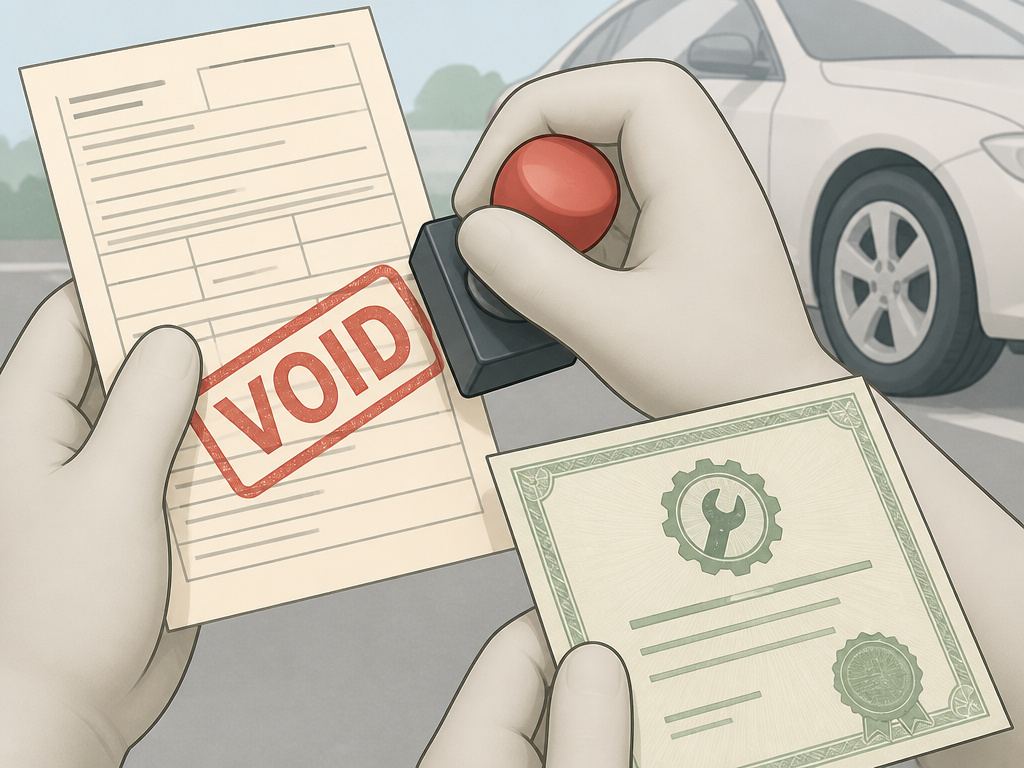
The consequence chain starts with a traffic stop or a failed inspection, and the outcomes are procedural and financial.
First, the ticket. In many states, like North Carolina, the law provides a built-in safety valve. The driver “shall be allowed 15 calendar days within which to bring the tires… Into conformance.” You get the citation, replace the dangerous tires, and then present a certificate from an inspection station to the court or prosecutor to have the charge dismissed. This isn’t a loophole; it’s an acknowledgment that the goal is compliance, not punishment.
Second, the inspection block. This is the more common and unavoidable result. Your vehicle will not receive the mandatory safety inspection sticker if equipped with illegal tires. No sticker means you cannot renew your registration. The system halts until you buy new rubber. For vehicles subject to annual inspection, this is the primary enforcement mechanism.
The liability shift is the silent third consequence. In the event of an accident, a citation for illegal tires, even one later dismissed, can be used to establish negligence. Your insurance company has clear grounds to raise your rates or deny a claim. Proving you were driving on unsafe tire condition is a straightforward task for an adjuster.
Exemptions and Edge Cases That Break the Rule
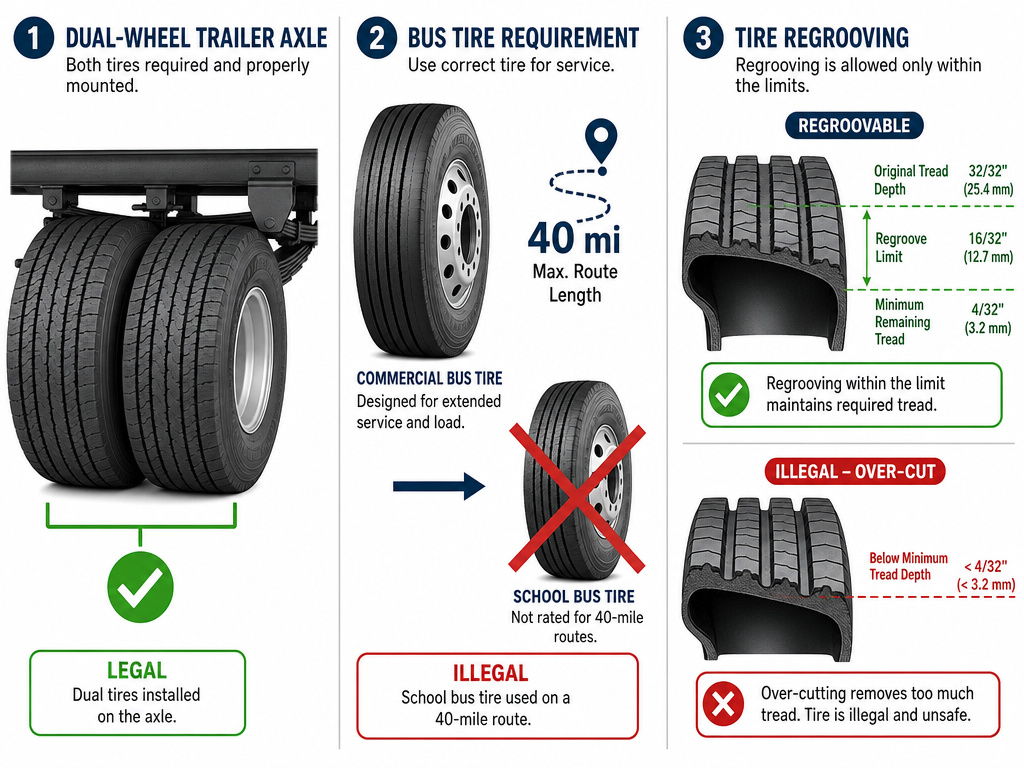
The law makes special provisions for specific operational realities. These exemptions are narrow, technical, and important to know if they apply to you.
Dual-wheel trailers get a pass in North Carolina. The statute explicitly states “the two thirty‑seconds tread depth requirements of this section shall not apply to dual wheel trailers.” The rationale is that a tire failure on a dualie is less likely to cause immediate loss of control. This does not apply to the tow vehicle itself.
Certain bus operations are exempt in Virginia. The law carves out buses operating wholly within a municipality or on urban/suburban lines where most passengers travel less than 40 miles one-way. However, this exemption slams shut for school buses, public, private, or contracted. The safety of children overrides operational convenience.
Regrooved commercial tires are a world of their own. The Virginia inspection code rejects any regrooved or recapped tire on a bus’s front wheels. For other commercial tires, it’s permitted only if the tire was originally designed and marked as “Regroovable.” This is a federal specification, not a shop’s judgment call. Installing a non-regroovable retreaded tires that’s been cut deeper is illegal and instantly fail-able.
Worth knowing before you start: The exemption for urban buses is about route distance, not ownership. A private charter bus running a 50-mile route doesn’t qualify, even if it never leaves the city limits.
Bald Tires vs. Other Illegal Tire Conditions
Baldness is just one path to an illegal tire. The statutes cast a wider net, covering damage and age-related failures that are equally hazardous.
Cord exposure is an instant fail. If you can see the fabric or steel belts of the casing, the tire is legally unsafe regardless of tread depth. This covers cuts, cracks, or wear severe enough to penetrate the outer rubber. This is a common endpoint for dry-rotted tires.
Tread separation and bulges are red flags. “Chunking”, the separation of the tread from the carcass, is specifically named in the North Carolina law as a disqualifier. A sidewall bulge indicates a broken internal belt, a prelude to a blowout.
Age, not just wear. While not all states have hard age limits, an inspector can reject a tire for weather cracking or deterioration. This makes the safety of old tires a judgment call based on condition, with severe cracking often leading to a fail even if tread remains.
Wrong type for the road. Using true racing slick tires on the street is illegal because they have zero tread grooves. Similarly, using studded tires outside of their permitted seasonal window violates state equipment laws.
The inspection is holistic. A tire at 3/32″ tread might still be failed for a deep sidewall crack or a separating belt. Baldness is the most common culprit, but it’s not the only one.
How to Check Your Tires and Stay Legal
Don’t wait for a police officer’s flashlight or an inspector’s gauge. Take your own measurements and understand the condition of your tires.
- Buy a tread depth gauge. They cost a few dollars. This is the only way to get a number you can trust against the legal standard.
- Find the major tread grooves. These are the wide, deep channels that circle the tire, not the smaller sipes.
- Measure in two adjacent grooves. Place the gauge pin firmly on the wear bar or the base of the groove.
- Check three spots around the tire. Measure at one point, then rotate the tire roughly 120 degrees and measure again. Do this a third time. Record the lowest reading from the thinnest groove.
- Know your vehicle’s GVWR. Check the door jamb sticker. If it’s over 10,000 lbs, remember the 4/32″ rule for front tires.
- Plan for replacement at 4/32″. Legality is 2/32″, but safety, especially in rain, drops off a cliff before that. Replacing at 4/32″ keeps you well clear of the legal line and much safer.
If you’re measuring and you’re close, don’t gamble. The cost of a set of tires is finite. The cost of a ticket, a failed inspection, a crashed car, or a denied insurance claim is not. When the treadwear indicators are nearly flush, your tires are telling you, and the law, that their job is done.
Frequently Asked Questions
Can I drive my car if the tread is at 3/32 of an inch?
Yes, you can drive legally if your tread measures 3/32″. The common legal minimum is 2/32″. However, your wet-weather stopping distance is already significantly lengthened at 3/32″. It’s legally permissible but becoming dangerously worn. Plan to replace tires soon.
What’s the penalty for driving with bald tires?
The immediate penalty is typically a traffic citation and a fine, which can vary by state. The more impactful penalty is failing your state’s mandatory vehicle safety inspection, which prevents registration renewal. In some states, you have a short window (e.g., 15 days) to fix the issue and get the ticket dismissed.
Are there any states where bald tires are legal?
No U.S. State allows completely bald tires for highway use. All have adopted the 2/32″ minimum tread depth standard either through specific statute or by referencing federal safety standards in their vehicle equipment codes. The enforcement mechanisms, inspections or traffic stops, may vary in intensity.
How do tread wear indicators work?
Treadwear indicators are small rubber bars molded at a precise height (2/32″) into the bottom of the major tread grooves. As the tread wears down, these bars become flush with the surrounding tread ribs. When they are even with the tread surface across the groove, the tire has reached the 2/32″ legal wear limit and is considered bald.
Do winter tires have a different legal tread depth?
Some states and provinces recommend or require deeper tread for winter conditions (e.g., 5/32″ or 6/32″), but these are advisories for safety, not the absolute legal minimum. The legal baseline for being “bald” remains 2/32″. However, a tire at 3/32″ may be legal but utterly useless in snow, as it cannot effectively expel slush.
Before You Go
The question isn’t really about legality. It’s about traction. The law uses the 2/32″ mark because that’s where the physics of grip fall apart in the wet. A tread depth gauge and ten minutes in your driveway give you the answer.
Remember the two-tier system: 2/32″ for most vehicles, 4/32″ for the steering wheels of heavy trucks. Know your GVWR. And use the inspection system as your reminder, if your tires won’t pass, they shouldn’t be on the road.
Your next step is simple. Check your tires tonight. If they’re near the limit, schedule the replacement. It’s a straightforward fix that keeps you legal, safe, and in control.
