
Are Advanta Tires Good? Real Performance Tests & Owner Data
This post contains affiliate links. As an Amazon Associate, we earn from qualifying purchases.
Advanta tires are a legitimate, budget-focused private-label brand that delivers competent performance in dry conditions and surprising comfort, but they require careful model selection and realistic expectations for wet weather. Their value hinges on specific warranties, like the ATX-850’s 50,000-mile and 3PMSF rating, and a documented history that makes buying from an authorized dealer non-negotiable.
The question is whether the specific tire you’re looking at matches your climate, driving style, and willingness to follow maintenance rules to keep the warranty valid. A Reddit user who manages a used car fleet reported buying hundreds of Advanta ER-800s with zero failures, while a 2014 Consumer Reports test exposed a batch of counterfeit tires that skewed public perception for years.
What follows is a breakdown of who actually makes them, a direct look at each major model’s tested performance, and the warranty fine print that decides if you save money or waste it.
Key Takeaways
- Advanta is a private-label brand distributed by U.S. AutoForce and manufactured under contract by American Pacific Industries (API) in multiple global facilities. Always check the DOT code on the sidewall.
- Performance is model-specific. The all-terrain Advanta ATX-850 is a standout with a 50,000-mile warranty and severe snow certification, while the touring Advanta SVT-02 excels in dry comfort but shows limitations in heavy rain.
- The brand’s 30-day satisfaction guarantee and mileage warranties have strict exclusions. Claims require documented rotations every 6,000 miles and are void after the tire is five years old from its manufacture date.
- A documented 2014 incident involved Consumer Reports testing counterfeit Advanta tires from an unauthorized factory. This underscores the critical importance of purchasing from an authorized U.S. AutoForce dealer.
- For pure highway commuting in dry climates, models like the ER-800 offer genuine value. For severe winter or frequent heavy rain, even their best models are a compromise.
Who Makes Advanta Tires? (It’s More Complicated Than “China”)
You won’t buy an Advanta tire from Advanta. The brand is a private-label operation, a common model in the tire industry for delivering value by cutting out middlemen and national advertising.
American Pacific Industries (API), based in Scottsdale, Arizona, owns the Advanta trademark and oversees manufacturing specifications. They don’t sell to you or your local shop. That job belongs exclusively to U.S. AutoForce, a massive distributor in Appleton, Wisconsin. Your dealer orders from them.
Manufacturing happens across API’s own plants and contracted facilities in the United States, China, India, Thailand, and Taiwan. This means two identical-looking Advanta SVT-02 tires bought a year apart could come from different countries. The only way to know is the DOT code embossed on the sidewall.
This decentralized production is why buying from an authorized dealer tied to U.S. AutoForce’s network is your first rule. It’s the only way to guarantee you’re getting a tire built to API’s current spec, not a leftover from a discontinued contract or, in a worst-case scenario, a counterfeit.
The 2014 Consumer Reports Incident & What It Means Today
The shadow over Advanta’s reputation concerns what happened when the supply chain broke down.
In 2014, Consumer Reports purchased “Pegasus Advanta SUV” tires for a light-truck tire test. The tires performed terribly, ranking last with poor snow traction and an average tread life of just 44,500 miles. API was shocked, their internal testing didn’t match these results.
Their investigation found the tires had 2012 production dates and were made at a Chinese factory (Qingdao Yellow Sea Rubber Co.) whose contract with API had ended in 2011. API stated molds had “gone missing” after the contract ended. These were, for all intents and purposes, counterfeit tires bearing the Advanta name that had entered the retail stream.
Where this goes sideways: Assuming any cheap Advanta listing is a legitimate deal. The 2014 incident proves counterfeit tires can reach even reputable testers. The fix is simple but non-negotiable: verify your seller is an authorized dealer.
This history is actually a point of credibility. API publicly disavowed the tires rather than hide the results. It shows they enforce a standard. For you, it means the DOT code and your dealer’s credentials are part of the product.
Decoding the Advanta Warranty: The Fine Print That Matters
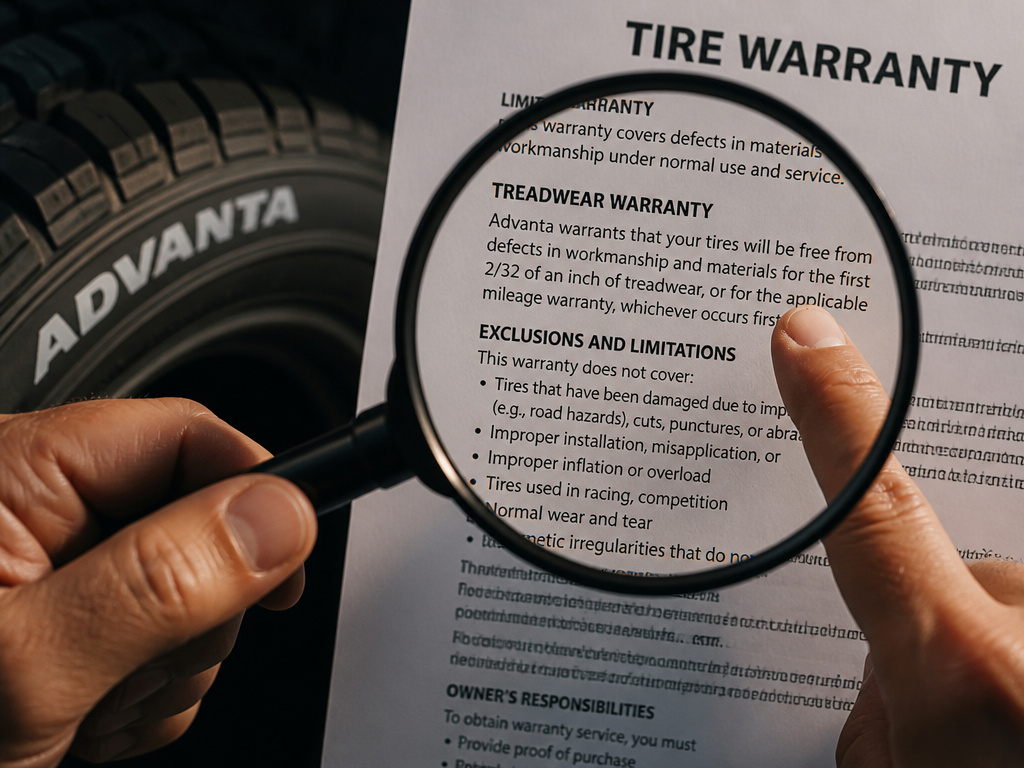
Advanta’s warranty package looks generous on the surface. Digging into the official document reveals the obligations that make it work, or void it completely.
The 30-Day Satisfaction Guarantee lets you exchange tires for any reason within 30 days or the first 2/32-inch of tread wear. Mounting and balancing are free, but you pay taxes. The key limit: it only applies to tires manufactured after August 1, 2014 (DOT code 3414 or later).
The Limited Mileage Warranty is where most of the value lies, but it’s conditional. The much-touted 50,000 or 60,000-mile coverage is a pro-rated credit if the tire wears evenly to 2/32-inch before hitting that mileage and before it turns five years old from its manufacture date.
| Warranty Obligation | Requirement | Consequence If Skipped |
|---|---|---|
| Tire Rotation | Documented rotation every 6 months or 6,000 miles. | Warranty claim is automatically denied. |
| Proof of Purchase | Original invoice must be presented with claim. | No proof, no adjustment. |
| Vehicle Conditions | Tires must be used on original vehicle, with proper alignment, inflation, and balance. | Damage from misalignment or underinflation voids coverage. |
| Age Limit | Claims only accepted within 5 years of tire’s manufacture date (from DOT code). | A 6-year-old tire with 20,000 miles left has zero warranty coverage. |
These are binding clauses. If you don’t keep a logbook or receipts from your rotation service, you own the tires outright, no matter how early they wear.This structure is common, but with a budget brand where the value proposition hinges on warranty longevity, your discipline is part of the cost savings.
Model-by-Model Breakdown: Where Advanta Tires Shine and Where They Compromise
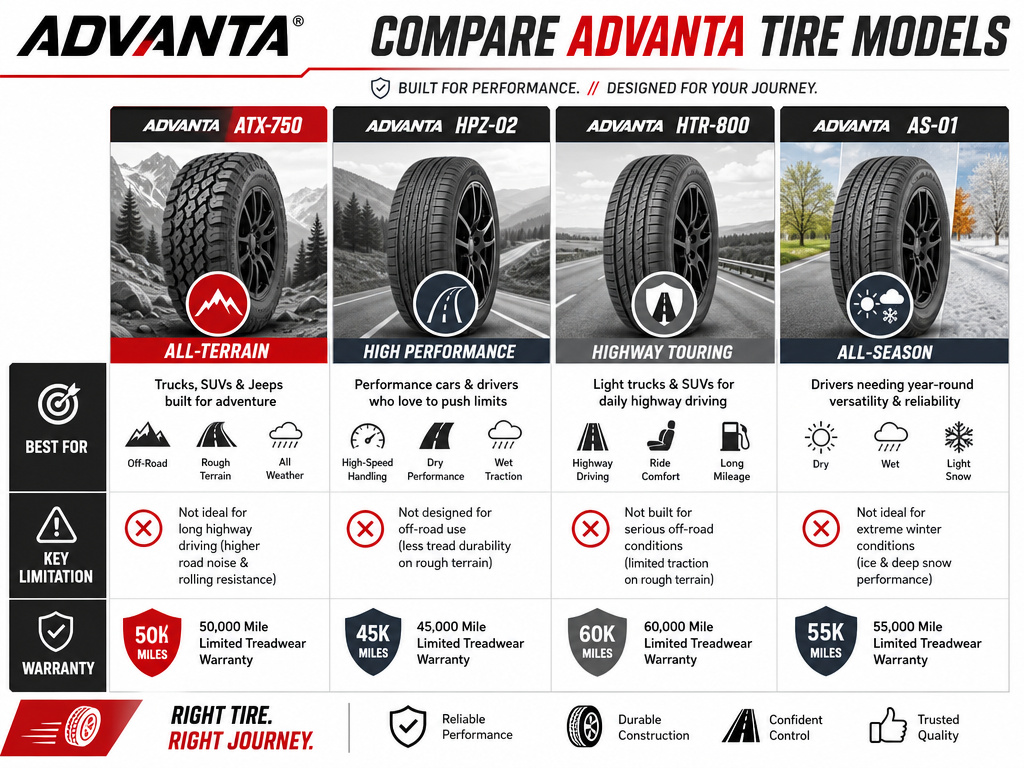
You can’t judge BF Goodrich tires or Black Hawk tires by one model, and Advanta is no different. Their lineup targets specific niches. Your climate and driving style pick the winner.
Advanta ATX-850 (All-Terrain)
This is Advanta’s flagship for a reason. It carries the Three-Peak Mountain Snowflake (3PMSF) symbol, meaning it’s certified for severe snow service, a rare feature in the budget all-terrain segment. It directly competes with tires like the Cooper Endeavor SUV tires but at a significantly lower entry cost.
The 50,000-mile warranty is solid. In testing, it delivered credible off-road traction and manageable on-road noise for its class. The trade-off is road manners; it’s less refined on pavement than a highway-focused tire. If you need actual all-weather, all-terrain capability on a tight budget, this is the pick.
Advanta SVT-02 (All-Season Touring)
The data comes from a 5,000-mile real-world test on a Honda Accord. Dry performance is the surprise: responsive steering, stable highway tracking, and braking that matched the original OEM Michelins. Ride comfort and noise levels rival tires costing 50% more.
The compromise is wet weather. In heavy rain at highway speeds, testers noted a pronounced hydroplaning sensation and longer wet braking distances. It’s fine for damp commutes but requires caution in downpours. It has no treadwear warranty, relying on its 500 UTQG rating.
Advanta ER-800 & HPZ-02 (Standard Touring & Performance)
These are the fleet and commuter specials. The ER-800 is the baseline passenger tire, with a 50,000-mile warranty. It’s designed for predictable, quiet wear. The HPZ-02 is its sportier cousin, aiming at the budget performance segment.
Feedback from a used car dealership that bought “an easy couple hundred” of these models reported zero failures or comebacks. That’s a powerful testament to basic reliability for daily driving. Don’t expect thrilling grip or storm-ready wet performance. Expect them to last without drama when maintained.
| Advanta Model | Best For | Key Limitation | Warranty |
|---|---|---|---|
| ATX-850 | Light truck/SUV owners needing true all-weather & off-road ability. | On-road noise and ride refinement. | 50,000-mile, 3PMSF certified. |
| SVT-02 | Sedan/SUV commuters in dry climates who prioritize comfort and low noise. | Wet-weather confidence at highway speeds. | No mileage warranty. |
| ER-800 | Cost-conscious daily drivers and fleet vehicles. | Basic, no-frills performance. | 50,000-mile. |
| HPZ-02 | Budget-minded drivers wanting sharper dry handling. | Stiff ride, mediocre wet grip. | 50,000-mile. |
Are Advanta Tires Good for Winter, Rain, and Highway Driving?
The answer is a conditional yes, heavily dependent on the model.
Winter: Only the ATX-850 (with 3PMSF) and the AW-03 (all-weather model) are rated for severe snow. The SVT-02, ER-800, and HPZ-02 are strictly for light, occasional snow. They are not substitutes for dedicated winter tires in the Snow Belt. Their rubber compounds harden in cold temperatures, reducing grip.
Rain: This is the universal weak spot across the lineup, even for the better models. The engineering priority is dry comfort and tread life. While they handle light rain, heavy standing water challenges their hydroplaning resistance. You must increase following distances and reduce speed in serious downpours. If you live in the Pacific Northwest or another high-rainfall area, this is a reason to look at an all-weather tire like the Bridgestone WeatherPeak.
Highway Driving: For dry pavement cruising, several models excel. The SVT-02’s low noise and comfortable ride make it a standout for long-distance commuters. The ATX-850 is stable but louder, a trade-off for its off-road tread. The key is matching the model to your priority: comfort (SVT-02) versus capability (ATX-850).
The Verdict: Who Should (and Shouldn’t) Buy Advanta Tires
Buy Advanta tires if: – You drive primarily in dry or mild climates and can budget for cautious driving in rain. – You are comparing specific models like the ATX-850 for its certified winter traction and warranty. – You are a disciplined owner who will document rotations and maintenance to keep the warranty valid. – You are buying from a verified, authorized U.S. AutoForce dealer and will check the DOT code.
Look elsewhere if: – You face frequent heavy rain or severe winters and need top-tier wet/ice performance. – You want the longest possible tread life regardless of cost; premium brands often offer 80,000+ mile warranties. – You dislike maintenance logs and prefer a “set it and forget it” warranty. – You are shopping based solely on the lowest online price from an unknown seller.
Advanta is a calculated value proposition. For the right driver, who picks the correct model, buys it legitimately, and maintains it by the book, these tires deliver performance that far exceeds their price.For everyone else, the compromises and conditions might erase the savings.
Frequently Asked Questions
Does Discount Tire or Costco sell Advanta tires?
No. Advanta tires are distributed exclusively through the U.S. AutoForce network to independent tire dealers and regional chains. Major national retailers like Discount Tire, Costco, and Belle Tire do not carry the Advanta brand. You must search for authorized local dealers.
What is the most common complaint about Advanta tires?
The most consistent feedback from long-term owners points to a gradual increase in road noise as the tires wear past the halfway point of their tread life. While often praised for quietness when new, some models, particularly touring tires like the SVT-02, become noticeably louder after 30,000 miles.
How do Advanta tires compare to other budget brands like Arizonian or Crossmax?
Advanta tends to offer more structured warranty support and specific model differentiation than many ultra-budget brands. Compared to Arizonian tire value or Crossmax tire durability, Advanta provides clearer warranty documents and model-specific performance data. However, real-world longevity among these budget tiers is often similar, making the dealer support and warranty claim process a key differentiator.
Are Advanta tires safe for highway use?
Yes, when properly selected, installed, and maintained. All Advanta tires meet U.S. Department of Transportation (DOT) safety standards. The safety consideration is one of performance envelope: a tire like the SVT-02 is safe for highway driving in dry conditions but requires the driver to adjust speed and following distance in heavy rain to account for its reduced hydroplaning resistance.
Can I use Advanta all-terrain tires for daily highway driving?
You can, but with acknowledged trade-offs. The Advanta ATX-850 will handle highway miles, but its aggressive tread block design generates more noise and slightly lower fuel economy compared to a highway-focused tire. Its strength is versatility, not refined pavement manners. For a daily driver that never goes off-road, a touring tire is a quieter, more efficient choice.
Before You Go
Advanta tires are a tool, not a toy. Their goodness is measured against a specific job: delivering reliable, warrantied mileage for a predictable cost. The ATX-850 is a genuinely good tool for light truck owners who see snow. The SVT-02 is a good tool for quiet, dry commutes.
Their history demands you buy smart, authorized dealer, fresh DOT date, full warranty paperwork. Their warranty demands you maintain diligently. Do those two things, and the value is real. Skip either, and you’re just buying cheap tires. For the disciplined driver who matches the model to the mission, Advanta is a defensible, often smart, choice.
