
Can Target Inflate Scooter Tires? What You Must Know First
This post contains affiliate links. As an Amazon Associate, we earn from qualifying purchases.
You can inflate a scooter tire at some Target stores, but only if they have an operational air station, typically a coin- or card-operated self-serve pump in the parking lot. Guest services won’t inflate it for you, and the service isn’t guaranteed at every location. The pressure gauge on those public pumps is often inaccurate, and you will need to know your scooter’s exact PSI requirement beforehand.
That “maybe” in the answer is the entire story. It turns a simple task into a scavenger hunt with a low chance of success and a high chance of wasted time. The faster path is knowing the three things that actually decide tire health: the correct PSI number printed on your tire, a pump that fits your valve, and a gauge you can trust.
What follows is a map of the real options. We’ll cover how to decode your tire’s sidewall, why a cheap pencil gauge fails you, the one portable pump I keep in my garage, and how to spot a tire that’s past saving. The goal is to get you riding, not circling a parking lot.
Key Takeaways
- Target stores only offer self-service air pumps, not staff-assisted inflation; call ahead to confirm the station is working.
- Under-inflated tires lose 1-2 PSI per week, dropping battery range by 10% and increasing rim damage risk within a month.
- A Schrader valve is standard; the Razor E300 needs its included valve extender for the rear tire, a step almost every guide misses.
- Digital or dial gauges are mandatory; pencil gauges can be off by 10 PSI, making over-inflation likely.
- For regular riders, a standalone portable pump like the Ryobi P747 is the fix. It ends the store-run guesswork.
The Target Tire Service Reality Check
Can Target inflate scooter tires? The answer isn’t universal. It depends on one thing: whether your local store maintains a functional air station.
These are almost always self-serve units in the parking lot. You drive up, insert coins or tap a credit card, and use the attached hose. The key word is self-serve. Target staff at the guest services desk will not inflate your scooter tire for you. Their policy is to direct customers to the outdoor station. If that station is broken, out of order, or removed, you are out of luck.
Common mistake: Assuming all Targets offer tire inflation. Many have removed their air stations to cut maintenance costs. A call to the store’s main line saves a trip.
Service availability is a coin toss. A Drive Smart Tools article on retail tire service confirms there’s no corporate mandate for Target to provide air. It’s a store-by-store decision. Even if the pump is present, the attached pressure gauge is frequently inaccurate from wear and weather exposure. You might think you’re hitting 45 PSI, but the real pressure could be 38 or 52. That variance introduces risk.
The takeaway is simple. Treating Target as a reliable tire service is a gamble. For a one-time emergency, calling first is smart. For anyone who rides regularly, it’s not a plan. It’s an invitation to frustration.
The Right PSI and How to Find It
Tire pressure is a spec that directly controls safety, battery life, and tire wear. Get it wrong and the scooter will tell you, usually through poor performance or a breakdown.
You find the correct PSI on the sidewall of your tire. Look for a range like “45-60 PSI” or a single number like “50 PSI”. This is the manufacturer’s instruction, not a rough guide. If you see a maximum pressure rating, aim for the middle of the range. Never exceed the maximum.
Why does a specific number matter? An under-inflated tire has more surface area on the ground. This increases rolling resistance. Your motor works harder, draining the battery faster. One test noted a 10% range reduction for every 10 PSI under the ideal pressure. Under-inflation also lets the tire flex too much. On a hard bump, the rim can pinch the tube against the pavement, causing a immediate flat. This is a pinch flat, and it happens in one bad pothole.
Over-inflation is the opposite problem. The tire becomes rock-hard, transferring every bump to the frame and your hands. More critically, the reduced contact patch hurts traction. A wet manhole cover or painted line becomes a slip hazard. Consistently high pressure also stresses the tire’s bead, the edge that seals against the rim. Over time, this can lead to a sudden bead failure and total air loss.
The Weekly Leak You Can’t Stop
Tires naturally lose air. The Razor E300 manual notes a loss of 1-2 PSI per week. That’s not a defect; it’s physics. Rubber is slightly porous, and the valve stem isn’t a perfect seal.
This slow leak has a timeline. After two weeks, a tire can be 3-5 PSI low. The ride feels a little sluggish. After a month, it can be 10-15 PSI down. Now you’re in the danger zone for pinch flats and rim damage. A weekly check is the bare minimum to stay ahead of the leak.
| Pressure State | PSI vs. Target | Immediate Effect | Long-Term Risk |
|---|---|---|---|
| Under-Inflated | 10+ PSI low | Sluggish acceleration, reduced range | Pinch flats, rim dents, motor strain |
| Ideal | Within 2-3 PSI | Smooth ride, maximum range, good traction | Minimal wear |
| Over-Inflated | 5+ PSI high | Harsh ride, reduced traction | Bead failure, blowout risk |
Cold weather accelerates the leak. For every 10°F drop in temperature, tire pressure falls about 1 PSI. A scooter stored in a garage over winter can lose 10-15 PSI just from the cold. Always check and adjust pressure when the seasons change.
The Gear You Actually Need
You need three tools to manage scooter tire pressure: a pump that fits, an accurate gauge, and the knowledge of your valve type. Getting any of these wrong turns a simple task into a struggle.
First, identify your valve. Most scooters use a Schrader valve. It’s the same type found on car tires and many bicycles, a short, cylindrical stem with a threaded tip and a pin in the center. Some higher-end models, particularly those with high-pressure road-bike heritage, might use a Presta valve. It’s thinner, has a locking nut at the top, and requires you to unscrew that nut before adding air. Never force a Schrader pump head onto a Presta valve; you’ll break the pin.
The Razor E300 has a standard Schrader valve, but with a twist. The rear tire valve is tucked behind the chain guard. You must use the small plastic valve extender that ships with the scooter, stored inside the right handlebar grip. Thread it onto the valve, attach your pump, inflate, and remove it immediately. Leaving the extender on during a ride will snap it off.
Why Your Gas Station Gauge Lies
The pressure gauge is the most important tool you own. The pencil-style gauges common at gas stations and cheap pumps are notoriously unreliable. They can be off by 5-10 PSI. The Schwinn Adult Scooter manual explicitly warns against them, recommending a high-quality dial or digital gauge instead.
A digital gauge reads within ±1 PSI. You press it onto the valve, it beeps, and you get a number. There’s no guessing. For under twenty dollars, it eliminates the single biggest variable in tire inflation. A dial gauge works too, but it’s more fragile.
Now, the pump. A standard bicycle floor pump with a Schrader head is the baseline. It works. But for portability and power, a cordless electric inflator is the upgrade. I keep a Ryobi P747 in my garage. It’s not the cheapest, but it reads pressure digitally, stops automatically at your target PSI, and runs on a standard power tool battery. It ends the hunt for a working air station.
Your Inflation Options, Ranked
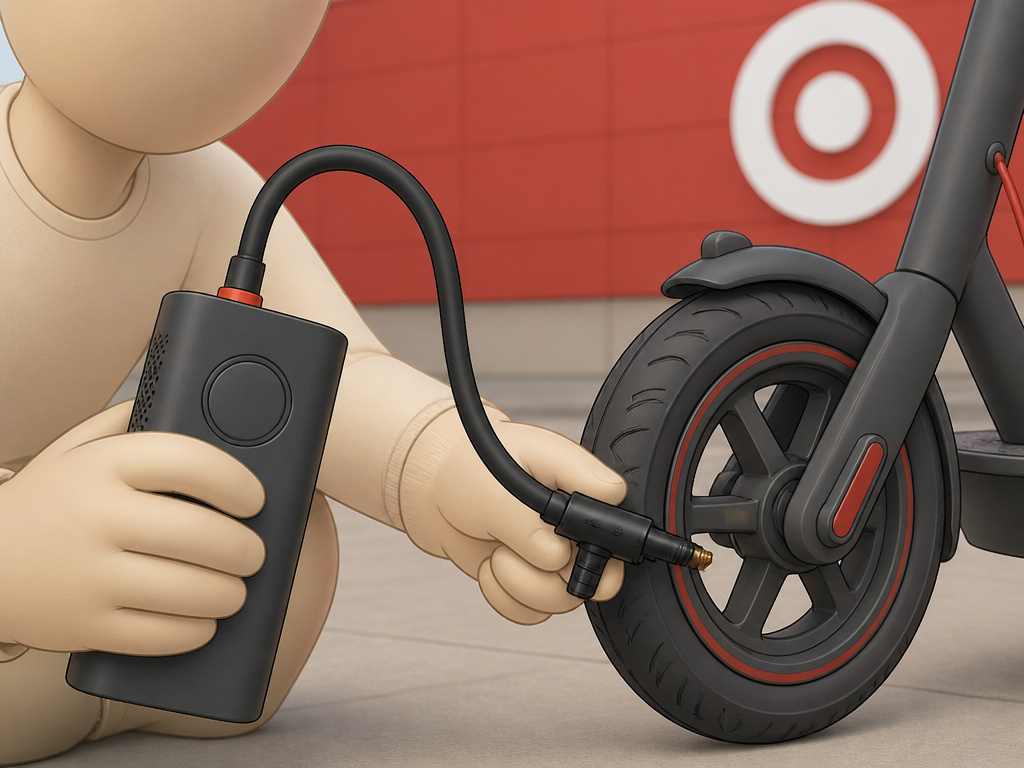 You have four paths to air. Each has a clear set of trade-offs between convenience, cost, and reliability.
-
A Personal Portable Pump (Best) This is the permanent solution. A quality bicycle floor pump or a cordless inflator lives where you store your scooter. The cost is upfront, but it pays off in the first month. You check pressure and add air in three minutes, anytime. No driving, no coins, no broken equipment. The Ryobi P747 is my pick because it’s precise and fast.
-
A Local Bike Shop (Reliable) Bike shops understand tire pressure. They have accurate floor pumps and gauges, and they’ll usually top you off for a small fee or even free. They can also spot worn tires or damaged valves you might miss. It’s a reliable, professional option.
-
A Gas Station Air Pump (Variable) Many gas stations have coin-operated air compressors. The challenges are the inaccurate gauges and the high pressure output. These compressors are made for car tires and can over-inflate a scooter tire in seconds. If you use one, add air in very short bursts and check with your own digital gauge after each burst.
-
Target or Big-Box Store (Least Reliable) As covered, this is a last resort. You must confirm the station works, have the correct change, and distrust the built-in gauge. It solves an immediate need but builds zero long-term capability.
| Option | Convenience | Cost per Use | Gauge Accuracy | Best For |
|---|---|---|---|---|
| Personal Portable Pump | High (at home) | Very low after purchase | High (you control it) | Every rider, especially regular commuters |
| Bike Shop | Medium (travel required) | Low to moderate | Very High | One-time service, tire inspections |
| Gas Station | Low (drive, coins, risk) | A few dollars | Very Low | Emergency roadside use only |
| Retail Store (Target) | Very Low (unpredictable) | A few dollars | Low | When you have no other option and have verified service |
The pattern is clear. Control over the process beats dependency on a public service. Investing in a pump and gauge is about ending the problem.
When Inflation Isn’t Enough: Tubes vs. Tubeless
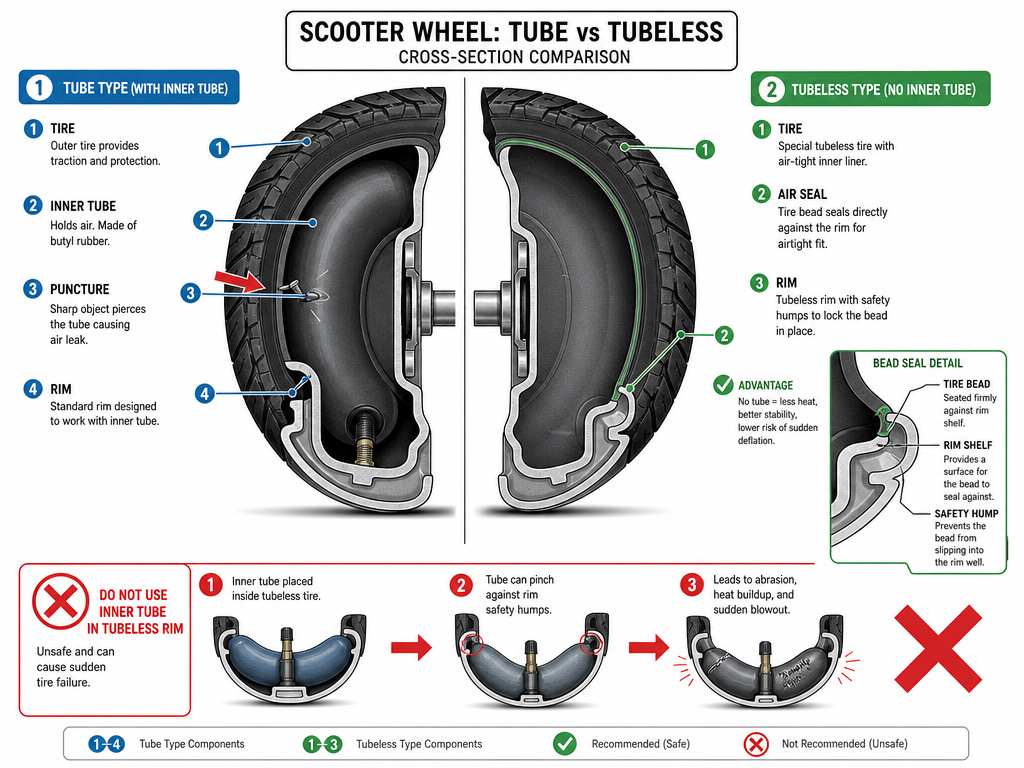 Sometimes, adding air doesn’t work. The tire goes flat again in hours or days. The next layer is understanding what’s inside your wheel: a tube or a tubeless system.
Most basic scooters use an inner tube. It’s a separate, inflatable rubber bladder inside the tire. A puncture in the tire often punctures the tube, causing a leak. These are repairable with patch kits, but replacement is often easier.
Higher-end models, like Apollo scooters, use tubeless tires. There’s no inner tube. The tire itself forms an airtight seal against the rim. They often include a self-sealing liquid inside that plugs small punctures automatically. The critical point is that Apollo rims are designed exclusively for tubeless use. You cannot add an inner tube to them, the rim shape won’t support it, and attempting to do so is unsafe.
Where this goes sideways: Trying to install a tube in a tubeless-only rim. The bead won’t seat correctly, and the tire can blow off the rim during inflation, a dangerous failure that happens in seconds.
If you have a persistent leak on a tubeless tire, the problem is often at the bead seal or the valve stem. A soapy water test, spraying a mix on the tire to look for bubbles, will show the leak’s location. Reseating a tubeless bead usually requires a high-volume air compressor, something a hand pump can’t provide.
Knowing your tire system dictates your repair strategy. It decides whether you order tires for a simple swap or need professional help for a bead reseal.
A Realistic Maintenance Schedule
Tire care is a habit, not a project. This schedule prevents 90% of problems.
- Before Every Ride: Do a visual check. Look for obvious flats, cuts, or embedded debris. Give the tire a firm press with your thumb. It should feel solid.
- Weekly: Check pressure with your digital gauge. Inflate back to the exact PSI on the sidewall. This weekly reset catches the natural 1-2 PSI loss.
- Monthly: Do a detailed inspection. Look for dry rot, cracks in the rubber sidewall. Check tread depth. Spin the wheel to look for cuts or bulges. Ensure the valve stem is straight and tight.
- Seasonally: Re-calibrate for temperature. Inflate tires in the fall for winter storage, and check them again in the spring. Cold garages drain pressure.
This routine integrates with broader electric scooter care. While you’re checking tires, glance at brake pads and listen for motor bearings. A five-minute weekly ritual extends the life of every component.
Adhering to this schedule means you’ll rarely face an emergency flat. You’ll replace tires based on wear, not failure. You’ll also maximize battery life by minimizing rolling resistance.
Frequently Asked Questions
What PSI should I use if the sidewall is worn off?
If the sidewall markings are completely gone, you have a bigger problem. Riding on an unmarked tire is a safety risk, as you have no reference for its pressure limits or speed rating. The only safe course is to buying tires that are correct for your model and have clear markings. Do not guess.
Can I use a car tire inflator on my scooter?
You can, but you must be extremely careful. Car inflators and gas station compressors deliver high volume air very quickly. They can over-inflate a scooter tire from 20 to 60 PSI in two seconds. If you use one, connect the hose, then add air in one-second bursts. Check the pressure with your own gauge after every burst.
My tire won’t hold air after a patch. What’s next?
Patch failing usually means the puncture is too large, the patch was applied poorly, or there’s a second puncture you missed. At this point, continuing to repair is a waste of time. Replace the inner tube. They are inexpensive and swapping in a new tube is faster than a second patch attempt.
Are slime or sealant kits worth it for scooter tires?
For tubed tires, yes, as a preventative. These liquid sealants can seal small punctures from the inside as you ride. For tubeless tires that are designed for sealant, they are essential. They are not a fix for sidewall cuts or large gashes.
How do I know when to replace the tire, not just the tube?
Replace the tire when the tread is nearly smooth, when you see cords showing through the rubber, or when there are cracks (dry rot) in the sidewall. Also replace it if the tire has a large, unsealable gash. A new tube inside a shredded tire is a temporary fix at best.
The Bottom Line
Can Target inflate scooter tires? Technically, sometimes. Practically, it’s a dead end. Relying on any retail store’s air pump is a plan built on “maybe.”
The real answer lives in your garage. A digital gauge and a reliable pump, a simple bicycle pump works, a cordless inflator is better, give you control. They turn tire maintenance from a chore into a thirty-second task. You’ll catch the weekly pressure drop before it hurts your range. You’ll spot a worn tire before it strands you.
Stop planning trips around broken air stations. Keep your tires at the number on the sidewall, check them every week, and store a pump where you store your scooter. That’s the fix. Everything else is just driving in circles.
