
Are Carbon Fiber Bikes Worth the Price? Uncover the Truth
This post contains affiliate links. As an Amazon Associate, we earn from qualifying purchases.
A carbon fiber bike is worth its high price only if you value its specific performance advantages, primarily a superior stiffness-to-weight ratio and vibration damping, and you accept the trade-offs: a predictable decline in stiffness over time, higher susceptibility to hidden impact damage, and a finite lifespan that can be as short as 3-7 years for budget frames or over 15 years for premium ones.
That 20% stiffness-loss threshold is the literal failure line defined by ISO 4210-3:2023 and DIN 14781 standards for rigid carbon forks, a point where the material is considered unsafe. The fork doesn’t snap there.It just gets too flexible to control properly on a descent.
What follows cuts through the marketing to the material science. We’ll look at the sourced standards that prove carbon gets softer, the hidden failure modes most riders never see, and the real cost-per-year math for different quality tiers. By the end, you’ll know exactly what you’re buying and how long you can realistically expect it to last.
Key Takeaways
- ISO and DIN standards define a 20% loss of stiffness as a failure point for rigid carbon forks, confirming that performance degradation is a predictable, measurable outcome.
- A single significant impact can cause internal delamination or micro-cracking that is invisible to the eye but reduces strength by more than 50%, leading to sudden, brittle failure without warning.
- Quality dictates lifespan: a budget press-molded frame might last 3-7 years, while a premium autoclave-cured frame with high-grade resin can exceed 15 years with proper care.
- Extreme temperatures are a silent killer: interior car temps above 60°C can soften the epoxy resin matrix, causing permanent deformation not covered by warranty.
- Carbon’s greatest weakness is its lack of “ductility”, it doesn’t bend or deform visibly before failing, making regular, methodical inspection non-negotiable for safety.
The Real Price Tag: What You’re Actually Paying For
You aren’t just paying for less weight. The premium buys a carefully engineered carbon fiber composite, a lattice of high-strength fibers locked in an epoxy resin matrix. The layup process, where sheets of carbon fabric (prepreg) are arranged in specific orientations inside a mold, is where the cost lives. Hand-laid, autoclave-cured frames from brands like Canyon CFR or Seven Cycles involve hundreds of labor hours and aerospace-grade materials. A press-molded budget frame from a giant OEM uses more automated processes and cheaper standard-modulus fibers.
The performance gain is real. That optimized layup creates a frame with an unmatched stiffness-to-weight ratio, so more of your pedaling effort translates directly into forward motion. It also allows engineers to tune vibration damping in specific zones, like the seatstays, for a smoother ride than aluminum. But this comes with a material reality: the resin that makes up roughly half the frame’s volume is brittle and has no functional fatigue strength. It’s the system’s weakest link.
Common mistake: Assuming a carbon frame’s lifespan is “indefinite” if it avoids crashes. The resin matrix micro-cracks under normal pedaling loads from day one, beginning a slow, irreversible decline in stiffness that testing standards quantify.
The Reality of Stiffness Degradation
Most riders don’t feel their frame getting softer. The change happens over thousands of miles, and your body adapts. The industry’s own testing protocols, however, measure it precisely.
The ISO 4210-3:2023 standard (section 4.6) states that a rigid carbon fork fails its fatigue test if its running displacement increases by more than 20% from its initial value. The parallel DIN 14781 standard uses the same 20% threshold. This standard is the point where the fork’s flex could compromise handling and control, particularly under heavy braking or in a high-speed turn. Frame tests (ISO 4210-6) are less strict on stiffness loss but require the structure to survive 100,000 cycles under heavy load.
| Quality Tier | Typical Construction | Estimated Frame Lifespan | Primary Aging Factor |
|---|---|---|---|
| Premium | Autoclave-cured, hand-laid | 10-15+ years | Resin micro-cracking from cyclic load |
| Mid-Range | Press-molded, decent resin | 7-12 years | Combined UV exposure and stress |
| Budget | Variable, often automated | 3-7 years | Lower-grade resin, potential voids/wrinkles |
This stiffness loss is why a ten-year-old carbon frame, even without a scratch, isn’t the same as a new one. The Seven Cycles white paper on carbon downfall describes it as an “inevitable, slow slide to ever-increasing flexiness.” It’s a wear-out mechanism, not just a breakage risk. This ties directly to understanding other long-term maintenance, like monitoring old tires for sidewall cracking, both are about material aging under stress.
The Unforgiving Nature of Impact Damage
This is where carbon diverges most dramatically from metal. Aluminum or steel will typically dent, bend, or deform visibly when overloaded. You see the damage. Carbon fiber, as outlined in the Trek Carbon Fiber Inspection Manual, does not bend. It either holds or it breaks.
A damaged carbon part can look perfectly normal. The failure happens internally: layers separate (delamination), the resin matrix cracks, or individual fibers snap. The part’s strength can be reduced by more than 50% while showing only a minor scratch or no visible mark at all. Then, during a routine ride, the remaining structure reaches its limit and fails catastrophically, snapping clean through without the warning bend a metal frame would give.
Where this goes sideways: A minor garage tip-over or a dropped chain. These small impacts can create subsurface damage that a quick glance misses. Two days later, the stressed resin settles and a faint blister or a subtle change in sound when tapped reveals the delamination.
The 2015 mountain bike frame failure case study published in Polymer Composites is a grim textbook example. The frame broke in two on a grass meadow at 25 km/h, dislocating the rider’s shoulder. Forensic analysis found pre-existing manufacturing defects, wrinkles, voids, and delaminations, that reduced the local static strength and stiffness by over 50%. The lesson is that a flaw you can’t see can be a fuse waiting for a spark. This hidden fragility makes routine, careful inspection as critical as checking for uneven tire wear caused by a worn suspension.
How to Inspect a Carbon Frame (The Right Way)
Forget just wiping it down. You need light, silence, and your fingertips.
- The Light Test: Use a bright LED flashlight. Hold it at a sharp angle to the tube surface and look along the length. Delamination or cracking will often cast a shadow. Pay extra attention around joints, cable rub points, and the underside of the down tube.
- The Sound Test: Flick the frame tubes gently with a coin or your fingernail. A healthy, solid carbon tube will produce a sharp, high-pitched ping. A dull, flat thud can indicate delamination or internal damage. Compare sounds from different sides of the same tube.
- The Flex Test (Carefully): The Trek manual warns against unnecessary flexing, but on very thin-walled frames, you may feel a difference. Support the frame securely and apply gentle, even pressure. Any creaking, cracking, or asymmetry in flex is a major red flag. If you’re unsure, stop and get a professional assessment.
- Check Metal Interfaces: Look for galvanic corrosion where aluminum parts (bottle cage bolts, derailleur hangers) contact carbon. It appears as white, powdery oxidation or bubbling paint, and it weakens the bond.
Skipping this ritual is like ignoring the signs of bald tires, you’re operating on borrowed time, and the failure won’t be graceful.
Environmental Enemies: Heat, Cold, and UV
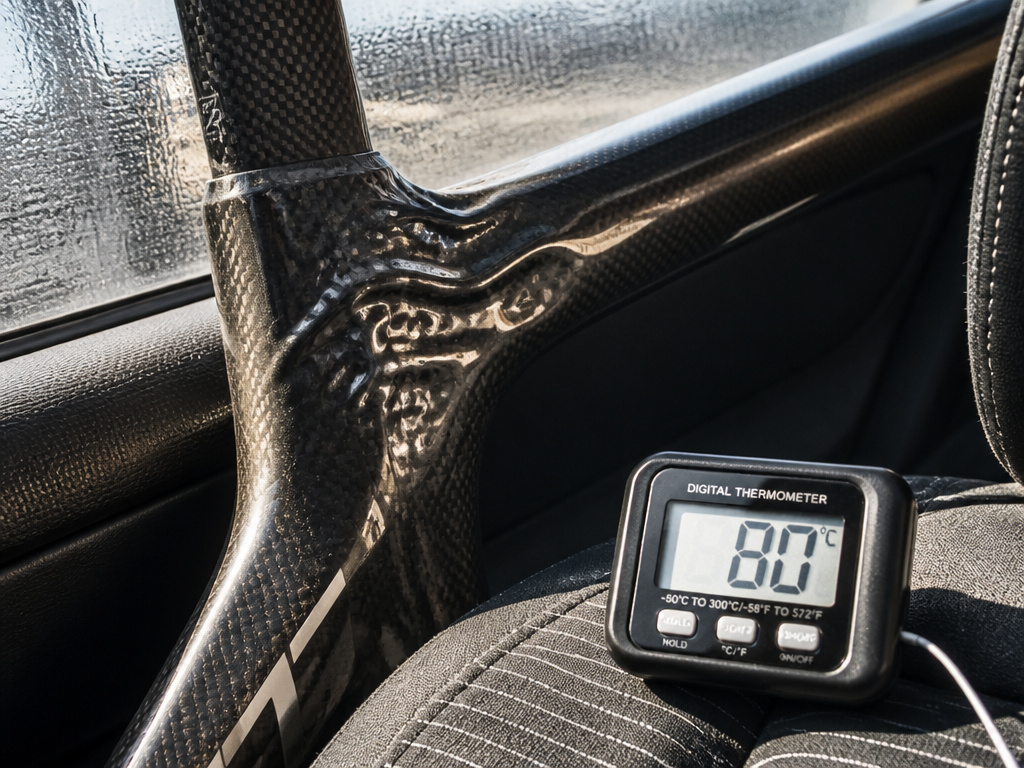
Carbon frames have a narrow happy zone. The epoxy resin’s glass transition temperature (Tg) is the key. Quality frames use high-Tg resins, but all resins soften with heat and become brittle with cold.
The safe operating range for a quality frame is typically -20°C to +60°C. Now consider a parked car on a sunny day: interior temperatures can easily exceed 80°C. At that point, even a high-Tg resin can soften enough for the frame to permanently deform under its own weight or the pressure of clamped parts. This thermal damage is almost never covered under warranty.
Cold is a less common but real threat. Below -20°C, the resin becomes increasingly brittle, raising the risk of a crack propagating from a tiny flaw under impact. UV radiation, especially on older frames with less stable resins, slowly degrades the epoxy, causing it to yellow, chalk, and lose strength over decades.
The takeaway is simple: store your bike indoors. Don’t leave it in a hot car or a freezing garage. This practice preserves the structural glue that holds your expensive frame together. It’s the same principle as protecting your vehicle’s rubber components; understanding tire age and safety is about knowing how environmental factors degrade materials you rely on.
Carbon vs. Aluminum: The Honest Comparison
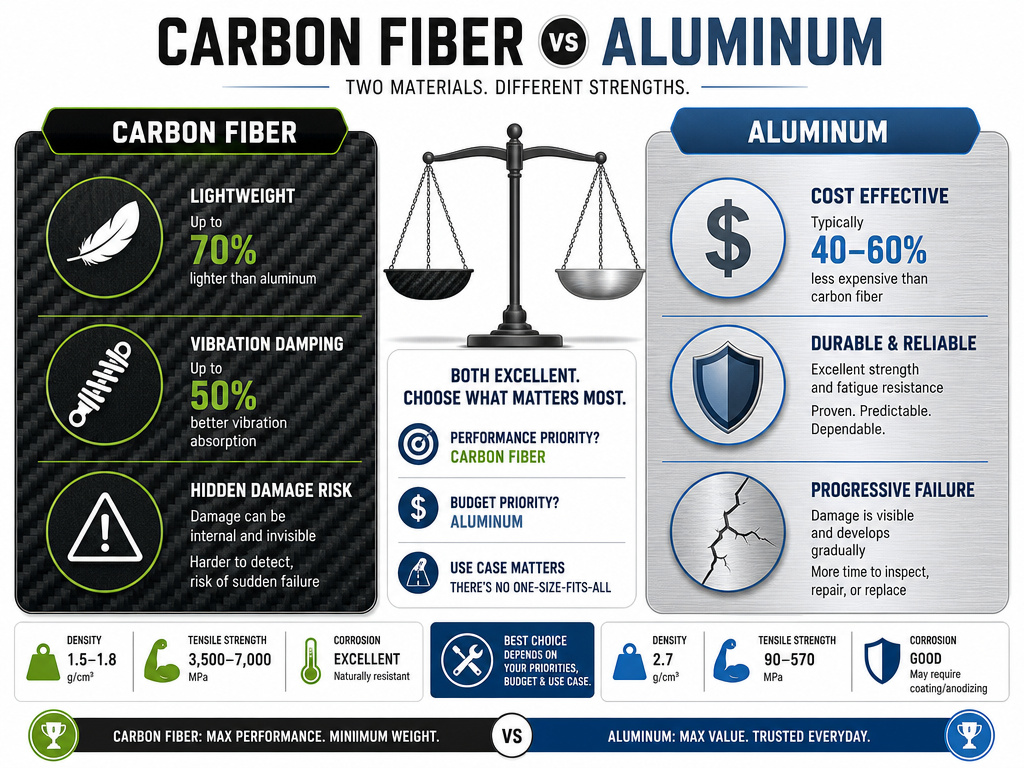
This isn’t about which is “better.” It’s about which is better for you, given the trade-offs you’re willing to live with.
Carbon Fiber wins on paper with its stiffness-to-weight and vibration-damping qualities. It lets engineers create complex, aerodynamic shapes. But it demands vigilance. It degrades predictably, hides damage, and has a finite service life dictated by resin quality. A crash that might put a dent in aluminum can write off a carbon frame. Repair is possible, but it adds weight, changes ride characteristics, and is often not cost-effective for mid-range frames.
Aluminum is heavier and transmits more road vibration, but modern hydroforming creates compliant, durable frames. Its fatigue life is finite and generally shorter than carbon’s, but it usually fails progressively, you’ll see a crack developing long before it breaks. It’s also more tolerant of minor impacts and mishandling. Crucially, a quality aluminum frame today costs a fraction of a carbon one, leaving budget for a better wheelset or groupset, which often has a bigger impact on ride quality.
| Consideration | Carbon Fiber | Aluminum |
|---|---|---|
| Ride Quality | Stiff, efficient, with tuned vibration damping. | Can feel harsher; modern designs improve comfort. |
| Long-Term Durability | Resin degrades; stiffness declines over 7-15+ years. | Metal fatigues; may develop cracks after 5-10 years. |
| Impact Damage | Often hidden; can lead to sudden catastrophic failure. | Usually visible (dent, bend); fails progressively. |
| Cost of Ownership | High initial cost; potential high repair/replacement. | Lower initial cost; often cheaper to replace. |
| Ideal Rider | Performance-focused, weight-sensitive, diligent with maintenance. | Value-focused, durable, tolerant of less-perfect care. |
The Bottom Line on Value
So, is a carbon fiber bike worth the price? It depends entirely on your calculus of performance versus longevity and risk.
If you’re chasing every watt, value the nuanced ride quality, and are committed to the inspection and care regimen, then a premium carbon frame from a brand like Canyon, Specialized, or Trek can be a justifiable long-term investment. You’re paying for a specific experience.
If your priority is durability, value, and lower stress, a high-quality aluminum frame is the smarter buy. The performance gap has narrowed dramatically, and the money you save can be spent where it matters more: on a proper tire rotation schedule, a professional bike fit, or simply more rides.
For most riders who aren’t racing, the answer lands in the middle. A mid-range carbon frame offers a taste of the performance benefits with a more manageable price tag, but understand you’re buying into the 7–12 year lifespan window. A high-end aluminum frame often delivers 90% of the performance for 50% of the cost, with fewer long-term worries.
Ultimately, a carbon bike is a high-performance consumable, unlike a steel frame which might be a ‘forever’ purchase. Buy it for the ride it gives you today, maintain it like the precision instrument it is, and plan for its eventual retirement.
Frequently Asked Questions
How long should a carbon bike frame last?
There’s no single answer. A premium, autoclave-cured frame with high-Tg resin, kept indoors and free from impacts, can last 15-20 years. A mid-range press-molded frame might be good for 7-12 years. A budget frame with variable quality control could show significant degradation in as little as 3-7 years. The rider’s weight, riding style, and maintenance are huge factors.
Can you repair a cracked carbon frame?
Yes, specialized repair shops can often repair cracks and delaminations by sanding away damaged material and bonding new carbon plies with aerospace-grade epoxy. The repair will be strong, but it will add weight and may subtly alter the frame’s ride feel. For high-value frames, repair can be worthwhile. For lower-cost frames or critical components like forks and handlebars, replacement is almost always the safer recommendation.
Do carbon bikes break easily?
They don’t break easily under normal use. They are, however, more vulnerable to catastrophic failure from impacts than metals. Aluminum will dent; carbon can fracture internally from the same hit. The key is that carbon doesn’t give a visual warning before it fails. This makes avoiding impacts and conducting regular inspections paramount.
Is carbon or aluminum better for a beginner?
For most beginners, aluminum is the better choice. It’s more forgiving of minor crashes and improper clamping, offers excellent value, and its performance is more than sufficient for learning and fitness riding. The money saved can be invested in better components, clothing, or tools. Once you’ve developed your riding style and maintenance habits, you’ll be better equipped to decide if carbon’s advantages are worth its demands.
Are there new technologies making carbon stronger?
Research is ongoing. The NSF-funded materials investigation into Z-axis reinforcement using milled carbon fibers shows promise, reporting over a 300% increase in compressive toughness without sacrificing stiffness in lab samples. This “supercomposite” approach aims to address carbon’s poor interlaminar toughness, the very weakness that leads to delamination. It’s not yet mainstream on consumer bikes, but it points to a future where carbon frames could be both light and more damage-tolerant.
