
What Is the Best Truck for Towing a Fifth Wheel? Key Specs
This post contains affiliate links. As an Amazon Associate, we earn from qualifying purchases.
The best truck for towing a fifth wheel isn’t the one with the highest advertised tow rating. It’s the truck whose payload capacity, the weight it can carry in its bed and cab, exceeds your trailer’s pin weight plus everything else you put in the truck. Most half-ton trucks fail this test immediately. A one-ton dually (dual rear wheel) usually passes.
That payload number is on your truck’s door jamb sticker, not in the brochure. A fifth-wheel transfers 15-25% of its loaded weight onto the truck as pin weight. A 14,000-pound trailer puts 2,100 to 3,500 pounds directly on the rear axle. Add your family, hitch, fuel, and gear, and you’ll burn through a 2,500-pound payload rating before you hook up.
What follows: the four weight ratings that decide your safe limit, why diesel engines complicate the payload math, and the single rear wheel vs. Dually choice that comes down to crosswind stability more than capacity.
Key Takeaways
- Your truck’s payload capacity is the most critical and most overlooked spec for fifth-wheel towing. It’s stamped on the door jamb.
- Pin weight (15-25% of your loaded fifth-wheel’s weight) counts against payload, not just towing capacity.
- Always verify weights at a CAT Scale with your rig fully loaded for a trip; brochure weights are fictional.
- A single rear wheel (SRW) one-ton truck can have enough rated capacity but may feel unstable with a large fifth-wheel in crosswinds; a dually trades daily driveability for planted confidence.
- The Gross Combined Weight Rating (GCWR) is a fixed ceiling for truck + trailer + everything; find it in your owner’s manual, not on the door sticker.
The 4 Weight Ratings That Actually Matter
Forget the big, shiny “Max Tow” number for a second. Four other ratings form the real guardrails, and exceeding any one of them makes your setup illegal and dangerous. Insurance can deny a claim if your rig was over any of these limits at the time of an accident.
First, find your truck’s Gross Vehicle Weight Rating (GVWR). This is the maximum allowable weight of the truck itself, fully loaded with fuel, passengers, cargo, and the pin weight from the trailer. It’s stamped on a label inside the driver’s door jamb. This is your truck’s absolute weight ceiling.
The Society of Automotive Engineers (SAE) J2807 standard governs how tow ratings are tested and verified. It mandates specific grade, acceleration, and braking tests, making modern ratings more realistic than in the past.
Second, know your trailer’s Gross Vehicle Weight Rating (GVWR). This is the maximum loaded weight of the fifth-wheel, found on its VIN tag. Assume you’ll hit this weight with fresh water, propane, supplies, and your gear. Never use the “dry weight” for calculations.
Third, locate your truck’s Gross Combined Weight Rating (GCWR). This is the total allowed weight of the truck, trailer, passengers, and all cargo combined. This number is buried in your owner’s manual or the manufacturer’s towing guide. It’s not on the door jamb. The math is simple: if your truck’s curb weight is 8,000 lbs and your trailer’s GVWR is 14,000 lbs, your combined weight is 22,000 lbs. Your GCWR must be higher than that.
| Rating | What It Limits | Where to Find It |
|---|---|---|
| Truck GVWR | Weight of the loaded truck (including pin weight) | Door jamb sticker |
| Trailer GVWR | Weight of the loaded fifth-wheel | Trailer VIN tag |
| GCWR | Combined weight of truck + trailer + everything | Owner’s manual |
| Payload Capacity | Weight truck can carry (people, cargo, pin weight) | Door jamb sticker |
Fourth, and most importantly, is payload capacity. This is the magic number. It’s also on the door jamb sticker, listed as “The combined weight of occupants and cargo should never exceed: XXXX lbs.” This is your truck’s carrying budget. Pin weight spends this budget fast.
Common mistake: Shopping by tow rating alone. A truck rated to tow 15,000 lbs might only have a 2,200 lb payload capacity. A 12,000 lb fifth-wheel with 2,400 lbs of pin weight would overload that truck before you even climbed into the driver’s seat.
Here’s the brutal math. Let’s say your door sticker shows a 2,800 lb payload. Your family and dog weigh 500 lbs. Your hitch weighs 150 lbs. Tools and firewood in the bed add another 300 lbs. You have 1,850 lbs of payload left for pin weight. That means your fifth-wheel’s pin weight cannot exceed 1,850 lbs. At a typical 20% ratio, that caps your trailer’s loaded weight at 9,250 lbs. If you were looking at a 12,000 lb fifth-wheel, your truck is already outmatched.
Pin Weight: The Fifth-Wheel’s Down Payment
Pin weight is the vertical load a fifth-wheel places on the hitch in your truck bed. Unlike a travel trailer’s tongue weight, which is 10-15% of its weight, a fifth-wheel’s pin weight is heavier: 15-25% of the loaded trailer’s weight. This is the price of that stable, over-the-axle connection.
The physics are straightforward. More weight over the drive axle improves traction and stability. But it also loads the truck’s suspension, springs, and tires directly. That’s why payload is king.
Where this goes sideways: Using the manufacturer’s “dry pin weight.” This number is measured on an empty trailer with no batteries, propane, or freshwater. Your real pin weight will be hundreds of pounds heavier. Always plan using 20-22% of the trailer’s GVWR for a safe estimate.
You must verify your actual pin weight. The only way to do this is to weigh your loaded rig. Roll the entire setup onto a CAT Scale (found at many truck stops). Get three weights: front truck axles, rear truck axles, and trailer axles. The weight on the rear truck axles with the trailer connected, minus the weight on the rear axles with the trailer disconnected, is your true pin weight. It’s a fifteen-minute, fifteen-dollar check that tells you everything.
If your pin weight is too low, below 15%, you risk “pin pop” and sway. If it’s too high, above 25%, you’re overloading the rear axle and will see a severe squat, which wears components and lights up your headlights into oncoming traffic.
Single vs. Dual Rear Wheels: The Stability Trade-Off
You can have a one-ton truck with a single rear wheel (SRW) or dual rear wheels (DRW, or “dually”). Both might have similar payload and tow ratings on paper. The difference isn’t on paper.
A dually has two tires on each side of the rear axle. This provides a wider track width and a larger tire contact patch. The result is dramatically better lateral stability, especially when a tall, broadside fifth-wheel catches a crosswind. The truck resists being pushed sideways.
A real-world test with a Chevrolet Silverado 3500 HD SRW towing a 15,000 lb, 44-foot fifth-wheel confirmed the ratings were sufficient. But in 15-20 mph crosswinds, the driver noted significant buffeting and a “white-knuckle” need for constant steering correction. The conclusion was that for frequent towing of large trailers, especially in plains or mountain regions, the dually’s stability is worth the trade-off in parking lot maneuverability and daily width.
I won’t recommend a single rear wheel for a fifth-wheel over 35 feet or 12,000 lbs. The numbers might work, but the pucker factor on a two-lane highway with a semi-truck passing the other way is real. A dually sleeps better.
For smaller, lighter fifth-wheels under 10,000 lbs, a well-equipped SRW truck is often perfectly capable and more pleasant to live with daily. The choice hinges on your trailer’s size, your typical driving environment, and your comfort level.
Diesel vs. Gas: The Torque and Payload Penalty
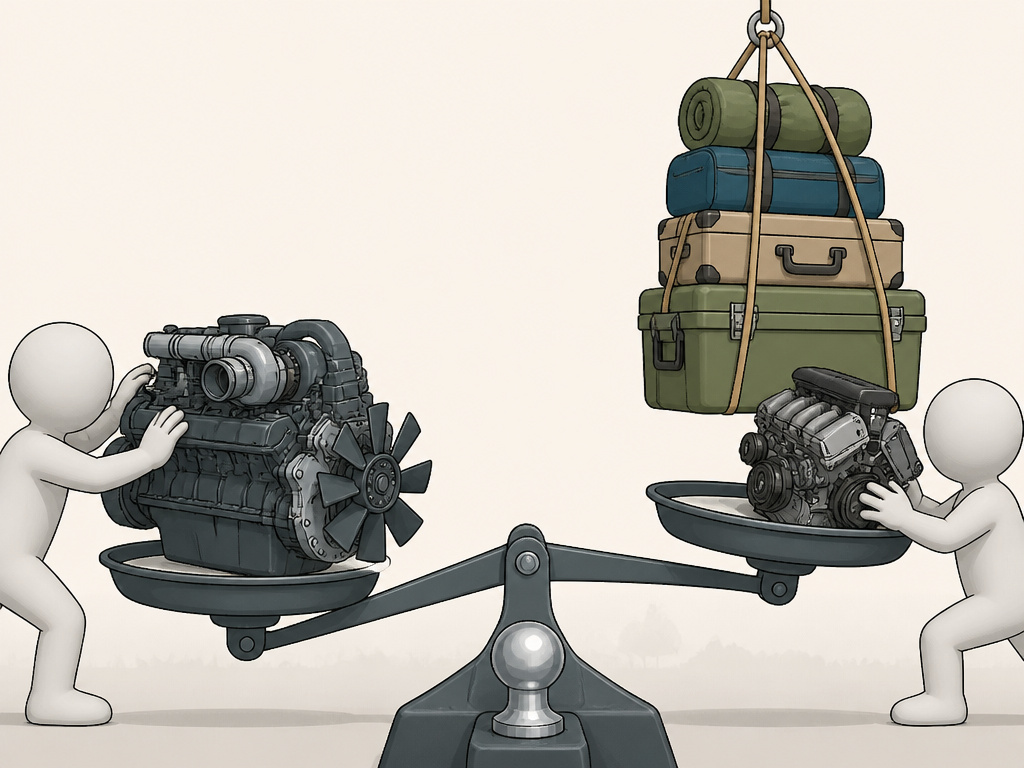
Diesel engines, like the Ford 6.7L Power Stroke or Ram 6.7L Cummins, are legendary for towing. They produce massive torque low in the RPM range, making acceleration with a heavy load effortless. Their exhaust braking systems provide incredible downhill speed control, saving your wheel brakes.
But diesel comes with a payload tax. The engine, emissions equipment (DEF tank, DPF filter), and reinforced components are heavy. This weight subtracts from the truck’s payload capacity before you add a single pound of passenger or cargo. A similarly equipped gas truck (like a Ford 7.3L Godzilla or GM 6.6L Vortec) will often have a 400-800 lb payload advantage.
| Engine Type | Pros | Cons |
|---|---|---|
| Diesel | High torque, excellent engine braking, better fuel economy under load. | Higher upfront cost, heavier (reduces payload), more expensive maintenance. |
| Gas | Lower cost, higher payload capacity, simpler/cheaper maintenance. | Lower torque, poorer fuel economy when towing, less effective engine braking. |
Your decision point is simple: if you need every last pound of payload, a gas truck might be the only way to stay legal. If you tow long distances over mountains and value driveline longevity and control, diesel is worth the penalty. For most fifth-wheel owners towing trailers in the 12,000-18,000 lb range, a gas one-ton is often the more sensible, capable choice.
The Hidden Specs: Frontal Area and Altitude
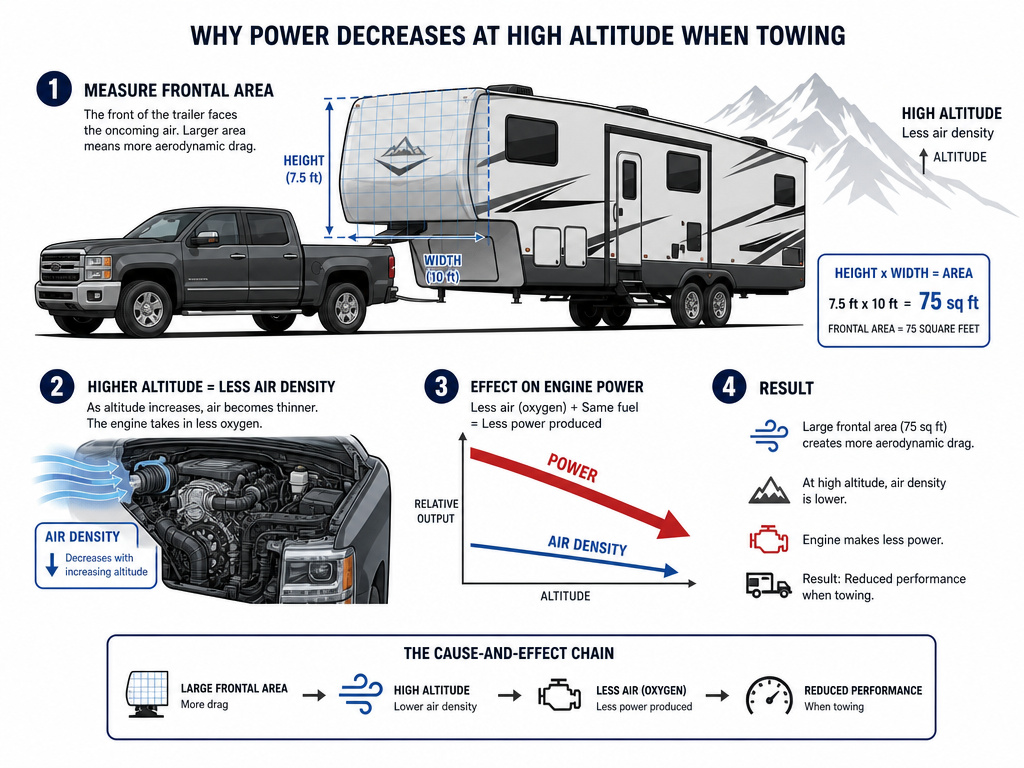
Two specs buried in your owner’s manual are easy to miss but will throttle your performance if ignored.
Trailer Frontal Area is the size of the front of your trailer facing the wind. Ford, for example, states that fifth-wheels and goosenecks should not exceed 75 square feet of frontal area. A taller, wider trailer acts like a giant sail. Exceeding this limit won’t break anything immediately, but it will “significantly reduce performance,” meaning your truck will struggle to maintain speed and will burn far more fuel.
High Altitude Derating is a real engineering constraint. For every 1,000 feet above sea level, internal combustion engines lose about 3% of their power due to thinner air. Ford’s manual specifies reducing the Gross Combined Weight by 2% per 1,000 feet starting at the 1,000-foot mark. If your GCWR is 30,000 lbs and you’re towing in Denver at 5,280 feet, you should derate your limit by roughly 10%. That’s a 3,000 lb reduction. This isn’t a suggestion; it’s a thermal and mechanical protection for your engine and transmission.
The Contenders: Which Truck Does the Job?
You need a ¾-ton (250/2500 series) or 1-ton (350/3500 series) truck. Half-tons (150/1500 series) are not serious candidates for fifth-wheels, with rare, light-exception builds.
For a definitive answer, you must compare specific build sheets, not brand headlines. A crew cab, long bed, 4×4 diesel truck with every luxury option will have a much lower payload than a regular cab, gas, 4×2 work truck from the same brand.
That said, here’s how the 2026 landscape shapes up for heavy-duty trucks:
- Ford Super Duty: The available F-350 DRW with the High-Capacity Trailer Tow Package can achieve a 35,000 lb fifth-wheel tow rating. Its F-450 is the undisputed king of GCWR, rated at 40,400 lbs, built for the largest fifth-wheels.
- Ram 3500: With the available 6.7L Cummins and optional ratings, it can tow up to 36,610 lbs. The Ram’s rear axle is often praised for its smooth ride when unloaded, a bonus for a daily-driven dually.
- Chevrolet Silverado HD / GMC Sierra HD: The 3500 series with the available Duramax diesel is a strong contender. Payload on the Silverado 3500 SRW can reach 3,760 lbs, which is competitive. As the real-world test showed, its SRW trucks are capable but may leave you wanting a dually for large trailers.
The “best” truck is the one whose door-sticker payload and manual-listed GCWR exceed your loaded, real-world weights with a safe margin. For most new fifth-wheel buyers, that points directly to a one-ton dually. It’s not the cheapest or easiest to park, but it’s the tool that matches the job’s physics.
Frequently Asked Questions
Can a half-ton truck tow a fifth-wheel?
Sometimes, but rarely well. A half-ton truck (e.g., Ford F-150, Ram 1500) with a max tow package can theoretically tow lighter fifth-wheels under 9,000 lbs GVWR. However, its payload capacity is usually the limiting factor. The pin weight of even a small fifth-wheel, plus passengers and gear, will likely exceed the truck’s payload rating, making it an illegal and unsafe setup.
Do I need a weight distribution hitch for a fifth-wheel?
No. Fifth-wheels do not use weight-distribution hitches. The pin is positioned over the truck’s rear axle, which optimally distributes the weight. You need a proper fifth wheel hitch mounted securely to the truck’s frame. Brands like B&W, Curt, and Reese make reliable hitches rated for specific weights.
How much pin weight should my fifth-wheel have?
Aim for 18-22% of your fifth-wheel’s fully loaded weight (GVWR). This range provides a stable tow without overloading your truck’s rear axle. Weigh your setup at a CAT Scale to know your exact pin weight. Below 15% risks instability; above 25% likely overloads your truck.
Is a dually necessary for fifth-wheel towing?
Not strictly necessary for legal towing if a single rear wheel (SRW) truck’s ratings are sufficient. However, for fifth-wheels over 35 feet or 12,000 lbs, a dually provides vastly better stability in crosswinds and emergency maneuvers. It’s a strong safety and comfort recommendation for large trailers.
What is the most important truck spec for fifth-wheel towing?
Payload capacity. It’s the number most often exceeded and the hardest to increase after purchase. The tow rating means little if you don’t have the payload capacity to carry the pin weight, your family, and your gear. Always check the door jamb sticker on the specific truck you’re considering.
Before You Go
The search for the best truck starts at the scale, not the dealership. Know your trailer’s real loaded weight. Calculate 20% of that for a target pin weight. Then, find a ¾-ton or 1-ton truck whose yellow-door-sticker payload exceeds that pin weight plus 1,000 pounds for your crew and cargo. Verify the GCWR in the manual covers the total.
The numbers that matter are the ones stamped on metal, not printed in glossy brochures. When in doubt, go bigger, a dually over a single wheel, a one-ton over a ¾-ton. An overpowered truck tows with ease. An underpowered one tows with stress, wear, and risk. Your choice is the difference between a relaxing highway cruise and a white-knuckle fight against physics.
