
How Often Should You Change Differential Fluid in a Truck
This post contains affiliate links. As an Amazon Associate, we earn from qualifying purchases.
Change differential fluid in a truck when the manufacturer’s severe-service schedule applies: every 30,000 to 60,000 miles for heavy towing, commercial use, or off-roading. Modern “lubricated for life” axles still require fluid changes after water submersion or if operated under high-stress conditions like frequent trailer towing in hot weather.
The word “lubricated” is doing a lot of work there. It doesn’t mean the fluid lasts the life of the truck; it means the factory fill is meant to last the warranty period under perfect conditions. Your conditions are not perfect. Stress the gears enough and the fluid shears, the additives burn off, and the metal-on-metal contact starts with a whine you can’t un-hear.
This guide walks through the specific schedules for Ford, GM, and Ram trucks, the exact specs your axle needs, and the physical signs that tell you you’re already late. By the end, you’ll know whether your 1500-series daily driver needs a change at 100k or your 3500 dually needs it before next season’s hauling starts.
Key Takeaways
- “Lubricated for life” is a marketing term for warranty coverage, not a maintenance recommendation. Plan on changing fluid by 60,000 miles for most severe use.
- Heavy towing in temperatures above 70°F (21°C) can mandate changes as often as every 3,000 miles for non-synthetic fluids, per Ford’s manual.
- Limited-slip differentials (like Ford’s Traction-Lok) require a specific friction modifier additive, XL-3 (EST-M2C118-A), or the clutches will chatter and burn out.
- The single most reliable sign you’re overdue isn’t noise; it’s fluid that’s dark, opaque, and smells burnt when you pull the fill plug.
- For maximum protection under stress, a full-synthetic gear oil like AMSOIL SEVERE GEAR outperforms conventional OEM fluids, especially in axles with reduced fluid capacity.
The Core Answer: “Lubricated for Life” Means This
Modern truck axles are often advertised as sealed, maintenance-free units. The owner’s manual might say “lubricated for life.” That life is the warranty period, not the 200,000-mile lifespan you’re aiming for.
The factory fill is a high-quality synthetic or semi-synthetic gear oil designed to last under a narrow band of “normal” driving: highway miles, moderate temperatures, no towing. The moment you hook up a trailer, load the bed with gravel, or drive on a dirt road, you’ve left normal.
Ford’s owner manual explicitly states that rear axles with synthetic fluid are considered “lubricated for life” only under normal conditions. It then lists multiple severe-service scenarios, like trailer towing above 70°F or commercial operation, that mandate specific, much shorter change intervals.
The gears and bearings inside your differential are bathed in this fluid. It does three jobs: lubricate to prevent wear, cool by transferring heat, and protect against corrosion. Under load, heat breaks down the oil’s viscosity, and mechanical shearing from the gear teeth tears apart the long-chain molecules that provide film strength. Once that happens, the fluid can’t maintain a protective layer. Wear accelerates, metal shavings appear, and the distinctive whine starts. By then, the damage is done.
Your Truck’s Specific Schedule: It’s in the Manual
You can’t use a generic interval. A Ford F-250 Super Duty towing a fifth-wheel has a different clock than a Chevy Silverado 1500 used as a grocery getter. The definitive answer lives in your truck’s owner manual or, even better, the factory service manual.
Here are the real-world intervals pulled directly from manufacturer documentation. These aren’t suggestions from a blog; they are the requirements to maintain warranty coverage and prevent premature failure.
| Vehicle / Use Case | Recommended Interval | Critical Notes |
|---|---|---|
| Ford Light-Duty (F-150, etc.) – Normal | “Lubricated for life” | Only valid for factory-specified synthetic fluid, no towing, no submersion. |
| Ford Light-Duty – Severe Towing | 3,000 miles / 3 months | For non-synthetic fluid only. Interval waived if using 75W140 synthetic meeting Ford spec WSL-M2C192-A. |
| Ford Super Duty (F-250+) – Commercial | 60,000 miles | For dual rear wheel (DRW) trucks operating near max Gross Vehicle Weight. |
| Ford Police/Taxi/Livery | 100,000 miles | Interval waived if using the specified 75W140 synthetic gear fluid. |
| Any Truck – Water Submersion | Immediately | Change fluid any time the axle is submerged, regardless of mileage. |
| General Heavy Use Guideline | 30,000 – 60,000 miles | A safe, proactive interval for most trucks that tow, haul, or see off-road use. |
The takeaway is binary. Either your use matches the perfect “normal” in the brochure, or it doesn’t. If you’re reading this, it doesn’t. Your truck transmission lifespan depends on the same logic, fluid breaks down under stress.
The Signs You’re Already Late: More Than Just Noise
Waiting for a howl from the rear end is like waiting for the engine to seize before changing the oil. The failure happens long before it’s audible. You need to read the physical evidence.
Pull the fill plug (the upper plug on the differential housing). Let a few drops come out onto a clean white paper towel or your finger. Good fluid is typically amber or light brown, translucent, and smells like heavy oil. Here’s what you don’t want to see:
- Dark, Opaque, Black Fluid: This means the oil is loaded with tiny metal wear particles and has oxidized from heat. It’s lost its lubricity.
- Gritty Texture: Rub the fluid between your fingers. Any grittiness is metallic debris. That’s your gears and bearings wearing away.
- Burnt Smell: A sharp, acrid odor indicates the fluid has overheated severely. The additives are cooked.
- Milky, Frothy Fluid: This is water contamination, usually from a faulty seal or, worse, submersion. Water and gear oil make a corrosive paste that destroys bearings.
A visual inspection should be part of your annual rust inspection routine. While you’re under the truck looking for frame issues, check the differential seals for leaks. Weeping seals let fluid out and dirt in, another fast path to failure.
The Limited-Slip Exception: The Friction Modifier Mandate
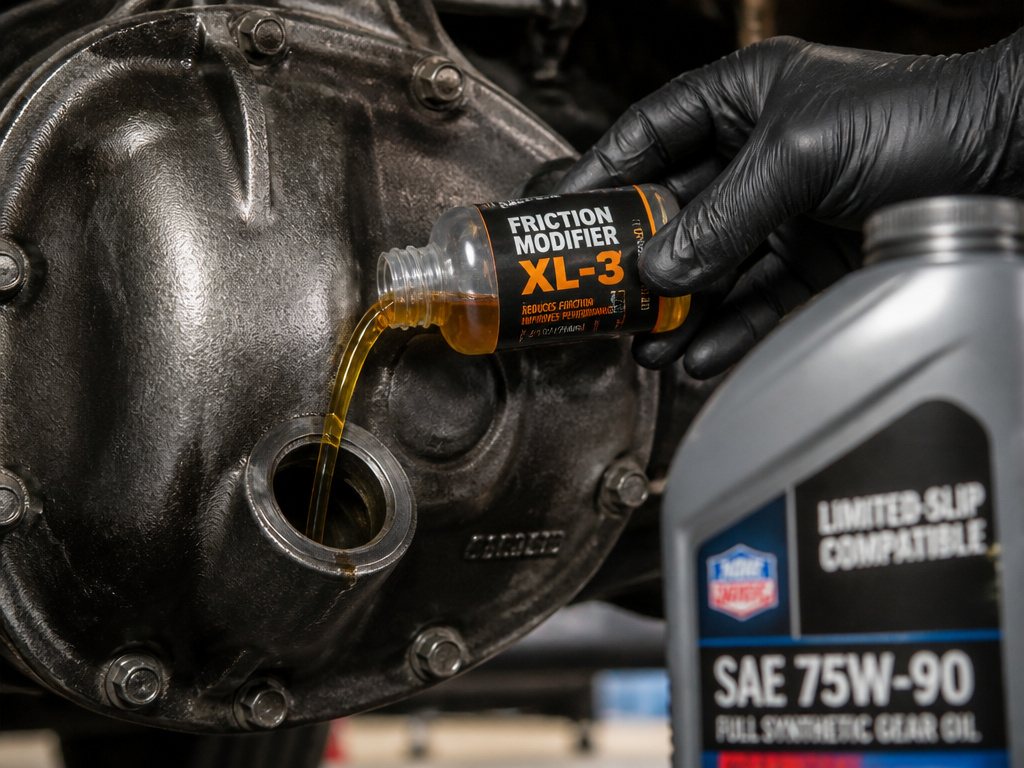
If your truck has a limited-slip differential (often called Traction-Lok, Posi, or G80), you have an extra component that demands a specific additive. Inside the differential are clutch packs that allow some slip for normal driving but lock up to transfer power when one wheel spins.
Those clutches require a friction modifier to operate smoothly. Without it, they chatter, shudder, and eventually glaze over and burn out. The chatter is most noticeable during low-speed parking lot turns.
Ford’s specification is exact. For a complete refill of a Traction-Lok rear axle, you must add 4 ounces (118 ml) of Friction Modifier XL-3 (EST-M2C118-A). For the larger 11.8-inch rear axle in a modern Super Duty, that requirement jumps to 8 ounces (238 ml). This isn’t a recommendation; leaving it out guarantees a noisy, expensive problem.
When you buy gear oil, look for bottles labeled “limited-slip compatible” or “contains friction modifier.” If you’re using a conventional oil, you must buy the XL-3 additive separately and add the correct amount. This is non-negotiable.
The Tool You Need Before You Start
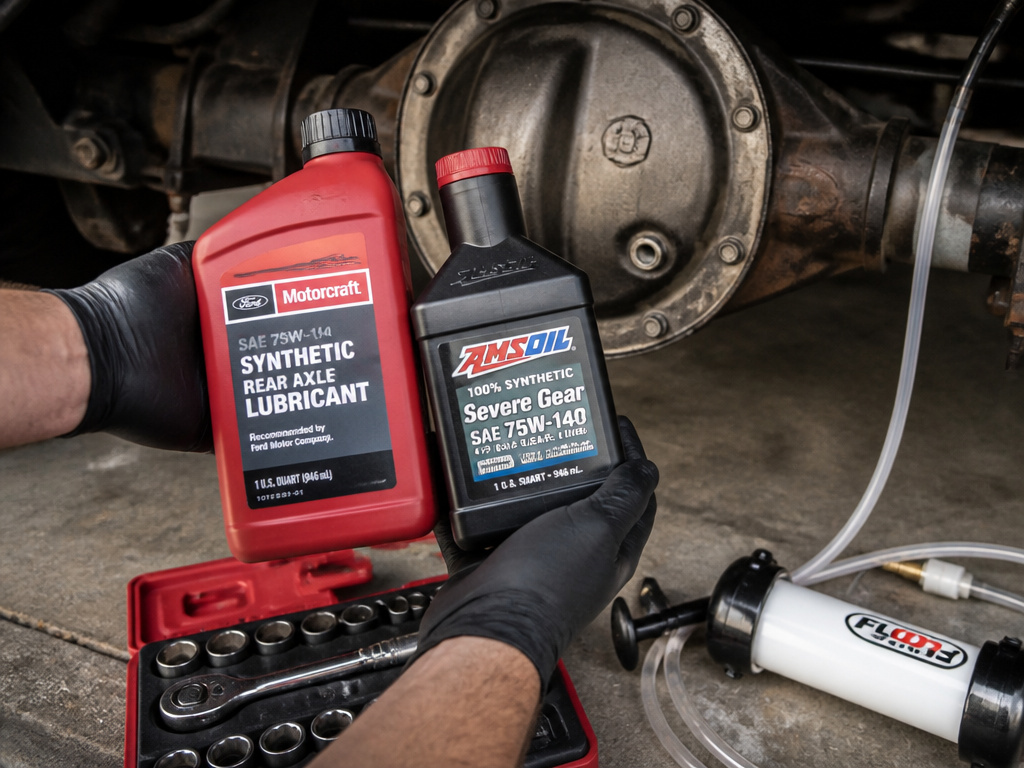
You can change differential fluid yourself with basic tools. It’s simpler than an oil change in many ways. But you must have the right gear oil on hand before you crack the first bolt.
- Identify Your Axle: Know if you have an open or limited-slip differential. Check your owner’s manual or the axle tag (usually on the rear cover bolt).
- Find the Spec: Your manual will list the required fluid specification (e.g., Ford WSL-M2C192-A for 75W140 synthetic) and the exact capacity.
- Choose Your Fluid: You have two paths.
- OEM Fluid: Buy the Motorcraft, ACDelco, or Mopar fluid from the dealer. It’s guaranteed to meet spec and often includes the friction modifier for limited-slips.
- Premium Synthetic: An aftermarket full synthetic like AMSOIL SEVERE GEAR or Mobil 1 Synthetic Gear Lube often exceeds the OEM specification. This is the best choice for severe service, as it resists thermal breakdown and shear far better. The AMSOIL differential fluid guide notes that modern trucks have less fluid capacity handling more stress, making fluid quality critical.
Before you start: The fluid in the differential is thick and can be hot enough to cause burns. Wear gloves and safety glasses. Have a large drain pan ready, it holds more than you think. Never service the differential on a sloped driveway or with only a jack supporting the truck; use proper jack stands.
Gather a ratchet set, a fluid transfer pump (a cheap manual pump is fine), a new gasket or RTV sealant for the cover (if you’re removing it), and your specified gear oil. A magnetic drain plug, often found in aftermarket differential covers, is a worthwhile upgrade to capture metal particles.
The 8-Step Change Procedure (And The One Mistake That Costs $2,000)
This assumes you have a standard differential with a removable rear cover, the most common setup. Some newer trucks have a “coverless” unit where you pump fluid out the fill hole.
- Drive the truck briefly to warm the fluid. This thins it and helps it drain completely, carrying suspended debris with it.
- Safely lift and support the rear axle. You need the truck level for an accurate fill.
- Place the drain pan under the differential. Remove the lower (drain) bolt or, more commonly, remove all bolts from the rear cover. Crack the cover loose at the bottom first to let fluid start draining before pulling it fully off.
- Inspect the old fluid and the inside of the cover. Look for large metal chunks (a sign of catastrophic failure) or a fine, silvery paste (normal wear).
- Clean everything. Scrape the old gasket material off the cover and housing. Use brake cleaner to wipe the inside of the housing and the cover spotlessly clean. A magnetic plug will have a collection of fine metal “fuzz”, this is normal.
- Apply a new gasket or a thin bead of RTV sealant (like Permatex Ultra Black) to the cover. Reinstall the cover and bolts, tightening in a star pattern to the specified torque.
- Pump new fluid into the fill hole until it just begins to weep out. This is the full point. For a limited-slip, add the friction modifier to the fluid before pumping, or add it directly into the housing first.
- Reinstall the fill plug. Lower the truck, clean up, and take it for a gentle test drive, making a few slow figure-eight turns to circulate the new fluid and work the friction modifier into the clutches.
The $2,000 mistake: Overfilling. The differential needs air space for the fluid to expand as it heats. If you pump until fluid is pouring out, you’ve overfilled it. The excess creates foam, churns, and overheats, leading to seal failure and pressure blow-out. Fill until a thin stream just starts to drip, then stop.
Towing, Hauling, and Off-Roading: The Severe-Service Clocks
This is where the generic 30,000-50,000 mile advice falls apart. Your specific use dictates its own timeline.
- Heavy Towing: This is the hardest job on a differential. Ford’s manual spells it out: for non-synthetic fluid, change every 3,000 miles when towing over 45 mph in temps above 70°F. Even with synthetic, the constant high heat demands more frequent changes. Plan on 15,000-30,000 miles.
- Commercial / Max Payload: If you’re running a dually at or near its Gross Vehicle Weight Rating (GVWR) daily, you’re in the “severe commercial” bracket. Ford specifies 60,000 miles for dual rear wheel trucks under max load. That’s your ceiling, not your target.
- Off-Road & Mud: The Isuzu truck manual explicitly says to change axle oil if operating “in muddy areas, on a beach.” Water and abrasive grit are the enemies. A single deep-water crossing mandates an immediate change. Regular off-road play should cut your interval in half compared to street use.
- Stop-and-Go City Driving: While not as extreme as towing, the constant load/unload cycles and lack of cooling airflow generate more heat than highway cruising. Consider the shorter end of your interval range.
These conditions are why a robust truck undercoatings and rust prevention strategy matters. Corrosion weakens the entire structure the differential hangs on.
Synthetic vs. Conventional: The Shearing Truth
The debate is over. For a truck differential, especially under load, full synthetic is the only rational choice.
Modern truck axles have less fluid capacity than older models but are asked to handle dramatically more torque and towing weight. As noted in the Motorist.org differential fluid guide, less fluid guarding against increased stress means the fluid’s film strength is paramount.
Conventional gear oils rely on long-chain hydrocarbon molecules for viscosity. Under the shear forces of hypoid gears, these chains literally snap, permanently reducing the oil’s thickness. It’s like cutting the strands of a rope.
Synthetic basestocks have more uniform, stable molecules that resist shearing. They also handle extreme temperatures better, flowing when cold and resisting thermal breakdown when hot. This is why Ford allows you to ignore the brutal 3,000-mile towing interval only if you use their specified 75W140 synthetic gear fluid (WSL-M2C192-A).
The upgrade pays for itself. You extend change intervals, get better protection, and reduce operating temperatures. For the price of one extra service visit, you buy insurance for the entire drivetrain.
Frequently Asked Questions
Does “lubricated for life” mean I never change it?
No. It means the factory fill is designed to last the powertrain warranty period under ideal, non-towing conditions. For long-term reliability, especially if you use your truck as a truck, you must change the fluid. Think of it as “lubricated for the life of the lease.”
What happens if I never change my differential fluid?
The fluid degrades, loses its lubricity, and gets contaminated with metal wear particles and water. The gears and bearings run metal-on-metal, overheating and wearing rapidly. This leads to a loud whining or howling noise, followed by complete bearing failure or shattered gears. The repair bill often exceeds the cost of a dozen fluid changes.
Can I use any 75W-90 gear oil in my truck?
Not safely. You must use a fluid that meets your manufacturer’s specification (e.g., Ford WSL-M2C192-A, GM 9986115). More importantly, if you have a limited-slip differential, the fluid must either contain the correct friction modifier or you must add it separately. Using the wrong fluid can cause clutch chatter and damage.
How do I know if my truck has a limited-slip differential?
Check your owner’s manual, the build sheet (window sticker), or the axle tag on the differential itself. Often, the tag will have a code like “L” or “LS” or a ratio listing followed by “L.” You can also perform a simple test: with one rear wheel on dry pavement and the other on a loose surface (grass, gravel), give light throttle. If both wheels spin, you likely have a limited-slip. If only one spins, it’s an open differential.
Is changing differential fluid a DIY job?
Yes, for most trucks with a removable rear cover, it’s a straightforward DIY task. You need basic hand tools, a fluid transfer pump, and the correct gear oil. The most critical steps are cleaning the sealing surfaces thoroughly and filling to the correct level, not overfilling. If your truck has a “coverless” unit or you’re not comfortable, a shop can do it quickly.
The Bottom Line
Stop wondering. For 99% of truck owners, the answer is yes, you need to change your differential fluid, and you’re probably overdue. The interval isn’t a mystery; it’s written in your manual under “severe service” because driving a truck is a severe service.
Buy the fluid that matches your axle’s spec, add the friction modifier if you have a limited-slip, and get under the truck. The hour you spend and the cost of a few quarts of synthetic oil are nothing compared to the silence of a healthy drivetrain, and the thousands you save by avoiding a rebuild. Your truck’s job is to work. Your job is to keep it working.
