
How to Check for Rust on a Truck Frame: Visual & Tap Test
This post contains affiliate links. As an Amazon Associate, we earn from qualifying purchases.
To check for rust on a truck frame, visually inspect the entire frame assembly, top, side, and bottom of all rails, for any visible holes or severe scaling. Then, perform a hammer tap test: using a 12–16 oz hammer, strike the side and bottom surfaces every 2 inches along the rails. If the metal flakes away or a tool pierces through a hole 10 mm (about 0.4 inches) or larger, the frame is structurally compromised and may qualify for manufacturer replacement programs.
The 10mm figure isn’t arbitrary. It’s the specific Rust Perforation Standard Toyota uses in its Customer Support Program ZKA for 2011–2017 Tacomas and in the Limited Service Campaign for 2000–2003 Tundras. A hole smaller than that is considered surface or pitting rust; a hole at or above that size triggers a full frame replacement at no cost if your vehicle and location qualify. The difference between a DIY fix and a warranty claim hangs on that measurement.
What follows: the exact visual and physical test from Toyota’s technical bulletins, the specific high-failure zones you must check, how to interpret the three levels of rust, and the critical steps to take if you find the bad kind.
Key Takeaways
- The official test involves a visual inspection followed by a hammer tap along the frame rails every 2 inches. Flaking metal or a puncture is a fail.
- Manufacturer coverage hinges on a perforation of 10 mm or more. A hole smaller than that won’t qualify for a warranty frame swap.
- Cold Climate States with high road salt usage drastically affect warranty coverage length, 12 years unlimited mileage vs. The standard 3-year/36,000-mile warranty.
- The worst rust always starts inside the frame rails and at leaf spring mounts and crossmembers, areas you must check with a flashlight and mirror.
- Never work under a vehicle with a visibly perforated frame without proper jack stands. The structure can collapse.
Why Frame Rust Is a Different Beast
A unibody car can rust and be repaired. A truck’s body-on-frame construction makes the frame a load-bearing skeleton. When that skeleton corrodes, it’s not a cosmetic issue, it’s a structural one. The frame holds the engine, transmission, cab, and bed together. It absorbs the twisting forces of towing and off-roading.
A rust-weakened frame can crack under load. In a collision, it may not crumple as designed, transferring excessive force to the cabin. This is why manufacturers like Toyota issue specific technical service bulletins and even full recalls. The NHTSA Tundra frame replacement campaign for 2000–2003 models exists because the stakes are safety, not just longevity. Your inspection isn’t about finding a spot to wire-brush; it’s about determining if the truck’s foundation is sound.
The Three Rust Classifications: Surface, Pitting, Structural
Before you grab a hammer, learn what you’re looking for. Rust severity falls into three tiers, each with a different prognosis and repair path.
| Rust Classification | Visual Appearance | Hammer/Probe Test Result | Typical Repair Action |
|---|---|---|---|
| Surface Rust | Orange/brown film or dust. No visible pits or holes. | Flakes off easily, reveals solid metal underneath. | Clean, treat with a rust converter, prime, and apply a protective coating. |
| Pitting Rust | Rough, cratered texture. Metal looks eaten away, but no clear hole through. | Probe sticks in pits, metal feels spongy but doesn’t puncture. | Aggressive grinding or cutting out the section, then welding in new metal. Major project. |
| Structural Rust (Perforation) | Visible holes, often with cracked or missing metal flakes around edges. | Tool (screwdriver) pushes through the hole easily. Hole measures ≥10mm. | For qualifying vehicles: full frame replacement. For others: costly section replacement or vehicle retirement. |
Common mistake: Calling any brown spot “surface rust.” Pitting hides under what looks like surface scale. You have to scrape it to know.
Surface rust is a maintenance call. Pitting rust is a repair project. Structural rust, a perforation, is a verdict. The rest of this guide is about accurately diagnosing which one you have.
Where to Look (The Hot Zones)
Rust doesn’t attack the frame evenly. It targets specific areas where moisture, salt, and debris collect. You need a good flashlight, a mechanic’s mirror, and the willingness to get dirty.
Inside the Frame Rails: This is enemy number one. Water and road salt splash up inside the boxed sections and sit there, unable to drain or dry. You often can’t see this rust from the outside until it eats its way through. Shine your light into any drain holes or openings.
Crossmembers, especially the rear ones ahead of the axle and the fuel tank straps. These horizontal members catch everything flung up from the road.
Leaf Spring Mounts and Shackles: The constant flexing cracks any factory coating, letting salt and moisture in. The bolt holes are prime failure points.
Body Mount Locations: Where the cab and bed bolt to the frame. The brackets create crevices that trap mud and salt.
If you live in a Cold Climate State, think New York, Ohio, Michigan, Illinois, Pennsylvania, the New England states, your inspection needs to be annual. Toyota’s own data shows these areas drive “more-than-normal corrosion” and trigger extended warranty coverage. A clean frame in Arizona can be a Swiss cheese frame in Buffalo after five winters.
The Hammer Tap Test: Toyota’s Official Procedure
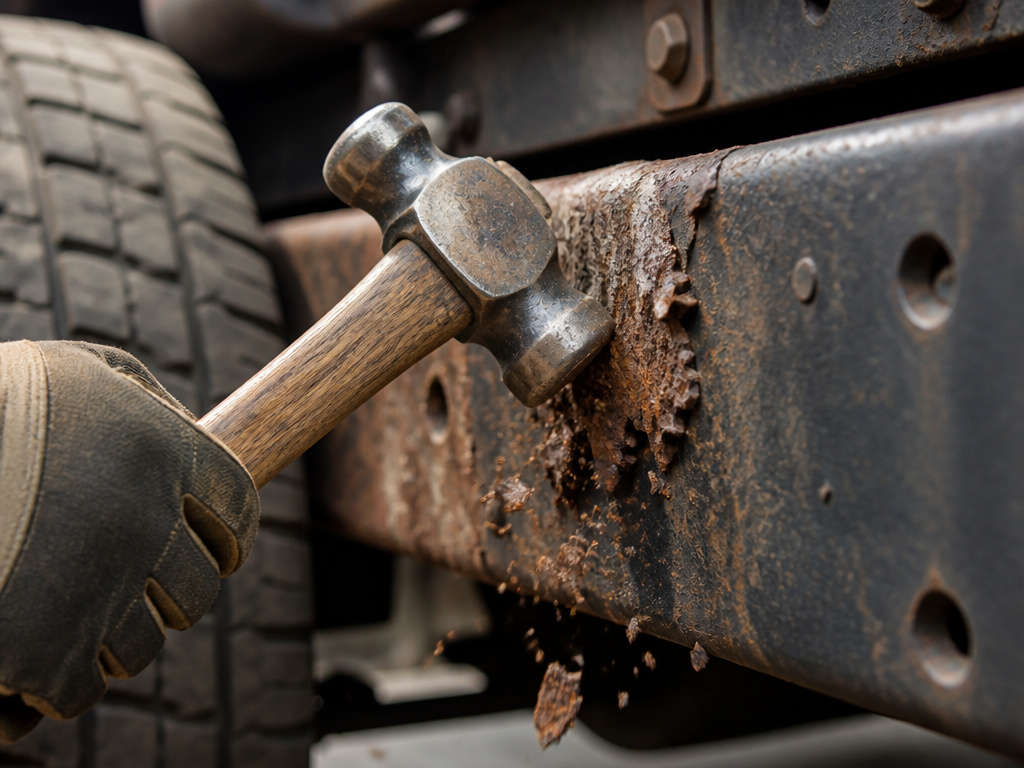
This isn’t folklore. The method comes straight from the NHTSA Tacoma frame inspection bulletin. It’s how dealers determine if a frame qualifies for replacement under warranty campaigns.
Before you start: Put on safety glasses and thick gloves. Rust flakes are sharp and will fly. If you see an obvious hole big enough to poke a finger through, do not get underneath the vehicle without supporting it on jack stands placed on solid, non-perforated sections of the frame.
- Visual Pass: With the truck on level ground, visually inspect the entire frame. Look at the top, sides, and bottom of all frame rails. You’re looking for any visible hole, or an area so thin and scaly that light shines through the rust.
- The Tap: Using a 12–16 ounce ball-peen hammer, strike the side (both inboard and outboard) and bottom surfaces of the frame rails. Use a swing of about 10–12 inches with light to moderate force. You’re not trying to dent good metal; you’re testing the integrity of the rusted metal.
- The Pattern: Repeat this tap every 2 inches along the entire length of both frame rails. Pay extra attention to the “hot zones” mentioned earlier.
- The Judgment: Does the hammer cause the metal to flake away excessively, revealing a hole or deep pit? Does a follow-up poke with a screwdriver blade go through the metal? If yes, you have perforation. The next step is to measure it.
Toyota Technical Instruction: “Perforation is visible on the frame. Is perforation present?… Replace the frame.” This is the binary decision tree from the official technician guide.
What if the metal seems solid but looks bad? That’s likely pitting rust. The hammer won’t go through, but the surface will be cratered. That’s your cue for rust prevention and repair, not a warranty claim.
The 10mm Threshold: What Qualifies for Replacement
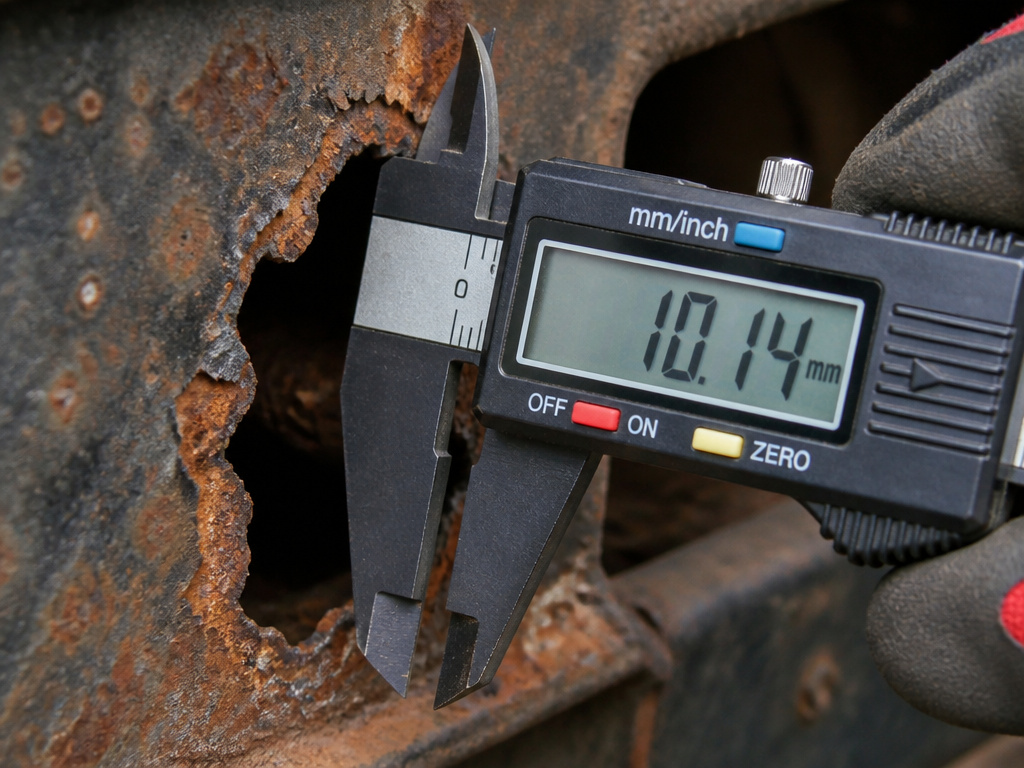
Here’s the non-commodity core of the whole issue. For covered Toyota trucks (like 2011-2017 Tacomas and 2000-2003 Tundras), the line between “no action” and “new frame” is a hole 10 millimeters in diameter.
That’s about the width of a standard pencil or two stacked dimes. Why that number? It’s the engineering point where Toyota’s corrosion specialists determined the frame’s structural integrity is compromised beyond reliable repair. A hole smaller than 10mm might be treatable with a patch; a hole at or larger than 10mm means the surrounding metal is too far gone.
This threshold is why a careful inspection matters. A dealer technician will find that hole, measure it with calipers, and submit photos through Toyota’s TIS (Technical Information System) for approval. If your DIY inspection finds a hole that looks close to that size, your next stop is the dealer for a formal inspection, not the hardware store for a patch kit.
If you have a different brand truck, check for similar technical service bulletins or recall notices. The principle is the same: manufacturers have a standard for what constitutes structural failure. Your job is to find out if your truck meets it.
What to Do Next: From Surface Rust to Perforation
Your inspection result dictates your next move. This isn’t a linear path.
If you found only surface rust:
Clean the area thoroughly with a wire brush. Apply a quality rust converter to neutralize any remaining oxidation. Once treated, protect it for the long term. This means a dedicated truck frame paint or a protective undercoating. The goal is to stop the process before it reaches the metal.
If you found pitting rust:
The repair scale jumps. You must grind or cut out all compromised metal until you reach clean, solid steel. This often requires welding in new patch panels. After metalwork, you must use a paint for rusty frames designed to adhere to etched metal and prevent recurrence. This is professional-grade work for most people.
If you found a perforation ≥10mm on a covered vehicle:
- Do not attempt to repair it. A patch weld on a frame under stress is a temporary fix at best and a liability at worst.
- Gather your documents: Vehicle registration, proof of ownership, and any maintenance records.
- Contact your authorized dealer. Schedule a formal frame inspection. Mention the specific campaign (e.g., Customer Support Program ZKA for Tacomas). The inspection itself takes about an hour.
- If approved, the frame replacement takes a dealer about a week. They will typically offer a complimentary loaner vehicle.
Where this goes sideways: Trying to hide perforation with body filler or a slap-dash weld before a dealer inspection. They will find it, and it will void your eligibility for the program. Transparency is the only path to a covered repair.
For vehicles outside formal campaigns, a perforation is a major financial decision. A full frame replacement can cost thousands. At that point, you must weigh the truck’s value against the repair cost.
Frequently Asked Questions
Does surface rust need immediate attention?
Yes, but not panic. Surface rust is the warning phase. Address it within the next few months, clean, treat, and protect it with a quality coating like rust-preventive paint. Letting it sit for another winter in a salt state accelerates it to pitting.
Can I use a screwdriver instead of a hammer for the test?
The hammer is specified because its impact force tests a wider area for hidden weakness. A screwdriver is for probing suspicious spots after the hammer test causes flaking. Use both, but start with the hammer.
My truck isn’t a Toyota. Does this still apply?
The inspection methodology is universal. The 10mm threshold is specific to Toyota’s programs. Check your manufacturer’s website or the NHTSA database for technical service bulletins related to frame corrosion for your specific make, model, and year. The process of visual inspection and hammer testing is standard industry practice for evaluating structural rust.
How often should I check my truck frame?
If you live in a Cold Climate State, inspect it every fall before winter and every spring after the salt has been washed away. For warm climate states, a thorough yearly check is sufficient. The best rust protection for trucks is consistent vigilance.
Will undercoating prevent all frame rust?
No coating is a perfect forcefield. Rubberized asphalt undercoatings can trap moisture against the metal if applied over existing rust or if they crack. Modern oil-based protective undercoatings like Fluid Film are better as they creep and self-heal, but they still need annual re-application. The goal is massive slowdown, not total elimination.
Before You Go
Checking for frame rust is a dirty, blunt exercise in applied physics. You’re not judging a finish; you’re evaluating structural integrity. The hammer doesn’t lie. Finding surface rust means you have a weekend project ahead. Finding pitting rust means you’re in for a serious repair. Finding a clean hole 10mm or wider means your truck’s factory skeleton is failing.
That 10mm standard is your ruler. Use it. If your truck qualifies under a manufacturer program, use that program, it’s the only way to get a true, safe fix. If it doesn’t, the cost of a proper frame swap often writes the truck’s final chapter. Either way, knowing the real condition beats hoping it’s okay. Hope is not a maintenance strategy.
