
Are Tonneau Covers Worth It? Fuel Economy Myth vs Safety Reality
This post contains affiliate links. As an Amazon Associate, we earn from qualifying purchases.
Tonneau covers are worth the investment only if you regularly need to secure and protect cargo in your truck bed, and you are willing to manage their limitations, fitment headaches, minor fuel savings (typically 1.8% at highway speeds), and the real risk of detachment under warranty. For everyone else, they are an expensive accessory that adds frustration more than function.
The 1.8% fuel economy figure from SEMA is a real lab result, but it’s a best-case scenario measured at a steady 48 mph with a perfectly flush hard cover. The everyday driving experience, stop-and-go traffic, varying speeds, crosswinds, eats away at that number. At current fuel prices, it works out to maybe fifty bucks a year for an average driver. It’s a rounding error at the pump, not a reason to buy.
This concerns the physical and legal reality that arrives after the install. Two major manufacturers have issued safety recalls because their covers detach at highway speeds.A Rivian manual explicitly states its cover is not watertight. And a high-end cover reviewed on YouTube had latches so hot in the Phoenix sun you couldn’t touch them without gloves. Your decision hinges on whether the benefits outweigh these documented, specific failures and annoyances.
What follows: a breakdown of the three real reasons to buy (security, organization, weather), the hard numbers on fuel, the safety recalls you must know, and a direct comparison of the four main cover types against actual use cases. By the end, you’ll know exactly which truck owner you are and whether this upgrade fits your life.
Key Takeaways
- Fuel savings are marginal at best, about 1.8% under ideal highway conditions, translating to roughly $50-$150 annually for most drivers. Don’t buy for the gas mileage.
- Security is the strongest argument. A locked hard cover is a physical barrier that deters opportunistic theft, making it a worthwhile investment for contractors and anyone carrying tools or valuable gear.
- Safety recalls are a real, documented risk. Both Toyota (recall 23V142) and General Motors (recall 19E031) have issued recalls because their accessory tonneau covers can detach while driving.
- They are not waterproof. Manufacturers like Rivian explicitly state their manual covers are “not watertight.” Expect water ingress at the tailgate seam and around panel joints.
- The right choice depends entirely on your cargo habits. If you use your bed as a locked, dry trunk weekly, a cover earns its keep. If your bed sits empty or you haul loose bulk materials often, skip it.
Are the Security and Weather Protection Claims Real?
Security is the tonneau cover‘s strongest selling point, and it’s the one promise that holds up without caveat. An open truck bed is a billboard. A locked hard cover is a steel or aluminum lid. That difference matters if you leave your truck parked with anything inside. A contractor’s $5,000 tool set, a weekend warrior’s camping gear, a hunter’s firearms, the cover turns a visible temptation into a hidden, locked obstacle. It’s not a vault, but it raises the effort level from a casual grab to a forced entry, which is often enough.
A hard tonneau cover adds 30 seconds to a smash-and-grab. That’s the difference between your gear being there when you return and calling the police.
Weather protection is more complicated. Marketing photos show pristine, dry beds. Reality is a damp line along the tailgate seam. The Rivian manual tonneau cover guide puts it bluntly: “The tonneau cover is not watertight.” It recommends using the front trunk or Gear Tunnel for items that must stay dry. This isn’t a defect; it’s physics. Water finds a way in through panel joints, around seals, and past the tailgate. A cover keeps out the worst of a downpour and protects against sun and dust, but it’s not a substitute for a sealed container or a tarp over sensitive cargo.
The organization benefit is often overlooked. A cover creates a flat, clean surface that makes your bed a usable trunk. You can toss bags, groceries, or small items back there without them bouncing around or flying out. Pair a cover with a bed mat or a cargo management system, and you have a surprisingly versatile storage area. This is where hard tonneau covers like the BakFlip or the Retrax Pro series deliver real daily value.
The Hard Numbers: Fuel Economy & Savings
Let’s talk about the 1.8%. This number comes from a SEMA (Specialty Equipment Market Association) study cited across the industry. It represents the measured improvement in fuel economy at a steady 48 mph with a hard, flush-mounted cover installed. The science is sound: an open truck bed creates a massive low-pressure vortex that drags on the vehicle. A cover smooths that airflow, reducing aerodynamic drag.
The real-world translation is less impressive. The 1.8% is a best-case, lab-condition figure. It assumes constant highway speed, no crosswinds, and a perfectly flush cover. Most driving isn’t like that. Mixed city and highway driving, traffic stops, and speed variations cut that number down. Real-world owner tracking through fuel logging apps shows results ranging from no measurable change to about a 2 mpg improvement on long highway trips. The average lands closer to 1%.
| Cover Type | Best-Case MPG Gain | Real-World Impact |
|---|---|---|
| Flush-Mount Hard | ~1.8% | Noticeable only on long highway hauls |
| Low-Profile Hard | ~1.5% | Minor improvement, often within margin of error |
| Soft Roll-Up | ~1.0% | Barely detectable at the pump |
| Open Bed | 0% | Baseline for comparison |
At an average of 20 mpg and 15,000 miles a year, a 1.8% gain saves about 15 gallons of fuel. Multiply that by your local gas price, it’s real money, but it’s not game-changing money. For most owners, it’s under a hundred dollars a year.
Where this goes sideways: Buying a cover primarily for fuel savings. The payback period stretches into a decade. The savings are a nice bonus, not a justification.
If you want to save fuel, keep your tires inflated, drive a little slower on the highway, and remove the 200 pounds of junk from your bed. Those changes are free and have a larger, more immediate impact. The fuel economy argument for a tonneau cover is a marketing hook, not a financial plan.
The Safety Recalls Nobody Talks About
This is the non-commodity core of the decision. A tonneau cover isn’t just an accessory; it’s a piece of equipment attached to your vehicle at highway speeds. When it fails, it becomes a hazard. The National Highway Traffic Safety Administration (NHTSA) has documented this failure at scale.
In March 2023, Toyota filed a Defect Information Report (DIR) for certain 2022-2023 Tundra and Tundra HV trucks. The official Toyota genuine accessory tonneau cover, part numbers PT954-34220-02 or PT954-34221-02, could detach while driving. Toyota’s own investigation found that the torque on some securing joints was insufficient to compress the lock washer. The fix was drastic: dealers were instructed to remove the covers and rails, drill holes in the covers to render them unusable, and discard them. Approximately 15,000 covers were involved. Owners were told to remove them immediately and wait for a remedy.
Similarly, General Motors issued a tonneau cover retention recall N192217500 for certain 2019 Chevrolet Silverado and GMC Sierra 1500 trucks. The attachment system on the tri-fold hard covers might not secure the cover sufficiently, allowing it to loosen and detach. The remedy involved installing an improved attachment kit.
These are federal safety recalls. The risk is a multi-pound piece of hard plastic or aluminum becoming a projectile on the interstate.The official NHTSA technical recall instructions for the Toyota recall include drilling six holes in the cover to prevent reuse. That’s the level of concern.
The lesson is twofold. First, factory or genuine accessory covers aren’t immune to design flaws. Second, installation torque matters. An aftermarket cover installed with a wrench in your driveway carries the same risk if the bolts aren’t tightened to spec. This moves the decision from “Do I want one?” to “Am I willing to maintain and inspect it as a safety-critical component?”
Soft vs. Hard vs. Retractable: Which One Actually Fits Your Life?
The type of cover dictates your daily experience more than any marketing claim. This isn’t a matter of good versus bad; it’s about matching a tool to a job.
Soft Roll-Ups (e.g., TruXedo LoPro)
These are the budget entry point. A vinyl or canvas sheet rolls up toward the cab. They’re light, simple to install, and get out of the way fast. * Best for: The owner who needs occasional weather protection and a clean look but hauls tall cargo (like mulch bags or furniture) regularly. * The catch: Security is minimal. A knife gets through the fabric in seconds. They can pool water in the seams after rain and often develop a sag or rattle over time. * Skip if: Security is a priority or you live in a very wet or snowy climate.
Hard Folding (Tri-Fold & Quad-Fold)
Panels made of aluminum or fiberglass fold up toward the cab. Quad-fold tonneau covers like the Gator FX offer more compact folding, blocking less of your rear window when open. * Best for: The balanced user. You get good security, decent weather resistance, and relatively easy access. They look sharp and feel solid. * The catch: When folded, they block a significant portion of your rear visibility. The folding hinges and latches are wear points. On cheaper models, the seals can fail. * Skip if: You need full, unimpeded bed access frequently or have a bed-mounted accessory like a toolbox that conflicts with the panels.
Hard Retractable
A series of aluminum slats retract into a canister at the front of the bed. Models like the Retrax Pro MX are sleek and ultra-convenient. * Best for: The premium user who wants maximum security, a clean look, and the easiest daily operation. They offer the best combination of full bed access and coverage. * The catch: They are the most expensive option by a wide margin. The canister consumes 8-12 inches of bed length at the front. Mechanical complexity means more potential failure points over a decade. * Skip if: Budget is a major concern or you need every inch of bed length for specific cargo.
Roll-Top (e.g., Pace Edwards Retractable)
Similar to a retractable, but the cover rolls up inside a canister. Often made of a durable fabric or interlocking aluminum. * Best for: A balance between the sleek look of a retractable and a slightly lower price point. They are generally very secure. * The catch: The rolling mechanism can jam if debris gets in the tracks. The fabric versions can be less durable than solid slats. * Skip if: You often haul dirty or sandy material that could clog the side rails.
The Installation and Compatibility Headache
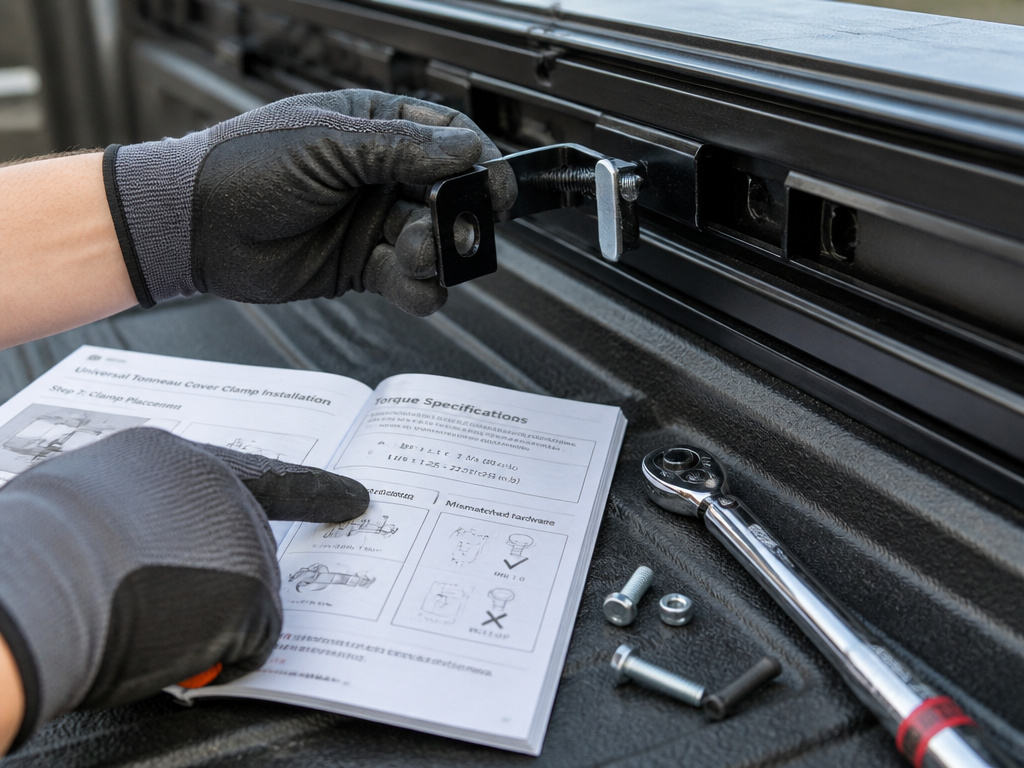
The box says “universal fit.” Your truck bed has a multi-function tailgate, bed-mounted speakers, and cargo rails. This is where the promise meets the purchase.
Factory instructions for a Ford F-150 soft fold cover explicitly state: if the truck has a power tailgate, you must check that it sits flush with the bed sides. If it’s “higher than flush,” you must return the vehicle to the dealer for adjustment before installing the cover. Miss that step, and the cover won’t seal, it will wear prematurely, and it may not latch. This kind of detailed compatibility check is standard for modern trucks.
Frank Markus, Technical Director at MotorTrend, documented his own struggle: his $83,000 Ram 1500 couldn’t accept most aftermarket covers without modification due to its multifunction tailgate and bed features. This pushes many buyers toward factory-fitted covers or premium brands like Paragon or Bak that invest in model-specific designs.
Installation torque is not a suggestion. The Toyota recall root cause was insufficient torque on the joint fasteners. The Hyundai Santa Cruz Technical Service Bulletin for a broken tonneau cover clip includes specific torque values for reassembly. Using a drill on an “easy no-tools” clamp system might get the cover on, but it won’t keep it on at 70 mph crosswinds. This is a mechanical fastener job, not a decorative one.
Common mistake: Assuming “clamp-on” means “install and forget.” Every six months, check the clamp bolts and rail fasteners. Vibration from the truck bed loosens them predictably.
The aftermarket thrives on truck tonneau covers, but the OEMs design beds with specific aerodynamic and functional profiles. An ill-fitting cover is a source of wind noise, water leaks, and eventual failure. Your first step before buying any cover is to read the fitment guide for your exact truck year, model, and bed length, including any factory bed liner or utility track system.
Tonneau Covers vs. Other Bed Storage
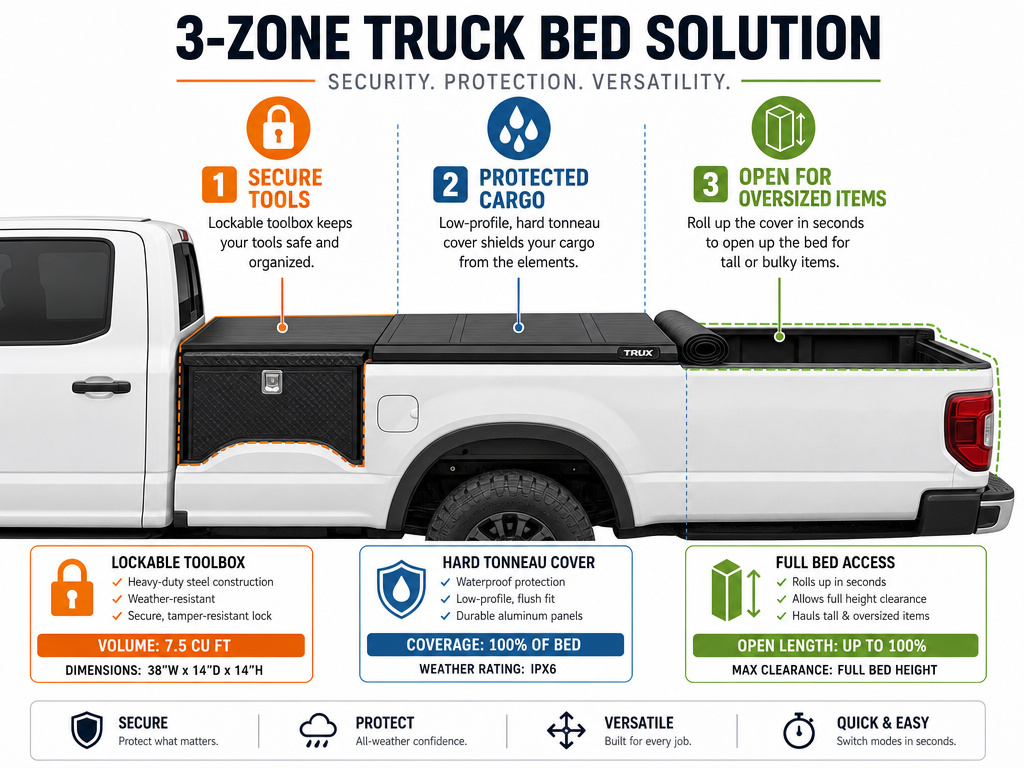
Is a cover the right tool, or are you trying to solve a problem that a different accessory handles better?
Tonneau Cover vs. Truck Bed Toolbox
A truck bed toolbox is a dedicated, lockable vault for tools. It’s more secure than any cover, but it’s permanent, heavy, and eats into cargo space. * Pick the toolbox if: You are a tradesperson carrying high-value tools daily and security is your non-negotiable #1 priority. * Pick the cover if: You need to secure a variety of items (luggage, groceries, sports gear) and want to retain full, flexible use of the bed floor.
Tonneau Cover vs. Bed Rack & Roof System
A bed rack holds cargo above the bed, perfect for oversized items, recovery gear, or rooftop tents. A cover typically can’t coexist with a full rack. * Pick the rack if: Your primary hauling involves bulky outdoor equipment (kayaks, bikes, lumber) or you want to mount a rooftop tent. * Pick the cover if: Your cargo fits inside the bed and needs protection from the elements and sight.
Tonneau Cover vs. Nothing
This is the real question. An open bed is supremely versatile for hauling dirt, mulch, large furniture, and anything tall. A cover adds steps to access that space. * Go open bed if: You use your truck primarily as a truck, for hauling loose, dirty, or oversized materials more than once a month. * Add a cover if: You use your truck as a daily driver and value having a clean, secure, trunk-like space more often than you need full, unimpeded bed volume.
The answer often lies in a combination. A low-profile hard tonneau cover combined with a removable, cross-bed truck bed toolbox behind the wheel well gives you both a secure vault and a protected general cargo area. It’s about layering the right tools for your specific habits.
Frequently Asked Questions
Do tonneau covers actually improve gas mileage?
Yes, but the improvement is small and conditional. Industry studies show about a 1.8% gain at steady highway speeds with a hard cover. In mixed real-world driving, most owners see a 0-1 mpg improvement, which translates to minimal annual savings. Fuel economy should be a bonus, not a primary reason to buy.
Are tonneau covers waterproof?
No mainstream tonneau cover is fully waterproof. Manufacturers like Rivian explicitly state their covers are “not watertight.” They are water-resistant, designed to keep out the bulk of rain and snow, but some moisture will inevitably seep in at the tailgate seam and panel joints. For items that must stay perfectly dry, use a sealed container inside the bed.
Can a tonneau cover fly off?
Yes, and it has happened on a large scale, prompting federal safety recalls. Toyota recalled certain 2022-2023 Tundra accessory covers (recall 23V142) and GM recalled some 2019 Silverado/Sierra covers (recall 19E031) due to detachment risks. Proper installation and periodic inspection of all fasteners are critical to prevent this.
What is the most secure type of tonneau cover?
Hard retractable or a hard folding cover with a robust locking mechanism (like the Paragon Tekonic or Bak Revolver) offers the highest security. These are made of aluminum slats or panels that resist cutting and prying far better than vinyl soft covers. Look for covers with integrated locking systems that tie into your tailgate lock.
How long do tonneau covers last?
High-quality hard cover from a reputable brand can last 10 years or more with proper care. Soft covers typically last 3-7 years, as UV exposure degrades the vinyl and stitching. Longevity depends heavily on climate, usage frequency, and maintenance, cleaning seals and lubricating moving parts annually.
Before You Go
Tonneau covers are a tool for a specific job. The value proposition crystallizes around a single question: how often do you need a dry, locked trunk space in your truck bed?
If the answer is “weekly,” the investment makes sense. The security for tools, the organization for daily life, and the protection from the elements justify the cost and the minor hassles. Prioritize a hard tonneau cover from a brand known for your specific truck model.
If your bed is either empty or full of loose gravel, mulch, or lumber more than once a month, a cover becomes an expensive obstacle. You’ll fight with it more than you benefit from it.
The middle ground is the soft roll-up. It’s a relatively low-cost way to test the waters, add a cleaner look, and gain light protection. If you outgrow it, you haven’t sunk a fortune.
Look past the 1.8% fuel figure. Look at the NHTSA recall documents. Read your truck’s manual about tailgate adjustment. Then decide. The right cover for the right truck owner is absolutely worth it. For everyone else, it’s just a shiny thing on the bed.
