
Are Truck Running Boards Worth It? The Lifespan & Failure Guide
This post contains affiliate links. As an Amazon Associate, we earn from qualifying purchases.
Running boards are worth it on a truck if you need easier cab access, want to protect the vehicle’s rocker panels from debris and rust, or regularly transport children, elderly passengers, or pets. For a stock-height daily driver, fixed boards are a straightforward upgrade. For a lifted truck or a rig used off-road, power steps or rock sliders solve the access problem without sacrificing ground clearance. The value hinges entirely on matching the right type to your specific cab configuration and actual use case.
That access and protection combo isn’t a marketing story. It’s a mechanical one. A running board interrupts the trajectory of road salt, gravel, and mud before it hits the lower door seam. That seam is a primary rust starter on body-on-frame trucks. A wide step also changes the biomechanics of getting in, you’re not hoisting yourself up by the steering wheel or door handle, which over years wears the interior components and the driver.
The rest of this guide walks the choice between fixed, powered, and specialty steps. You’ll get the torque specs manufacturers actually print, the failure modes factory technical bulletins document, and a clear framework to decide if the cost and install time pay off for your truck.
Key Takeaways
- Fixed running boards are worth it for daily drivers and work trucks needing simple protection and a step, with installs requiring basic hand tools and torquing M8 bolts to 7 ft-lbs.
- Power running boards are worth the premium for lifted trucks and families, but they introduce motors and wiring that can fail in extreme cold or if mounted incorrectly.
- Rock sliders are the only option that combines a step with genuine rocker panel protection for off-road use, but they offer the least drop height for access.
- Skipping model-specific fitment guarantees a poor installation; a board for a SuperCab will not fit a SuperCrew, and universal brackets often contact the body mount housing.
- Ford’s Technical Service Bulletin G0000073 details warrantable failures like corrosion-caused peeling, non-warrantable issues include slow operation in cold temps and damage from forcing a stalled motor.
What Are the Main Types of Running Boards?
The five main types are fixed running boards, nerf bars (or side step bars), drop steps, power running boards, and rock sliders. Each changes the truck’s function, ground clearance, and install complexity in a specific way.
Fixed running boards are always deployed. They’re simple, affordable, and require no wiring or motors. Aries Automotive and similar brands make models with up to 6.5 inches of textured stepping surface. The install is purely mechanical: bolt brackets to the frame or body mounts, torque the hardware, and you’re done. This is the default choice for a stock-height Ford F-150 or Chevy Silverado used as a daily driver or work truck.
Nerf bars are the circular-tube cousins of running boards. They offer less flat stepping area, often just two plastic pads, which can be slick when wet. Their value is almost purely aesthetic and cost-driven. They provide a minimal step and slight debris deflection, but their narrow profile does little to shield the full rocker panel.
Drop steps, like the Westin HDX, mount lower than the rocker panel to provide a deeper step down. This is a genuine help for lifted trucks. The trade-off is immediate: you lose ground clearance. That lower step hangs down, directly impacting your breakover angle off-road. It’s a solution for access that actively works against utility in rough terrain.
Power running boards, such as the AMP Research Power Step or the Westin PRO-E series, retract flush against the body when the doors are closed. They deploy automatically when a door opens, dropping between 7 and 9.5 inches. This solves the access issue for lifted trucks without the permanent ground-clearance penalty of a drop step. The cost is higher, the install involves wiring and control modules, and they add moving parts that can be susceptible to ice buildup or motor failure.
Rock sliders, from companies like Addictive Desert Designs, are built from 120-wall steel. Their primary job is protecting the rocker panel and cab during rock crawling. The step function is secondary. They offer excellent traction along their length but provide minimal drop height, so access assistance is limited. You’re paying for armor, not convenience.
| Type | Best For | Primary Trade-off | Install Complexity |
|---|---|---|---|
| Fixed Running Board | Daily drivers, work trucks, family haulers | Permanent ground clearance reduction | Low (Mechanical only) |
| Nerf Bar / Side Step Bar | Budget, aesthetic upgrade | Poor traction, minimal protection | Low |
| Drop Step | Lifted trucks where access is the only goal | Significant ground clearance loss | Low-Moderate |
| Power Running Board | Lifted trucks, luxury trim, families | Cost, electrical complexity, potential motor issues | High (Mechanical + Electrical) |
| Rock Slider | Off-road, overlanding, rock crawling | High cost, minimal step-down height | Moderate-High |
What Problems Do Running Boards Actually Solve?
They solve three concrete problems: difficult cab entry, rocker panel damage, and interior wear. The first is obvious. The second and third are long-term ownership costs most owners don’t attribute to missing steps.
Easier entry isn’t just about comfort. For a tall truck, the act of climbing in stresses the driver’s seat bolster, the door hinges, and the interior door handle mechanism over thousands of cycles. A step reduces that climb. For children, elderly passengers, or anyone carrying cargo, it transforms a hoist into a step. The value here is directly proportional to how often you have passengers or load gear.
The protection claim is physical. The rocker panel area, the metal sill below the doors, is a direct target for road debris. Gravel pings it. Salt spray coats it. Mud packs against it. Running boards act as a shield. They take the impact and contamination instead of your truck’s painted metal. This doesn’t make rust impossible, but it dramatically slows its onset by keeping the primary attack surface cleaner and drier.
Where this goes sideways: Choosing a style that doesn’t match your truck’s use. Putting fixed boards on a serious off-road truck sacrifices clearance you’ll regret on the trail. Putting flimsy nerf bars on a truck that sees winter roads means the boards rust out while the rockers they’re supposed to protect still get coated in salt spray.
Finally, they offer a stable platform for cleaning the roof or bed, or for securing items to a roof rack. It’s a small perk, but one you’ll use more than you think.
The 4-Step Framework to Decide If They’re Worth It For You
Forget generic advice. Answer these four questions in order. Your answers will point to the right type, or reveal that you don’t need boards at all.
1. What is your truck’s primary use? Be brutally honest. * Daily Driver / Family Hauler: Fixed running boards or power steps. The choice here comes down to budget and whether you have a lift. A fixed board like the Aries Automotive models works for stock height. * Work Truck: Fixed boards. They’re durable, cheap, and you won’t cry if they get scratched. * Lifted / Off-Road Truck: Power steps or rock sliders. Power steps if access is the main issue. Rock sliders if you actually drag the truck over rocks. * Weekend / Show Truck: Nerf bars or sleek fixed boards. Aesthetics lead.
2. What is your cab configuration? This is non-negotiable. A board for a Ford F-150 SuperCab is the wrong length for a SuperCrew. Measure your wheelbase or know your exact trim. Getting this wrong means returning parts.
3. What is your tolerance for installation and maintenance?
- Low Tolerance: Fixed boards or nerf bars. A Toyota Tacoma install, per the factory guide, involves removing plastic plugs to access M8 weld nuts and torquing bolts to between 10.8 and 18.0 lbf-ft. It’s a Saturday morning job.
- High Tolerance: Power steps. The Westin PRO-E Electric Running Boards for a Ford F-250 estimate a 3-4 hour install involving wiring harnesses, control modules, and battery connections.
4. What is your budget, including installation if you’re not doing it yourself?
The price spread is vast. Nerf bars can be a few hundred dollars. A full AMP Research Power Step system is over $1,500. Rock sliders can hit $1,400. Factor in professional installation if you’re not comfortable with wiring, that’s another few hundred.
If you answered “Daily Driver, SuperCrew, Low Tolerance, Mid-Range Budget,” the answer is clear: fixed running boards are worth it. If you said “Lifted Trail Rig, SuperCrew, High Tolerance, High Budget,” you’re in power step or rock slider territory.
How Much Protection Do They Really Offer?
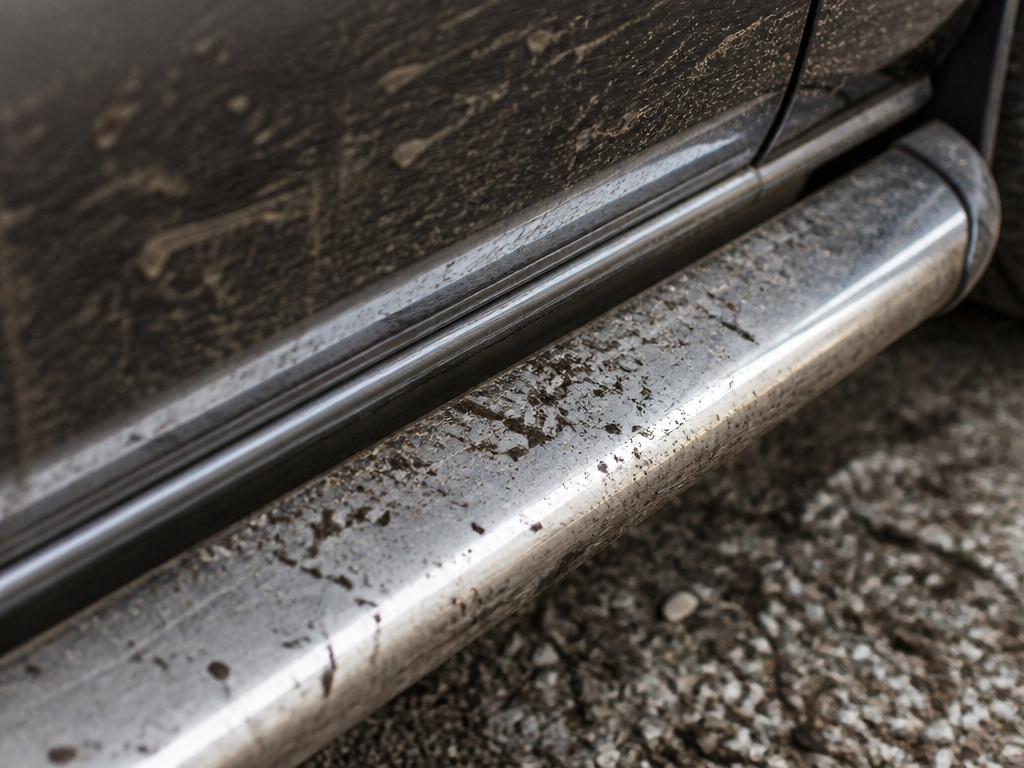
They offer direct physical protection to the rocker panels, but zero protection to the doors above. The protection is also limited by design.
Fixed boards and nerf bars act as a shield, taking the brunt of road debris. This is effective against kicked-up gravel and minor brush. Salt and mud coverage is partial; spray will still wick up behind the board, but the direct coating is reduced. The board itself will corrode, which is why finishes matter. Stainless steel or powder-coated aluminum outlast painted steel in winter climates.
Rock sliders offer the highest level of protection, they’re designed to bear the weight of the truck on rocks. They protect the critical rocker seam from crushing impacts that would total a cab.
Common mistake: Assuming any running board is a “rock slider.” A standard board’s brackets are not designed for vertical loads. Sliding over a rock on a fixed running board will likely shear the brackets and dent the board into the door.
Power steps offer the least protection when retracted, as they tuck up high. When deployed, they are as vulnerable as any other board. Their motors and linkages are additional failure points exposed to the elements.
The warranty coverage reflects this. Ford’s Technical Service Bulletin G0000073, published January 28, 2022, explicitly calls out “corrosion causing peeling or bubbling” as a warrantable condition. It also notes that power boards may not deploy in extreme ice and that only defective components are covered, not whole assemblies. The protection has limits, and the manufacturers know it.
What Are the Real Downsides and Failure Points?
The downsides are lost ground clearance, added maintenance, specific failure modes, and potential for incorrect installation. They are not a zero-cost add-on.
Ground Clearance Loss is the big one for fixed boards, drop steps, and nerf bars. They hang below the frame rails. For off-roading, this is a deal-breaker. A drop step is the worst offender, directly attacking your breakover angle.
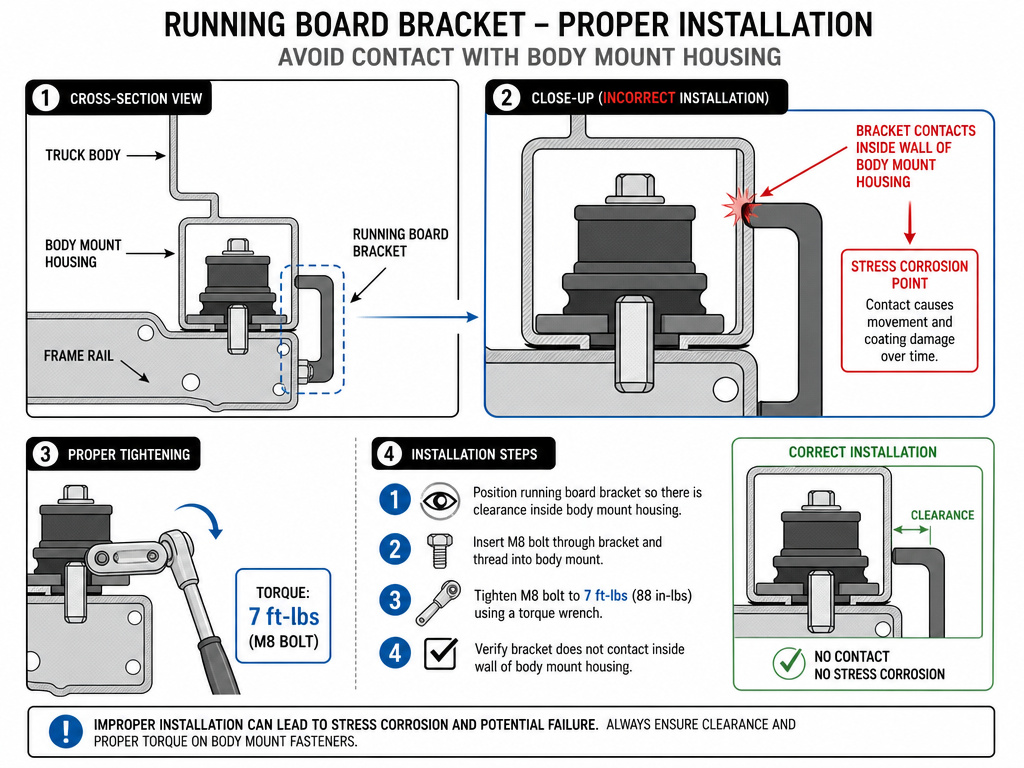
Installation Errors are rampant. The Curt Manufacturing manual warns that brackets must not touch the inside wall of the body mount housing. Forcing contact creates a point for noise, vibration, and stress corrosion. Universal brackets often require this exact finesse.
Specific Failure Modes:
- Power Board Motor/Actuator Failure: The most common issue. Motors can stall from ice buildup, dirt intrusion, or electrical faults. The TSB states they may operate slowly in cool temperatures and reverse direction if an object is encountered.
- Corrosion: Even on stainless boards, brackets and fasteners can rust, leading to the “peeling or bubbling” that Ford’s warranty covers. This starts at weld points and bracket seams.
- Wiring Harness Issues: For power steps, chafed wires, poor connections, or blown fuses disable the system. The Aries manual advises using slit loom and cable ties to secure routing.
- Bracket Fatigue: On fixed boards subjected to heavy use or off-road flex, brackets can crack at the welds. This is why weight ratings are static. Curt lists 650 lbs as a stationary load rating, not a dynamic stepping force.
The part nobody mentions: Torque specs are critical. Overtightening M8 bolts past the 7 ft-lbs (per Curt) or 15-18 ft-lbs (per Westin PRO-E) spec can strip the threads in the vehicle’s weld nuts. That turns a simple bolt-on job into a threaded insert repair.
What Does a Correct Installation Actually Require?
It requires the right tools, the vehicle-specific instructions, and strict adherence to torque specifications. It is not a “tighten until it feels right” operation.
Tools Required: Ratchet, socket set (metric and SAE), torque wrench, level, safety glasses, and possibly a drill for wiring pass-throughs on power steps. A second pair of hands is mandatory for holding boards in position.
The Process for Fixed Boards (e.g., Toyota Tacoma):
- Remove plastic plugs covering the M8 weld nuts in the body (6 per side).
- Lift the board into position with help. Align brackets.
- Hand-thread all bolts to start, ensuring no cross-threading.
- Adjust the board laterally and vertically for even gaps (often via slotted brackets).
- Torque in sequence: Toyota specifies 10.8 to 18.0 lbf-ft for Tacoma M8 bolts. Curt’s general spec is 7 ft-lbs for M8. Use the manufacturer’s spec for your product.
- Re-check all fasteners after 100 miles of driving.
The Process for Power Steps (e.g., Westin PRO-E):
- Disconnect the vehicle’s battery.
- Mount motor linkage assemblies to the frame, routing wires neatly.
- With help, loosely install the running board, aligning the sliding T-nuts with slots in the motor bases.
- Connect the wiring harnesses: motors, door sensors, control module, LED lights.
- Reconnect the battery. Test deployment by opening/closing each door individually.
- Final-torque all hardware: M6 to 8-9 ft-lbs, M8 to 15-18 ft-lbs per Westin’s PRO-E manual.
- Set the manual cutoff switch if the vehicle will sit idle for over a week to prevent battery drain.
Skipping the torque wrench is how bolts loosen and boards start rattling. Ignoring wire routing leads to chafed harnesses and dead motors. The instructions are there for a reason.
Frequently Asked Questions
Do running boards hurt gas mileage?
Minimally. The aerodynamic penalty of fixed boards is small, likely resulting in a decrease of less than 1 MPG. The added weight (40-100 lbs) has a more measurable effect, but for a full-size truck, it’s still marginal. The fuel cost over years of ownership is far less than the potential repair cost from rocker panel rust or interior wear.
Can you install running boards yourself?
Yes, for fixed boards, nerf bars, and most drop steps. The mechanical installation is straightforward with basic tools and a torque wrench. Installing power running boards yourself is possible if you are competent with vehicle wiring and can follow a diagram. If the phrase “splice into the door trigger wire” makes you nervous, budget for professional installation.
Do running boards cause rust?
They don’t cause it, but they can trap moisture and debris against the rocker panel if not designed or installed with proper gaps. This is why high-quality boards use rubber isolators or spacers and why cleaning behind them periodically is advised. Poor installation that lets the metal brackets contact the body paint can create a galvanic corrosion point.
Are running boards or nerf bars better?
Running boards are better for function, they offer a wider step and more rocker protection. Nerf bars are better for a low-cost aesthetic upgrade and a minimal step. If your goal is to make entry easier for passengers or to protect the truck, choose a running board. If you just want the look, a nerf bar is sufficient.
How long do running boards last?
Fixed aluminum or stainless-steel running boards can last the life of the truck with only cosmetic wear. Powder-coated steel boards may show corrosion in 3-5 years in harsh winter climates. Power running boards have a more variable lifespan (5-10 years) dependent on motor quality, electrical protection, and exposure to road salt and moisture. The actuators are the weak point.
Before You Go
Running boards are worth it if they solve a problem you actually have. For a stock truck that hauls kids or tools, a fixed board is a logical, durable upgrade. For a lifted rig, power steps are the only way to regain easy access. For a truck that sees trails, rock sliders are a functional necessity disguised as a step.
The value isn’t in the accessory itself. It’s in the correct match. Know your cab size. Read the install guide before you buy. Torque the bolts to the printed spec. That’s what separates a worthwhile addition from an expensive, rattling mistake that you’ll remove in a year.
If you’re comparing specific models, our guides on the best running boards for lifted trucks and top-rated truck steps and running boards break down the pros and cons of today’s top brands. For model-specific fit, see our deep dives on Ram 1500 running boards and Silverado 1500 running boards. Like any truck accessory, from tonneau covers to truck bed toolboxes, the right choice always starts with a clear picture of how you actually use the vehicle.
