
Do All Terrain Tires Affect Gas Mileage | The 15% Penalty
This post contains affiliate links. As an Amazon Associate, we earn from qualifying purchases.
Do all terrain tires affect gas mileage? Yes, a typical all-terrain tire reduces fuel economy by 3% to 15% compared to a highway-focused tire. The loss comes from increased rolling resistance, caused by the tire’s aggressive tread pattern and heavier construction flexing more as it rolls. The exact penalty depends on tread aggressiveness, inflation pressure, and vehicle type.
That 15% figure isn’t a guess. It’s the measured result from a 182-mile test loop comparing a street-biased Michelin LTX M/S2 to a trail-oriented Dick Cepek FC-II. The physics behind that number are predictable, not mysterious.
What follows is a breakdown of the three things that decide your mpg penalty: tread design, rubber composition, and the one maintenance factor that can cut your losses in half. We’ll look at the data, name the trade-offs, and show where you can push back.
Key Takeaways
- All-terrain tires increase fuel consumption primarily through rolling resistance, which can account for 15-25% of a vehicle’s energy use at low speeds.
- In a controlled test, aggressive all-terrain tires delivered 15% worse fuel economy (14.93 mpg vs 17.16 mpg) than all-season highway tires over the same route.
- A 10% reduction in average rolling resistance improves fuel economy by 1-2% for most passenger vehicles, according to the Transportation Research Board.
- Underinflation is a bigger enemy than tread design; dropping from 32 psi to 24 psi increases rolling resistance by over 10%, wiping out any tire’s efficiency gains.
- Original Equipment (OE) tires are typically more fuel-efficient than replacement all-terrains, as automakers tune them to help meet federal fuel economy standards.
How Much Fuel Economy Do You Lose?
The short answer is enough to notice at the pump over a year. The long answer requires a specific number.
A MotorTrend test put a set of Dick Cepek FC-II radials (about 7,300 miles on them) against Michelin LTX M/S2s (about 2,000 miles) on the same truck over a 182-mile mixed-driving loop. The Cepeks, an aggressive all-terrain pattern, returned 14.929 mpg. The Michelins, a street-oriented all-season, returned 17.160 mpg. That’s a difference of 2.231 mpg, or 15%.
Where this goes sideways: Assuming the loss is linear. A mild all-terrain might only cost you 3-5%. A full mud-terrain tire with deep, widely spaced lugs could push the penalty toward 20% on pavement. The jump from an all-season to an all-terrain is the first and biggest hit.
This isn’t about one brand being “bad.” It’s about tread purpose. The Michelin is designed for low rolling resistance and long wear on pavement. The Cepek is designed to clear mud and grip loose surfaces. That extra gripping and clearing requires more rubber to deform, which directly translates to more energy wasted as heat.
For a real-world baseline, check the official fueleconomy.gov mud-terrain tire comparison for specific vehicle configurations. The government’s side-by-side tool shows the tested impact of factory mud-terrain options.
| Tire Type | Typical MPG Penalty vs Highway Tire | Primary Cause | Best Use Case |
|---|---|---|---|
| Highway All-Season | Baseline (0%) | Low rolling resistance, shallow tread | Daily driving, long commutes |
| Mild All-Terrain | 3% – 7% | Moderately aggressive tread blocks | Occasional dirt roads, four-season versatility |
| Aggressive All-Terrain | 8% – 15% | Deep, multi-pitch lug patterns | Frequent off-pavement use, towing on mixed surfaces |
| Mud-Terrain (MT) | 15% – 20%+ | Very deep, widely spaced lugs | Dedicated off-road, deep mud, rock crawling |
The penalty scales with tread aggressiveness. A best all-terrain tire for highway use will have a shallower, more closed tread pattern to minimize this loss, prioritizing on-road comfort and efficiency.
The Physics of Rolling Resistance
Rolling resistance isn’t friction in the simple sense. It’s hysteresis.
When your tire rolls, the part of the tread touching the pavement flattens (deforms). As that section leaves the contact patch, it springs back to its original shape. This constant flexing converts mechanical energy from your engine into heat within the tire’s rubber and belts. The engine must then replace that lost energy, burning more fuel.
The rolling resistance encountered by a vehicle can be extreme when it is driven on a soft or rough surface, such as a gravel or dirt road. On hard paved surfaces… The main source of rolling resistance is the repeated flexing of the vehicle’s tires as they roll.
All-terrain tires amplify this effect in three ways: 1. More Tread Rubber: Deeper lugs and thicker tread blocks mean more hysteretic material is flexing with each revolution. 2. Stiffer Sidewalls: Many all-terrains have reinforced sidewalls for durability off-road. This can increase the tire’s overall stiffness and resistance to deformation, sometimes counterintuitively increasing energy loss. 3. Tread Pattern: Open, independent lugs flex and squirm more individually than the continuous ribs of a highway tire.
The industry measures this with a Rolling Resistance Coefficient (RRC). Most new passenger tires fall between 0.007 and 0.014. A lower number is better for fuel economy. The TRB Special Report 286 states that a 10% reduction in average rolling resistance can improve vehicle fuel economy by 1% to 2%. The inverse is also true: a tire with a 10% higher RRC will cost you that 1-2% in fuel.
This is why the choice between a comfortable highway tire and a capable all-terrain is a genuine engineering compromise. You cannot have a tread that digs into soft earth without also asking that same tread to work harder on asphalt.
The Inflation Pressure Multiplier
Your tire’s air pressure is the single most powerful lever you control. It can double your fuel penalty or cut it significantly.
The relationship is direct and non-linear. Research from the National Academies shows that for tires in the 24-36 psi range, each 1-psi drop in pressure increases rolling resistance by about 1.4%. Let’s run that math: – Recommended pressure: 32 psi. – Actual pressure (common underinflation): 26 psi. – Drop: 6 psi. – Increase in rolling resistance: 6 psi * 1.4% = 8.4%.
That 8.4% higher rolling resistance could translate to a 1.7% to 3.4% loss in fuel economy by itself, before you even consider the tire’s design. You’ve just added the equivalent of a mild all-terrain penalty simply by neglecting your gauge.
Common mistake: Setting and forgetting pressure seasonally. A tire at 35 psi in July might be at 28 psi by January in colder climates. That 7-psi seasonal drop is silently adding a 10% rolling resistance penalty every winter.
A Chalmers University study modeled this precisely. Their full-vehicle simulation for the New European Driving Cycle found fuel consumption reduction up to 5% simply by increasing tire pressures from 2 bar (29 psi) to 3 bar (43.5 psi). While 43.5 psi may be too high for comfort or wear on some vehicles, it illustrates the magnitude of the effect.
Check your pressure monthly, when the tires are cold. This one habit does more to protect your investment and fuel economy than any magic tire additive. It’s also critical for safety and even wear, especially on heavier vehicles using LT all-terrain tires.
OE Tires vs. Replacement All-Terrains
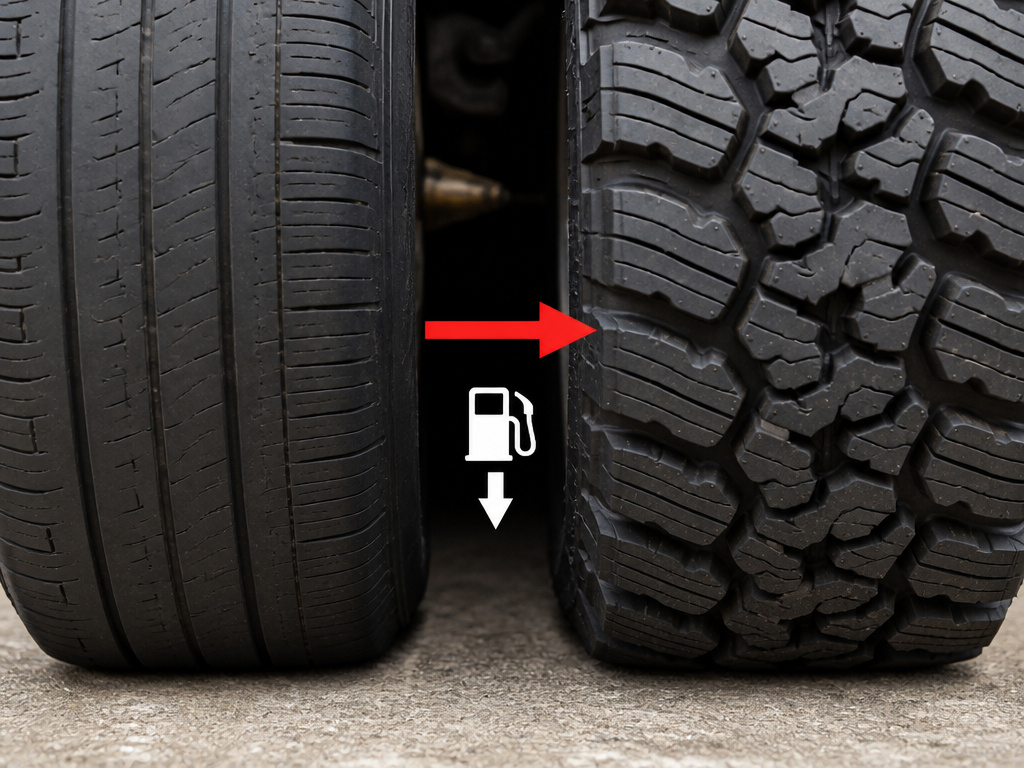
When your new truck or SUV rolls off the lot, its tires are part of a calibrated system. Automakers select Original Equipment (OE) tires to balance ride, noise, handling, wear, and fuel economy to help the vehicle meet regulatory targets.
The National Academies tire fuel economy chapter notes there is “considerable evidence” that OE tires cause less rolling resistance, on average, than replacement tires. Replacement tires, including most all-terrains, are designed by tire companies for a broader market segment, often prioritizing traction, wear resistance, and appearance.
This creates a hidden penalty. Swapping out a worn set of OE highway tires for a new set of aggressive all-terrains is a double-hit: you’re moving from a low-RRC design to a high-RRC design. The fuel economy drop isn’t just from “new tires”—it’s from a fundamentally different product category.
If you want to minimize this gap, look for replacement all-terrains that emphasize low rolling resistance. Some modern models use specialized rubber compounds and tread patterns to close the efficiency gap. Reading best all-terrain tire reviews that mention fuel economy or highway comfort can point you toward these designs.
How to Choose & Minimize the MPG Hit
You need traction, but you also have to live with the daily drive. The choice isn’t binary.
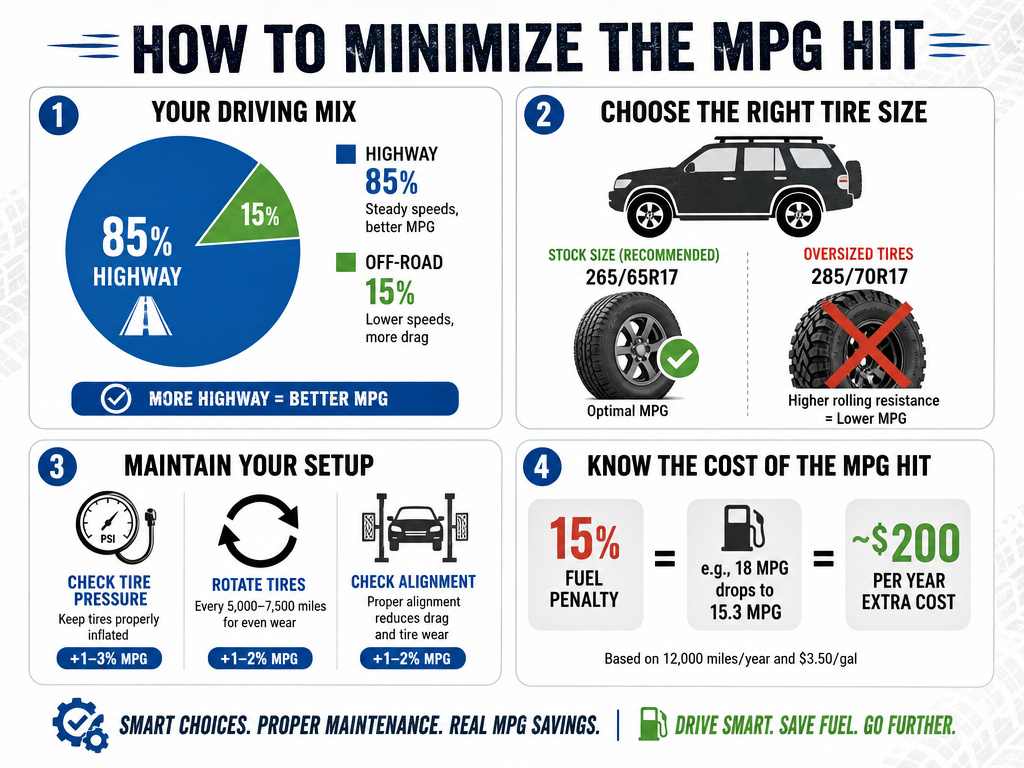
First, match the tire to your actual driving mix. Be honest. If you see a dirt road twice a year, you don’t need a gnarly all-terrain. A capable all-season or a mild all-terrain will handle that and save you fuel the other 363 days. For true mixed use, the best all-terrain tires for highway driving are engineered for this compromise.
Second, prioritize proper sizing. Going dramatically wider or taller than your OE size increases weight and frontal area, compounding the rolling resistance penalty. Stick close to the stock diameter.
Third, maintain religiously. 1. Inflate to the doorjamb sticker pressure, not the max pressure on the tire sidewall. Check monthly. 2. Rotate every 5,000-7,500 miles. Even wear keeps the rolling resistance profile consistent. 3. Balance and align annually. A dragging tire or incorrect alignment forces the engine to work harder.
Fourth, consider the long-term cost. A 15% fuel penalty on a 15,000-mile year at $3.50/gallon and 20 mpg baseline adds about $200 per year in extra fuel. Weigh that against the capability you’re actually gaining. For a vehicle that sees heavy use, a tire with better tread life might offset some cost, even if its initial efficiency is lower.
Frequently Asked Questions
Do bigger tires affect gas mileage more?
Yes, almost always. Larger diameter tires change the final drive ratio, often making the engine work harder (at lower RPM) to maintain speed. Larger, wider tires also weigh more and can increase aerodynamic drag. The combined effect of size and aggressive tread can be significant.
Can I get good gas mileage with all-terrain tires?
“Good” is relative. You can get the best possible mileage for an all-terrain by choosing a model designed for lower rolling resistance, maintaining perfect inflation, and sticking near the OE size. But it will almost never match the mileage of a dedicated highway tire from the same era.
Do all-terrain tires get better gas mileage over time?
Interestingly, rolling resistance generally diminishes slightly with tire wear, as noted in the EPA tire fuel economy analysis. As the hysteretic tread material wears away, there’s less rubber to flex. However, the improvement is marginal (often cited as a >20% decline in RRC over the tire’s life) and is far outweighed by the initial design penalty.
Are all-terrain tires bad for your vehicle?
No, when properly selected and maintained, they are not harmful. The trade-offs are economic (fuel, sometimes faster wear on pavement) and experiential (often increased road noise from tires). Ensure your chosen tire meets or exceeds your vehicle’s load and speed rating requirements.
Should I worry about gas mileage if I tow often?
Yes, especially. Towing dramatically increases rolling resistance due to the added load. An inefficient tire will compound that effect, increasing fuel consumption and heat buildup. For frequent towing, a robust LT all-terrain tire with a strong sidewall, kept at proper pressure, is a better investment than an aggressive, high-RRC mud-terrain pattern.
The Bottom Line
All-terrain tires affect gas mileage. The penalty is real, measurable, and rooted in the physics of rolling resistance. A typical hit is 3-15%, with the exact figure depending on how aggressive the tread is compared to what you’re replacing.
The key is to buy for your actual needs, not your aspirational ones. If your driving is 90% pavement, a mild all-terrain or a robust all-season is the smarter financial and functional choice. For true dual-purpose use, research the models that balance on-road efficiency with off-road competence.
Then, once they’re mounted, become obsessive about air pressure. It’s the cheapest, simplest way to claw back every mile per gallon the tread design gives up. Your wallet and your fuel gauge will show the difference.
