
Are Wider Tires Better for Snow | The 40% Stopping Gap
This post contains affiliate links. As an Amazon Associate, we earn from qualifying purchases.
Wider tires are not better for snow on paved roads. Narrower tires cut through snow to reach the pavement, while wide tires float on top, reducing grip and increasing stopping distances by up to 40% according to Transport Canada tests. The main winter advantage goes to a taller, narrower tire, a phenomenon off-roaders call the “pizza cutter effect.”
That 40% figure changes the entire argument. It’s not a small margin or a theoretical risk. It’s a lab-tested, Transport Canada-verified performance gap between a Mud+Snow (M+S) rated tire and a true Three-Peak Mountain Snowflake (3PMSF) winter tire. It means a wide, aggressive-looking all-terrain tire can stop like a sled while a narrower, less imposing winter tire digs in.
What follows is the breakdown: the physics of why a narrow contact patch works, where wide tires actually fail, and the specific certifications you must look for instead of trusting width. By the end, you’ll be able to read any tire’s sidewall and know instantly if it’s built for winter or just looks the part.
Key Takeaways
- A narrow tire increases ground pressure, letting it cut through snow instead of floating. This is the “pizza cutter effect.”
- Transport Canada found M+S tires without the 3PMSF symbol required 40% longer stopping distances than 3PMSF-rated tires, regardless of width.
- Wide tires become snow plows in deep conditions. They only outperform narrow tires in snow deeper than 110% of your vehicle’s ground clearance.
- The USTMA mandates installing winter tires on both axles, not just the drive wheels, for control.
- For most paved winter driving, a dedicated narrower winter tire on smaller wheels (like a 17-inch instead of an 18-inch) is the safest choice.
The Physics: Why Narrow Wins in Snow
It boils down to pounds per square inch. Your vehicle’s weight is constant. Spread that weight over a wide, short contact patch, and the pressure on any square inch of snow is low. Concentrate it over a long, narrow patch, and the pressure spikes. High pressure cuts; low pressure floats.
A narrow tire acts like a pizza cutter, concentrating vehicle weight to slice through slush and reach the pavement. A wide tire acts like a sled, distributing weight over a broad area that floats on top of the snow, losing steering control and braking grip.
This isn’t just an analogy. It’s the working principle behind mechanical keying and deformation, the two traction elements that matter on irregular, low-traction surfaces like snow-covered pavement. A narrow tire flexes and conforms to tiny imperfections in the ice or packed snow beneath the loose stuff. A wide tire simply skates over the top.
The shape of the contact patch is critical. Engineers refer to the long, thin contact patch of a narrow tire. This shape maximizes the length of tread biting into the snow, creating a longer lever for forward motion and braking. The short, wide patch of a fat tire is great for dry cornering grip but terrible at initiating bite in a soft medium.
Why-Layer: The higher ground pressure of a narrow tire breaks the surface tension of the snow layer. Think of pushing a thumbtack versus a dinner plate into foam. The thumbtack’s concentrated force penetrates easily where the plate just compresses the surface. In snow, that penetration means the tire’s sipes and tread blocks can engage the higher-friction surface below, be it packed snow or asphalt.
The Certification That Matters More Than Width
You’ll see “M+S” (Mud and Snow) on many all-terrain and even some all-season tires. It’s a manufacturer self-certification with no standardized test. The marking that counts for winter is the Three-Peak Mountain Snowflake (3PMSF) symbol. This symbol means the tire has passed a specific, standardized traction test on packed snow.
The difference isn’t minor. Research by the University of Michigan Transportation Research Institute cites Transport Canada’s 2008 tests, which showed that M+S tires without the 3PMSF symbol required 40% longer stopping distances than M+S tires with the symbol. The tread pattern could be aggressive. The width could be substantial. None of it mattered without the right rubber compound and siping design that the 3PMSF certification demands.
This is the first filter. Before you even consider width, check for the snowflake symbol. An all-terrain tire without it is categorically worse in winter than a narrower dedicated snow tire with it. The all-terrain vs snow tires debate ends right there for icy roads.
| Tire Type | 3PMSF Symbol | Best Use Case | Worst Trait in Snow |
|---|---|---|---|
| All-Season (M+S only) | No | Dry/wet pavement, mild climates | Hardens below 7°C (45°F), loses grip |
| All-Terrain (M+S only) | No | Dirt, gravel, light snow | Floats on slush, long stopping distance |
| Winter / Snow Tire | Yes | Ice, snow, temps below 7°C | Wears fast on warm, dry roads |
| All-Weather (3PMSF) | Yes | Year-round use, moderate snow | Compromise grip vs dedicated winter |
Where this goes sideways: Assuming a wide, knobby tire is a “snow tire.” The rubber compound is more important than the tread pattern. A true winter tire uses a special soft compound that stays pliable in freezing cold. A summer or all-season tire compound turns into hard plastic, making the widest tire useless on ice.
Wide Tire Disadvantages in Winter
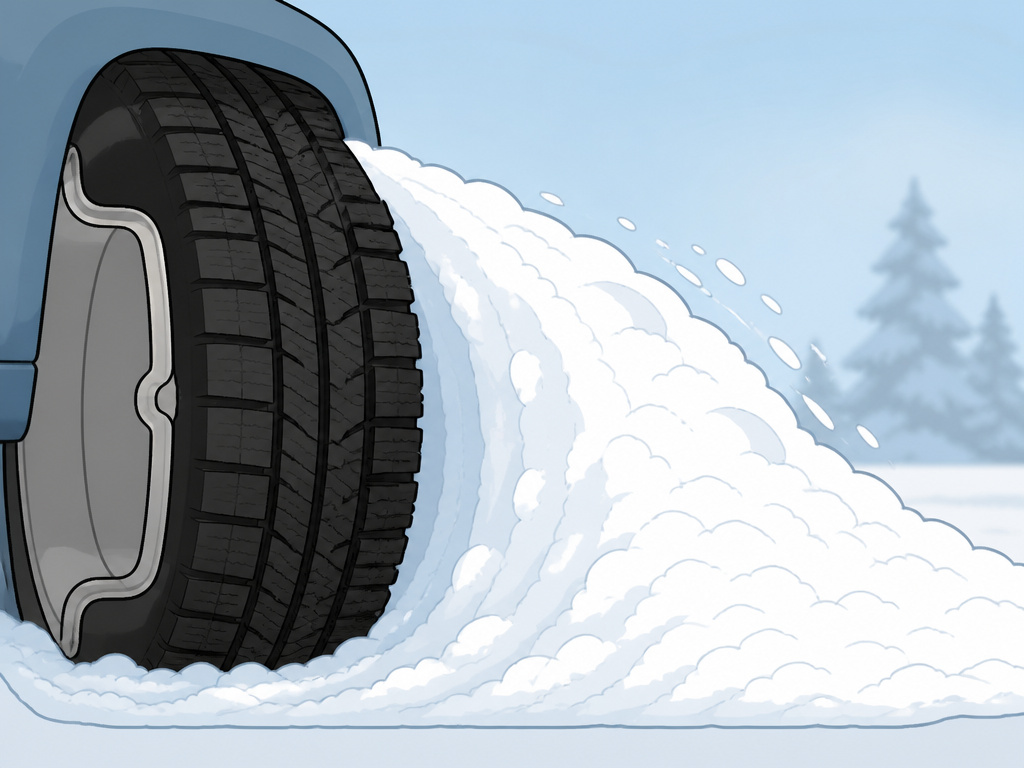
Wide tires bring three specific penalties in snow and slush: plowing, hydroplaning, and reduced braking force.
Plowing Effect: In deep, unplowed snow, a wide tire doesn’t cut. It pushes a bow wave of snow ahead of it, like a boat’s prow. This creates massive rolling resistance, bogging the vehicle down. The “Skinny-tire White-paper” for expedition vehicles states wide tires are “not appropriate…unless they are crossing the Gobi.” For snow deeper than 110% of the vehicle’s minimum ground clearance, a wide tire aired down can float. For anything less, it’s a plow.
Slush-Planing: This is hydroplaning’s winter cousin. A wide tire has a larger surface area to lift on a film of water. In wet snow or slush, that wide contact patch can lose contact with the road entirely. The narrow tire’s high pressure punches through the watery layer.
Braking Distance: As the Transport Canada data shows, width doesn’t compensate for a poor compound. The larger contact patch of a wide tire can’t generate braking force if the rubber can’t grip the ice beneath the snow. Stopping is about friction coefficient, not contact area, when the surface is uniformly slick.
When Are Wider Tires Actually Better?
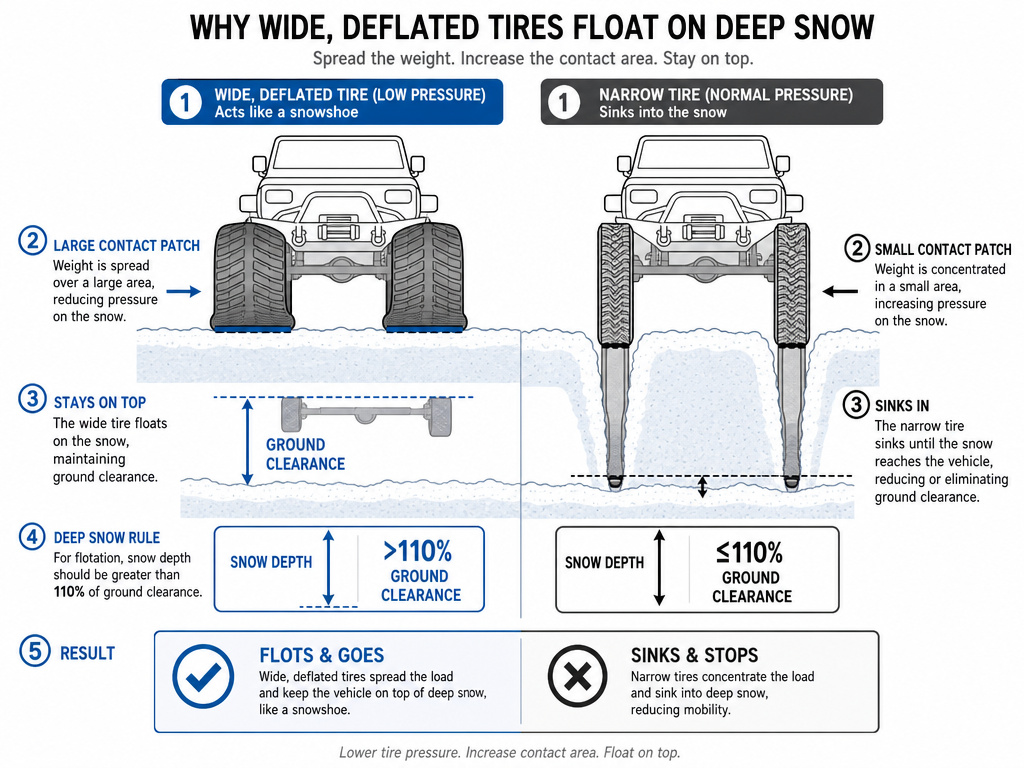
The rule has an exception, defined by depth. When snow or soft mud is deeper than 110% of your vehicle’s ground clearance, the goal shifts from cutting to floating. Here, a wider tire, aired down to a lower pressure, spreads the vehicle’s weight over a larger area. This prevents it from sinking, much like a snowshoe.
This is a niche scenario. It applies to dedicated off-road vehicles tackling deep powder or mud bogs, not to a daily driver on plowed or packed snow roads. For those vehicles, a wide mud-terrain tire like the BF Goodrich Mud Terrain KM3 in a 33×12.5 size might be chosen. But even then, its winter limitations are severe on ice.
Most consumer SUVs and trucks are not used this way. Sticking with a narrower, 3PMSF-rated winter tire is the safer, more effective choice for 95% of winter driving scenarios.
The Right Winter Setup: Narrower, Smaller, Softer
For maximum winter safety, you want a tire that excels in the three key areas: compound, siping, and pressure.
- Compound: A dedicated winter tire uses a soft, silica-rich rubber that remains flexible in sub-freezing temperatures. This is non-negotiable. All-season rubber hardens, losing its ability to conform to micro-imperfections in ice.
- Siping: These are the thousands of tiny slits in the tread blocks. They open and flex, creating thousands of biting edges on ice. More sipes are better for ice traction. A wider tire can have more total sipes, but only if it’s a dedicated winter design.
- Pressure: This is where minus-sizing comes in. Swapping to a smaller diameter wheel (e.g., 17-inch instead of 18-inch) allows you to fit a narrower tire with a taller sidewall. This increases the contact pressure for cutting and provides more sidewall flex to help the tread conform.
This approach is often more effective than simply installing wider tires on stock rims. A narrower winter tire on a dedicated set of smaller steel wheels is the gold standard. It transforms a vehicle’s winter performance.
Common mistake: Installing winter tires only on the drive wheels. The USTMA’s Tire Information Service Bulletin 42 is unambiguous: if you put winter tires on the front, you must put them on the rear. Installing them only on the front can cause dangerous oversteer and loss of control during braking or cornering.
Wide vs Narrow: A Direct Comparison
Let’s put it in a head-to-head table. Assume both tires have the 3PMSF symbol.
| Condition | Wide Winter Tire | Narrow Winter Tire | Winner |
|---|---|---|---|
| Deep, Unplowed Snow | Acts as a plow, high resistance. | Cuts through, lower resistance. | Narrow |
| Packed Snow / Ice | Larger siped area may help on sheer ice. | Higher pressure bites better into hard pack. | Draw (Ice: Wide, Packed Snow: Narrow) |
| Slush & Wet Snow | Prone to slush-planing. | Punches through watery top layer. | Narrow |
| Dry Winter Pavement | Stable, confident feel at highway speed. | Can feel less planted, more responsive. | Wide |
| Fuel Economy | Higher rolling resistance reduces MPG. | Lower resistance improves MPG slightly. | Narrow |
| Steering Feel | Heavier, slower response. | Lighter, more direct response. | Narrow |
The narrow tire wins in the conditions that cause most winter accidents: transition zones where snow turns to slush, and in braking emergencies on snow-covered roads. The best all-terrain tires for winter try to bridge this gap, but they remain a compromise.
For a truck owner, the choice might be between a wide M+S rated all-terrain and a narrower 3PMSF-rated option. The data says the narrower, certified tire is the safer bet for snow. You can explore specific best mud and snow tires for trucks that meet this need.
Frequently Asked Questions
Do I need winter tires if I have all-wheel drive?
Yes. All-wheel drive helps you go. It does virtually nothing to help you stop or turn. Winter tires provide the grip for all four wheels to brake and corner effectively. An AWD car on all-season tires will stop in a much longer distance than a 2WD car on proper winter tires.
Can I just put two winter tires on my front-wheel-drive car?
Never. This is extremely dangerous. It creates a drastic imbalance in grip between the axles, which can cause the rear end to swing out during braking or cornering. Industry guidelines mandate a matched set on both axles. Installing wider tires or any tires on just one axle is a critical error.
Are all-weather tires with the 3PMSF symbol good enough?
They are a legitimate step up from all-seasons and are fine for moderate winter climates with occasional snow. They lack the ultra-soft compound and aggressive siping of a dedicated winter tire, so their ice performance and wear in very cold temperatures is inferior. Understand their capabilities of all-weather tires before choosing them for severe winter.
How much narrower should my winter tires be?
There’s no fixed rule, but a common practice is to go down one width size from your summer setup (e.g., from a 225 width to a 205). Always ensure the new tire meets or exceeds the load index and speed rating on your vehicle’s placard. Consult a tire professional for fitment that clears your brakes and fenders.
Do low-profile tires work in snow?
They are at a disadvantage. The short, stiff sidewall doesn’t flex as well to absorb impacts from hidden potholes or help the tread conform to the road surface. A taller sidewall is generally better for winter. The challenges of low-profile tires in snow are significant.
Before You Go
Wider tires are not better for snow on the road. The physics of pressure and the data from official tests agree: a narrower footprint cuts where a wide one floats. The 40% stopping distance gap is real.
Forget width. Look for the 3PMSF snowflake symbol. Prioritize a soft, flexible winter tire compound over an aggressive all-terrain tread pattern. Consider minus-sizing to a smaller wheel for a taller, narrower tire profile that increases bite. And always, always mount them in a matched set on all four corners.
Your safest winter setup isn’t the widest tire. It’s the right tire, designed for cold, and sized to concentrate your vehicle’s weight into a precise, cutting edge. That’s how you turn a slippery commute into a controlled one.
