
California Studded Tire Laws: Are They Legal & When?
This post contains affiliate links. As an Amazon Associate, we earn from qualifying purchases.
Studded tires are legal in California between November 1 and April 30 each year, provided the metal studs do not exceed 3% of the tire’s contact patch area with the road. Retractable studs and authorized emergency vehicles are exempt from this seasonal restriction.
That 3% cap is a hard engineering limit written into the California Vehicle Code to protect road surfaces. More than 3% metal contact, or using studs outside the season, turns a legal safety upgrade into a ticketable offense that damages asphalt.
The following guide unpacks the Vehicle Code line by line. You will see the exact dates, the metal-contact math, the four year-round exceptions, and the clear line between studs and mandatory chain controls.
Key Takeaways
- The legal window runs from November 1 to April 30. Driving on studs outside this period is illegal unless you qualify for an exemption.
- Metal studs cannot exceed 3% of the total tire surface touching the road. This is a non-negotiable design limit.
- Studded tires are NOT traction devices. When chain controls are posted, you must still carry or install chains, even with studs.
- Retractable stud systems and authorized emergency vehicles can use studs year-round, a critical exception for specific users.
- Tires with embedded wire follow a separate, more complex rule, allowing up to 20% metal contact during a break-in period.
The Exact Law: California Vehicle Code 27454
Headlines give the season. The law gives the specs.
The primary regulation is California Vehicle Code Section 27454. It prohibits any tire from having metal or wood protuberances on its periphery, then lists specific exceptions. The studded tire exception is detailed in subdivision (e).
The studded tire provision in VEH 27454(e)(1) permits pneumatic tires containing metal-type studs of tungsten carbide or other suitable material between November 1 and April 30 of each year. The studs must be inserted or constructed so that under no condition will the number of studs or the percentage of metal in contact with the roadway exceed 3 percent of the total tire area in contact with the roadway.
The 3 percent metal-contact limit is the mechanical heart of the rule. It forces manufacturers to space studs widely within the tread pattern. A tire crammed with studs is illegal on principle, regardless of the calendar.
The November 1 to April 30 window is fixed by statute. However, the law includes a safety valve. The commissioner, after consulting with the Department of Transportation (Caltrans), can extend this period in any area of the state due to adverse weather. This is rare, but it means an early October snowstorm in the Sierra won’t trap you legally.
Chain Controls vs. Studded Tires: The Critical Difference
This is the point where confident drivers get tickets.
Studded tires improve traction on ice. Tire traction devices, chains, cables, textiles, automatic systems, are a separate legal category defined in California Vehicle Code Section 605. When a road is under chain control, the posted requirement is for traction devices, not just aggressive tires.
Where this goes sideways: Relying on studded tires in a chain control zone. Studded snow tires are not considered tire traction devices and may not be used in lieu of chains. If the sign says “Chains Required,” you need chains.
Caltrans posts three levels of chain control, outlined in their official chain control information. Knowing them determines whether you can proceed or must turn around.
| Control Level | Applies To | Exception (What Can Proceed Without Chains) |
|---|---|---|
| R-1 | All vehicles | Passenger vehicles & light trucks under 6,000 lbs gross weight with snow tires on at least 2 drive wheels. Must carry chains. |
| R-2 | All vehicles | 4WD/AWD vehicles under 6,500 lbs gross weight with snow tires on all four wheels. Must carry chains for one set of drive wheels. |
| R-3 | All vehicles | No exceptions. All vehicles must install chains. |
Snow tires are defined here by their sidewall marking: M+S, M/S, M-S, or the words MUD AND SNOW. They must also have a minimum tread depth of 6/32 of an inch. An all-terrain tire without that marking is not a legal snow tire for chain control exceptions.
So your studded Nokian Hakkapeliittas might get you an R-2 exception, but you still must have chains in the car. The moment conditions worsen to R-3, those studs are irrelevant, everyone chains up.
The 3% Rule and Other Design Limits
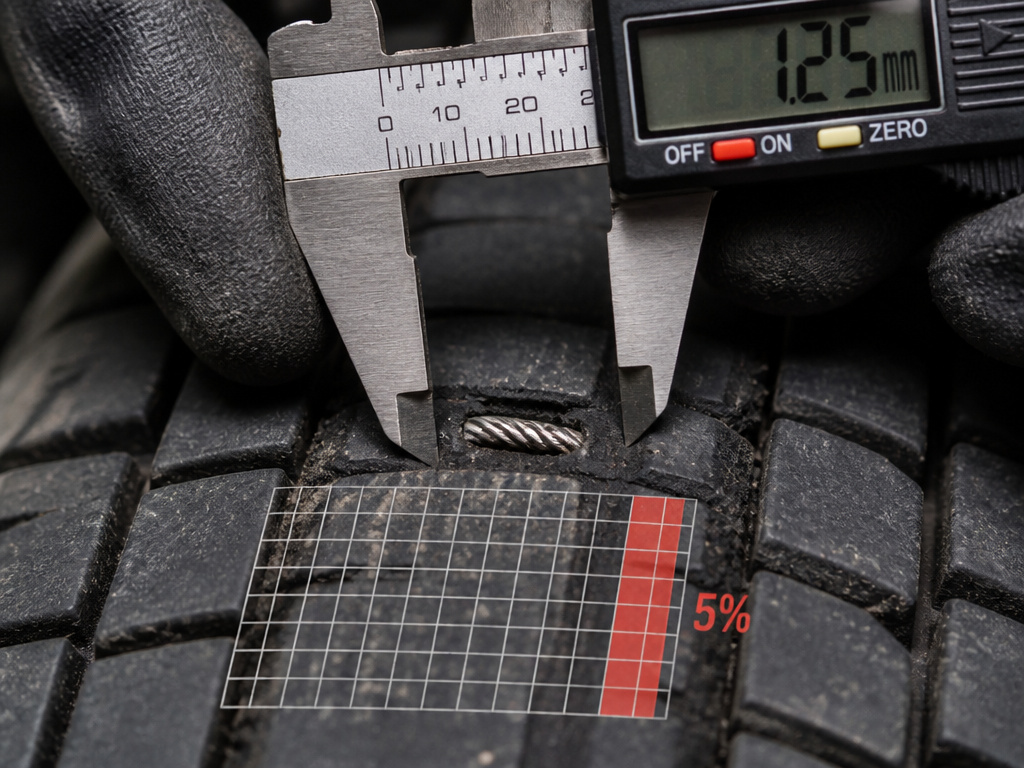
The 3% figure is a compromise between ice grip and pavement wear. But the Vehicle Code contains another, often overlooked rule for a different kind of tire.
Wire-Embedded Pneumatic Tires (VEH 27454(b)): Some tires have metal wire embedded in the rubber for strength. The law allows this, but with strict limits: – Wire diameter cannot exceed 0.075 inches. – Metal contact with the road cannot exceed 5% of the total contact area. – During the first 1,000 miles, the metal contact may exceed 5% but must never exceed 20%.
This rule is for reinforced tires, not winter studs. It matters because it shows the state’s method: specific diameters, specific percentages, specific break-in periods. The 3% limit for studs follows the same legal engineering.
Exceptions: When Studs Are Allowed Year-Round
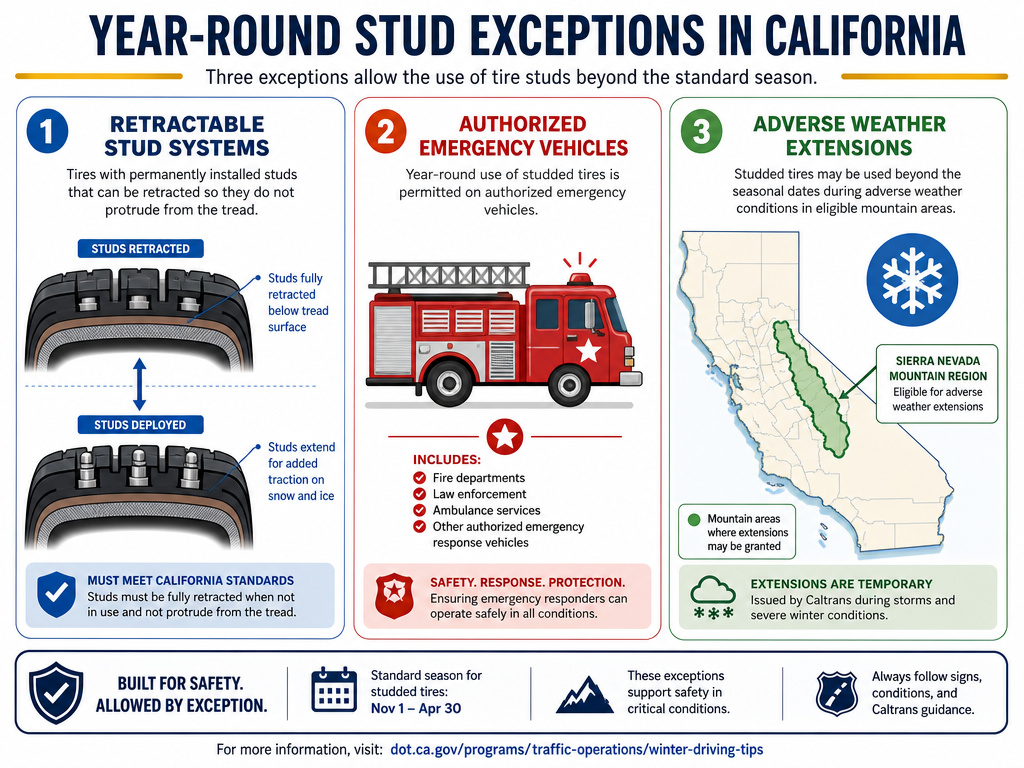
The November-to-April rule has two permanent holes and one temporary one.
1. Retractable Stud Systems (VEH 27454(e)(1)): If your tires have studs that retract pneumatically or mechanically when not in use, you can drive on them year-round. The catch, the studs must be retracted between May 1 and October 31. The law even warns that the tire cannot be worn so thin that retracted studs protrude beyond the tread. Systems like the Nokian Hakkapeliitta 10 are built for this.
2. Authorized Emergency Vehicles (VEH 27454(f)): Fire trucks, ambulances, and law enforcement vehicles marked as authorized emergency vehicles can use studded pneumatic tires unrestricted, 365 days a year. They still must obey the 3% metal-contact limit, but the seasonal calendar does not apply.
3. Adverse Weather Extensions (VEH 27454(e)(2)): As noted, the state can extend the studded tire season. This is a formal declaration by the commissioner in consultation with Caltrans, typically for a defined region experiencing unusually severe or early winter conditions.
What Counts as a “Stud” and Other Edge Cases
The law specifies “metal-type studs of tungsten carbide or other suitable material.” Tungsten carbide is the gold standard for hardness and wear. Softer metals would wear down too quickly, becoming ineffective and potentially increasing metal discharge onto roads.
The 5% rule for wire-embedded tires is a true edge case. It exists for industrial or specialty tires, not passenger vehicles. If you’re buying a studdable winter tire, you’re dealing with the 3% stud rule, not the 5% wire rule.
Another edge case involves traction engines or tractors operated under a Caltrans permit, they’re exempt from the protuberance rule entirely. This is for construction, not commuting.
Studded Tires vs. Traction Devices: A Direct Comparison
You need to know what you’re buying and what you’re required to carry. This isn’t academic.
| Feature | Studded Tires | Tire Traction Devices (Chains/Cables) |
|---|---|---|
| Legal Basis | California Vehicle Code 27454(e) | California Vehicle Code 605 & chain and studded tire rules |
| Primary Use | Enhance ice traction for general winter driving. | Meet mandatory chain control requirements during storms. |
| Seasonal Restriction | Yes (Nov 1 – Apr 30). | No. Required whenever posted, regardless of date. |
| Installation | Mounted on vehicle for the season. | Carried in vehicle, installed only when required. |
| Road Wear | Moderate, regulated by 3% contact limit. | High, but intermittent. |
| Performance | Excellent on hard-packed ice. | Superior in deep snow and slush. |
The bottom line: Studs are a seasonal performance upgrade. Chains are a mandatory, on-demand safety system. One does not replace the other. A set of best studded winter tires might be your best bet for a Lake Tahoe winter, but you’ll still have a set of SCC Super Z6 cable chains in the trunk for the drive over Donner Pass when R-2 is posted.
The Tools and Knowledge You Actually Need
You don’t need special tools to comply with the law. You need the right information.
First, know your tire’s sidewall. Find the “M+S” or “M/S” marking to confirm it’s a legally recognized snow tire. Check the tread depth with a gauge, it must be above 6/32″ to qualify for chain control exceptions.
Second, understand the three levels of chain control (R-1, R-2, R-3). Bookmark the Caltrans chain control guide. It’s the official source for current requirements and road conditions.
Third, if you’re investing in studs, buy from reputable brands that engineer for the 3% limit. Brands like Nokian, Bridgestone, and Michelin design their studded tire selection around these legal constraints. Avoid obscure brands that might over-stud.
Common mistake: Assuming studs make you invincible on ice. They don’t. They improve grip on smooth, hard ice by maybe 20%. On wet ice, slush, or deep snow, their advantage shrinks. Drive for the conditions, not for the hardware.
Finally, know the calendar. Mount your studded tires after Halloween. Take them off before May Day. It’s that simple. Mark it in your phone. The fine for out-of-season use starts at a hundred bucks and goes up, and it’s enforced.
Frequently Asked Questions
Can I use studded tires in Southern California?
Yes, the law is statewide. From November 1 to April 30, you can legally drive on studded tires anywhere in California, including Los Angeles or San Diego. Practically, it’s overkill and you’ll accelerate wear on dry pavement, but it’s not illegal.
Are studded tires illegal in summer?
Yes, with two exceptions. Using non-retractable studs between May 1 and October 31 violates VEH 27454. The exceptions are for retractable stud systems (with studs retracted) and authorized emergency vehicles.
Do studded tires damage roads?
Yes, they cause more wear than standard tires. The 3% metal-contact limit and seasonal restrictions are designed to minimize this damage. This is a primary reason for the legal window.
Do I need chains if I have studded tires?
Yes. Studded tires are not a substitute for chains. When chain controls are in effect, you must comply with the posted requirement (R-1, R-2, or R-3), which will mandate carrying or installing chains regardless of your tires.
How do I know if my studded tires are legal?
Check the calendar first. Then, inspect the tread. The studs should be evenly spaced and not overly dense. If you can see more metal than rubber in the contact patch, it likely exceeds the 3% limit. When in doubt, consult the tire manufacturer’s specification sheet, they design to this limit.
The Bottom Line
California’s studded tire law is a clear, engineering-driven compromise. You get from November to April. The studs can cover no more than 3% of the footprint. You must still carry chains when required.
The system is built for a specific weather problem, smooth ice, while balancing safety, mobility, and infrastructure cost. For most drivers crossing the Sierra or the Siskiyous, a high-quality studdable winter tire like the Michelin X-Ice Snow or the Bridgestone Blizzak WS90, paired with a set of cable chains, is the smarter, more flexible choice.
But if you face sheer black ice daily from December through March, the absolute grip of a proper studded snow tire is worth the seasonal hassle. Just watch the calendar, respect the chain signs, and keep the metal where it belongs, under 3%.
