
Off Road Tires in Snow: Are They Actually Good for Safety?
This post contains affiliate links. As an Amazon Associate, we earn from qualifying purchases.
Off-road tires are situationally good in snow: they excel in deep, loose powder but dangerously underperform on packed snow and ice compared to certified winter tires. The key distinction is the Three-Peak Mountain Snowflake (3PMSF) symbol, not the generic M+S marking. A Transport Canada study found M+S tires without the 3PMSF symbol had a 40% longer stopping distance than those with it on packed snow.
That 40% braking gap is the whole conversation. It turns a fender-bender into a totaled truck. The difference isn’t academic grip levels; it’s the distance between controlled panic stop and hitting the guardrail.
This breaks down the three variables that decide your traction: the tire’s certification, its rubber compound’s cold-weather pliability, and the specific snow condition you’re driving on. By the end, you’ll know exactly when an off-road tire is a capable tool and when it’s a liability, with the research to back the call.
Key Takeaways
- The 3PMSF symbol certifies a tire meets a minimum snow-traction standard; the common M+S marking is a manufacturer’s declaration with no performance guarantee.
- Off-road and all-terrain tire rubber compounds harden below 45°F (7°C), drastically reducing grip on cold pavement, ice, and hard-packed snow.
- For deep, unplowed powder, aggressive tread can work, but for any plowed or packed surface, a 3PMSF-rated tire is the bare minimum for safety.
- Studded tires and dedicated winter rubber remain the gold standard for icy conditions, outperforming even the best 3PMSF-rated all-terrains.
- Always use four matched tires of the same type and wear level, especially on AWD/4WD vehicles, to maintain predictable handling.
The 40% Braking Gap Most People Miss
Look at the sidewall of your off-road tires. Do you see the letters “M+S” or a symbol with a mountain peak and a snowflake? Most drivers think they’re the same. They are not.
The M+S marking is a legacy term for “Mud and Snow.” It’s a manufacturer’s declaration based on tread pattern, not a certified performance standard. The Three-Peak Mountain Snowflake (3PMSF) symbol, introduced in 2012 under EU Regulation 661/2009, is different. A tire earns it only after passing a standardized acceleration test on medium-packed snow, proving it delivers at least 10% better traction than a standard reference tire.
A Transport Canada study tested all-terrain tires with aggressive M+S tread patterns, comparing those with and without the 3PMSF symbol. The M+S tires without the symbol had a 40% longer stopping distance than the identical-looking tires with the 3PMSF certification. Transport Canada subsequently stated that wide, high-performance tires not specifically designed as winter tires (3PMSF) are unsuitable for snow-covered roads.
That’s the non-negotiable baseline. An aggressive look means nothing without the certification. A tire can have lugs that look ready for a glacier but fail the basic snow-braking test. This certification gap is the first filter for whether your off-road tire is merely for looks or for actual winter capability.
How Cold Kills Your Traction (The 45-Degree Rule)
Traction isn’t just about tread. It’s about rubber chemistry. Most all-terrain and mud-terrain tires use a durable, heat-resistant compound designed for summer rocks and desert sand. These compounds have a high glass transition temperature—the point where rubber shifts from flexible to hard and glassy.
That threshold is about 45°F (7°C).
Where this goes sideways: Running standard off-road rubber below 45°F. The compound hardens, the tread can’t conform to micro-textures in the pavement, and the tire literally skates on top of the road surface. Braking distances balloon, and cornering feel goes from confident to vague.
Winter tires use silica-infused compounds that stay pliable down to -40°F. They feel greasy and wear quickly in summer heat, which is why you swap them seasonally. An all-terrain tire is a compromise, and in winter, the compromise is grip. Below that 45°F line, even on dry but cold asphalt, your all-terrain tires are operating at a fraction of their warm-weather capability. Add snow or ice, and the deficit becomes dangerous.
Off-Road Tires vs. All-Terrains vs. Dedicated Winters
Not all off-road tires are built the same. Mud-terrain (M/T), all-terrain (A/T), and dedicated winter tires are engineered for different jobs. Picking the right one for your winter mix is critical.
| Tire Type | Best For | Worst For | Key Winter Limitation |
|---|---|---|---|
| Mud-Terrain (M/T) | Deep, unplowed powder; loose snow on trails | Plowed roads, ice, hard-packed snow | Very few sipes; hard compound stiffens quickly |
| All-Terrain (A/T) with 3PMSF | Light to moderate snow on plowed roads; mixed winter/off-road use | Severe ice; deep, prolonged sub-zero temps | Tread block stability reduces sipe count vs. Winter tires |
| Dedicated Winter Tire | Ice, hard-packed snow, slush, and cold dry roads | Summer heat; serious rock-crawling | Soft compound wears fast off-road; not for year-round use |
Mud-Terrain Tires: Their large, paddle-like lugs are excellent for digging into and self-cleaning deep powder. Think remote forest trails after a fresh dump. However, the wide gaps between lugs reduce the contact patch on pavement. The rubber is notoriously hard for durability. On plowed roads or ice, they become unpredictable. The mud tires you love for summer trails are a liability on your winter commute.
All-Terrain Tires: This is where the 3PMSF symbol does heavy lifting. Modern all-terrains like the BFGoodrich All-Terrain T/A KO2 or Falken Wildpeak AT3W often carry the certification. They blend more siping (thin slits in the tread blocks) for ice biting with a compound that stays moderately flexible in the cold. They are the realistic choice for someone who sees plowed-but-snowy roads and also wants trail capability. For a deeper dive on top performers, see our guide on the best mud and snow tires for trucks.
Dedicated Winter Tires: There is no substitute. The soft compound, abundant siping (sometimes hundreds per tire), and specific tread design are in a different league. A proper winter tire will out-brake and out-corner any 3PMSF all-terrain on ice and packed snow. If your winters are severe, a second set of light truck snow tires is the safest path.
When an Off-Road Tire Can Work in Snow
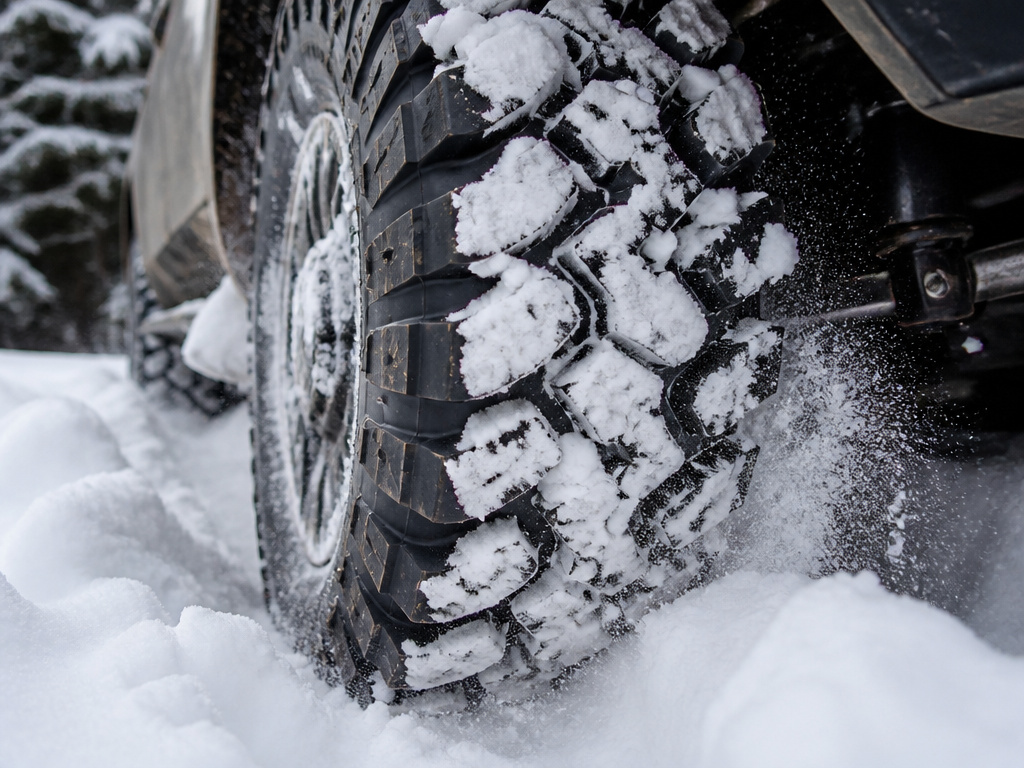
The picture isn’t all bad. There are specific, limited scenarios where your standard off-road tire is not just okay but ideal.
- Exclusively Deep, Unplowed Snow: If you’re driving on fresh powder that hasn’t been compacted by traffic, aggressive lugs can act like paddles. The tire penetrates the snow, and the large voids eject it, preventing buildup. This is common on rural properties, unmaintained mountain roads, or dedicated off-road parks in winter.
- Very Low-Speed, Technical Crawling: At walking pace, the mechanical digging action of the tread can provide enough traction to keep moving over snow-covered obstacles, even if the rubber is hard. Momentum is the enemy here; slow and steady can work where speed would cause instant slip.
- Paired with Other Extreme Measures: In polar research operations, like on snow roads at McMurdo Station, standard light-truck tires are run at very low pressures (around 18 psi) to maximize the contact patch and floatation on snow. This is a specialized, slow-speed technique, not for highway driving.
Skip this if: You ever drive on plowed public roads, encounter black ice, or face temperatures consistently below freezing. In those conditions, the tire’s inherent weaknesses override any tread advantage.
The rule is simple. If the snow is soft, deep, and you’re the only one making tracks, an off-road tire might suffice. The moment you see pavement, hard pack, or ice, you’re on borrowed time.
The Legal & Insurance Landscape
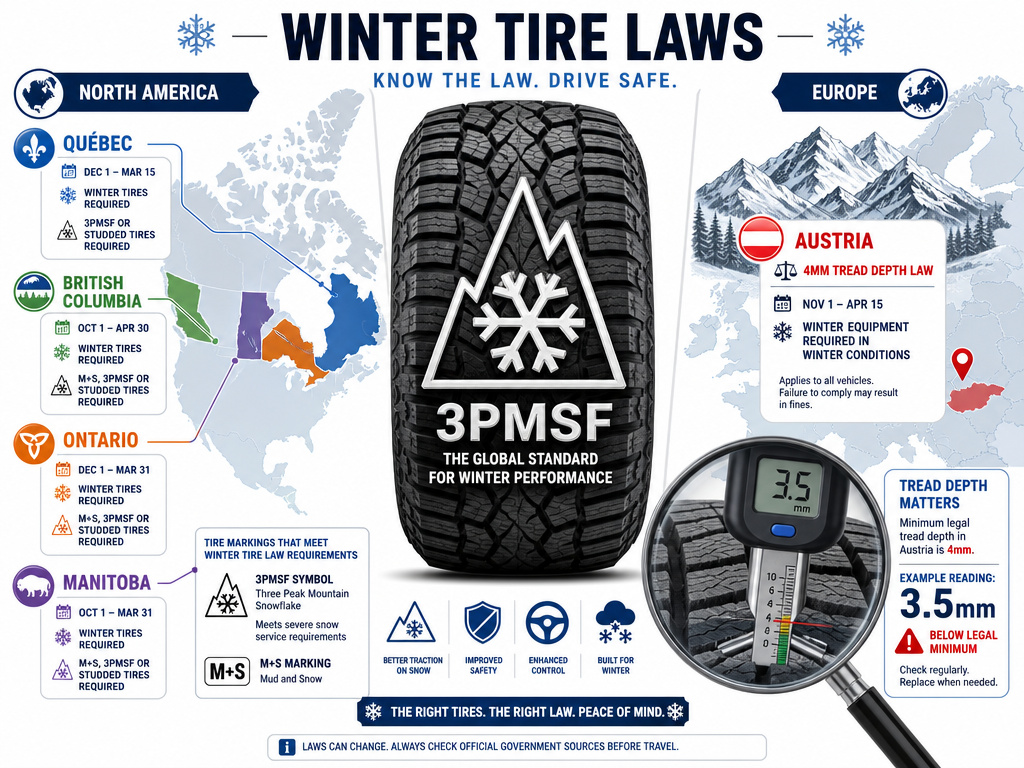
Your tire choice isn’t just about physics; it’s about law and liability. In North America, winter tire legislation is concentrated in Canada, and it hinges on those symbols.
- Quebec: Mandates winter tires on all passenger vehicles from December 15 to March 15.
- British Columbia: Requires winter tires (M+S or 3PMSF with 3.5mm tread) on designated mountain highways from October 1 to March 31.
- Ontario & Manitoba: Offer insurance incentives for using four winter tires.
In Austria and other European alpine nations, similar laws exist with strict tread-depth minimums (e.g., 4mm for radial tires on passenger cars).
From an insurance standpoint, not having winter tires where they are demonstrably beneficial can affect fault determination after a crash. While it won’t automatically make you at-fault, it can influence the degree of liability assigned. If you crash in a winter storm on summer tires, your insurer will note it. The official USTMA severe snow tire definition provides the industry standard that many legal and insurance judgments reference.
How to Decide: Your Winter Tire Checklist
Stop looking at tread and start asking these questions. Your answers dictate your tire.
-
What surfaces do I drive on most in winter?
- Plowed highways & city streets: A 3PMSF-rated all-terrain is the minimum. Dedicated winters are better.
- Unplowed rural roads & trails: A 3PMSF all-terrain can work. For deep powder only, an aggressive all-terrain might suffice.
- Mix of both: This is the classic use case for a high-quality 3PMSF all-terrain tire.
-
How cold does it get?
- Temperatures mostly above 45°F: All-terrains are fine.
- Regularly below freezing, with ice: You need the softer compound of a dedicated winter tire. Consider studded snow tires for the worst ice.
-
What’s my vehicle’s drivetrain?
- 4WD/AWD: Helps you go, does nothing for stopping or turning. Don’t let it give you false confidence.
- 2WD: You need every advantage you can get. Do not cheap out on tires.
-
Am I willing to swap tires seasonally?
- Yes: Get dedicated winter tires and dedicated summer/off-road tires. It’s the best performance and safety for both seasons.
- No: You are committing to a compromise. Invest in the highest-rated 3PMSF all-terrain you can find, like the BFGoodrich KO2 or Falken Wildpeak AT4W, and understand its cold-weather limits.
For specific vehicle applications, like outfitting a Jeep Wrangler snow tires setup, the principles are the same, but the tire models will differ.
Practical Winter Driving Tips with Off-Road Tires
If you’re running all-terrains for the winter, you must adjust your driving.
- Increase Following Distance Double. Assume your braking distance is at least 40-50% longer than in dry conditions, per the Transport Canada data.
- Lower Tire Pressure (Cautiously). For deep snow off-road, dropping pressure to 20-25 psi can increase the contact patch and flotation. Re-inflate to highway pressure before returning to paved roads. High-speed driving on underinflated tires is dangerous.
- Carry Traction Aids. Keep sandbags over the rear axle for 2WD trucks, and always have a shovel, traction boards, and perhaps chains in the vehicle.
- Store Spares Correctly. If you have a second set of wheels, store the off-season tires in a cool, dark, dry place away from ozone-generating motors. If stored mounted, reduce pressure to 15 psi.
The research from the CRREL snow-road tire testing program shows that for specialized snow-road use, performance is more about contact pressure and floatation than aggressive tread. For the rest of us, it’s about managing the known weaknesses of our chosen compromise.
Frequently Asked Questions
Are 3PMSF all-terrain tires as good as winter tires?
No. A 3PMSF all-terrain meets a minimum snow acceleration standard. A dedicated winter tire is engineered for maximum performance across ice, packed snow, slush, and cold pavement. The winter tire will have a softer compound, more sipes, and a tread pattern optimized for winter hazards alone. The all-terrain is a compromise for year-round use.
Can I just use my mud tires in winter if I have 4WD?
4WD helps you move forward. It provides zero benefit for stopping or cornering. On ice or packed snow, your mud tires’ hard rubber and lack of siping will make braking distances prohibitively long and cornering unstable. 4WD with poor tires is a common recipe for overconfidence and accidents.
How much worse are all-terrains than winter tires on ice?
Significantly. Test data from manufacturers and independent groups like Tire Rack show stopping distances on ice can be 20-30% longer for even the best 3PMSF all-terrains compared to dedicated winter tires. On sheer ice, a winter tire with studs can cut braking distance in half compared to an all-terrain.
Do I need four matching winter tires?
Yes. Absolutely. Mixing tire types or wear levels unbalances the vehicle’s handling, strains the drivetrain (especially on AWD systems), and creates unpredictable grip levels at each corner. Always install four identical tires. This is a hard rule for winter tires for light trucks and all passenger vehicles.
Is a wider tire better or worse for snow?
Narrower is generally better. A narrower tire cuts through snow to find firmer ground underneath, creating higher pressure on a smaller contact patch for better bite. A very wider tire tends to float on top of loose snow and has lower pressure across a wider patch, which can reduce grip on hard-packed surfaces. There’s a balance for your specific vehicle weight.
Before You Go
Off-road tires and snow have a complicated relationship. In the right fluffy, deep stuff, they can be great. On the plowed and packed roads most of us drive, they range from mediocre to dangerously inadequate. The 3PMSF symbol is your baseline indicator of tested snow traction, a vital step above the meaningless M+S marking.
Your safest bet is a dedicated set of winter tires. Your most practical, single-set solution is a premium 3PMSF-rated all-terrain tire, driven with heightened caution below 45°F. Never let aggressive tread lull you into a false sense of security. The rubber meeting the road decides everything, and in winter, that rubber needs to be soft, siped, and certified.
