
Are BF Goodrich Tires Good? Baja Champion or Safety Risk?
This post contains affiliate links. As an Amazon Associate, we earn from qualifying purchases.
BF Goodrich tires are good for a specific driver: someone who splits time between highway and serious off-road use, values durable construction and traction over quiet comfort, and understands the brand’s history includes two major safety recalls. Models like the All-Terrain T/A KO2 and KO3 are proven in brutal conditions, but they carry a firmer ride, noticeable road noise, and come with a limited 6-year warranty that expires regardless of tread depth.
That’s the direct answer. The real question is whether those trade-offs fit your driving.
The warranty length is the pivot point. BFGoodrich’s coverage stops at six years from purchase or when the tread wears down to 2/32″, whichever comes first. This clashes with the tire’s reputation for longevity. It means a tire sitting unused in your garage for seven years has zero defect coverage, even if it’s never been mounted. That detail reframes the “good” question from pure performance to a value calculation over time.
What follows is a breakdown of where these tires genuinely excel, where they’ve failed publicly, and the specs that matter more than marketing claims. By the end, you’ll know whether a BFGoodrich tire belongs on your vehicle or if your money is better spent elsewhere.
Key Takeaways
- BFGoodrich’s All-Terrain T/A KO2 and new KO3 are benchmark tires for mixed on/off-road use, with Baja-proven durability and a Severe Snow Rating.
- The brand has two NHTSA safety recalls (2012 and 2015) for specific Commercial T/A and Rugged Terrain models, involving sidewall ruptures and tread separation.
- The standard limited warranty covers defects for only six years from the date of purchase, not the life of the tire.
- New technologies like the KO3’s mud-phobic bars and extended sidewall rubber address specific failure modes from the KO2.
- For pure on-road comfort and low noise, other brands in the Michelin family are better suited.
The Baja Champion Legacy
BFGoodrich doesn’t just sponsor the Baja 1000; it wins it. Thirty-five Baja 500 and thirty-three Baja 1000 overall victories are stamped literally on the sidewalls of its performance tires. This isn’t marketing fluff. It’s a direct feedback loop where race-level punishment informs consumer tire design. The CoreGard technology in the sidewalls of the KO2 and KM3 mud-terrain tire, a multi-ply construction to resist cuts and bruises, came from watching what shredded tires in the desert.
The interlocking shoulder blocks on the KO2 and KM3 are not for show. They grip loose soil and sand when the tire is aired down to 15-20 PSI, preventing the wheel from spinning uselessly in a silt bed. This is the kind of detail that separates a tire that can go off-road from one that can work off-road.
This legacy creates a halo effect. When you see “Baja Champion” on the side, you’re buying into fifty years of off-road tire evolution. But it also sets a high bar. The tire on your Ford Raptor isn’t the same as the one on Rob MacCachren’s trophy truck, but the design philosophy filters down. The expectation is extreme durability.
That expectation makes the next section matter even more.
What’s the Deal with BFGoodrich’s Safety Recalls?
Performance reputation means nothing if the tire can’t stay intact. BFGoodrich has had two notable tangles with the National Highway Traffic Safety Administration (NHTSA), and they are specific, documented, and serious.
The larger one, NHTSA Recall 15T-016, was announced in August 2015 and involved approximately 104,000 tires. The affected models were specific sizes of the BFGoodrich Commercial T/A All-Season, Commercial T/A All-Season 2, and Rugged Terrain T/A lines. The official defect: these tires “may experience rapid air loss due to a rupture in the sidewall in the bead area.” The consequence stated in the NHTSA tire recall owner letter was clear: “loss of vehicle control, increasing the risk of a vehicle crash.”
| Recalled Model | Example Affected Size | Defect |
|---|---|---|
| Commercial T/A A/S | LT275/70R18 125/122Q LRE | Sidewall rupture in bead area |
| Commercial T/A A/S 2 | LT235/80R17 120/117R LRE | Sidewall rupture in bead area |
| Rugged Terrain T/A | LT275/70R18 125/122R LRE | Sidewall rupture in bead area |
An earlier recall, 12T-019 from 2012, targeted around 800,000 BFGoodrich Commercial T/A A/S tires. The issue was different: “tread loss and/or rapid air loss resulting from tread belt separation.” Both recalls were for light truck tires common on commercial vans and pickups.
Where this goes sideways: Assuming “all-terrain” means “all models.” These recalls were not for the popular All-Terrain T/A KO2 or mud-terrain lines. They targeted specific commercial all-season and rugged-terrain models. The takeaway is to always check the NHTSA recalls database by your tire’s exact DOT number, not just the brand.
The fixes were replacements, free of charge. But the incidents are a permanent part of the brand’s record. For a company that leans hard on durability, a sidewall rupture is the exact opposite of the Baja Champion image. It’s a reminder that when you’re evaluating any brand’s all-terrain truck tires, you have to look at the specific model’s history, not just the brand’s logo.
The 6-Year Warranty Clock (And Why It Ticks)
Here is the most counterintuitive fact about BFGoodrich’s famous durability: the company’s limited warranty doesn’t believe in it forever. According to the BFGoodrich Owner’s Manual, the standard warranty covers defects in workmanship and materials for “the life of the original usable tread, or six (6) years from date of purchase, whichever comes first.”
Usable tread life is defined as the original tread worn down to the treadwear indicators—2/32 of an inch remaining. After six years or when that wear point is reached, “all warranties, expressed or implied, expire.” Full stop.
This creates two scenarios most buyers don’t consider: 1. A tire with 50% tread left at year seven has zero defect coverage. 2. A brand-new tire you stored in your garage for seven years also has zero defect coverage from its manufacture date.
Why does this matter? Because it directly contradicts the “last forever” reputation. It means the company’s confidence in its materials has a firm expiration date. This six-year window is a stark contrast to the indefinite performance many assume comes with a premium, off-road-focused tire. When comparing to other brands in its class, this warranty is standard but surprisingly short given the tire’s rugged marketing.
KO2 vs. KO3: What Actually Changed?
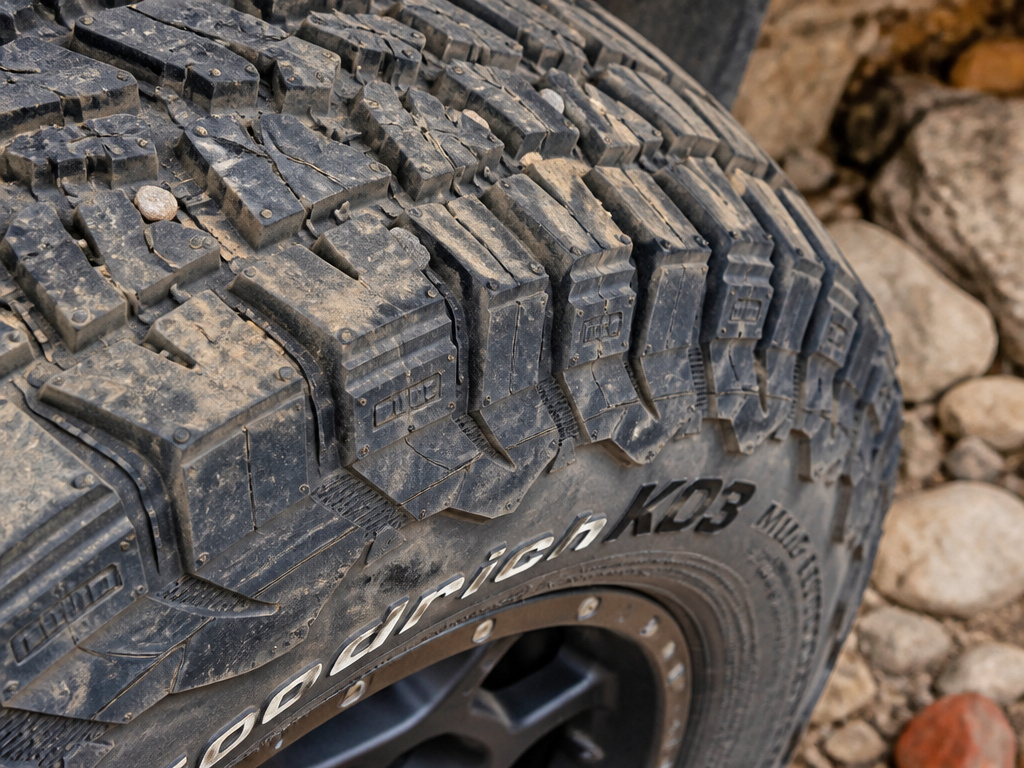
The All-Terrain T/A KO2 has been the gold standard for over a decade. The new KO3, launched in 2024, isn’t a revolution—it’s a targeted evolution fixing specific KO2 weaknesses. If you’re looking at best all-terrain tires, understanding this shift is key.
The KO3’s updates are mechanical, not cosmetic. BFGoodrich extended the shoulder rubber further down the sidewall. This protects more of the critical sidewall failure zone from impacts and helps deflect protruding objects. It’s a direct response to off-road trail damage. New “mud-phobic bars” between the tread blocks are designed to shed sticky mud more efficiently, preventing the tire from becoming a slick, weighted doughnut.
From a tire review test in Alaska, the KO3 showed a “distinct lack of pebbles being tossed into the truck’s wheelwells.” This is credited to a “reduction in space between the tread blocks,” a focused effort to improve gravel road wear and cut down on thrown debris. For someone using their truck on forest service roads, that’s a tangible, daily-life benefit.
| Feature | T/A KO2 | T/A KO3 |
|---|---|---|
| Sidewall Protection | CoreGard 3-ply sidewall | Extended shoulder rubber, CoreGard+ |
| Mud/Snow Clearing | Standard siping & grooves | Added “mud-phobic bars” |
| Gravel Debris | Standard tread spacing | Reduced space between blocks |
| Rubber Compound | Long-life silica compound | Updated race-derived compound |
So, is the KO3 worth the upgrade over a discounted KO2? If your driving includes regular mud, sharp gravel, or you simply want the latest sidewall protection, yes. If you stick to dry trails and pavement, the KO2 remains a formidable and now more affordable A/T tire. The KO3 is a surgeon’s scalpel, not a sledgehammer.
The Storage Rule Everyone Ignores
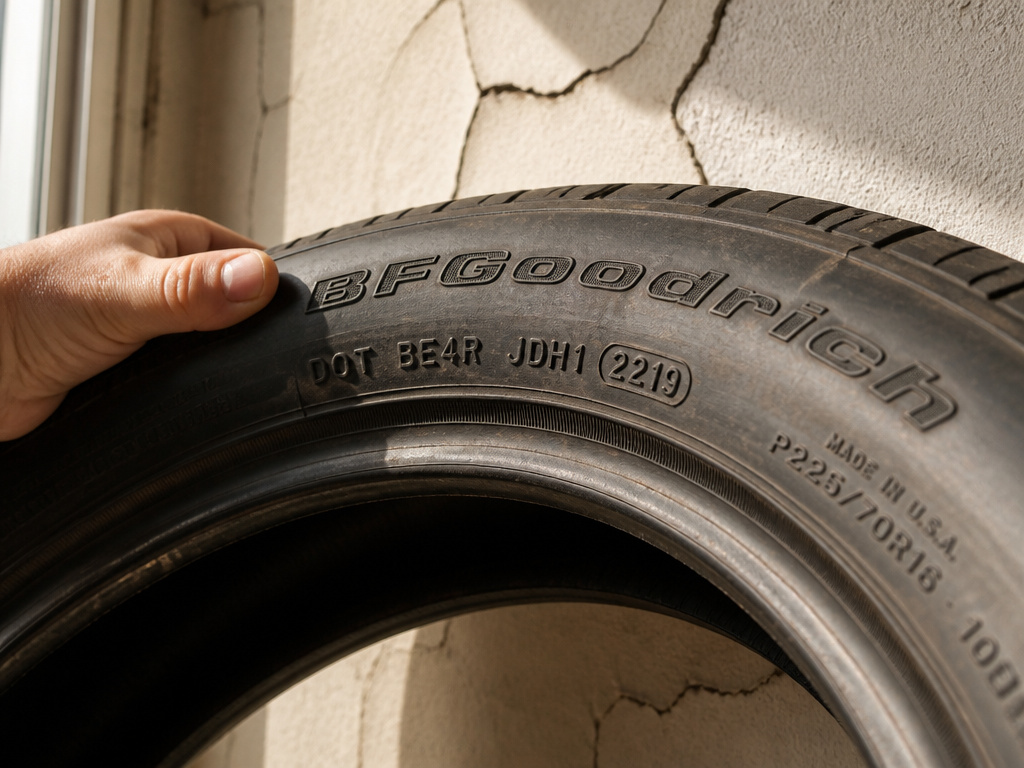
BFGoodrich’s official stance on tire aging is precise. Tires in use for five years or more should be inspected annually by a specialist. Any tire in service for ten years or more from its date of manufacture “should be replaced with new tires as a simple precaution.” The date is in the DOT code on the sidewall: the last four digits represent the week and year (e.g., “2219” is the 22nd week of 2019).
But the critical advice is for stored tires. The company states that tires should be kept in a “cool, dry place away from direct sunlight, heat sources, and ozone.” Exposure to these elements “will exhaust the tire’s oxidation and weathering agents within the rubber compounds and result in cracking.” This is a chemical process, not just physical wear.
Common mistake: Storing spare or seasonal tires in a hot garage or shed against a sun-facing wall. The surface may look fine, but the internal rubber compounds degrade and lose elasticity. When mounted, that tire is more prone to impact damage and irregular wear, regardless of its untouched tread depth.
This is why buying “new old stock” tires online is a gamble. A tire manufactured five years ago that’s been baking in a warehouse has already consumed much of its built-in anti-aging protection. It might be new in box, but it’s not new in composition. Always check the DOT date before buying.
When BFGoodrich Tires Are the Right Call
The brand’s sweet spot is the driver whose needs are split. You need a tire that can handle a Monday commute, a Friday night highway drive, and a Saturday trail run without swapping wheels. The All-Terrain T/A KO3 is the default pick for most full-size trucks and serious SUVs. Its severe snow rating makes it a legitimate three-season tire for mountain passes, and the durability justifies the investment.
For heavier trucks, the HD Terrain T/A KT or HD Pro T/A lines are built for heavy-duty truck tires and commercial use, often featuring a 10-ply Load Range E construction. If your world is only pavement, the BF Goodrich Advantage Control provides a comfortable, quiet alternative with solid wet-weather grip, though it faces stiff competition from its corporate sibling, Michelin.
When to Look Elsewhere
BFGoodrich tires demand trade-offs. The aggressive all-terrain and mud-terrain tread patterns generate noticeable road hum. The stiff sidewalls that resist punctures transmit more road vibration to the cabin than a standard highway tire. If your priority is luxury-car quietness and a pillowy ride, look at Michelin’s Defender or Primacy lines.
If you own a crossover or SUV that never leaves pavement, brands like Bridgestone or Continental often provide better blend of comfort, noise, and wet-weather performance for the money. A Bridgestone WeatherPeak is a dedicated all-weather touring tire, while BFGoodrich’s offerings in that segment, like the Advantage Control, are competent but not class-leading.
Finally, if long-term warranty coverage is your top priority, know that the six-year clock is always ticking. Some competitors offer longer warranty periods on their premium touring lines, which might be a better fit for a vehicle you plan to keep for a decade.
Frequently Asked Questions
Are BF Goodrich tires made by Michelin?
Yes. Michelin North America, Inc. Owns and operates the BFGoodrich brand. The tires are designed and manufactured within the Michelin group, which means they benefit from Michelin’s compound research and global manufacturing standards, but are aimed at a different, more performance-oriented market segment.
What does the “T/A” stand for in BF Goodrich tire names?
“T/A” stands for Traction Advantage. It’s a designation BFGoodrich uses across its performance tire lines, from all-terrain to high-performance summer tires, signaling a focus on grip and handling.
How many miles do BF Goodrich all-terrain tires last?
Real-world testing and owner reports suggest a well-maintained set of BFGoodrich All-Terrain T/A KO2 or KO3 tires can last between 50,000 and 65,000 miles. This depends heavily on alignment, rotation frequency, inflation discipline, and driving style. Aggressive off-road use will shorten this lifespan significantly.
Are BF Goodrich tires good in snow?
Models with the Three-Peak Mountain Snowflake (3PMSF) symbol, like the All-Terrain T/A KO2 and KO3, are rated for severe snow service. They perform very well in winter conditions, offering better snow traction than a standard all-season tire. They are not, however, a substitute for dedicated winter tires in extreme ice and sustained sub-freezing temperatures.
Is the BF Goodrich 60-Day Satisfaction Guarantee real?
Yes. If you purchase a new set of eligible BFGoodrich tires and are not satisfied within 60 days, you can return them to the selling dealer for an exchange. The guarantee covers the tires themselves, not mounting or balancing fees, and the tires must not be damaged or used in racing. It’s a strong consumer-friendly policy that lowers the risk of trying a new set.
The Bottom Line
BFGoodrich tires are good for the right application. They are not a universal “yes.” They are a tool.
If your driving involves a mix of pavement, gravel, mud, and snow, and you value toughness over luxury, the All-Terrain T/A KO3 is arguably the best tool in the box. Its upgrades are thoughtful, and its pedigree is real. Just know you’re accepting more noise, a firmer ride, and a warranty that views the calendar as its enemy.
Before you buy, do two things. First, check the specific model’s history—recalls like the 2015 sidewall rupture are tied to specific lines, not the entire brand. Second, look at the DOT date on the sidewall. A tire older than a couple of years has been aging on the shelf, consuming its protective compounds.
For pure on-road comfort, you’re in the wrong aisle. Walk over to the Michelin or Bridgestone shelves. But if you hear the call of a trail, BFGoodrich is listening.
