
Are All Terrain Tires Loud? The dB Label Lie Explained (58 chars)
This post contains affiliate links. As an Amazon Associate, we earn from qualifying purchases.
All-terrain tires are louder than highway tires, but the official noise label on the sidewall can be wrong by up to 4 decibels. The real-world difference between a quiet all-terrain and a loud highway tire is often 3-4 dB, not the 8-10 dB the label implies. The ELANORE research project found that tire rankings based on actual ISO track measurements do not match the manufacturer’s label rankings, with discrepancies as high as 4 dB.
That label inaccuracy is the key. You’re not just choosing between a quiet and a loud tire; you’re choosing between a number the manufacturer tested under perfect lab conditions and the sound your truck makes on your local asphalt at 70 mph. The label is a starting point, not a guarantee.
What follows: the exact decibel limits set by UN Regulation 117, the three physical reasons an all-terrain tire hums, and the specific models that beat the noise curve. By the end, you’ll know how to read a label skeptically and pick a tire based on what it actually does on the road.
Key Takeaways
- Tire noise labels (like “72 dB”) are measured under strict ISO test track conditions and can be off by up to 4 dB compared to real-world performance, per the ELANORE project.
- The legal noise limit for a standard passenger tire (C1) under UN ECE Regulation 117 is 72 dB for widths over 245mm; snow or reinforced tires get a 1 dB allowance.
- All-terrain noise comes from air pumping (air trapped in tread grooves), pitch sequencing (varying lug shapes to cancel sound), and tread block stiffness.
- A new all-terrain tire is at its quietest; noise increases as the tread wears and the remaining rubber blocks harden.
- For the quietest experience without sacrificing capability, look at on-road oriented all-terrain tires like the Continental TerrainContact A/T or Nokian’s offerings, which use packed shoulder blocks and advanced variable pitch designs.
The Science of Tire Noise: Air Pumping and Pitch Sequencing
Forget the myth that noise is just rubber slapping pavement. The dominant sound inside your cabin is air pumping. Each tread groove is a tiny chamber. As the tire rolls, these chambers compress against the road, forcing air out. Then they open up, sucking air back in. This rapid in-and-out creates a constant, low-frequency hum.
The larger and more aggressive the tread blocks, the louder that pumping action becomes. This is exactly why mud-terrain tires with huge, chunky lugs are so noisy — they’re displacing enormous volumes of air with every revolution.
Aggressive all-terrain tires amplify this effect with wider shoulder gaps and deeper voids. The shoulder is where most air enters the tread. An open-shoulder design, common on traditional all-terrains, acts like an open door for noise.
The fix is variable pitch sequencing. This isn’t marketing fluff. It’s an engineering solution where adjacent tread lugs are cut to slightly different sizes and shapes. One lug might be 30mm long, the next 32mm, the next 28mm. This variation makes each lug produce a sound at a slightly different frequency. When these frequencies hit your ear, they interfere with each other, canceling out some of the drone. A tire without this technology has a monotonous, resonant hum that’s far more noticeable on the highway.
Where this goes sideways: Assuming a tire with a low decibel label (e.g., 69 dB) will be quiet in all conditions. The ELANORE project tested tires on multiple ISO tracks and found ranking inconsistencies. A tire labeled 69 dB measured 4 dB louder on one track. The test surface, temperature, and even slight wear from previous testing changed the results.
How Loud Are They, Really? Decibels and Regulations
The noise level of any tire sold in major markets is governed by UN ECE Regulation 117. This regulation sets maximum permissible sound levels, measured on a specific ISO 10844 test surface. The limits depend on tire width and type.
For passenger vehicle tires (Category C1), the current “Stage 2” limits are:
| Tire Width (Nominal Section) | Maximum Noise Limit | Notes |
|---|---|---|
| Up to 185 mm | 70 dB(A) | Standard passenger tire. |
| Over 185 mm up to 245 mm | 71 dB(A) | Common width for crossovers and SUVs. |
| Over 245 mm up to 275 mm | 72 dB(A) | Common for trucks and full-size SUVs. |
| Over 275 mm | 74 dB(A) | Wide, performance, or off-road tires. |
These limits increase by 1 dB(A) for snow tires rated for severe conditions, extra-load (XL), or reinforced tires. This is why an all-terrain tire with the Three-Peak Mountain Snowflake symbol has a slightly higher noise allowance.
So, are all terrain tires loud? By the book, a 265mm all-terrain tire must be at or below 72 dB to be sold. A highway tire of the same width must also meet the 72 dB limit. The difference is where they land within that limit. A premium highway tire might hit 68 dB. A traditional all-terrain might hit the limit at 72 dB. That’s a measurable gap, but it’s not the deafening roar people imagine—it’s about the difference between a quiet conversation and a vacuum cleaner.
The real story is in the testing. The ELANORE project conducted a Round Robin Test, measuring tires on multiple ISO tracks and comparing results to their EU label values. Their finding was stark: “The ranking of the tyres on the measured ISO tracks does not correspond to the label ranking.” Differences up to 4 dB were recorded. This means you cannot shop by label alone. A tire’s rating for highway driving is best judged by owner reviews and professional tests that measure real-world sound, not just the standardized test.
What Makes an All-Terrain Tire Hum? The 3 Physical Factors
Noise isn’t a single flaw; it’s the outcome of a tire’s physical design. Three factors combine to create the signature all-terrain drone.
-
Tread Pattern Geometry. This is the biggest contributor. It’s a balance between off-road grip and on-road civility.
- Block Size & Spacing: Large, independent lugs dig into dirt but have big gaps that pump air loudly. Closely packed blocks, like those on the Continental TerrainContact A/T, restrict airflow.
- Groove Width & Depth: Deep grooves for mud clearance become resonant chambers on pavement. Shallower, siped grooves are quieter.
- Shoulder Design: Open, square shoulders are noisy. Many modern quiet all-terrains use serrated or linked shoulder blocks to break up air entry.
-
Rubber Compound Stiffness. The tread isn’t a uniform slab. The base compound and the internal construction matter.
- A softer, more elastic compound can absorb some vibration and sound. A harder, longer-lasting compound transmits more noise.
- Reinforced sidewalls add durability for off-roading but increase overall casing stiffness. A stiffer casing vibrates more, transferring noise into the vehicle’s structure. This is a direct trade-off for tire longevity and puncture resistance.
-
Tire Wear and Age. A brand-new all-terrain tire is as quiet as it will ever be. As it wears, two things happen:
- The tread pattern subtly changes shape, altering its acoustic properties.
- The remaining rubber loses plasticizers and hardens. These stiffer tread blocks slap the pavement with more force and resonate more. This is why a half-worn all-terrain can often be louder than a new one, even with less aggressive tread depth. Regular rotation is critical to manage this wear pattern for daily driving.
Common mistake: Chasing the absolute quietest tire for a dedicated off-road rig. If your truck sees more dirt than pavement, prioritize traction and sidewall strength. The noise is part of the package. Save the acoustic engineering for your primary vehicle used for regular on-road use.
All-Terrain vs. Highway Tire Noise: A Side-by-Side Comparison
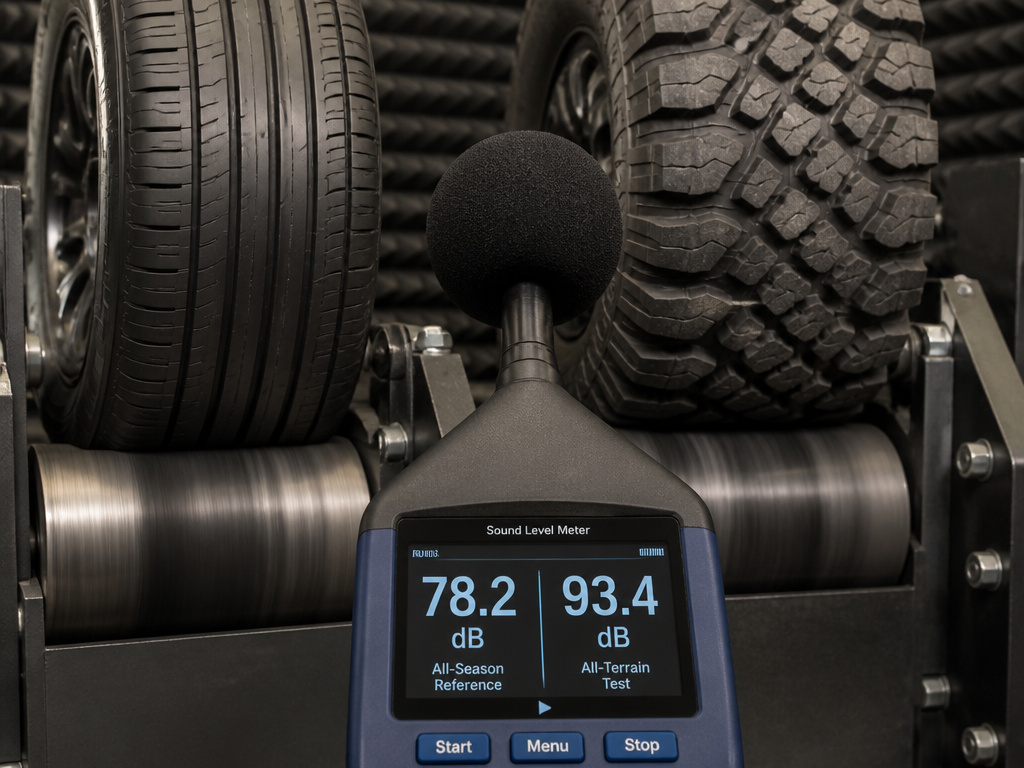
The gap exists, but how wide is it in practical terms? Let’s move past labels and look at real-world categories and experiences.
| Tire Category | Typical Noise Level | Best Use Case | Why It Sounds That Way |
|---|---|---|---|
| Grand Touring All-Season | 65–68 dB | Sedans, crossovers, daily commuting | Silica-rich compounds, symmetric treads with small blocks, foam liners. Engineered for silence. |
| Highway All-Season (SUV/Truck) | 68–71 dB | Highway-focused trucks and SUVs | Larger footprint than car tires, but uses continuous ribs and sipes to minimize air pumping. Prioritizes fuel economy and comfort. |
| On-Road Oriented All-Terrain | 70–73 dB | Trucks/SUVs with occasional light off-road use | Tighter tread blocks, variable pitch sequencing, packed shoulders. Models like the Nokian or BFGoodrich Trail-Terrain T/A use these tricks. |
| Traditional All-Terrain | 72–75 dB | Mixed on/off-road use | Larger, more independent lugs, deeper grooves. The classic hum comes from significant air displacement. Examples include the Falken Wildpeak A/T3W. |
| Mud-Terrain | 74–78+ dB | Off-road, rock crawling, mud | Huge, widely spaced lugs and deep, open voids. Maximum air pumping and block vibration. Unavoidably loud on pavement. |
A real-world test from Ember Offroad measured a Maxxis AT811 all-terrain tire at about 71 dB and a comparable mud-terrain at 74 dB on the same vehicle at 50 mph. That 3 dB difference is perceptible—it’s about a 23% increase in sound pressure. The jump from a highway tire at 68 dB to that all-terrain at 71 dB is the same 3 dB increase.
The bottom line: The step from highway to all-terrain is noticeable. The step from all-terrain to mud-terrain is dramatic. Your choice in all-terrain tires for quiet highway driving should focus on the “on-road oriented” segment of the table.
Can You Make All-Terrain Tires Quieter? 5 Practical Tips
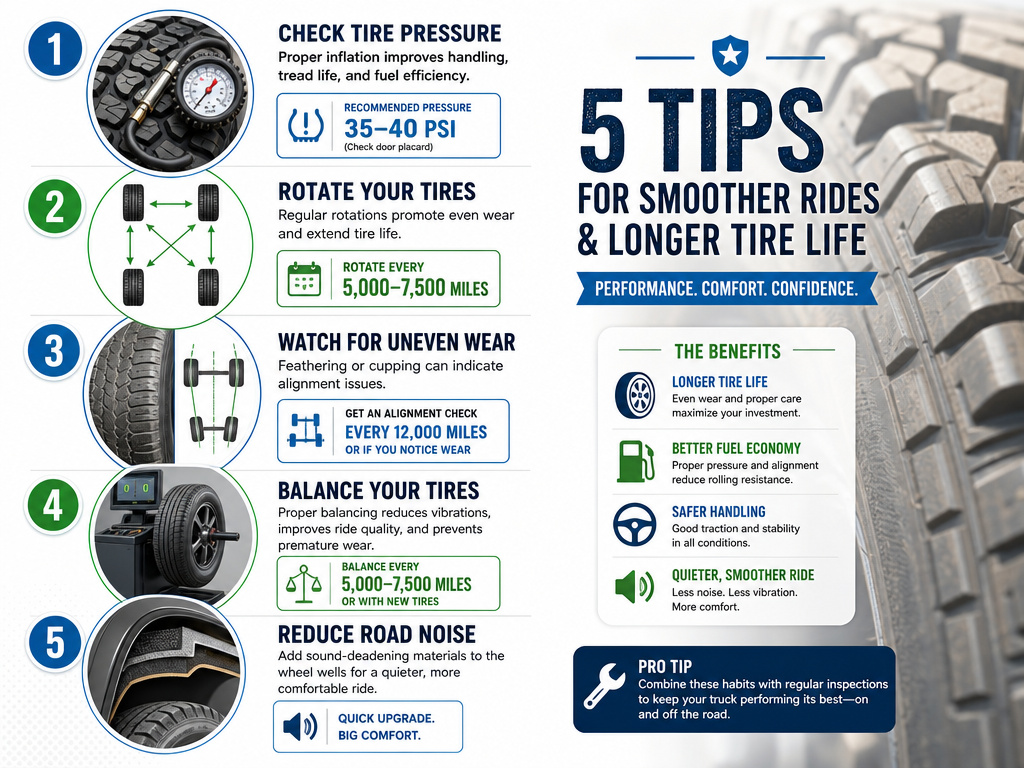
You can’t change a tire’s fundamental design, but you can optimize its environment to minimize noise.
- Maintain Precise Tire Pressure. Under-inflated tires increase the contact patch and cause tread block squirm, which adds a flapping sound. Over-inflated tires reduce the contact patch but make the casing drum-tight, transmitting more impact noise. Use the pressure listed on your driver’s door jamb, not the maximum on the tire sidewall. Check it monthly when the tires are cold.
- Rotate Tires Every 5,000–7,500 Miles. This is non-negotiable for noise control. All-terrain tires wear unevenly, especially on heavy trucks. The front tires wear faster on the shoulders from turning; the rears wear more evenly. Rotating them cross-pattern evens out wear, preventing one tire from becoming a noisy outlier. It also maximizes tread life.
- Get an Alignment Check Annually. A misaligned tire doesn’t roll straight. It scrubs sideways slightly with every revolution. This scrub creates a distinct, fast-paced whirring or feathering sound and will quickly wear the tread unevenly. Hitting a big pothole is enough to knock alignment out.
- Balance Tires When Vibrations Appear. Imbalance causes a rhythmic vibration and hum that increases with speed. It feels like a shake in the steering wheel or seat. Rebalancing redistributes weight so the tire rolls smoothly.
- Consider Sound Deadening. If you’ve done all the above and the drone still bothers you, the issue is cabin amplification. Adding mass-loaded vinyl or closed-cell foam to the floor and rear wheel wells can dampen noise transmitted through the sheet metal. This is a more involved project but is highly effective for trucks with large, hollow cabins.
Worth knowing before you start: Brand-new tires sometimes have mold release lubricant on them. They can be slightly noisier for the first 50–100 miles until this coating wears off. Don’t judge a tire’s permanent noise level until after this brief break-in period.
The Quietest All-Terrain Tires: What to Look For
If your priority is taming the hum, target tires that win in the three noise battlegrounds: shoulder design, pitch sequencing, and compound.
The Continental TerrainContact A/T is the benchmark here. Its shoulder lugs are tightly packed and connected, drastically reducing the main air entry point. The tread uses a sophisticated variable pitch sequence across its entire face. Continental’s compound is also tuned for compliance, not just durability. It’s a tire that genuinely bridges the gap to comfortable highway tires.
Nokian consistently ranks high in subjective noise tests. Their approach often involves a lot of siping (small cuts in the tread blocks) which breaks up large lugs into smaller, less resonant segments. This also boosts their winter performance, making them a strong dual-purpose choice.
For a more traditional look with modern noise management, the BFGoodrich Trail-Terrain T/A is worth a look. It uses a combination of variable pitch and stepped groove walls to disrupt sound waves. It’s quieter than their iconic KO2 but retains clear all-terrain styling.
Skip the “hybrid” mud-terrain tires if silence is a goal. Tires that try to split the difference between all-terrain and mud-terrain almost always inherit the mud-terrain’s noise profile. The large, independent lugs needed for mud cannot be engineered into silence.
When researching, look for professional test results that mention “cabin noise” or “sound levels.” Read owner reviews and listen for comments about highway drone. The label is a clue, but the collective experience of other owners running the same tires on tires for SUVs is your best evidence.
Frequently Asked Questions
Do all-terrain tires get louder as they wear?
Yes, significantly. New tires have full tread depth and a more compliant rubber compound. As they wear down, the tread blocks become shorter and stiffer. This stiffness increases the impact force as they slap the pavement and reduces their ability to dampen vibrations. A tire at 5/32nds of tread will almost always be louder than when it was new.
Are wider all-terrain tires louder?
Generally, yes. A wider tire has a larger contact patch and often wider grooves, which can displace more air. However, a well-designed wide tire with advanced noise-canceling features can be quieter than a poorly designed narrow one. The width alone isn’t the sole dictator of noise.
Can tire foam inserts really reduce noise?
Yes, acoustic foam liners glued to the inside of the tread area are effective. They absorb the sound waves generated by air pumping and cavity resonance before they can amplify inside the tire and transmit to the cabin. Tires like the Michelin Primacy Tour A/S use this. It’s a real technology, but it adds cost and can complicate repairs.
Are all-terrain tires louder than snow tires?
It depends. A severe snow service-rated all-terrain tire and a dedicated winter tire are both allowed a 1 dB higher limit under regulation. In practice, a studless winter tire with thousands of tiny sipes can produce a high-frequency whine on dry pavement that some find more annoying than an all-terrain’s low hum. For snow and ice traction, the noise trade-off is usually worth it.
Do all-terrain tires affect gas mileage?
Yes, they typically reduce fuel efficiency by 1-3 MPG compared to highway tires. The aggressive tread creates more rolling resistance, and the heavier, stiffer construction requires more energy to spin. This impact on fuel efficiency is a key trade-off for off-road capability.
The Bottom Line
All-terrain tires are louder than highway tires. Accept that. But the modern gap isn’t the canyon of noise it was 15 years ago. Engineering has narrowed it to a manageable hum for most daily use tires.
The real insight isn’t about volume—it’s about trust. The decibel rating on the sidewall is a laboratory result that can be 4 dB off from real-world performance. Don’t shop by that number alone. Shop by design: look for packed shoulders, variable pitch sequencing, and reviews that mention quiet highway manners. Choose an on-road oriented all-terrain like the Continental TerrainContact A/T if your pavement miles dominate.
For a truck that lives off-road, embrace the sound. It’s the price of admission for traction that gets you home. For everyone else, a quiet all-terrain tire is not a myth. It’s a product of smart engineering, and it’s sitting on the shelf right now.
