
Do Honda CR-V Have Heated Steering Wheel | The
This post contains affiliate links. As an Amazon Associate, we earn from qualifying purchases.
Heated steering wheels are available on the Honda CR-V EX-L and Touring trims for the 2023 through 2025 model years. The base LX and Sport trims do not include this feature from the factory. The system targets a surface temperature of approximately 30°C (86°F) and can take over 30 minutes to reach that temperature in a cold cabin.
That temperature target and warm-up time are not a defect. They are the design specification published by multiple automakers in technical service bulletins. If your CR-V’s wheel seems slow or uneven, the issue is likely the cabin’s ambient temperature, not a broken element. The real problems to watch for are complete failure or unexpected shutdowns, which trace to the Steering Column Control Module or specific recalls.
What follows: a trim-by-trim breakdown for the current generation, the official performance specs most owners never see, and the two factory recalls that specifically involve components connected to the heated steering system in affected hybrids.
Key Takeaways
- The heated steering wheel is a standard feature on the CR-V EX-L and Touring trims. It is not available on the LX or Sport.
- Factory specifications state the wheel aims for a surface temperature of 30°C ± 3°C (86°F ± 5°F). In a cold car, reaching this can take over 30 minutes.
- A complete lack of heat often points to the Steering Column Control Module (SCCM), not the wheel itself.
- Certain 2023-2025 CR-V Hybrid models are subject to recalls for the steering gearbox and battery module, repairs that require disconnecting the wheel’s heating element.
- Adding heat to a trim that didn’t come with it requires replacing the entire steering wheel, the SCCM, and the HVAC control module, a complex and expensive retrofit.
Which Honda CR-V Trims Have a Heated Steering Wheel?
Check the trim badge on your tailgate. For the 2023, 2024, and 2025 model years, the feature breakdown is consistent.
The LX is the entry point. You get a well-equipped SUV but without the premium comfort features. No heated steering wheel here. The Sport trim adds more aggressive styling and larger wheels but follows the same feature set as the LX for the steering wheel. Heat is not included.
The upgrade happens at the EX-L. This trim adds leather-appointed seats, a power tailgate, and the heated steering wheel as standard equipment. The Touring trim includes everything from the EX-L and adds advanced features like a hands-free power tailgate, front and rear parking sensors, and a premium audio system. The heated wheel remains standard.
Where this goes sideways: Assuming all “higher” trims have it. The Sport trim sits above the LX in price and style but does not include the heated wheel, a common point of confusion for buyers focusing on aesthetics over the features list.
There is no standalone option package to add a heated steering wheel to the LX or Sport. The feature is integrated into the wiring harness, control modules, and steering wheel assembly specific to the EX-L and Touring. This is why a simple aftermarket add-on isn’t feasible. To properly install a heated steering wheel on a lower trim, you must swap the steering wheel, the SCCM behind it, and the HVAC control module that hosts the button, essentially performing the factory upgrade yourself.
How the Factory Heated Wheel Works (And Why It Feels Slow)
Press the button on the dash. A light illuminates. You wait. And wait. This is normal.
The system isn’t designed for instant blistering heat. It’s a comfort feature meant to take the deep chill off the rim. According to diagnostic specifications from Ford and Audi published through the NHTSA, which use similar resistive element technology, the target surface temperature is approximately 30°C ± 3°C (86°F ± 5°F). The temperature sensor is embedded under the leather or vinyl cover, not on the surface your hands touch.
The measured sensor value at this target surface temperature is 34°C (93°F) underneath the cover. This discrepancy between sensor reading and surface feel explains why the wheel never seems as hot as the air vents.
The time to reach that target is heavily dependent on the starting temperature of the steering wheel rim and the cabin air. If you park outside in -10°C (14°F) weather, the metal and plastic inside the wheel are that cold. The element must warm the entire mass. Official service bulletins note the warm-up can take over 30 minutes under severe conditions. The system may also automatically shut off after a period, often around 5 minutes, if it senses the cabin is already warm or if the wheel is in direct sunlight, to prevent overheating.
| Perceived Issue | Likely Cause (Not a Fault) | Typical Timeline |
|---|---|---|
| Wheel heats slowly | Very cold ambient temperature | 20-35 minutes to reach target |
| Heat feels uneven | Top of wheel loses heat to cabin air faster | Constant while system is on |
| System turns off by itself | Automatic temperature safeguard | After ~5 minutes in a warm cabin |
| Heat is barely noticeable | Hands are cold, wheel is only ~30°C | Immediate perception vs. Reality |
If the heat is truly inoperative, the button light comes on but the wheel stays stone cold, the problem is usually electrical. The first component technicians check is the Steering Column Control Module (SCCM). This module, which also controls turn signals and wipers, manages the power supply to the heating element. A fault here is more common than a broken element inside the wheel itself. Diagnosing this requires checking the element’s resistance, which should be between 1.31 Ω and 1.60 Ω at room temperature, as outlined in the NHTSA heated steering wheel diagnostic guide.
The Two Recalls That Involve the Heated Steering System
If you own a 2023-2025 CR-V Hybrid, your heated steering wheel is connected to two major safety recalls. The repairs require technicians to work directly on components that necessitate disconnecting the wheel’s heater.
Steering Gearbox Recall (NHTSA 24V-744)
This recall affects certain 2023–25 CR-V and CR-V Hybrid models. A defective steering gearbox worm wheel can swell, increasing friction and steering effort. The fix requires replacing the end cap, spring, and spring seat inside the Electric Power Steering (EPS) gearbox and injecting new grease.
To perform this repair, the technician must first disable the airbag and disconnect the steering wheel, which includes unplugging the heating element connector. While the heating element itself isn’t the target, it is in the path of the repair. Any error in reassembly could lead to a poor connection and a non-functional heater afterward.
Hybrid Battery Module Recall (NHTSA 24V-745)
This recall is for specific 2023 CR-V Hybrids built between October 2022 and January 2023. A manufacturing flaw in the lithium-ion battery module (Part Number 1D100-69F-A00) could lead to a broken terminal, a spark, and fire risk. The remedy is a full battery module replacement.
This repair is massive, often requiring partial interior disassembly. While not directly related to the steering wheel, it underscores the complexity of systems in higher-trim hybrids that come with features like a heated wheel. It’s a reminder that adding complex features introduces more potential failure points.
Can You Add a Heated Steering Wheel to a CR-V That Didn’t Come With One?
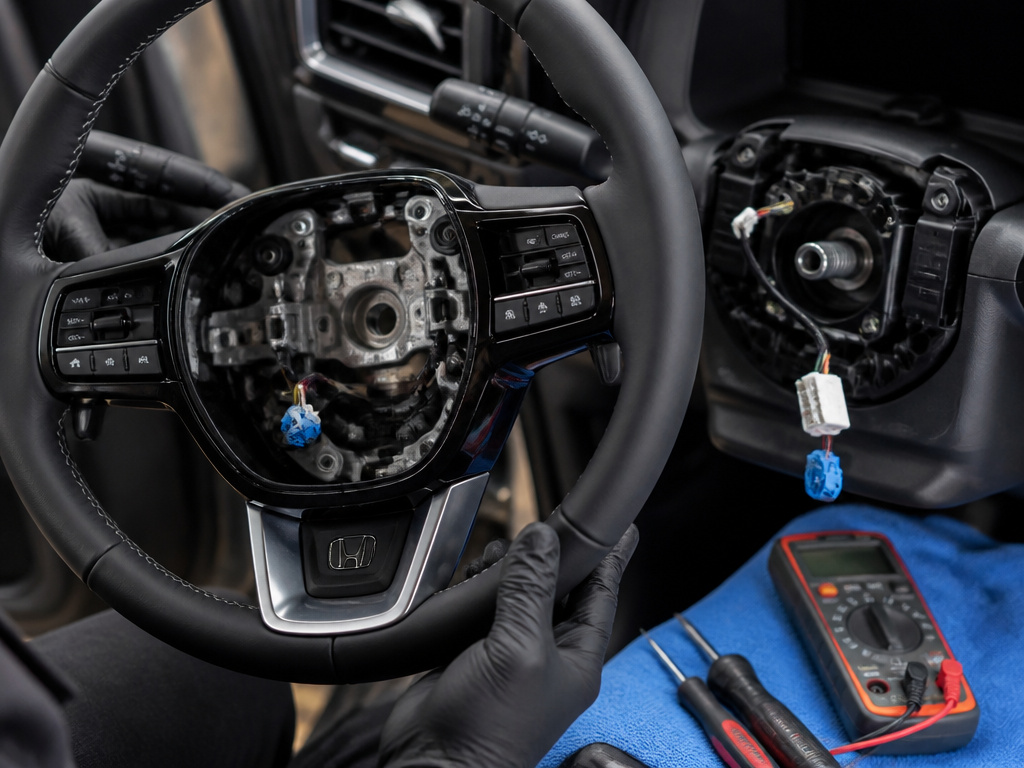
Technically, yes. Practically, it’s a significant undertaking that approaches the cost and complexity of a steering wheel replacement for customization, not just a feature add.
You cannot just swap in a heated wheel from an EX-L. The lower-trim vehicles lack the necessary wiring in the steering column harness and the software configuration in the SCCM. Here is the real parts list for a factory-correct retrofit:
- Heated Steering Wheel Assembly: The complete wheel with the embedded element.
- Steering Column Control Module (SCCM): The module that recognizes the wheel and provides power to the heater. You must find the exact part number (e.g., NL3Z-3F791-BA) that matches your vehicle’s other options like auto wipers.
- HVAC Control Module: The unit that contains the physical heated steering wheel button for your dashboard.
- Wiring Harness Adapters: Likely custom, as the pin-outs differ between trims.
After installing these parts, the vehicle’s body control module needs to be reprogrammed using a factory diagnostic tool to enable the feature. This is not a DIY project for most people. The total cost in parts alone often runs into the hundreds, and professional installation adds several more hours of labor. For many, the smarter comfort solution in winter is to find one of the best heated steering wheel covers that plug into the 12V outlet.
Heated Wheel Care and Incompatible Upgrades
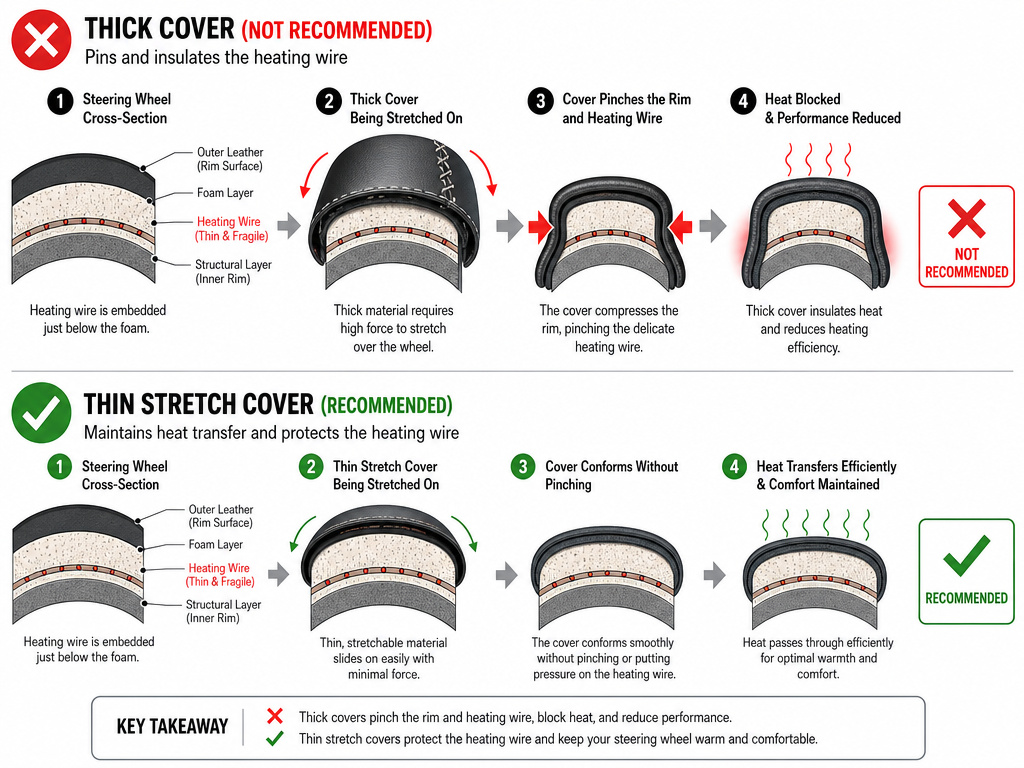
The heating element is a thin, fragile wire sandwiched between layers of the wheel’s material. This makes it vulnerable to damage from certain aftermarket accessories.
Steering wheel covers are the biggest risk. A poorly fitting cover that is too tight can pinch and break the heating wires. Even a good cover insulates the wheel, making the heater less effective and causing the sensor to misread the surface temperature. If you must use a cover, choose a very thin, stretchable model designed for compatibility. Our guide on covers for heated steering wheels explains the specific materials and fits that work.
Common mistake: Installing a thick, leather-stitched cover for aesthetics. It can reduce heat transfer by over 50% and void any warranty claim related to a subsequent heating failure.
Cleaning is the other concern. Never soak a heated steering wheel with liquid cleaners or conditioners. Moisture can seep into the seams and damage the electrical element or its connections. Use a slightly damp microfiber cloth with a mild cleaner intended for automotive interiors. This is especially important for leather steering wheel covers that may be added on top.
Frequently Asked Questions
Does the 2024 Honda CR-V Sport have a heated steering wheel?
No. For the 2024 model year, the heated steering wheel remains exclusive to the EX-L and Touring trims. The Sport trim offers exterior styling upgrades but does not include this premium comfort feature.
Why is my Honda CR-V heated steering wheel not hot?
First, give it time, it can take over 30 minutes in very cold weather. If it’s truly cold after a long drive, the issue could be a blown fuse, a faulty button on the HVAC module, or a failed Steering Column Control Module. The heating element itself is a less common point of failure.
Can I install a heated steering wheel myself?
It is not recommended for most DIYers. The retrofit requires replacing the steering wheel, the Steering Column Control Module (SCCM), and the HVAC control panel, followed by professional software configuration. It is a complex electrical and programming task.
Is a slow-heating steering wheel covered under warranty?
Yes, if the wheel never reaches a reasonable temperature. However, if diagnostic tests show the element is heating to the factory specification of ~30°C, the dealer will deem it operating as designed. Your perception of “slow” is not a warrantable defect.
Do heated steering wheels wear out faster?
The heating element itself is generally reliable for the life of the vehicle. However, the repeated thermal expansion and contraction can potentially accelerate the drying out and cracking of the wheel’s outer material, especially if exposed to harsh cleaners or direct sunlight.
Before You Go
The heated steering wheel in a Honda CR-V is a trim-defining feature, not a universal one. Look for the EX-L or Touring badge. If your wheel seems lazy, remember its goal is a mild 30°C, not scorching heat. Real failures are usually in the control module, not the wheel. And if you own a recent hybrid, check your VIN for the two related recalls, your warm hands depend on a network of systems that are more connected than you might think. For everything else, a good pair of gloves and a plug-in wireless heated steering wheel cover can bridge the gap without touching a single factory wire.
