
Are Audi A4s Front Wheel Drive? The 5-Model Truth
This post contains affiliate links. As an Amazon Associate, we earn from qualifying purchases.
Many Audi A4 models are front-wheel drive, but many are not. The A4 has been offered with both front-wheel drive (FWD) and quattro all-wheel drive (AWD) since its introduction. Whether a specific A4 is FWD depends on three things: the model year, the exact engine, and the trim level. For example, a 2024 Audi A4 Sedan 35 TFSI is FWD, while a 2024 Audi A4 Sedan 40 TFSI quattro is AWD.
That “it depends” is the whole conversation. Audi doesn’t treat the A4 as a single drivetrain proposition. They build a platform that accepts both, and your car’s configuration is a snapshot of market strategy, cost, and performance tier from that specific year.
What follows is the decoder ring: the specific engines, model years, and transmission types that came with front-wheel drive, how to spot them, and what you gain or give up by choosing one over the other.
Key Takeaways
- The Audi A4 has always been offered with both front-wheel drive (FWD) and quattro all-wheel drive (AWD) variants.
- Base model, lower-powered engines are typically FWD. Higher-performance trims and larger engines almost always come with quattro.
- The transmission is a major clue: Multitronic (CVT) and most S tronic (dual-clutch) gearboxes indicate FWD. A traditional torque-converter automatic or a manual paired with quattro is a different beast.
- Modern “quattro with ultra technology” can disengage the rear axle for fuel savings, blurring the line between permanent and on-demand AWD.
- Never assume, always check the vehicle’s original specification label or VIN decoder.
The Short Answer: It Depends on the Model
The question “Are Audi A4s front wheel drive?” misses the mark because there is no single answer for the entire model line. It’s like asking if sedans are blue. Some are, most aren’t.
Audi’s strategy is deliberate: front-wheel drive is the efficiency and entry-level play. All-wheel drive is the performance and capability upgrade. This split exists in the very first generation (B5) and continues through the current B9.
Drive type Front-wheel drive – This line appears in the official technical data sheet for the 2002 Audi A4 2.0, the 2008 A4 Avant 2.0 TFSI, and the 2024 A4 Sedan 35 TFSI MHEV. The consistency across 22 years proves FWD is a core, permanent offering.
Your answer lies in the specific car’s build sheet. A 1.9 TDI from 2003? Almost certainly FWD. A 3.0 TDI from 2011? That’s a quattro permanent all-wheel drive with self-locking center differential as stated in its factory data. The spread is that wide.
A4 Drivetrain History: When FWD Was the Default
To understand the present, look at the past. For many years, especially in Europe, front-wheel drive was the default configuration for the Audi A4. This wasn’t a compromise; it was the standard.
- The Early Years (B5/B6/B7 Generations): Four-cylinder gasoline and diesel engines, like the 2.0L, 1.9 TDI, and 2.5 TDI V6, were commonly paired with front-wheel drive. The tell-tale sign was often the transmission: the Multitronic continuously variable transmission (CVT) was exclusively a FWD unit. If you see “Multitronic” on the gear selector or in the ad, you’re looking at a front-wheel drive car.
- The Diesel Example: The 2002 Audi A4 Avant 2.5 TDI (163bhp) technical data sheet lists “Type of drive: Front-wheel drive with Electronic Stability Program ESP” for both the manual and Multitronic versions. A six-cylinder diesel, yet still FWD.
- The North American Twist: The U.S. Market has always had a stronger bias towards quattro, especially for higher-trim models. However, even here, FWD existed. The 2007 A4 2.0T was available as a “FrontTrak” model with the Multitronic CVT.
The shift happened as performance expectations rose and quattro technology became more efficient and marketable.
| Generation (Example Years) | Typical FWD Engines | Typical AWD (quattro) Engines | Key FWD Transmission |
|---|---|---|---|
| B5/B6/B7 (1995-2008) | 1.9 TDI, 2.0, 2.5 TDI | 3.0 V6, 2.0T (higher trims), 4.2 V8 (S4) | Multitronic CVT |
| B8/B8.5 (2009-2016) | 2.0 TDI, 1.8 TFSI | 2.0 TFSI (higher output), 3.0 TFSI, 3.0 TDI | Multitronic CVT |
| B9 (2017-Present) | 35 TFSI, 35 TDI | 40 TFSI, 45 TFSI, all S4/RS4 | 7-speed S tronic (FWD variant) |
How to Spot a Front-Wheel Drive A4
You don’t need to lift the car. Three checks will tell you what’s driving the wheels.
1. Check the Model Badge and VIN.
This is the most reliable method. The model badge on the trunk often tells the story. A “35 TFSI” badge on a modern B9 A4 indicates a 150 PS engine that is almost exclusively front-wheel drive. A “40 TFSI” or “45 TFSI” badge almost certainly denotes a quattro model. For definitive proof, run the VIN through a decoder like Audi’s own or a third-party service. It will list the original drivetrain code.
2. Look at the Transmission.
The type of transmission is a huge clue. As a rule: * Multitronic (CVT): This gearbox was only used with front-wheel drive Audi A4s. If the car has a CVT, it’s FWD. * S tronic (Dual-Clutch): This gets tricky. A 7-speed S tronic can be used with both FWD and AWD. You need to cross-reference with the engine. In a modern A4, the 7-speed S tronic paired with a 35 TFSI engine is a FWD setup. * Manual or Tiptronic Automatic: These were used with both drivetrains. A manual doesn’t tell you much on its own.
3. Feel the Drive (The Parking Lot Test).
Find an empty, clean asphalt lot. Turn the steering wheel to full lock and accelerate gently from a stop. If you feel a slight shudder or vibration through the steering wheel and floor, a sensation called torque steer, you’re likely in a front-wheel drive car. Quattro systems largely eliminate this because power is split between all four wheels. No shudder doesn’t guarantee quattro, but pronounced torque steer strongly suggests FWD.
Common mistake: Assuming all automatics mean quattro. The Multitronic CVT and many S tronic setups are FWD. The transmission type is a clue, not a verdict.
Front-Wheel Drive vs. Quattro: What You Gain and Lose
 This isn’t about good versus bad. It’s about choosing the right tool for your conditions and priorities.
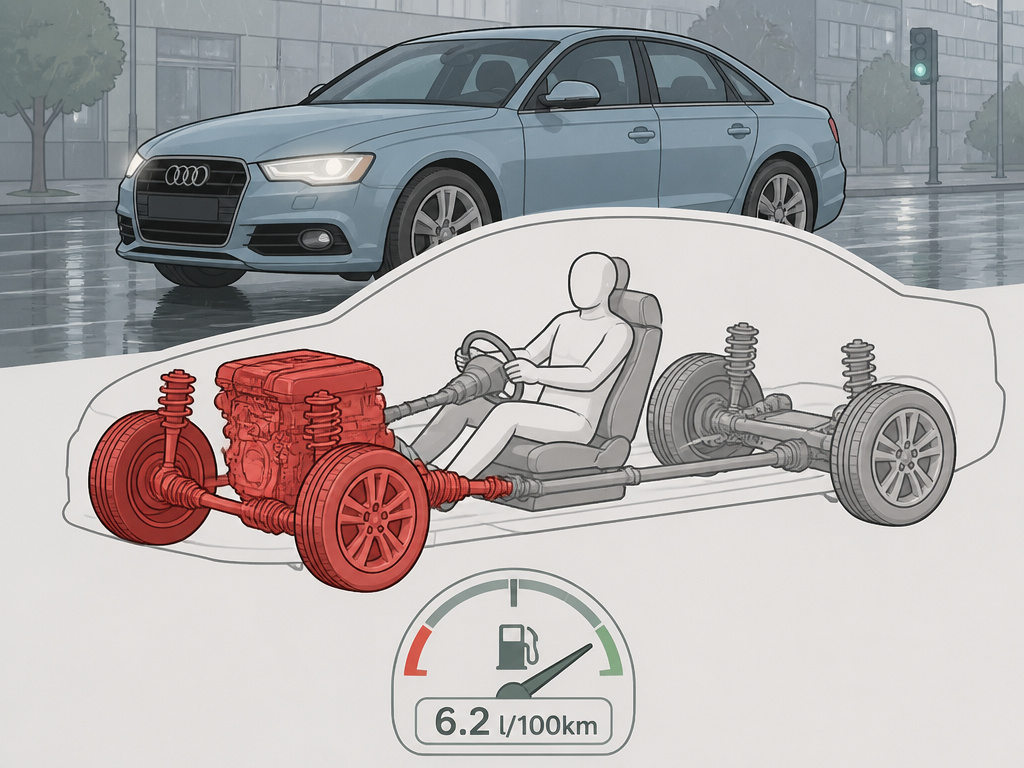
The Case for Front-Wheel Drive (35 TFSI, 35 TDI, etc.):
- Lower Purchase Price: FWD models are almost always the entry point into the A4 lineup.
- Better Fuel Economy: With less mechanical drag (no center differential, rear driveshafts, or rear differential), FWD models post better MPG and lower CO2 figures. The 2024 A4 35 TFSI has a combined consumption of 6.2-7.3 l/100km; the 40 TFSI quattro is slightly higher.
- Lighter Weight: Less hardware means a lighter car, which improves agility and efficiency. The 2024 A4 35 TFSI has an unladen weight of 1,470 kg, while the 40 TFSI quattro starts at 1,560 kg.
- Adequate for Most Conditions: For daily commuting on paved roads, a FWD A4 with a good set of all-season or winter tires is perfectly capable.
The Case for Quattro (40 TFSI and above, S4):
- Superior Traction: This is the undisputed king. Acceleration in wet or snowy conditions is vastly improved. Power is distributed to the wheels with the most grip.
- Enhanced Performance Feel: Quattro provides more neutral handling, especially when cornering under power. It reduces understeer, the natural tendency of a FWD car to push wide in a turn.
- Resale Value: In many markets, especially snowy regions, quattro is a highly desirable feature that protects resale value better than a FWD counterpart.
- The “Ultra” System: Modern A4s use quattro with ultra technology. It’s an on-demand system that can decouple the rear axle completely during cruising to save fuel, then re-engage in milliseconds when needed. It blends FWD efficiency with AWD capability.
If your driving is mostly urban and you prioritize cost and efficiency, the FWD A4 is a rational, polished choice. If you face regular inclement weather, enjoy spirited driving, or simply want the added security, quattro is the defining upgrade. This is the same fundamental choice presented by other luxury brands, like the decision between a rear-wheel drive X3 and one equipped with BMW xDrive.
The Modern Lineup: Decoding the B9 A4
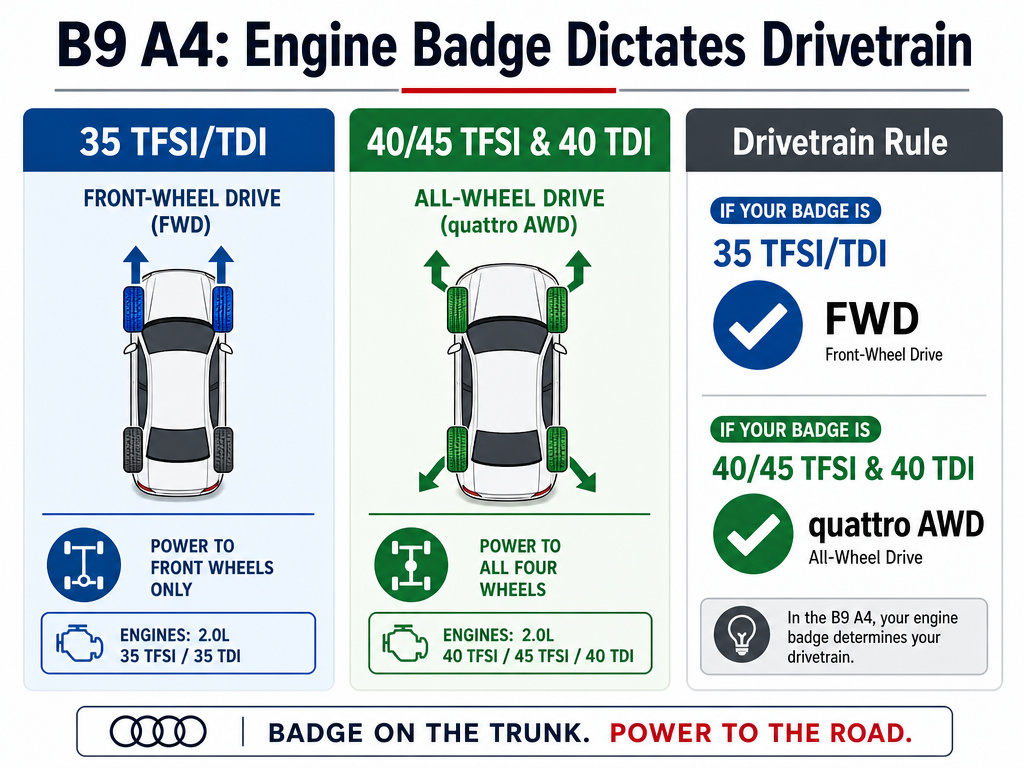 The current generation (B9, 2017 onward) makes the distinction very clear through its model naming.
- Audi A4 35 TFSI: This is the base gasoline engine (150 PS/110 kW). It is exclusively front-wheel drive, paired with a 7-speed S tronic dual-clutch transmission. This is your modern, efficient FWD A4.
- Audi A4 40 TFSI & 45 TFSI: These higher-output engines (204 PS/150 kW and 265 PS) are exclusively paired with quattro all-wheel drive. You cannot get a 40/45 TFSI in FWD.
- Audi A4 35 TDI & 40 TDI: Similar rules apply. The lower-power 35 TDI is typically FWD, while the more powerful 40 TDI gets quattro.
This segmentation is clean. The badge tells you the engine, and the engine dictates the drivetrain. It removes the guesswork for new car buyers. When comparing to a segment like AWD sedans from competitors, Audi’s strategy of reserving AWD for higher trim levels is common, though some rivals offer it across more of the range.
Frequently Asked Questions
Were any Audi A4 models only available with front-wheel drive?
No generation or body style was only FWD. Quattro has always been an option, even if it was less common on certain base models in specific markets. There has always been a choice.
Is a front-wheel drive Audi A4 still a good car?
Absolutely. It’s still an Audi A4, which means a well-built, comfortable, and refined sedan or wagon. You get the same interior quality, technology, and ride comfort. You simply miss the all-weather traction and performance edge of quattro. For many drivers, that’s a perfectly acceptable trade-off for a lower price and better fuel economy.
Does quattro use more fuel than front-wheel drive?
Yes, due to added weight and mechanical drag. The difference in modern cars with “ultra” technology is smaller, often just 0.5-1.0 l/100km, but it still exists. Older, permanent mechanical quattro systems had a more noticeable impact on fuel consumption.
Can I add quattro to a front-wheel drive A4?
No. The drivetrain is a fundamental part of the vehicle’s architecture. Converting a FWD car to AWD would require replacing the transmission, fuel tank, floor pan, rear suspension, and electrical systems. It is cost-prohibitive and not feasible. This is a factory-set configuration, much like the fundamental difference between a Chevrolet Camaro (a rear-wheel drive platform) and an all-wheel drive sedan.
How do I know for sure if my used A4 is FWD or AWD?
- VIN Decoder: This is the most reliable method.
- Model Badge: Check for “quattro” badging on the rear. Its absence suggests FWD, but some owners debadge.
- Visual Inspection: Look under the rear of the car. If you see a differential housing between the rear wheels and half-shafts connecting to them, you have quattro. If you see just a simple rear axle beam or independent suspension with no central differential, it’s FWD.
- Owner’s Manual or Service Book: The original specifications are often noted.
Before You Go
The Audi A4 is a chassis that wears two different suits. One is the efficient, cost-conscious front-wheel drive suit, perfect for the daily grind on dry pavement. The other is the capable, confident quattro suit, ready for rain, snow, and back-road bends.
Your job isn’t to find out if the A4 is front-wheel drive. It’s to find out which specific A4 you’re looking at. Check the badge, decode the VIN, and know the history. That 35 TFSI is a competent FWD cruiser. That 40 TFSI is a quattro-equipped all-rounder. Both are authentic A4s, they just answer the call of the road differently.
