
Can You Add a Heated Steering Wheel to Your Car? OEM Guide
This post contains affiliate links. As an Amazon Associate, we earn from qualifying purchases.
Yes, you can add a heated steering wheel to many cars, but the process splits into three distinct paths with wildly different difficulty, cost, and outcome. The right path depends entirely on whether your car’s factory wiring and steering control module have the dormant hardware for heat. Factory accessory kits, OEM recall upgrades, and full aftermarket retrofits each solve a different piece of the puzzle.
The semiconductor shortage created a documented edge case. For models like the 2023 Ford F-150, the hardware was physically installed but the specific chip in the Steering Column Control Module was missing, making a dealer software-and-module flash the official fix. That’s a rare, free upgrade. For everyone else, adding heat means either a factory-sanctioned accessory kit that replaces the entire steering wheel and clock spring, or a complex aftermarket project that risks airbag systems and requires professional coding.
What follows is the breakdown of those three paths: the plug-and-play factory kits, the recall-specific module swaps, and the professional-grade retrofits. We’ll name the specific tools, the required software, and the one mistake that permanently disables your steering angle sensor.
Key Takeaways
- Factory accessory kits from Honda/Acura exist for specific models (like the 2022 CR-V kit P/N 08U97-TLA-100F) and include a new wheel, switch, and cable reel, they are the only true DIY-friendly option.
- OEM recall programs (Ford’s 22G06, GM’s N222371150) address cars built with incomplete hardware; the dealer replaces the Steering Column Control Module (SCCM) and enables the feature with proprietary software like FDRS.
- Aftermarket retrofits on luxury cars (Porsche, BMW) require a compatible heated wheel, a new control module, and mandatory coding with a factory tool like PIWIS to avoid dashboard errors and a non-functional airbag.
- The clock spring (cable reel) is the most fragile component. Forcing a steering wheel puller bolt too deep, as warned in the Honda manual, shreds the ribbon cable and kills the horn, airbag, and steering controls in one move.
- Steering wheel covers are a thermal barrier. Even the best heated steering wheel covers add a layer of insulation that significantly delays and dampens heat transfer from an OEM element.
The Three Paths to a Heated Steering Wheel
Your car’s build sheet determines everything. Vehicles that left the factory with a heated steering wheel as a paid option but were built during the chip shortage are the easiest case. The wiring and heating element are present, but the module lacks the chip to control it. The 2023 Ford F-150 program 22G06 is the textbook example.
The next tier is cars that never had the option configured. Manufacturers like Honda and Acura sell genuine heated steering wheel kits for models like the CR-V and MDX. These kits include every physical part: a new wheel with the heating element, a new left-side switch, and a new cable reel with the extra pins for heat. They are designed for dealer installation but come with instructions.
The final, most complex path is the true retrofit for luxury or performance models where the manufacturer never offered a kit. This involves sourcing a compatible heated wheel, a matching steering control module that supports heat, and the factory diagnostic software to code the car to accept it. This is not a driveway project.
| Path | Best For | Core Requirement | Professional Tools Needed? |
|---|---|---|---|
| OEM Recall/Program | 2021-2023 trucks/SUVs built during chip shortage | Car has pre-installed heating element | Yes – dealer FDRS/PIWIS for configuration |
| Factory Accessory Kit | Honda, Acura, some Toyota/Lexus models | Manufacturer sells a kit for your exact model | Recommended – requires steering wheel puller, torque wrench |
| Full Aftermarket Retrofit | Porsche, BMW, Mercedes, older models | Compatible heated wheel & control module | Mandatory – factory scanner (PIWIS/ISTA) for coding & calibration |
The part nobody mentions: On a Porsche, the steering angle sensor is integrated into the clock spring. Installing a new control module without immediately performing a steering-angle sensor calibration with PIWIS leaves the stability control (PSM) blind and triggers relentless dashboard warnings.
The labor time in the official bulletins tells the story. Ford’s 22G06 program allots 1.1 hours to replace the SCCM and HVAC module. That’s a fast job for a tech with the software. A full Honda kit installation takes a skilled technician about half a day. The Porsche retrofit? That’s a multi-hour job that ends with a laptop, not a wrench.
The Critical Hardware: It’s All About the Module
The steering wheel itself is just the delivery device. The real magic, and the real obstacle, lives in the Steering Column Control Module (SCCM) and the cable reel. The SCCM is the computer that talks to the heating element. The cable reel is the spinning electrical connector that carries power and signals from the column to the wheel while allowing it to turn.
If your SCCM doesn’t have the hardware or software to manage heat, a new wheel does nothing. This is why Ford’s fix for the F-150 is a module replacement, not a wheel swap. The service bulletin lists three different SCCM part numbers (like ML3Z-3F791-HB for trucks with a power-adjustable column) because getting the wrong one means the column controls won’t work.
The cable reel is even more critical. It’s a precise, fragile ribbon cable coiled inside a plastic housing. The Honda installation guide includes a specific warning: if you thread the steering wheel puller bolts in more than 5 threads, they will hit and destroy the cable reel. That single mistake costs hundreds in parts and disables your airbag.
Technical Snippet: For the 2022 Honda CR-V heated steering wheel kit (P/N 08U97-TLA-100F), the factory torque specification for the new steering wheel bolt is 36 ft-lb. The installation requires a 5.5 mm punch to release the airbag, a steering wheel puller, and the i-HDS diagnostic system to verify system operation after installation.
This is why checking for a factory steering wheel cover compatibility guide matters. A thick aftermarket cover can physically interfere with the clock spring’s rotation or insulate the wheel so effectively the heater seems broken.
Path 1: The Factory Recall & Customer Satisfaction Program
This is the simplest, cheapest path, if you qualify. From 2021-2023, millions of vehicles were built with “delete” options due to the semiconductor shortage. Heated steering wheels were a common casualty. In response, Ford, GM, and others launched free retrofit programs.
- Ford Program 22G06: For 2023 F-150s built between September 2022 and March 2023. The dealer replaces the SCCM (and sometimes the HVAC module) and uses the Ford Diagnostic & Repair System (FDRS) to “Enable Heated Steering Wheel.” The program expires September 30, 2026.
- GM Program N222371150: For 2022-2023 Cadillac XT4, Chevrolet Silverado, and GMC Sierra models built after January 6, 2022. The fix is replacing the heated steering wheel control module (part numbers like 84863347). Allotted labor time is 0.6 hours.
How do you know if you qualify? Your Vehicle Identification Number (VIN) is key. Contact a dealer with your VIN, or check the NHTSA recalls website. If your vehicle is included, the repair is free at any authorized dealer. This is not an upgrade, it’s the manufacturer fulfilling the original build specification.
Trying to force this upgrade yourself on a non-qualified vehicle is a dead end. The FDRS software is restricted to dealer networks, and the “Enable Heated Steering Wheel” function simply won’t appear for a VIN that isn’t flagged for the program.
Path 2: The Genuine Accessory Kit Installation
For models without a recall but with factory support, this is the gold standard. Honda and Acura publish detailed installation instructions for their kits. The 2025 Acura MDX kit (P/N 08U97-TYA-200B) is a complete parts bundle: a new steering wheel, control unit, left switch, cable reel, cord, and bolts.
The process is methodical and requires specific tools. You must disconnect the battery and wait three minutes before touching any airbag components. The airbag is released with a punch. The steering wheel is removed with a puller, using extreme care not to damage the cable reel. Then, you transplant switches and trim from your old wheel to the new heated one before installing the new cable reel and connecting the heater harness.
Before you start: Disconnect the negative battery terminal and wait at least three minutes. The airbag capacitor retains enough charge to trigger deployment during those first 180 seconds. A live airbag can inflate with enough force to cause serious injury if you mishandle the connectors.
While a skilled DIYer with a torque wrench and trim tools can follow these steps, the manuals are clear. Honda’s CR-V guide states: “The information in this installation instruction is intended for use only by skilled technicians… These procedures should not be attempted by ‘do-it-yourselfers.’” The risk isn’t just a broken clip, it’s an inoperative airbag.
If this feels beyond your comfort zone, a professional installation is a wise investment. It ensures the steering wheel replacement is done safely and the heating system is activated correctly.
Path 3: The Professional Aftermarket Retrofit
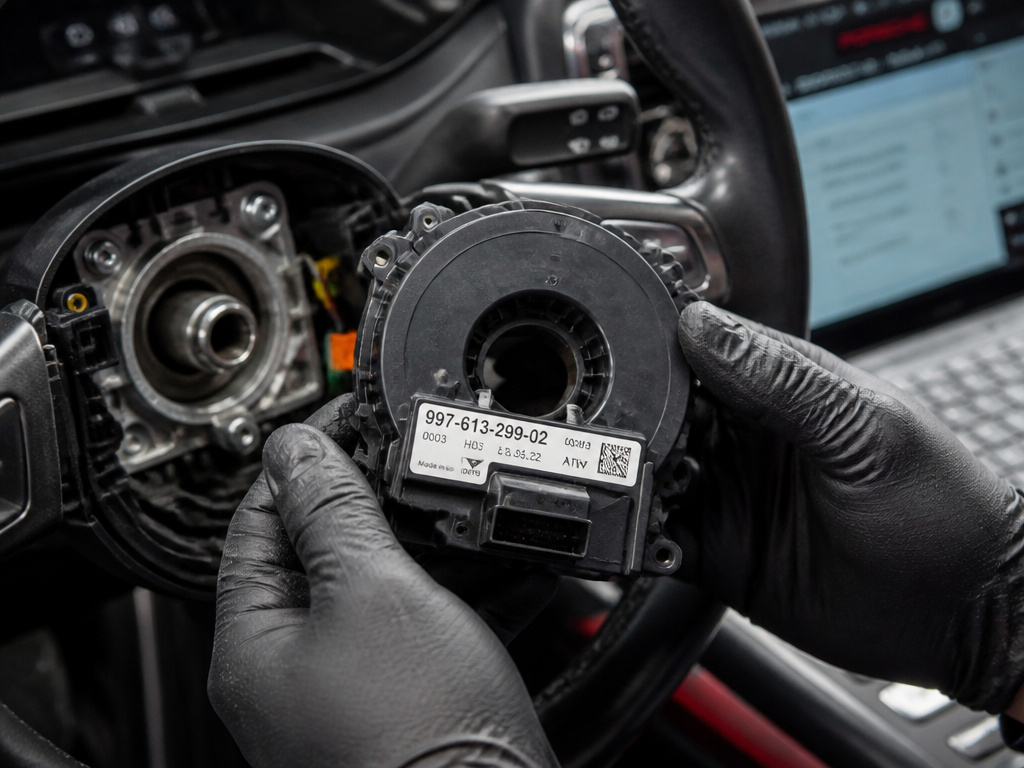
This is for enthusiasts with deeper pockets and a car that never had a factory heated wheel option, think older luxury cars or base-model sports cars. The process mirrors the Porsche example from the research: source a compatible heated wheel, replace the steering control module and clock spring with heated-support versions, and code the car.
The parts hunt is the first challenge. You need a wheel that fits your spline and has the heating element. You also need the correct steering control module. For a 997.2 Porsche, that’s part number 997-613-299-02 for the module and 955-652-611-22 for the heated clock spring.
The coding is non-negotiable. As the Porsche guide states, installing the new module without coding “will result in many error messages.” You must use the factory PIWIS system to code the new module to the car, enable the heated steering wheel function (often with a VIN-specific activation code purchased from the dealer), and then calibrate the steering angle sensor. Miss the calibration and your stability control system is disabled.
This path has no room for error. It’s why even experienced shops often sublet the final coding to a dealership specialist. For a modern car, attempting a full replace steering wheel retrofit without the software plan is a guarantee of a stranded project.
What About Heated Steering Wheel Covers?
This is the most common question and the simplest answer. Heated steering wheel covers exist, and they work. They are standalone units with their own battery or 12V plug-in power source. The best wireless heated covers use rechargeable battery packs for cord-free operation.
They are a fantastic solution for a car you can’t or won’t modify. However, they are an addition, not an integration. They add bulk, can interfere with grip, and their heat pattern is often less uniform than a factory-built element. They also have nothing to do with your car’s internal wiring.
If you go this route, ensure any steering wheel covers you use are thin enough to allow heat transfer if you later install a factory heated wheel. A thick leather steering wheel cover will block most of the warmth.
Frequently Asked Questions
Can I just swap in a heated steering wheel from a higher trim?
Rarely. Unless your car’s wiring harness and SCCM already have the connectors and programming for heat, the new wheel will be cold. You might get the button to light up, but without the control signal from the module, the element gets no power. This is a common dead-end on forums.
Do all Teslas have heated steering wheels?
Most newer Tesla heated steering wheel models (2021 and later Model 3/Y, refreshed Model S/X) include it as standard or a common option. It’s controlled via the touchscreen. Retrofitting it into an older Tesla that lacks it is exceedingly complex and not supported by Tesla Service.
Can I add a heated wheel to my Toyota RAV4?
It depends on the model year. For newer RAV4s, checking if a RAV4 heated steering wheel was a factory option for your trim is the first step. If it was, a dealer may be able to install the OEM parts and program it. For older models, an aftermarket cover is the practical choice.
Is it the same for a Honda CR-V?
Yes. The Honda CR-V heated steering wheel is available as a factory accessory kit (P/N 08U97-TLA-100F for the 2022 model). This is the cleanest integration path. For CR-Vs outside that model year, you’re back to investigating trim swaps or using a cover.
What’s the biggest risk of a DIY installation?
Damaging the clock spring (cable reel). This component handles the airbag, horn, and steering wheel controls. If you break its ribbon cable by forcing the steering wheel, over-tightening bolts, or piercing it with a puller bolt, you face a costly repair and lose critical safety systems.
The Bottom Line
Adding a heated steering wheel is absolutely possible, but it’s not a universal plug-and-play operation. Your first move is always a VIN check for an open recall or satisfaction program, that’s a free fix. Next, search for a genuine factory accessory kit for your exact model; this is the most reliable upgrade path.
If neither exists, you’re looking at a professional-grade retrofit requiring parts sourcing, module replacement, and factory-level coding. For most people, that’s prohibitively expensive and complex. In that case, a high-quality wireless heated steering wheel cover from a reputable brand is the smart, safe, and effective choice. It delivers the warmth without touching a single airbag connector.
