
Toyota RAV4 Automobiles – Your Guide to Warranties & Recalls
This post contains affiliate links. As an Amazon Associate, we earn from qualifying purchases.
Toyota RAV4 warranty coverage is a layered system: a 36-month/36,000-mile basic warranty, an 8-year/100,000-mile hybrid system warranty, a 10-year/150,000-mile hybrid battery warranty, and a 5-year corrosion perforation warranty. The vehicle has been subject to several NHTSA safety recalls, including issues with suspension arms, power steering, and 12-volt battery fire risks, affecting specific model years and production dates.
That layered warranty structure means your coverage changes at different mileage and time markers. The basic warranty handles most things for three years, but critical hybrid components carry much longer protection. Missing the transition point between warranties is how owners get stuck with a four-figure repair bill for a part they thought was still covered.
What follows is a breakdown of each warranty’s fine print, the exact model years and production dates caught in major recalls, and the maintenance schedule that keeps your RAV4 within its coverage terms. By the end, you’ll know which repairs are Toyota’s problem and which ones are yours.
Key Takeaways
- The hybrid battery and control systems are covered for 10 years or 150,000 miles, but the basic bumper-to-bumper warranty drops to just 12 months for air conditioning recharge and wheel alignment.
- A 2020 recall (20TA11) for power steering assist affected only about 50 total vehicles built between July 2019 and February 2020.
- The massive 2023 battery fire recall (23TA13) for 2013-2018 models is being fixed in three phases, with remedies for 2017-2018 models not available until late July 2025.
- Scheduled maintenance every 5,000 miles is non-negotiable for warranty compliance; skipping it gives Toyota grounds to deny a claim.
- Always check your VIN against the NHTSA recalls database before purchase, even for certified pre-owned models.
What Warranties Cover the Toyota RAV4?
The coverage isn’t one blanket. It’s four separate warranties that activate and expire on different schedules. Think of it as concentric circles of protection that shrink over time.
The Basic Warranty is your outermost circle. It covers repairs for defects in materials or workmanship for 36 months or 36,000 miles. This is the “bumper-to-bumper” coverage. There’s a critical carve-out: air conditioning recharge, wheel alignment, and wheel balancing drop to 12-month/12,000-mile coverage. If your A/C blows warm air at 25,000 miles, that’s likely on you.
The Hybrid System Warranty protects the core electrical components for 8 years or 100,000 miles. This includes the hybrid control module, the inverter with converter, and the battery control module. The Hybrid Battery Warranty extends specifically for the battery pack to 10 years or 150,000 miles. These are the longest protections and a major reason people buy the hybrid.
The Toyota Hybrid Battery Warranty is in effect for 10 years or 150,000 miles from the vehicle’s in-service date. This covers repairs needed to correct defects in materials or workmanship of the battery pack.
The Powertrain Warranty (on non-hybrid models) and the Corrosion Perforation Warranty round out the package. The powertrain warranty runs 5 years/60,000 miles. The corrosion warranty covers rust-through on original body panels for 5 years, with no mileage limit.
| Warranty Type | Coverage Period | Key Components Covered | Common Exclusion |
|---|---|---|---|
| Basic New Vehicle | 36 mo / 36,000 mi | Most defects in materials/workmanship | A/C recharge, alignment, balancing after 12 mo/12,000 mi |
| Hybrid System | 8 yr / 100,000 mi | Control module, inverter, converter | Does not cover the hybrid battery itself |
| Hybrid Battery | 10 yr / 150,000 mi | Traction battery pack | Capacity loss below a specified threshold may not be covered |
| Corrosion Perforation | 5 yr / unlimited mi | Original body panel rust-through | Surface rust, corrosion from damage or lack of maintenance |
You must follow the scheduled maintenance in the manual to keep these warranties valid. Using the wrong engine oil or skipping a coolant flush can be grounds for a denied claim. The dealer records every service, and Toyota can access that history.
The Toyota RAV4 Recall History
Recalls are fixes for safety defects, and they’re free. The RAV4 has had a few significant ones. Knowing which ones apply to your model year is the difference between a known, solvable problem and a dangerous surprise.
The NHTSA safety recall 20TA11 is a rare but serious example. Issued in June 2020, it concerned a potential loss of power steering assist. The scope was incredibly narrow. It affected approximately 41 non-hybrid 2019-2020 RAV4s built between early July 2019 and mid-February 2020, and about 5 hybrid models built from mid-December 2019 to mid-February 2020. Total vehicles: around 50. If your RAV4 falls outside those production windows, this recall doesn’t apply.
Where this goes sideways: Ignoring a recall notice because the car “feels fine.” The power steering assist could fail during a tight turn, requiring significantly more force to steer. The remedy was a replacement of the steering gear assembly.
A much larger issue is NHTSA safety recall 23TA13, announced in November 2023. This involves a fire risk related to the 12-volt battery in 2013-2018 RAV4 models. The problem is with some replacement batteries that have smaller top dimensions. If the hold-down clamp isn’t tightened correctly on a small-top battery, the battery can shift during forceful turns. The positive terminal can contact the clamp and short circuit. Toyota is fixing this in three phases, replacing the clamp, tray, and terminal cover. Phase 1 (2013-2014 models) is active. Phase 2 (2015-2016) starts late April 2025. Phase 3 (2017-2018) starts late July 2025.
Other recalls include 20TA08 for front lower suspension arm separation on certain 2019-2020 models, and 20TA04 for engine block issues that could lead to stalling or fire in non-hybrid 2019-2020 models (the hybrid version had a separate document).
| Recall Code | Model Years Affected | Primary Safety Issue | Approximate Vehicles | Remedy |
|---|---|---|---|---|
| 20TA11 (20V373) | 2019-2020 RAV4 & RAV4 HV | Loss of power steering assist | ~50 | Replace steering gear assembly |
| 23TA13 (23V-734) | 2013-2018 RAV4 | 12V battery short circuit / fire risk | ~1,854,000 | Replace battery hold-down clamp, tray, and positive terminal cover |
| 20TA08 (20V286) | 2019-2020 RAV4 & RAV4 HV | Front lower suspension arm separation | Varies | Replace front lower suspension arms |
| 20TA04 (20V064) | 2019-2020 RAV4 (non-hybrid) | Engine block defect / stall or fire | Varies | Inspect and replace engine assembly or short block |
Checking for open recalls is straightforward. Use your 17-digit VIN on the NHTSA recalls website. This is non-negotiable before buying a used RAV4. A dealer should perform all open recall repairs before selling a certified pre-owned vehicle, but private sales are a different story.
Scheduled Maintenance and Warranty Compliance
Your warranty is a contract. Toyota’s side is to fix defects. Your side is to maintain the vehicle as specified. The 2024 RAV4 Hybrid maintenance schedule calls for service every 5,000 miles or six months, whichever comes first.
The 5,000-mile service is not just an oil change. It’s a multi-point inspection. Technicians check brake fluid, coolant level and condition, drive shaft boots, steering linkage, and the HV battery cooling intake filter. That last one is specific to hybrids. A clogged filter can cause the hybrid battery to overheat, leading to reduced performance and potential long-term damage.
Clean the HV battery cooling intake filter every 20,000 miles. It’s behind a small vent, usually in the rear seat area. Letting it clog is like putting a blanket over a laptop fan—the system can’t shed heat.
Here is the critical path for the first 30,000 miles: 1. 5,000 Miles: Oil and filter change, tire rotation, multi-point inspection. 2. 10,000 Miles: Repeat 5,000-mile service. 3. 15,000 Miles: Repeat 5,000-mile service. Inspect brake pads and discs. 4. 20,000 Miles: Repeat 5,000-mile service. Clean the HV battery cooling filter. 5. 25,000 Miles: Repeat 5,000-mile service. 6. 30,000 Miles: Repeat 5,000-mile service. Replace engine air filter and cabin air filter.
Skipping these services gives Toyota a documented reason to deny a warranty claim. If your engine seizes at 28,000 miles and there’s no oil change record past 15,000, you will have a very difficult argument. Keep all receipts, even if you do the work yourself. Document the date, mileage, and exact parts used—specifically the recommended oil for the Toyota RAV4.
Model Year Changes and Known Issues
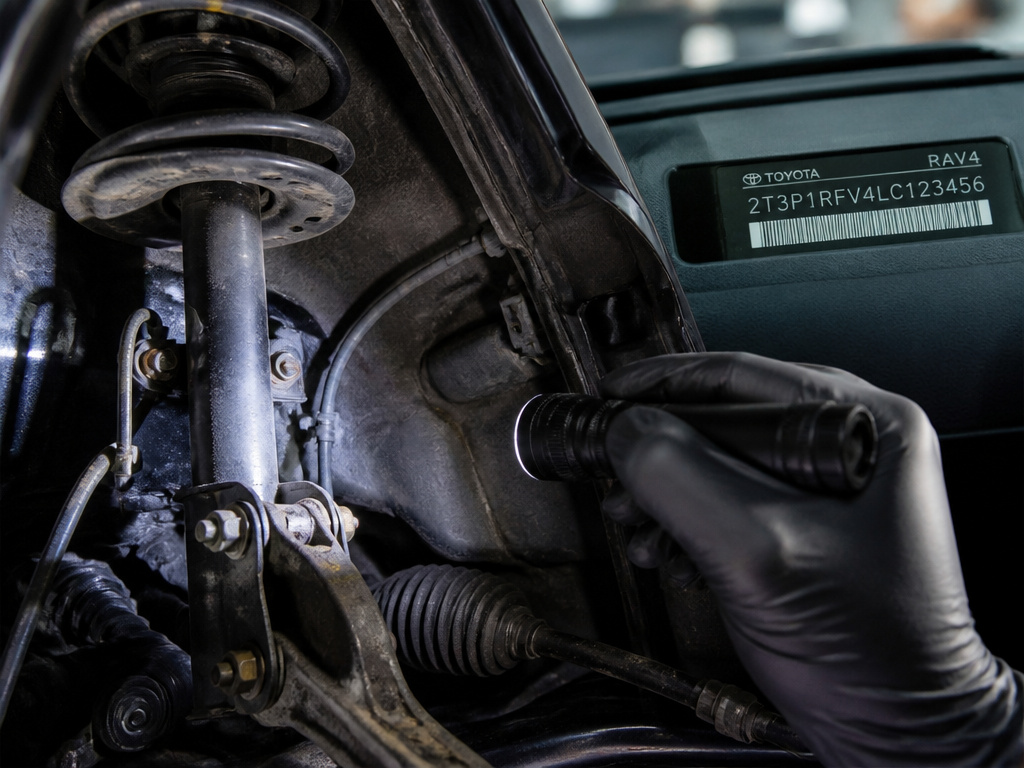
The RAV4 has evolved. Knowing where the trouble spots are by generation helps you inspect a used model or understand your own vehicle’s quirks.
The fifth-generation model (2019-present) brought the TNGA-K platform, a more powerful engine, and updated hybrid systems. It also introduced the recalls discussed earlier. The 2019-2020 model years are the ones to scrutinize for suspension and engine block recalls. By the 2021 model year, many of these early production issues had been resolved.
The fourth generation (2013-2018) is generally robust but is squarely in the middle of the massive 12-volt battery fire recall. It also marks the period where Toyota refined the hybrid system used today. These models are good values if the recall remedy has been performed. Always verify.
Common mistake: Assuming a newer model year is flawless. The 2020 RAV4 Hybrid had a specific power steering recall. Always check the VIN, regardless of the year.
Common issues outside of recalls include occasional infotainment system glitches, wind noise from the side mirrors on some 2019 models, and a somewhat coarse engine note under hard acceleration in the hybrid. These are generally not safety-related and are often addressed by software updates or minor adjustments at the dealer.
For owners looking to personalize or enhance their SUV, popular additions include all-terrain tires for improved off-pavement capability, roof racks for extra gear storage, and dash cams for security and incident documentation.
The Ownership Experience: Costs and Considerations
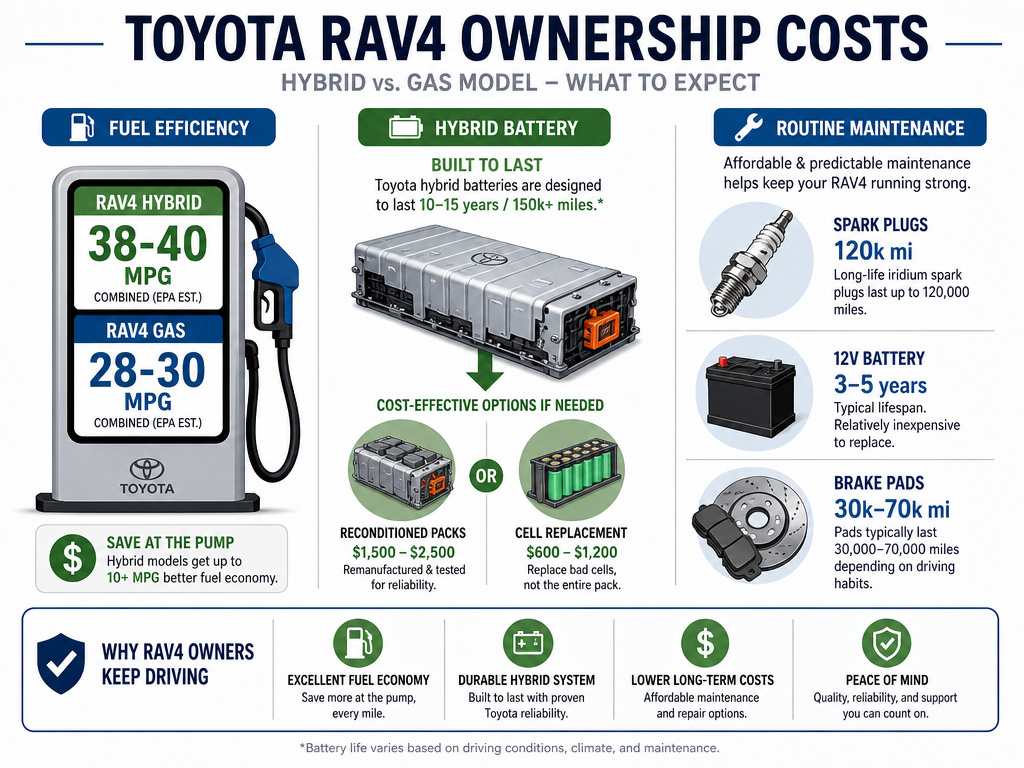
Beyond the warranty, you own the operating costs. The RAV4 is relatively affordable to maintain, but the hybrid adds a few specific considerations.
Fuel costs are a clear win for the hybrid. Real-world mileage often hits 38-40 MPG combined. The non-hybrid averages around 28-30 MPG. Insurance costs are typical for the compact SUV segment. Depreciation is among the best in class, a key Toyota strength.
The hybrid system does introduce unique potential costs. While the battery is under warranty for a long time, its eventual replacement is expensive. Out-of-warranty, a new hybrid battery pack is a significant investment. However, third-party reconditioned packs and individual cell replacements are becoming more common and affordable.
Other wear items are standard. Brake pads often last longer on hybrids due to regenerative braking. Spark plugs on the 2.5-liter engine have a long service interval, around 120,000 miles. The car battery in the hybrid is a standard 12V auxiliary battery, not the large traction battery. It can fail like any other battery.
If you plan to keep the vehicle long-term, budget for larger services at higher mileages: transmission fluid service, coolant replacement (both engine and inverter coolant), and potentially brake fluid flushes. Using quality parts like the best spark plugs for RAV4 when the time comes ensures longevity.
For accessories that protect your investment, consider seat covers to preserve the upholstery and a quality RAV4 bike rack if you’re an active owner. These don’t affect warranty but preserve resale value.
Frequently Asked Questions
What is the basic warranty on a 2024 Toyota RAV4?
The basic bumper-to-bumper warranty is 36 months or 36,000 miles, whichever comes first. However, coverage for air conditioning refrigerant recharge, wheel alignment, and wheel balancing drops to just 12 months or 12,000 miles.
How long is the Toyota RAV4 hybrid battery warranty?
The hybrid battery warranty is 10 years or 150,000 miles from the original in-service date, whichever occurs first. This covers defects in the high-voltage traction battery pack. It’s separate from the 8-year/100,000-mile hybrid system warranty.
How do I check if my Toyota RAV4 has an open recall?
Go to the National Highway Traffic Safety Administration (NHTSA) website at nhtsa.gov/recalls. Enter your vehicle’s 17-character VIN. The tool will show all unrepaired recalls associated with your vehicle. You can also call any Toyota dealership with your VIN.
Is the 2019 Toyota RAV4 a reliable model?
The 2019 RAV4 was the first model year of the current generation and was subject to several recalls, including for the suspension arms and engine block. Once these recalls are performed, it can be a reliable vehicle. It’s crucial to verify all recall work is complete before purchasing a used 2019 model.
What maintenance does a Toyota RAV4 hybrid require?
Follow the schedule in your maintenance guide. The core requirement is service every 5,000 miles or 6 months. This includes an oil change, tire rotation, and a multi-point inspection. Every 20,000 miles, the hybrid battery cooling intake filter must be cleaned. Major fluid changes (engine/inverter coolant) occur at 100,000+ mile intervals.
Can I do my own maintenance without voiding the Toyota warranty?
Yes, but you must keep detailed records. The Magnuson-Moss Warranty Act protects you. Keep receipts for parts (like oil and filters) and a log with the date, mileage, and work performed. Use parts that meet Toyota specifications. If a warranty claim arises, you must prove maintenance was performed on schedule.
Before You Go
The Toyota RAV4’s warranty is strong where it counts, especially on the hybrid components. Its recall history is specific, not blanket—knowing your model’s production date is key. The ownership cost hinges on adhering to that 5,000-mile service ritual. Check those recalls, keep those records, and that SUV will cover the miles. For those moving into the electric future, the same principles apply to models like the Toyota bZ4X. It’s all about knowing what’s covered, what’s been fixed, and what you need to do.
