
Guide to Ferrari F40 Specs, Performance, Engine & Key Features
This post contains affiliate links. As an Amazon Associate, we earn from qualifying purchases.
The Ferrari F40 is defined by its 2.9-liter twin-turbo V8 (Tipo F120A), producing 478 horsepower, a kerb weight of 1100 kg, and a claimed top speed of 201 mph. It was the last car approved by Enzo Ferrari, built as a spartan, raw driving machine to celebrate Ferrari’s 40th anniversary, with just over 1,300 units produced between 1987 and 1992.
That 201 mph claim wasn’t just marketing. It made the F40 the first production car to officially break the 200 mph barrier, a direct challenge to the technologically complex Porsche 959. The car’s entire philosophy was a reaction against plush interiors and electronic aids—a statement that performance came from lightweight materials, forced induction, and driver skill, not luxury.
What follows is a breakdown of what made the F40 tick: the exact specs of its legendary engine, the race-derived chassis that kept it under 2,500 pounds, the subtle but critical differences between model years, and the very real ownership considerations that separate a museum piece from a driver’s car.
Key Takeaways
- The F40’s 2.9-liter V8 used twin IHI water-cooled turbochargers running 1.1 bar of boost and Weber-Marelli electronic injection to make 478 hp.
- Its dry weight of 1100 kg was achieved through extensive use of composites like Kevlar and a brutally minimalist interior with cloth seats and pull-cord door handles.
- Two distinct engine types were used: the early Tipo F120A and the later Tipo F120 D with catalytic converters, which altered power and torque delivery.
- Major service items include the rubber fuel cells, which have a 10-year lifespan and require expensive replacement, and brittle Kevlar body panels prone to cracking.
- For a pure, analog supercar experience, the European-spec, non-catalyzed F120A cars are considered the most visceral, though all F40s deliver an unfiltered driving engagement.
The F40’s 2.9-Liter Twin-Turbo V8: How It Made 478 HP
Look past the iconic slatted engine cover. The heart of the F40 is the Tipo F120A, a 90-degree V8 with an 81.9 mm bore and a 69.5 mm stroke for a total displacement of 2936 cc. This wasn’t a clean-sheet design. It was an evolution of the unit from the 288 GTO, but with critical changes that pushed it into new territory.
The F40’s engine, designated Tipo F120A, featured twin water-cooled IHI turbochargers running at 1.1 bar of boost, paired with Behr intercoolers. A Weber-Marelli IAW combined electronic injection and ignition system managed the 7.0:1 compression ratio to produce 478 SAE net horsepower at 7000 rpm and 426 lb-ft of torque.
The choice of IHI turbos over the KKK units used in Ferrari’s contemporary F1 cars was deliberate. Engineers found the IHI units offered better drivability and throttle response for a road car. The turbos are water-cooled for durability, and the massive Behr intercoolers mounted atop the engine are among the most recognizable visual features under the rear clamshell.
The engine uses a dry-sump lubrication system. This allows the engine to be mounted lower in the chassis for a better center of gravity and prevents oil starvation during extreme cornering. The five-speed manual transmission is mounted directly to the back of the engine, forming a rigid transaxle, and features a limited-slip differential.
Why the specific turbo choice mattered: IHI’s turbo technology in the late 80s provided a slightly faster spool time than the alternatives Ferrari tested. In a car with this much power and relatively short gearing, lag management was everything. The hit of boost feels progressive, not binary, which is why the F40, despite its reputation, can be driven smoothly.
Chassis, Weight, and That Iconic Body: A Race Car for the Road
Ferrari called it a “racing car for the road,” and the structure backed the claim. The chassis is a tubular steel space frame reinforced with bonded carbon fiber and Kevlar inserts at critical stress points like the sills, floorpan, and bulkheads. This created an immensely stiff central safety cell.
The body panels are made from lightweight composites, primarily Kevlar. This saved hundreds of pounds over steel. The downside is that Kevlar becomes brittle with age and exposure. Crazing, micro-cracks, and delamination are common issues on unrestored cars, and repair is a specialist’s job.
| Chassis & Body Component | Material / Specification | Owner Consideration |
|---|---|---|
| Primary Structure | Tubular steel space frame | Highly rigid; rarely an issue if undamaged. |
| Reinforcement Panels | Bonded carbon fiber | Inspect bonding points for stress cracks. |
| External Body Panels | Kevlar composite | Prone to cracking and crazing with age; expensive to repair correctly. |
| Front Suspension | Unequal-length wishbones, coil springs, Koni dampers, anti-roll bar | The 1991+ adjustable suspension option allows 20mm of ride height change. |
| Brakes | 330mm ventilated discs, four-piston Brembo calipers | Strong for the era; pad choice is critical for street vs. Track use. |
| Wheels & Tires (Original) | Speedline 17″, 8″ front / 10″ rear, Pirelli P Zero | Original tires are unsafe; modern performance rubber is a mandatory upgrade. |
The suspension is pure double-wishbone at all four corners, with coil springs over Koni shock absorbers. In 1991, Ferrari introduced an optional adjustable suspension system that allowed the ride height to be raised or lowered by 20 mm—useful for driveways or track optimization.
Where this goes sideways: Ignoring the 10-year service life on the rubber fuel cells. They are a sealed, safety item. When they degrade, they can contaminate the fuel system with rubber particles, leading to injector and pump failures. US-spec cars got more durable aluminum tanks.
The car’s aerodynamics, including the massive fixed rear wing and downturned nose, were designed for stability at over 200 mph. They generate real downforce, which is palpable at legal speeds. The F40 feels planted in a way few cars of its era did.
F40 Competizione vs. Standard: The Race-Bred Evolution
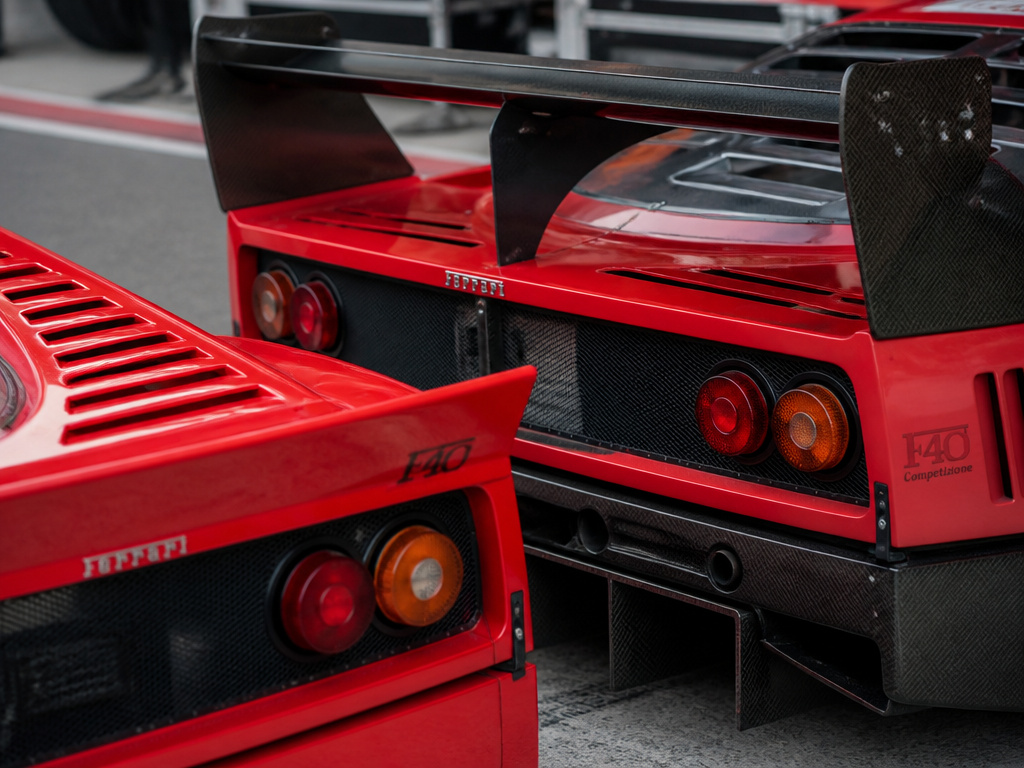 The F40 LM and Competizione models are a different breed. Born from a French importer’s desire to race at Le Mans, these are essentially factory-built race cars. Ferrari’s official Ferrari F40 Competizione page details the stark upgrades.
The Competizione’s engine was radically reworked. Displacement stayed at 2.9 liters, but power jumped to 515 kW (700 hp) at 8100 rpm thanks to higher boost, revised internals, and a 7.7:1 compression ratio. It used a Weber-Marelli electronic injection system specific to the race application.
| Aspect | F40 Standard | F40 Competizione |
|---|---|---|
| Engine Output | 478 hp @ 7000 rpm | 700 hp @ 8100 rpm |
| Compression Ratio | 7.0:1 | 7.7:1 |
| Clutch | Twin-plate | Multi-plate |
| Fuel Tank | 120L rubber cells | Racing fuel cell |
| Bodywork | Kevlar composite | Extensive lightweight composites & race aerodynamics |
| Purpose | Road-legal supercar | Homologated GT race car |
The chassis was further lightened, the aerodynamics were massively enhanced with larger wings and diffusers, and the interior was stripped to a bare roll cage. Only about ten of these cars were built. They represent the absolute pinnacle of the F40’s performance envelope, but they are not road cars. Their value reflects that, often commanding multiples of a standard F40’s price at auction.
When comparing legends, the F40’s raw approach stands in stark contrast to the technological showcase of the Porsche 959. While the 959 was a marvel of all-wheel-drive and computer control, the F40’s philosophy was pure, analog feedback.
Model Year Evolution: F120A, F120 D, and U.S. Specifications
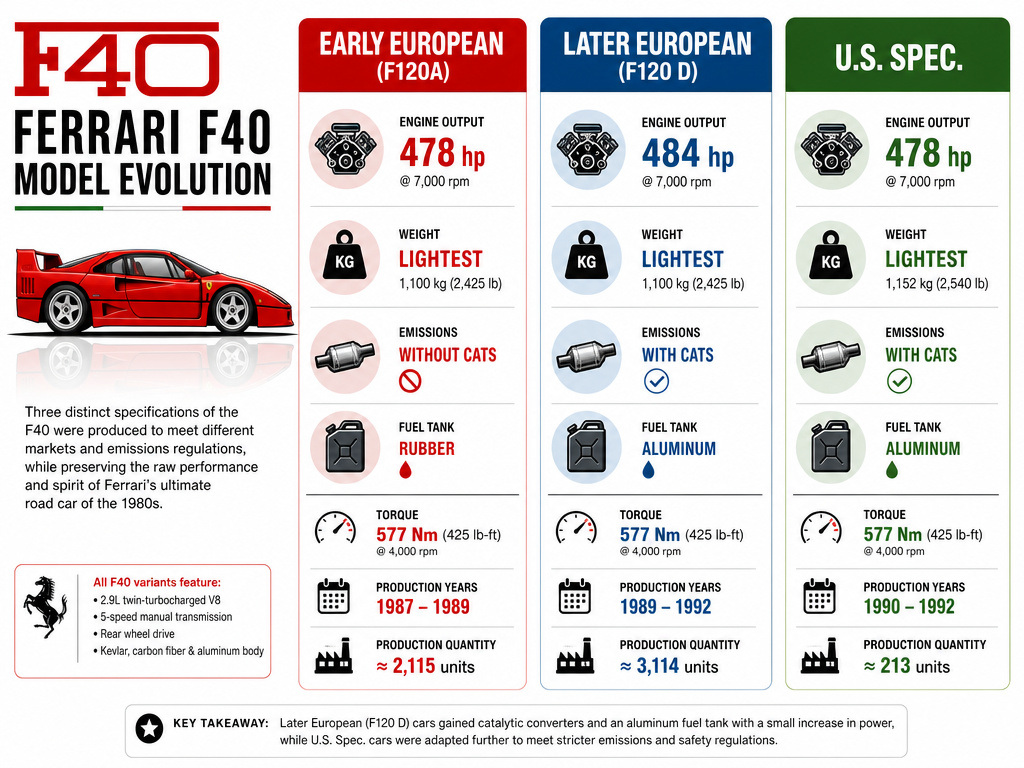 Not all F40s are identical. The car evolved during its five-year production run, leading to three main variants that affect driving character and value.
- Early European (1987-1990): These cars have the Tipo F120A engine without catalytic converters. They are the lightest, loudest, and most responsive. The engine produces its 478 hp and 426 lb-ft of torque with a freer-breathing exhaust. This is the spec most enthusiasts seek for the purest experience.
- Later European (1991-1992): These cars received the Tipo F120 D engine. To meet new emissions regulations, catalytic converters were added. The intake valve timing was altered to compensate for exhaust back-pressure. Official figures list a slight power increase to 484 hp, but torque dropped to 424 lb-ft and arrived 500 rpm later at 4500 rpm. The character is marginally tamed.
- U.S. Specification (1991-1992): Based on the F120 D engine, these cars had additional changes. They featured taller gearbox ratios to meet noise regulations, side-impact door beams, and—critically—the replacement of the perishable rubber fuel cells with aluminum tanks. While sometimes considered less “pure,” the aluminum tank is a permanent fix for a known failure point.
The adjustable suspension option became available in 1991 across all markets. Another early change was the deletion of the sliding Plexiglas side windows after the first 50 cars, replaced with conventional roll-down glass.
The part nobody mentions: The engine designation stamped on the block is the definitive way to tell an F120A from an F120 D. Registry documents and build sheets can be vague or incorrect. For a seven-figure car, confirming this spec in person is non-negotiable.
These variations mean shopping for an F40 requires a clear goal. Do you want the rawest, most collectible early car, or a later, slightly more usable example with the desirable suspension option and potentially more durable fuel tank? The price difference reflects the market’s preference for purity.
Ownership Realities: It’s Not a 458
Buying an F40 isn’t like buying a modern Ferrari. It’s a commitment to maintaining a complex, hand-built artifact from the 1980s. The driving experience is the reward, but the process demands respect.
First, the fuel cells. If your car has the original rubber bladders and they haven’t been replaced in the last decade, budget for a five-figure replacement immediately. It’s not a suggestion; it’s a mandatory safety and reliability item. The job requires dropping the entire rear subframe and fuel system.
Second, the Kevlar body. It cracks. Sun exposure, temperature cycles, and minor impacts can cause spider-webbing and delamination. Proper repair isn’t a simple fill-and-sand; it requires composite specialists. A full, show-quality respray on an F40 is an astronomical undertaking because of the material.
Third, it’s a raw machine. The cabin is incredibly loud—a combination of engine, turbo, transmission whine, and road noise. The unassisted steering is heavy at low speeds. The clutch is stiff. The lack of sound insulation means you hear every creak and pop of the chassis flexing. This isn’t a fault; it’s by design. But it makes a long trip a physical undertaking.
For perspective on maintaining a high-strung, exotic powertrain, the procedures in a factory Ferrari F40 workshop manual are essential. This isn’t a car for a general mechanic.
Its character is the polar opposite of a modern, tech-laden hybrid supercar like the Lamborghini Temerario. You trade seamless speed and comfort for a visceral, mechanical connection. You don’t drive an F40; you operate it.
Performance Legacy and Lasting Impact
The F40’s performance numbers remain impressive today. The 0-60 mph claim of 3.7 seconds and the 201 mph top speed set a benchmark that defined the “supercar” for a generation. More importantly, it set a philosophical template for Ferrari.
It proved there was an insatiable market for limited-edition, extreme flagships. The production cap lessons learned from the F40’s over-subscription directly led to the strictly enforced limits on the F50 (349 units), Enzo (399 units), and LaFerrari (499 units). It re-established Ferrari’s performance crown and became the last car personally approved by Enzo Ferrari, cementing its mythical status.
Its influence is visible in every subsequent limited-series Ferrari. The focus on lightweight materials, the celebration of the engine as a centerpiece, and the prioritization of driver engagement over isolated comfort all started here. While a modern American supercar like the Corvette ZR1 can match or exceed its performance metrics with advanced tech, it cannot replicate the F40’s singular, analog intensity.
The F40 wasn’t about being the most sophisticated car on the road. That was the Porsche 959’s job. It was about being the most thrilling. In that, it succeeded completely, creating a legacy that has only grown stronger with time. It is the definitive analog supercar.
Frequently Asked Questions
What is the top speed and 0-60 time of the Ferrari F40?
Ferrari claimed a top speed of 201 mph and a 0-60 mph time of 3.7 seconds. The 201 mph figure made it the first production car to officially break the 200 mph barrier. Real-world tests of well-maintained examples often confirm these numbers are achievable.
How many Ferrari F40s were made?
Ferrari produced 1,311 to 1,315 F40s between 1987 and 1992. The initial planned run was only 400 units, but overwhelming demand led to the increased production. Of these, 213 were built for the United States market.
What is the difference between the F40 and the F40 Competizione?
The F40 Competizione (and its predecessor, the F40 LM) is a factory-built race car. It features a tuned engine producing 700 hp, a multi-plate clutch, a full roll cage, stripped interior, and extensive aerodynamic modifications. Only about ten were built for customer racing programs.
Is the Ferrari F40 reliable?
As a hand-built 1980s supercar, “reliable” is relative. Its mechanical components, like the V8 engine and gearbox, are robust if maintained. However, it has known age-related failure points: the rubber fuel cells require replacement every 10 years, and the Kevlar body panels can crack. It demands specialist care and a generous maintenance budget.
Why is the Ferrari F40 so special?
It is the last car approved by Enzo Ferrari, built to celebrate the company’s 40th anniversary. It championed a raw, lightweight, and driver-focused philosophy in an era of increasing electronic complexity. Its combination of a twin-turbo V8, extensive composite materials, and a spartan interior created an unfiltered driving experience that is irreplicable today.
The Bottom Line
The Ferrari F40 isn’t defined by a single spec sheet. It’s defined by a feeling. The blast of boost from the IHI turbos, the direct communication through the unassisted steering wheel, the smell of hot Kevlar and exhaust after a hard drive—this is a machine that engages every sense. While later models like the Competizione pushed the boundaries of outright speed, the standard F40’s genius was in its brutal simplicity. It remains the benchmark for analog supercar thrill, a raw celebration of power and weight that modern regulations and digital interfaces will never allow again. For that, it is immortal.
