
What Is Uninsured Motorist Coverage? A Guide to State Laws
This post contains affiliate links. As an Amazon Associate, we earn from qualifying purchases.
Uninsured motorist coverage is an optional or required addition to your auto policy that pays for your medical bills and vehicle repairs if you’re hit by a driver with no insurance or insufficient insurance. It comes in two main types: Bodily Injury (UMBI) and Property Damage (UMPD), and it often applies to hit-and-run accidents. You buy it to protect yourself from the financial gap left by another driver’s lack of coverage.
That gap is real, and it’s measured in state law. Illinois mandates at least $25,000 per person and $50,000 per accident for UMBI, and caps the UMPD deductible at $250. Texas sets its UMPD deductible at the same $250. These aren’t just numbers on a page, they’re the floor of protection your state says you need because roughly 13% of drivers on the road carry no insurance at all.
What follows is a breakdown of the two coverage types, a state-by-state map of where it’s mandatory, and the critical differences between UM and your other policies like collision insurance. You’ll also see when it makes sense to match your UM limits to your liability coverage, and the one situation where even having UM might still leave you paying out of pocket.
Key Takeaways
- Uninsured Motorist coverage splits into Bodily Injury (UMBI) for medical costs and Property Damage (UMPD) for car repairs, with state laws dictating availability and minimums.
- In states like Illinois and Texas, the law caps the UMPD deductible at $250, which is often far lower than a standard collision deductible.
- Hit-and-run incidents are typically covered under UMBI, but UMPD coverage for hit-and-run damage varies by state and may require you to use collision coverage instead.
- Even if your state doesn’t require UM, turning it down means accepting the risk of paying tens of thousands in medical and repair bills if an uninsured driver hits you.
- Your health insurance does not cover lost wages or pain and suffering; UMBI does, which is why it’s a crucial supplement.
The Two Types of Uninsured Motorist Coverage
Don’t think of it as one blanket policy. Insurance companies break uninsured motorist protection into two distinct buckets, each with a specific job. Getting this split wrong is how people end up with a policy that doesn’t cover their actual loss.
Uninsured Motorist Bodily Injury (UMBI) handles the human cost. If an uninsured driver injures you or your passengers, UMBI pays for medical expenses, lost wages if you can’t work, and even compensation for pain and suffering. This is the coverage that plugs the biggest financial hole, your health plan might cover the hospital bill, but it won’t replace your income. GEICO explicitly lists these covered expenses in its policy descriptions, making UMBI a direct financial backstop for your recovery.
Uninsured Motorist Property Damage (UMPD) deals with the metal. It pays to repair or replace your vehicle after an accident with an identified, at-fault uninsured driver. The catch is in the word “identified.” Some states exclude hit-and-run incidents from UMPD, forcing you to use your collision coverage instead. Furthermore, states like Texas and Illinois impose a specific deductible for this coverage. As noted by the Texas Department of Insurance guide, “The deductible for uninsured/underinsured coverage is $250.” This is a fixed, often lower cost compared to your chosen collision deductible.
A standard auto policy might include collision, but that only pays for damage to your car regardless of fault. UMPD, where available, can cover damage to your car and other property like a fence or garage door, but only when the uninsured driver is known.
What Uninsured Motorist Coverage Actually Covers
The simple answer is: it covers the bills the at-fault driver’s insurance should have paid. The practical answer involves a short list of scenarios and a longer list of state-specific fine print.
First, the core scenarios. Your UM coverage kicks in when: * You’re hit by a driver who carries no auto insurance whatsoever. * You’re hit by a driver whose policy limits are too low to cover your total damages (this is the “underinsured” part). * You’re the victim of a hit-and-run accident (coverage type depending on your state).
Now, the fine print. This is where people get tripped up. UMBI generally has no deductible. You file a claim, and it pays out according to your policy limits after the other driver’s insurance (if any) is exhausted. UMPD often carries that state-mandated $250 deductible. More critically, UMPD may not apply if the other driver is unidentified, as in a hit-and-run. In that case, you’re relying on your collision coverage and its higher deductible.
| Scenario | Coverage That Likely Applies | Key Limitation |
|---|---|---|
| Hit by an uninsured driver, medical injuries | UMBI | Must meet your policy’s injury threshold. |
| Hit by an uninsured driver, car damage | UMPD (if available) or Collision | UMPD may require a $250 deductible; may not cover hit-and-runs. |
| Hit by an underinsured driver, medical injuries | Underinsured Motorist Bodily Injury (UIMBI) | Only pays the difference between their limits and yours. |
| Hit-and-run, car damage only | Collision | UMPD often requires an identified driver. |
The table shows the split. Relying solely on collision for hit-and-run damage means paying your chosen deductible, which could be $500, $1000, or more. Knowing whether your state’s UMPD includes hit-and-run protection changes the math on your out-of-pocket costs immediately after an accident.
Where Is Uninsured Motorist Coverage Required?
This isn’t a national rule. Your obligation to carry UM coverage depends entirely on your zip code. The map is a patchwork, and living near a state line means the rules can change with a 20-minute drive.
Common mistake: Assuming your state’s rules are the norm. New Hampshire doesn’t require any auto insurance at all, but if you buy a policy there, it must include UM. Virginia lets you opt out for a fee. Rhode Island only requires UM if you choose liability limits above the state minimum.
A cluster of states mandate both UM and UIM coverage. This includes Illinois, Connecticut, Maryland, and Minnesota. The Illinois Department of Insurance definitions page states the law clearly: uninsured motorist limits must be at least $25,000 per person and $50,000 per accident. Other states, like Massachusetts and South Carolina, only require UM coverage, not UIM. Then there are “no-fault” states like Michigan and Florida, where your own PIP insurance handles injuries regardless of fault, but UM can still play a role for severe cases or property damage.
Even in states where it’s optional, insurers are usually required to offer it to you. You have to formally reject it in writing. Before you sign that waiver, understand what you’re giving up. You’re betting that you’ll never be hit by one of the millions of uninsured drivers, a bet with your savings account on the line.
UMBI vs. UMPD vs. Your Other Insurance
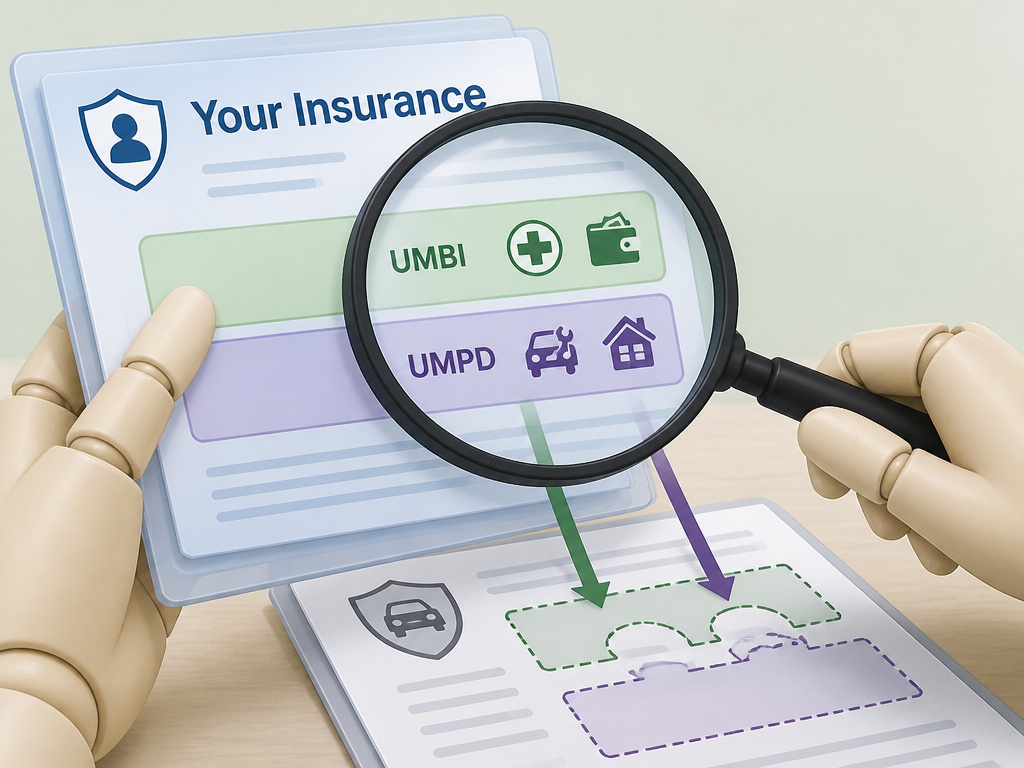 This is where coverage overlaps, and where gaps appear. You already have liability insurance, collision, comprehensive, and maybe health insurance. Where does UM fit?
Think of UM as a specialized backup for your liability coverage. Your liability insurance pays for the other guy’s problems when you’re at fault. UM pays for your problems when the other guy is at fault but can’t pay. If you have health insurance, it will cover your medical bills, but UMBI goes further. It covers deductibles and co-pays your health plan might charge, plus lost wages and pain and suffering, things health insurance never touches.
The real confusion comes with UMPD and collision. Both pay for your car’s repairs after an accident with an uninsured driver. The difference is fault and scope. Collision pays no matter who caused the accident. UMPD only pays when the other driver is at fault and uninsured. However, UMPD can cover more than just your car; it might extend to other property you own that was damaged in the incident. Choosing between leaning on UMPD or collision depends on your state’s rules and your insurance deductible amounts.
TL;DR: UMBI supplements your health insurance for non-medical costs. UMPD supplements collision for at-fault, uninsured driver incidents. They’re layers, not replacements.
How Much Uninsured Motorist Coverage Do You Need?
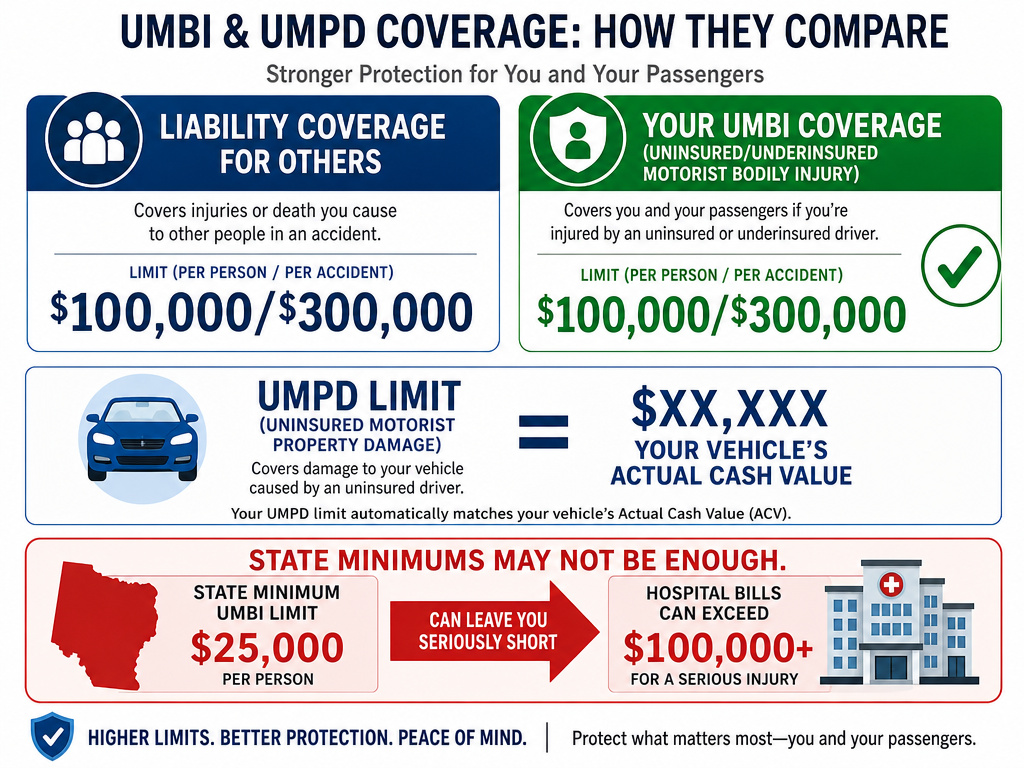 A good rule is to match your UM limits to your liability limits. If you carry $100,000/$300,000 in bodily injury liability, set your UMBI to the same. This ensures you have the same level of protection for yourself as you’re required to have for others. For UMPD, a common recommendation is to set the limit to match the actual cash value of your vehicle.
States that require UM often set minimum limits that are shockingly low, like Illinois’s $25,000 per person. An extended hospital stay can burn through that in days. The Texas Department of Insurance guide notes you can usually add more coverage in $5,000 increments. Don’t just take the minimum. Assess your insurance coverage needs based on your assets, your vehicle’s value, and your tolerance for risk.
Where this goes sideways: Dropping UM coverage because your state doesn’t require it. The one accident with an uninsured driver could cost you the $250 deductible under UMPD versus your $1,000 collision deductible, plus tens of thousands in medical bills your health plan won’t fully cover. That’s a financial hit that stalls lives.
When reviewing your policy with your agent, ask two questions: “Does my UMPD cover hit-and-runs in this state?” and “What is the exact deductible for UMPD versus my collision deductible?” The answers dictate your real-world costs after an accident.
Frequently Asked Questions
Does uninsured motorist coverage have a deductible?
Uninsured Motorist Bodily Injury (UMBI) typically has no deductible. Uninsured Motorist Property Damage (UMPD) usually does, and in states like Texas and Illinois, the law caps that deductible at a maximum of $250.
Will uninsured motorist coverage pay for a hit-and-run?
It depends on the type and your state. UMBI will commonly cover bodily injuries from a hit-and-run. UMPD often will not cover vehicle damage from a hit-and-run unless the driver is later identified. In that case, you would use your collision coverage.
Is uninsured motorist coverage the same as underinsured?
No. Uninsured Motorist (UM) covers accidents where the at-fault driver has no insurance. Underinsured Motorist (UIM) applies when the at-fault driver has some insurance, but their policy limits are too low to cover your total damages. UIM pays the difference between their limits and yours.
Can I sue an uninsured driver instead of using my coverage?
You can, but collecting is the problem. Someone without car insurance often lacks the assets to pay a judgment. Your UM coverage provides a guaranteed payment path without the costly and uncertain process of a lawsuit.
Do I need UM if I have full coverage?
“Full coverage” isn’t a technical term, but it usually includes collision and comprehensive. It does not automatically include UM. You need to specifically add UM/UIM to your policy. Collision will fix your car after a hit-and-run, but it won’t pay for your medical bills or lost wages, that’s what UMBI is for.
The Bottom Line
Uninsured motorist coverage isn’t about the other driver. It’s about insulating your own finances from their irresponsible choice to drive without insurance. State laws create a baseline, but the real protection is in the limits you choose above that minimum.
Match your UMBI to your liability coverage. Know whether your state’s UMPD includes hit-and-run or if you’ll need to rely on collision. And remember that $250 deductible for UMPD in states like Texas, it’s a specific, lower-cost backstop written into law. Before you renew your policy, look at the UM section. If you’ve rejected it, understand you’re carrying the entire risk of an uninsured driver collision yourself. In a system with millions of uninsured vehicles, that’s a bet with very long odds.
