
What is Gap Insurance? Do You Need It for Your Car Loan?
This post contains affiliate links. As an Amazon Associate, we earn from qualifying purchases.
Gap insurance is an optional auto coverage that pays the difference between your car’s Actual Cash Value (ACV) and your outstanding loan or lease balance if the vehicle is totaled or stolen. It protects you from paying off a loan for a car you no longer have. This coverage is most relevant for new cars, long loans, small down payments, or leased vehicles where depreciation outpaces your payments.
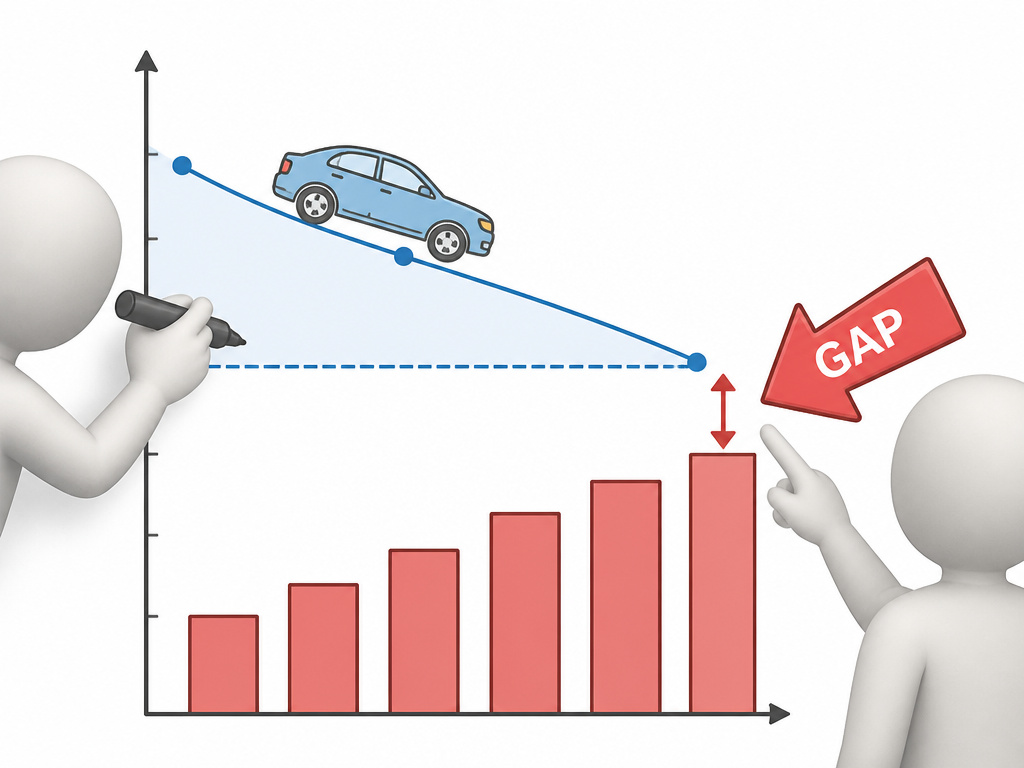
That “gap” is a specific number. It’s the dollar amount left after your primary insurer pays the ACV settlement. Without gap coverage, that amount comes from your pocket, and it can hit thousands of dollars in the first few years of a loan.
What follows is a breakdown of how gap insurance functions, the precise financial scenarios where it’s worth the premium, and the critical details—like lease mandates and policy exclusions—that most summaries gloss over. By the end, you’ll know whether this add-on fits your loan and how to get it without overpaying.
Key Takeaways
- Gap insurance only activates after a total loss and covers the numeric shortfall, not repairs or maintenance.
- It is often mandatory for leased vehicles, and skipping it when required can breach your contract.
- Buying gap coverage from your auto insurer (like Progressive or Liberty Mutual) is typically cheaper than buying a dealer’s product rolled into your loan.
- The need vanishes once your loan balance falls below your car’s market value—you should then cancel the coverage.
- Gap policies have exclusions: they won’t cover willful damage, finance charges, or excess mileage fees unless specifically stated.
What Is Gap Insurance?
Gap insurance is a financial backstop, not a repair policy. Its sole job is to settle a math problem created by rapid car depreciation and long loan terms. When you drive a new car off the lot, its value drops immediately. If you financed most of the purchase price, you instantly owe more than the car is worth. This is negative equity.
A standard auto policy with comprehensive and collision insurance covers the car’s Actual Cash Value at the time of a total loss. ACV is the market price for a similar used car, not what you paid. The gap is the leftover loan balance after the ACV payment is applied.
Common mistake: Thinking gap insurance pays for repairs. It doesn’t. If your car is damaged but not totaled, your collision coverage handles repairs minus your insurance deductible. Gap insurance sits idle unless the vehicle is declared a total loss or stolen and not recovered.
How Does Gap Insurance Work?
The process is sequential and hinges on a total loss declaration from your primary insurer. First, your auto insurance company investigates the claim, determines the ACV, and issues you a settlement check for that amount. That check goes to your lienholder (the bank) or lessor. If the ACV check is less than the payoff amount, the gap is your responsibility.
Gap insurance then engages as a second payer. You file a separate claim with your gap provider, submitting the ACV settlement documents and the loan payoff statement. The gap policy pays the difference directly to the lender, zeroing out your balance. Without it, you owe the lender the remaining balance out of pocket, even though the car is gone.
Here is the typical sequence and the parties involved:
| Step | Action | Who Pays/Receives | What Happens Without Gap |
|---|---|---|---|
| 1. Total Loss | Insurer declares car totaled/stolen unrecovered. | – | – |
| 2. ACV Settlement | Primary insurer pays Actual Cash Value. | Insurer → Lender | Same. |
| 3. Gap Assessment | Lender calculates loan balance minus ACV payment. | – | You are notified of the shortfall. |
| 4. Gap Claim Payout | Gap insurer covers the calculated shortfall. | Gap Insurer → Lender | You owe the lender the full shortfall amount. |
The entire mechanism is triggered by a total loss. This is a specific threshold, usually when repair costs exceed about 75% of the car’s ACV. Understanding the insurance process for a totaled car is key, as gap insurance is irrelevant for any other claim.
What Does Gap Insurance Cover (And What It Doesn’t)?
Coverage is narrowly defined. A basic gap policy covers one thing: the arithmetic difference between the ACV settlement and the remaining loan or lease balance at the time of a covered total loss. Some policies are more generous, offering add-ons or “enhanced” gap coverage.
What it typically COVERS:
- The principal balance shortfall on a loan or lease.
- In some policies: security deposits waived on a lease, deductible reimbursement (up to a limit), and finance charges.
What it definitely DOES NOT COVER:
- Repairs for a damaged but drivable car.
- Medical bills or liability claims from an accident (that’s your liability coverage).
- Extended warranties or routine maintenance costs.
- Excess wear-and-tear or mileage charges on a lease.
- Willful misconduct (e.g., intentional damage).
- Personal belongings left in the vehicle.
Where this goes sideways: Assuming your gap policy covers everything. Most exclude lease disposition fees and over-mileage penalties. If you total a leased car with 10,000 extra miles, you could still owe the leasing company thousands, even with gap insurance.
When Do You Need Gap Insurance?
 The need is purely financial and situational. It’s not about the car model or your driving history; it’s about your loan structure and equity position. You are a candidate for gap insurance if any of these apply.
You leased the vehicle. Many leasing companies explicitly require gap coverage. It’s often baked into the lease agreement. Even if not required, it’s almost always advisable because lease payments are calculated differently and you have no equity.
You made a small down payment (less than 20%). A low down payment means you start the loan with minimal equity. Depreciation in the first year can easily outpace your principal payments, widening the gap.
You financed for a long term (72+ months). Longer loans mean slower principal payoff. You can be 3 years into a 6-year loan and still owe more than the car’s value, especially if it’s a model that depreciates quickly.
You rolled negative equity into your new loan. This is the strongest use case. If you traded in a car you still owed money on, that old debt was added to your new loan. You are instantly “upside-down” by a larger amount, making the potential gap much wider.
The flip side is just as clear. You do not need gap insurance if: * You paid cash for the car. * You have substantial equity (your loan balance is less than the car’s value). * You can comfortably absorb a potential shortfall of several thousand dollars from savings.
Gap Insurance vs. Loan/Lease Payoff Coverage
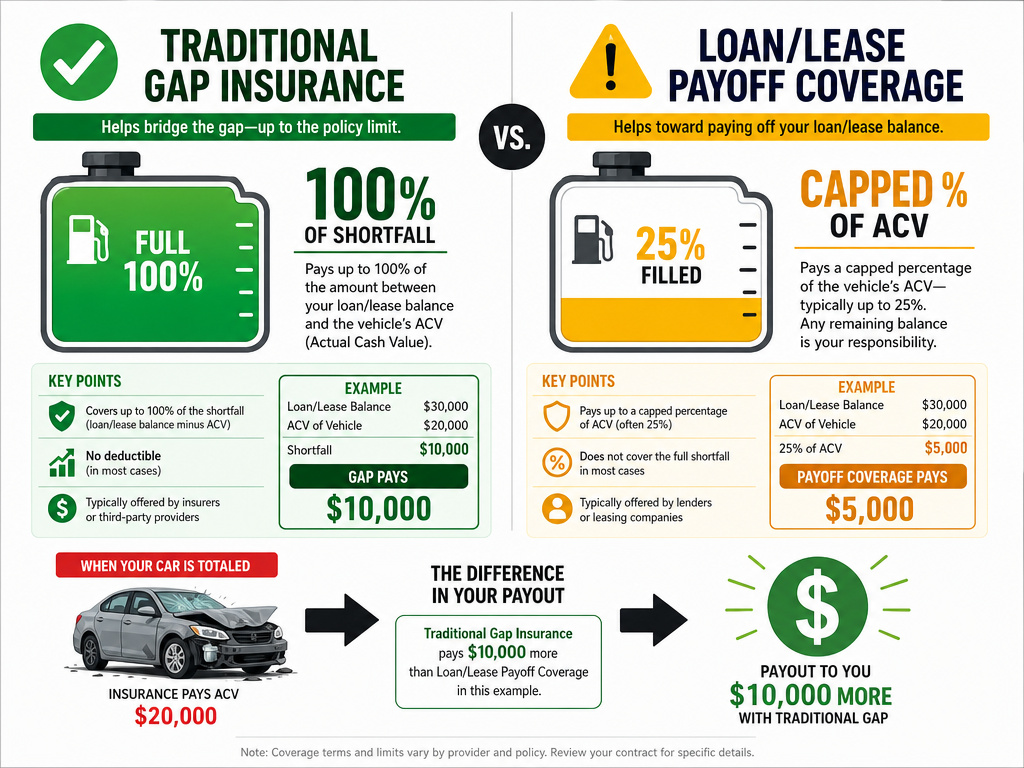 Some insurers, like Progressive, offer “loan/lease payoff” coverage instead of a traditional gap policy. The function is similar, but the limits are different. This is a crucial head-to-head for shoppers.
| Feature | Traditional Gap Insurance | Loan/Lease Payoff Coverage |
|---|---|---|
| Primary Function | Covers 100% of the loan/lease balance shortfall. | Covers a capped percentage (e.g., 25%) of the car’s ACV. |
| Cost | Often a standalone add-on or from a third party. | Added as an endorsement to your auto policy. |
| Best For | Large gaps, high depreciation cars, negative equity. | Smaller gaps, shorter loans, or where cost is a bigger concern. |
| Requirement | Usually requires comprehensive and collision insurance. | Always requires comprehensive and collision on the policy. |
The cap on loan/lease payoff coverage is the deciding factor. If your potential gap is $8,000 but the coverage only pays up to 25% of a $20,000 ACV ($5,000), you’re still on the hook for $3,000. Traditional gap insurance would cover the full $8,000. Always read the limit clause.
How and Where to Buy Gap Insurance
You have three main sources, and the cost and convenience vary dramatically.
1. Your Auto Insurance Company
This is often the best route. Adding gap coverage to an existing policy with companies like Liberty Mutual or Progressive is straightforward. The cost is usually a modest increase to your premium, paid monthly or semi-annually. A major advantage is ease of management—you can cancel it with a phone call when you no longer need it, and it’s listed right on your declarations page.
2. The Car Dealer or Lender
The finance manager will often push a gap product at signing. It’s convenient because the cost is rolled into your loan amount. This is also its biggest drawback: you finance the gap premium, paying interest on it over the life of the loan. It can be difficult to cancel later, and refunds are often prorated. According to the Consumer Financial Protection Bureau guide, you have the right to cancel these optional products, but the process can involve paperwork.
3. Standalone Specialty Providers
Some banks and credit unions offer gap policies directly. This can be a competitive option, especially if you have a relationship with the institution. Compare the terms and cost against your auto insurer’s offering.
The part nobody mentions: If you buy gap from the dealer, you must cancel it through them, not your insurer. If you refinance your auto loan, the original dealer gap policy may become void, leaving you unprotected unless you secure new coverage.
Is Gap Insurance Worth It? Making the Decision
The value equation is personal but calculable. Ask yourself two questions: What is my potential financial exposure? And what is the premium to protect it?
First, estimate the gap. Online tools like Kelley Blue Book can give you an estimated current value for your car. Compare that to your loan payoff amount (not your monthly payment). The difference is your current “gap.” In the first two years, this can easily be $4,000-$8,000.
Second, get a quote. Call your insurer and ask for the annual cost to add gap coverage. Let’s say your potential gap is $5,000 and the annual premium is $120. That’s 2.4% of the risk per year. For most people, that’s a reasonable cost for peace of mind.
When to cancel gap insurance: The need isn’t permanent. Once your loan balance dips below your car’s market value, cancel the coverage. This typically happens in the third or fourth year of a five-year loan. Dropping it then stops the premium bleed for a risk that no longer exists. This directly affects your long-term car insurance coverage levels.
Frequently Asked Questions
Can I get gap insurance after I buy the car?
Yes, but there’s often a window. Many auto insurers require you to add gap coverage within the first year of a new loan or lease. If you initially declined it at the dealer, call your insurance company promptly. They will likely need a copy of your purchase contract or loan statement.
Does gap insurance cover a stolen car?
Yes, if the car is stolen and not recovered, it is treated as a total loss. Your comprehensive coverage pays the ACV, and your gap insurance would cover any remaining loan balance beyond that payout.
Is gap insurance required?
It is rarely legally required by state law. However, it is very commonly contractually required by leasing companies. Your lease agreement will specify this. Some lenders may also require it for certain high-risk loans. Always check your finance documents.
What happens to gap insurance if I pay off my loan early?
If you pay off the loan, the need for gap insurance disappears. Contact your provider to cancel the policy. You should receive a prorated refund for the unused portion of the premium if you paid upfront. If it was bundled into your loan by the dealer, you may need to request a refund from them.
Does gap insurance transfer if I sell my car?
No. Gap insurance is attached to a specific vehicle and loan. It does not transfer to a new car or a new owner. When you sell or trade in the car, cancel the coverage and seek a refund.
The Bottom Line
Gap insurance is a specific tool for a specific problem: being upside-down on your car loan when it’s totaled. For new cars, leases, long loans, or anyone who rolled negative equity, it’s a smart, low-cost hedge against a potentially devastating bill.
Skip the dealer markup. Get a quote from your current auto insurer first—it’s almost always cheaper and simpler. Then, run the numbers. If your loan balance is within a few thousand dollars of your car’s value, the premium might not be worth it. But if you see a wide gap, spending a hundred dollars a year to close it is one of the more straightforward financial decisions you’ll make in the car ownership journey. Just remember to cancel it when you finally climb back into positive equity.
