
Are Pop Up Campers Worth It | The 2-3 Year Canvas Reality
This post contains affiliate links. As an Amazon Associate, we earn from qualifying purchases.
Pop up campers are worth it for a specific, narrow user: a family with 2-4 kids, a tow-capable SUV, garage storage, and a tolerance for 10-15 minute setup in fair weather for weekend trips. Their value collapses if you need insulation, privacy, long-term durability, or plan to store them outside, where sun and rain destroy the canvas in 2-3 years.
That “lowest dollar-per-bed” claim is true on paper. The trade-off is living in a tent on wheels. You get a queen mattress and a roof over it, but the walls are canvas or vinyl. They block wind, not cold, noise, or determined wildlife.
What follows is the arithmetic most first-time buyers skip: the cost of a replacement canvas ($1,500–$2,500), the real sleeping capacity of a 60×72 inch bunk, and the warranty clauses that void coverage if you use it for more than short recreational trips. This breakdown details what breaks, how fast, and for whom the math still works.
Key Takeaways
- Realistic sleeping capacity is 30-40% lower than the “sleeps 7” marketing. Bunk-out beds are kid-sized (60×72 inches).
- Outdoor storage destroys the canvas in 2-3 years. A $5,000 used camper needs a $2,000 canvas replacement if it’s been sitting in a yard.
- Most warranties, like Soaring Eagle Campers’ 1-year “Bumper to Hitch” coverage, explicitly exclude damage from long-term or full-time occupancy.
- Major repair costs are front-loaded on the lift system (scissor arms, cables) and roof panel delamination ($1,500–$20,000).
- They are a tactical buy for fair-weather, weekend family camping with garage storage. For four-season use, privacy, or long trips, a small hard-side trailer wins.
The Honest Spec Envelope & Real Capacity
Forget the brochure. The real numbers that define a pop-up camper’s usefulness are physical dimensions and predictable degradation timelines.
Most pop-ups are 10 to 18 feet long collapsed, weigh 1,500 to 3,500 pounds, and need a tow vehicle rated for at least 3,500 pounds—a job for a midsize SUV or larger. The fuel penalty is mild, with tow vehicles often seeing 18–28 MPG. The new price bracket is $9,000 to $28,000. The used market discounts that by 20–40% at the five-year mark, which is also when the canvas is nearing its end-of-life.
The #1 pop-up buying mistake is assuming ‘sleeps 7’ means 7 adults. The bunk-out beds are kid-sized: typically 60×72 inches (full-bed dimensions), miserable for two adults. Realistic capacity: 2 adults in main bed + 2 adults in second bunk OR 3-4 kids in second bunk.
That 60×72 inch bunk is the core of the capacity lie. It’s a full-size mattress. Two adults can technically fit. They will not sleep well. The realistic math is two adults in the main queen bed, and the second bunk is either for two more adults who are very close friends or, more practically, three to four children. The dinette that converts to a bed is best for one kid. The advertised “sleeps 7” is a counting exercise, not a comfort plan.
The canvas itself has a known lifespan. Water and UV degrade it predictably. A pop-up from 2018 with “minor stains” likely needs canvas replacement within a year or two. Models from before 2015 are almost always at canvas-replacement age. This is a matter of when.
| Spec | Real-World Range | What It Means for You |
|---|---|---|
| Length | 10–18 ft | Fits in a standard garage when collapsed. |
| Weight | 1,500–3,500 lbs | Requires a Class II hitch (3,500 lb rating) on an SUV or truck. |
| Bunk Size | 60 x 72 inches | A full bed. Fits one adult comfortably, two is a squeeze. |
| Canvas Lifespan | 8–12 years (garaged), 2–3 years (outdoor storage) | Outdoor storage is a financial death sentence for the tent. |
| New MSRP | $9,000–$28,000 | The entry point is low, but optional A/C and heaters add $1,000+ each. |
The value proposition only holds if these specs match your garage, your vehicle, and your family’s size. If any one is off, the costs start to spiral.
Where Pop Ups Fail (And What That Costs)
The charm of a pop-up is its simplicity. The failure modes are equally straightforward. They cluster in three areas: the fabric, the lift mechanism, and the climate you camp in.
The Canvas and Vinyl
The tent is the camper. When it fails, you are effectively homeless. Sun is the enemy. In Southern California sun, the plasticizers in vinyl-coated fabric migrate out faster than owners expect. The vinyl then cracks along the fold lines. Repair shops see this constantly. Once it starts, the panel must be replaced.
Water damage is the other killer. A small leak at a seam seems minor until you discover the subfloor under the dinette is soft. According to repair shop OCRV, the decision to fix a water-damaged pop-up hinges on the box frame. If the frame has rotted at the corner posts, the repair is often not economical. The camper is totaled.
The Lift System
This is the mechanical heart. Scissor arms, steel lift cables, corner pulleys, a winch, and torsion bars all work to raise a heavy roof. The weak point is often the crank gearbox. Its nylon or powdered metal gears wear over time. You’ll notice it skipping under load. Ignore that skip, and a tooth eventually shears. The roof can then drop unexpectedly.
A single corner that won’t latch is almost never a latch problem. It means the four lift cables are no longer landing the roof in a common plane, or a scissor arm pivot has elongated. Forcing the latch hides the cause and puts a permanent twist into the roof frame.
Climate Limitations
These are three-season campers, and that season is narrow in many places. Without an optional roof-mounted A/C unit ($1,000–$1,500 install), summer use in Texas, Florida, or Arizona is unbearable. Most pop-ups also lack a built-in furnace. You’ll need a portable propane “Buddy heater” for chilly mornings, which introduces moisture and requires ventilation.
Cold weather brings condensation. The interior volume is small. A family of four can vaporize up to three gallons of water daily through breathing and cooking. Without massive ventilation, that moisture condenses on every cold surface—walls, ceiling, windows. It leads to mold. Manufacturer manuals, like Soaring Eagle Campers’, explicitly state this condensation is not a warranty issue.
Where this goes sideways: Storing the camper outside between trips. Outdoor exposure to sun and rain destroys the canvas in 2-3 years, turning a cheap used buy into a $2,500 canvas replacement job before you even take a trip.
The Warranty Fine Print You Must Read
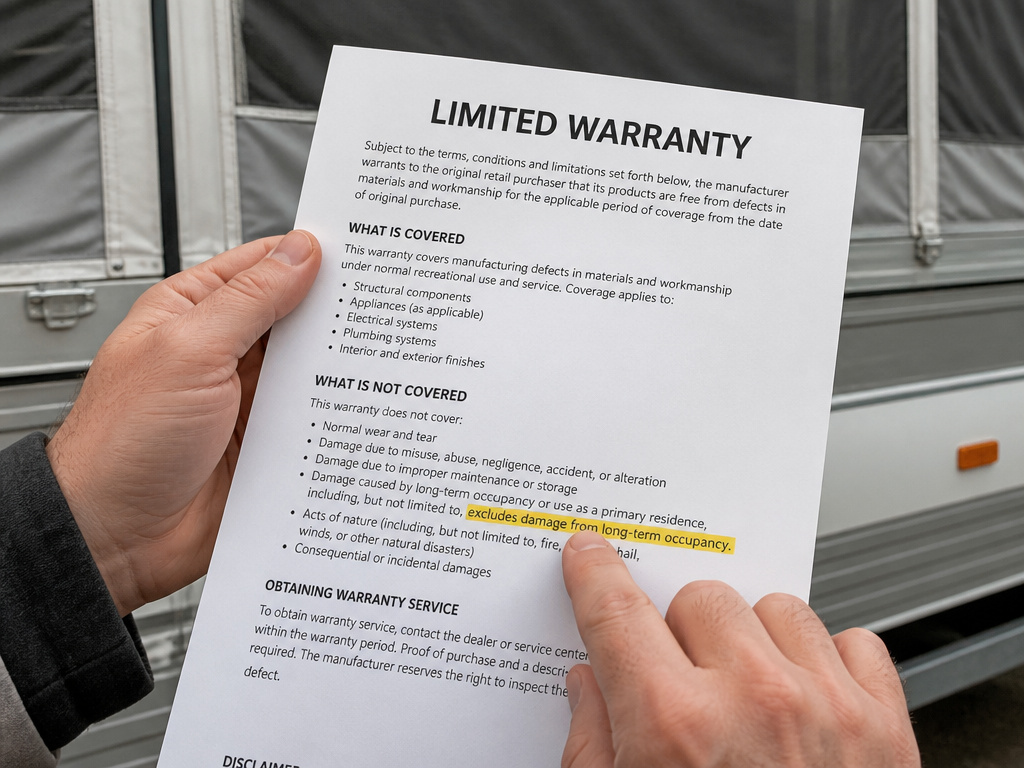
The warranty is your first clue about how the manufacturer views long-term durability. Read it not for what’s covered, but for what’s excluded.
Soaring Eagle Campers offers a clear example. Their warranty has two tiers: a one-year “Bumper to Hitch” warranty for manufacturing defects, and a three-year warranty for structural defects. Minor adjustments—doors, latches, sealants—are covered for only the first ninety days. After that, they’re the owner’s responsibility.
More critically, their manual states campers are designed for “recreational use and short-term occupancy, not full-time living.” Damage from long-term occupancy is considered “misuse, abuse or neglect” and reduces warranty protection. This is a common stance. These units are not built for the wear and tear of daily life.
Four Wheel Campers structures its warranty differently, covering the vinyl pop-up enclosure (soft sides) for five years from the date of purchase, but again, against defects in materials and workmanship. Wear from sun exposure or improper storage is expected maintenance.
| Warranty Aspect | Soaring Eagle Campers | Four Wheel Campers | The Takeaway |
|---|---|---|---|
| General Coverage | 1 year (Bumper to Hitch) | 1 year (materials/workmanship) | The first year is for major factory flaws. |
| Structural Coverage | 3 years | 5 years (aluminum framework) | The box is built to last longer than the systems. |
| Canvas/Enclosure | Not explicitly detailed | 5 years (vinyl pop-up) | Even a 5-year cover doesn’t protect against UV rot. |
| Key Exclusion | Damage from long-term/full-time use | “Normal wear and tear” | Using it too much or storing it wrong voids your protection. |
The bottom line is that the warranty is a safety net for catastrophic factory errors, not a maintenance plan. The onus is on you to store it right, ventilate it, and not live in it.
Pop Up vs. The Alternatives
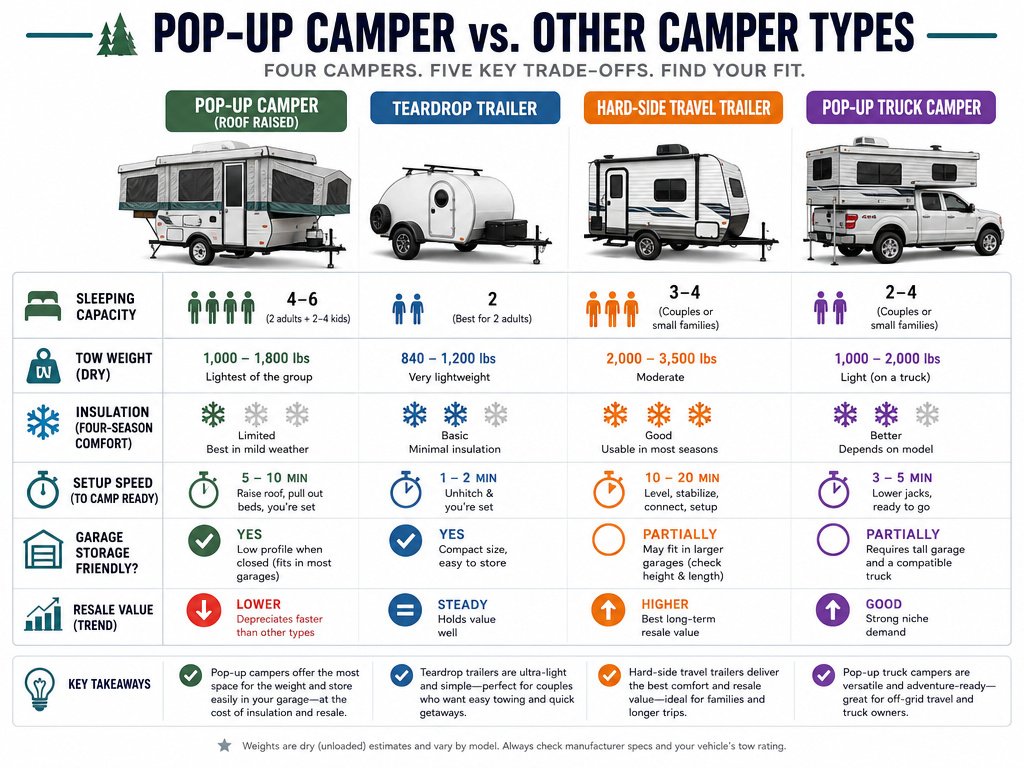
A pop-up camper isn’t competing with luxury motorhomes. Its real rivals are other entry-level, towable shelters. The choice comes down to what you’re willing to trade.
Pop Up vs. Teardrop Trailer
A teardrop trailer sleeps two, max. It has a hard shell, often a galley in the rear, and tows even easier than a pop-up. You gain insulation, security, and near-instant setup. You lose all interior standing room and any capacity for kids beyond a very small one. The decision is binary: if you have more than two people, the pop-up wins on space. For a couple, the teardrop’s comfort and durability are superior. You can explore the best options in our guide to the best teardrop campers.
Pop Up vs. Small Travel Trailer
A small hard-side travel trailer (15-19 feet) costs more, often starting over $20,000. What you buy is insulation, integrated heating, a solid lockable door, and true four-season potential. You lose the low tow weight and garage-storable profile. If your budget can stretch and you camp in shoulder seasons, the small travel trailer is a better long-term investment. It’s also worth considering small campers as a more durable middle ground.
Pop Up vs. Truck Camper
This comparison is about vehicle strategy. A pop-up truck camper, like those from Four Wheel Campers, sits in your truck bed. It turns your truck into a single, maneuverable unit. You gain access to tighter off-road spots and don’t tow a trailer. You lose the ability to drop your camper and use your truck independently. The value question is similar; read our analysis on whether truck campers are worth it for your needs.
The part nobody mentions: The resale depreciation curve is the worst in towables. A pop-up camper can lose 60% of its value in 5 years. You’re buying an experience, not an asset.
Who Should Actually Buy One (And Who Should Walk Away)
The profile of the ideal pop-up owner is specific. If you don’t match it, the headaches will outweigh the savings.
Buy a pop-up camper if:
- You have a family with 2-4 kids and need the bunk beds.
- You own a tow-capable SUV (3,500 lb hitch rating) and a standard garage.
- You primarily take weekend trips (3-4 days max) in spring, summer, and fall.
- You are mechanically inclined and don’t mind a 10-15 minute setup/teardown ritual.
- You view it as a stepping stone to learn what you really want in an RV.
Walk away from a pop-up camper if:
- You camp in bear country. Canvas walls and cooking smells are a wildlife magnet.
- You live in a hot climate and the model doesn’t support A/C.
- You have nowhere to store it except outdoors.
- You want privacy or quiet. Canvas transmits every sound from the neighboring site.
- You plan trips longer than a week. The daily setup chore becomes oppressive.
For those who fit the first list, the value is real. It’s the most affordable way to get a family of five into campground camping with real beds and a roof. Start your search with a focus on lightweight pop-up campers that match your SUV’s capacity. For others, the compromises are too great. Look at tiny campers with hard walls or a used travel trailer instead.
The Real Cost of Ownership
The purchase price is the first of several checks you’ll write. To own a pop-up is to maintain a system of fabric, cables, and seals.
Annual & Upfront Costs:
- Covered Storage: If you lack a garage, budget $50–$150/month for a storage unit. Outdoor storage is a false economy.
- Canvas Waterproofing: An annual treatment with a UV-resistant water repellent is mandatory.
- Lift System Inspection: Before each season, crank the roof up and down, listening for skips and watching for uneven travel.
- Optional A/C/Heat: Factor $1,000–$1,500 for A/C install and $85 for a portable heater if your model lacks them.
Repair Cost Table:
Based on shop estimates from OCRV, here’s what specific failures will run you. This is the reality behind “good condition” used listings.
| Repair | Cost Range | Time in Shop | Cause & Prevention |
|---|---|---|---|
| Canvas Replacement | $1,500 – $2,500 | 10–20 hours | UV degradation, mildew. Prevent with indoor storage and annual treatment. |
| Roof Delamination Repair | $1,500 – $20,000 | 10–100 hours | Water intrusion into roof panel. Catch leaks early, reseal seams annually. |
| Crank Gearbox Replacement | $400 – $900 | 3–5 hours | Worn nylon gears from skipping under load. Don’t force the crank; lubricate. |
| Lift Cable & Pulley Service | $500 – $1,500 | 4–8 hours | Corrosion, fraying. Keep mechanism clean, lubricate pulleys. |
| Water Damage Assessment | $250 (inspect) – $5,000+ (repair) | Varies widely | Rot in subfloor or corner posts. Park on level ground, fix leaks immediately. |
The financial risk lies in the domino effect. A $500 gearbox replacement ignored becomes a $2,000 cable and structural twist repair.A $50 seam sealant job skipped becomes a $5,000 floor replacement. Discipline is the only thing that keeps the math positive.
Frequently Asked Questions
Are pop up campers safe in wind?
They are safe within clear limits. With the roof up, you should avoid steady winds over 25 mph or gusts over 35–40 mph. In gusty conditions, the prudent move is to lower the roof. Their low weight and high profile make them more susceptible to crosswinds than a hard-sided trailer. Always use wheel chocks and consider stabilizing jacks.
Can you use a pop up camper in winter?
You can, but you will be cold and damp. They have no insulation. Any heat you generate (from a portable heater) will create massive condensation as it hits the cold canvas walls. Ventilation is critical, which then lets the cold air in. Manufacturer manuals often state that damage from condensation is not covered under warranty. Winter camping requires a hard-sided unit with an insulated envelope and a powered roof vent.
How long does a pop up camper last?
The mechanical frame can last 15-20 years with care. The canvas is the limiting component. When stored in a garage and meticulously maintained, a canvas can last 8-12 years. Stored outdoors, it will degrade in 2-3 years. Most pre-2015 used pop-ups are at or near the point of needing a $1,500–$2,500 canvas replacement, which is a major factor in their steep depreciation.
Is it worth buying a used pop up camper?
It can be, but you must inspect with a focus on the canvas and the lift system. Assume any camper stored outdoors needs a new canvas. Crank the roof up slowly; listen for gear skipping and watch for uneven lifting. Push on the floor around the dinette and galley for soft spots indicating water damage. A used pop-up with a perfect canvas, a dry floor, and a smooth lift mechanism, stored in a garage, is a find. One with “minor stains” sitting in a yard is a project.
Do pop up campers have bathrooms?
Very few have wet baths. The vast majority do not have any bathroom facilities. You will use the campground bathhouse. Some higher-end or larger models may offer an optional portable toilet that stows in a cabinet. If a bathroom is a must-have, you need to look specifically at pop-up campers with bathroom facilities, which are a rare and specialized subset.
The Bottom Line
Pop up campers are a tool for a specific job. They solve the problem of affordable family camping for weekend warriors with a garage. Their worth is entirely situational.
If your situation matches the tool—SUV, garage, fair-weather weekends—then the low entry cost and unique experience can be worth it. You’ll accept the setup time, the noise, and the maintenance ritual. Start by looking at the best popup campers that fit this profile.
If your life doesn’t match that checklist, a pop-up will feel like a punishing compromise. The canvas will feel flimsy, the space cramped, and the repair bills inevitable. In that case, your money is better spent on a used teardrop trailer for two or a small hard-side travel trailer for a family. Those units are assets. A pop-up, for most, is a consumable.
