
How to Choose the Best Truck for Pulling a Travel Trailer
This post contains affiliate links. As an Amazon Associate, we earn from qualifying purchases.
The best truck for pulling a travel trailer is the one whose payload capacity, gross combined weight rating (GCWR), and maximum towing capacity all exceed your loaded trailer’s weight, with payload being the most common limiting factor. For trailers under 8,000 lbs, a properly equipped half-ton like the Ford F-150 3.5L EcoBoost works. For 8,000–13,000 lbs, you need a three-quarter-ton truck. Beyond 13,000 lbs, a one-ton diesel is the only safe choice.
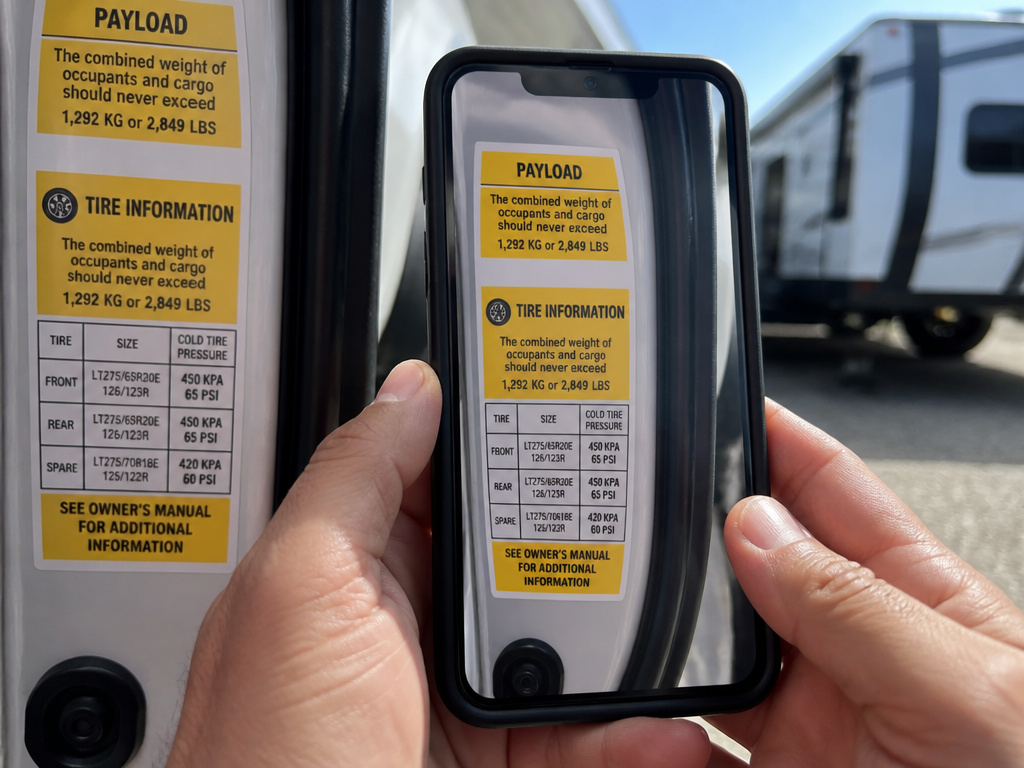
Forget brand loyalty and marketing claims. The real answer is printed on a sticker inside the driver’s door jamb of every truck. That sticker lists the vehicle’s payload, the absolute ceiling for everything you add, including people, gear, and the trailer’s tongue weight. Exceed it, and the truck sags, steering goes light, and braking distances stretch. It happens quietly, over the first three trips, until a crosswind or emergency stop turns a vacation into a report.
What follows is how to read that sticker, match three truck ratings to your trailer’s numbers, and pick between a half-ton, three-quarter-ton, and one-ton. We’ll use specs from the 2026 Ford and Chevrolet guides, explain why a salesperson’s “best-in-class” claim is often useless, and name the hitches that keep the combination stable.
Key Takeaways
- Your truck’s payload capacity is the first number to check. It must cover the weight of all passengers, cargo, and the trailer’s tongue weight.
- Gross Combined Weight Rating (GCWR) is the total allowed weight of truck, trailer, people, and cargo. Exceeding it strains the drivetrain and voids warranties.
- Half-ton trucks (e.g., Ford F-150) max out around 13,500 lbs towing. Three-quarter-ton trucks (e.g., Ford F-250) are for trailers from 8,000 to 18,000 lbs. One-ton trucks (Ford F-350) handle 18,000 lbs and up.
- Always verify capacities using the door jamb sticker and the manufacturer’s towing guide, not the sales brochure.
- A weight-distributing hitch is mandatory for bumper-pull trailers over 5,000 lbs to correct sag and sway.
The 3 Critical Truck Specs You Must Match
You need three numbers from the truck and three from your trailer. Get any one wrong, and the setup is unsafe.
First, the truck’s specs: 1. Payload Capacity: Found on the door jamb sticker. This is the maximum weight of all cargo and passengers the truck can carry inside and on itself. It includes you, your family, the dog, tools in the bed, the hitch, and, critically, the tongue weight of the trailer. 2. Gross Combined Weight Rating (GCWR): Found in the owner’s manual or towing guide. This is the absolute maximum allowed weight of the fully loaded truck plus the fully loaded trailer. 3. Maximum Towing Capacity: The most advertised number. It’s the maximum weight the truck can pull, calculated by subtracting the truck’s curb weight from the GCWR. This number assumes only a 150-pound driver and no other cargo.
Now, the trailer’s specs: 1. Gross Vehicle Weight Rating (GVWR): The maximum weight of the fully loaded trailer. This is your target weight for towing capacity. 2. Actual Loaded Weight: What the trailer actually weighs when ready for a trip. Weigh it at a CAT scale. 3. Tongue Weight: The downward force the trailer exerts on the hitch. For travel trailers, plan for 10–15% of the loaded trailer weight.
GCWR is the total system limit. Towing capacity is a derivative number assuming a nearly empty truck. Payload is the capacity of the truck’s suspension and frame. All three must be respected.
Here is where people overload without realizing it. They buy a truck rated to tow 10,000 lbs. They buy a 8,000 lb GVWR trailer. They think they have a 2,000 lb buffer. Then they load the truck with a family of four (650 lbs), a weekend’s gear (200 lbs), and a 100 lb hitch. The trailer’s tongue weight is 1,200 lbs. That’s 2,150 lbs added to the truck, far more than the door-jamb payload, which might only be 1,800 lbs. The truck is overloaded before the trailer even hits the scale.
Why Payload Is the First Limit
Payload is a fixed number based on the truck’s suspension, axles, and tires as it left the factory. You cannot increase it with aftermarket parts without voiding the frame warranty. The 2026 Ford F-150 with the 3.5L EcoBoost V6 has a maximum payload rating of 2,440 pounds, but that’s for a specific, stripped-down configuration. A higher trim level with more features might have a payload of only 1,600 lbs.
Common mistake: Comparing only maximum towing numbers between trucks. The F-150’s 13,500 lb towing rating is useless if your chosen trim’s payload is 1,400 lbs and your trailer’s tongue weight is 1,600 lbs.
Calculate your needed payload: add the weight of all passengers, all cargo in the cab and bed, the weight of the hitch itself, and the trailer’s tongue weight. If that sum is within 85% of the door-sticker payload, you are in the green zone. At 95%, you are at the absolute limit. Over 100% is illegal and dangerous.
The GCWR Check
The Gross Combined Weight Rating is the drivetrain’s limit. It protects the engine, transmission, and brakes from overload. The 2026 Chevrolet Silverado 2500 HD with the Duramax 6.6L Turbo-Diesel and Max Trailering Package has a GCWR of 30,000 lbs. If your truck weighs 7,500 lbs loaded and your trailer weighs 12,000 lbs loaded, your GCW is 19,500 lbs, well within the limit.
Exceed GCWR, and you overheat the transmission on the first mountain pass. The clutch packs glaze, shift points become erratic, and repair bills start at four figures.
The Half-Ton vs. Heavy-Duty Decision
Your trailer’s GVWR decides the truck class. This is not a matter of preference; it’s physics.
| Trailer GVWR Range | Truck Class Required | Example Trucks & Configurations | Primary Limiter |
|---|---|---|---|
| Up to 8,000 lbs | Half-Ton (1/2-ton) | Ford F-150 3.5L EcoBoost, Ram 1500 5.7L HEMI, Chevrolet Silverado 1500 with Max Trailering Pkg | Payload (1,500–2,400 lbs) |
| 8,000 – 13,000 lbs | Three-Quarter-Ton (3/4-ton) | Ford F-250 6.2L Gas, Chevrolet Silverado 2500 HD 6.6L Gas | GCWR (24,500–28,700 lbs) |
| 13,000 – 18,000 lbs | One-Ton Single Rear Wheel (1-ton SRW) | Ford F-350 SRW 6.7L Diesel, Ram 3500 SRW Cummins | Axle Ratings |
| 18,000 lbs and above | One-Ton Dual Rear Wheel (1-ton DRW) | Ford F-350 DRW 6.7L Diesel, Chevrolet Silverado 3500 HD DRW Duramax | GCWR (36,000–40,000 lbs) |
The Half-Ton Reality
A modern half-ton truck is incredibly capable. The 2026 Ford F-150’s 3.5L EcoBoost V6 produces 500 lb.-ft. Of torque and can tow up to 13,500 pounds when properly equipped. That’s enough for many 25–30 foot travel trailers.
But that 13,500 lb rating requires the Max Tow package, a specific axle ratio, and a truck with almost no options. The more luxurious the trim (King Ranch, Platinum), the lower the payload. Your comfortable, well-appointed half-ton might only be able to tow 8,500 lbs safely. This is why you must look at the sticker, not the brochure.
Where this goes sideways: Trusting a dealership salesperson who quotes the maximum towing number from a base-model truck when you’re looking at a loaded Lariat trim. The difference can be 5,000 pounds.
Stepping Up to Heavy-Duty
When your trailer’s GVWR crosses 8,000 lbs, move to a three-quarter-ton. Trucks like the Ford F-250 and Chevrolet Silverado 2500 HD are built on stronger frames with heavier-duty suspensions, brakes, and axles. Their payload ratings start where half-tons max out.
The Ford F-250 with the 6.7L Power Stroke diesel has a maximum conventional towing rating of 18,200 pounds and a GCWR up to 25,700 lbs. More importantly, its base payload is over 3,000 lbs. This gives you the margin you need for families, gear, and that 1,800 lb tongue weight from a large fifth-wheel.
The jump to a one-ton truck (F-350, Silverado 3500) is about stability and reserve capacity. The dual rear wheel (DRW) models, with their wider stance, are the gold standard for towing large fifth-wheels over 18,000 lbs. They fight sway from crosswinds and passing semis far better than any single-rear-wheel truck.
Essential Towing Gear You Cannot Skip
The right truck is only half the equation. The hardware connecting it to the trailer determines control and safety.
- Weight-Distributing Hitches (WDH): For any bumper-pull travel trailer over 5,000 lbs, this is non-negotiable. A good weight distributing hitch uses spring bars to transfer tongue weight from the truck’s rear axle to its front axle and the trailer’s axles. This levels the ride, restores steering control, and massively reduces sway. Brands like Equal-i-Zer and Blue Ox are benchmarks.
- Sway Control: Often integrated into the WDH. If you experience trailer sway, a frightening side-to-side fishtailing, a dedicated sway control hitch or add-on sway bars applies friction or braking force to stop the oscillation.
- Fifth-Wheel or Gooseneck Hitches: For trailers over 13,000 lbs, this is the connection. It places the pivot point over the truck’s rear axle for superior tracking. A gooseneck hitch like those from B&W uses a ball in the bed. A fifth-wheel hitch uses a jaw mechanism. For short-bed trucks, a sliding fifth-wheel hitch is essential to prevent the trailer from hitting the cab in tight turns.
- Tires: Never tow on worn or lightweight tires. You need tires for towing with a high load range (E or F) and proper inflation. The extra ply count prevents sidewall flex under heavy loads.
I won’t recommend a half-ton for a 30-foot trailer, even if the math barely works. The physical length and sail area of the trailer create leverage that a heavier, longer-wheelbase three-quarter-ton manages with less drama. That’s the difference between a white-knuckle drive and a relaxed cruise.
The Verification Process: How to Know You’re Right
 Before you buy anything, follow this checklist.
- Know Your Trailer’s True Weight. Take your loaded trailer to a truck stop CAT scale. Get the actual weight and the tongue weight.
- Find the Truck’s Door Sticker. Look at the specific truck you intend to buy. Photograph the yellow sticker that shows “Payload” and “Tire Information.”
- Consult the Official Guide. Download the model-year towing guide from Ford or Chevrolet. Find the chart for your exact truck configuration (engine, cab, bed, axle ratio, 4×4).
- Run the Math.
- Passengers + Cargo + Hitch + Tongue Weight ≤ Payload Capacity.
- (Loaded Truck Weight + Loaded Trailer Weight) ≤ GCWR.
- Loaded Trailer Weight ≤ Max Towing Capacity.
- Get the Right Hitch. Match the hitch to the trailer’s coupler and weight. A frame-mounted heavy-duty hitch is required for weight distribution.
This process takes an afternoon. It replaces guesswork and sales talk with data. It is the only way to be sure.
Frequently Asked Questions
What is more important, towing capacity or payload?
Payload is almost always the first limit you hit. Towing capacity assumes a nearly empty truck. In the real world, you fill the truck with people and gear first, which consumes payload. A truck can have a high towing number but a low payload, making it unfit for family RVing.
Can I increase my truck’s towing capacity?
No. The ratings are set by the manufacturer based on the vehicle’s certified design limits. You can add cooling upgrades or better truck hitches, but you cannot legally or safely increase the GCWR, payload, or towing capacity printed in the guide. Doing so voids warranties and your insurance in an accident.
Do I need a diesel truck for a travel trailer?
Not necessarily. For trailers under 13,000 lbs, modern gas engines like Ford’s 7.3L Godzilla or GM’s 6.6L V8 have ample torque. Diesel becomes advantageous for heavy trailers (over 13,000 lbs) and frequent mountain towing due to its massive low-end torque and exhaust braking. But it comes at a higher upfront and maintenance cost.
Is a short-bed or long-bed truck better for towing?
Long-bed truck has a longer wheelbase, which naturally improves towing stability by reducing the leverage the trailer has on the truck. It also provides more cargo space. However, a short-bed is easier to park and maneuver when not towing. For fifth-wheel trailers, a short-bed truck usually requires a sliding fifth wheel hitch to prevent cab damage during sharp turns.
How much should I budget for a towing setup beyond the truck?
Plan for at least $1,500–$3,000 for a quality weight-distributing hitch system with sway control, professional installation, and a wireless backup camera. For fifth-wheel setups, the hitch alone can cost $2,000–$4,000 installed. This is not an area to cheap out on.
The Bottom Line
The best truck isn’t the one with the highest advertised number. It’s the one whose door-sticker payload and GCWR comfortably envelop your specific trailer and your family’s loaded weight. Start with your trailer’s GVWR, use it to select the truck class, then verify everything against the manufacturer’s towing guide for that exact VIN.
For most couples or small families with trailers under 8,000 lbs, a well-equipped half-ton like the Ford F-150 3.5L EcoBoost is the default. It’s a comfortable daily driver that can handle weekend trips. When you cross into larger, family-sized trailers from 8,000 to 13,000 lbs, the Ford F-250 or Chevrolet Silverado 2500 HD is the workhorse. Its strength and stability are worth the ride-quality trade-off. For the largest fifth-wheels, the one-ton dually is the only tool for the job.
Find your truck’s door sticker. The answer is already there.
