
What Towing Capacity Do I Need for My Camper? The 80% Rule
This post contains affiliate links. As an Amazon Associate, we earn from qualifying purchases.
You need a towing capacity greater than your camper’s Gross Vehicle Weight Rating (GVWR). The real answer lives in three other numbers: your vehicle’s payload capacity, the trailer’s tongue weight, and the Gross Combined Weight Rating (GCWR). Ignore the single “max tow” figure on the window sticker, it assumes an empty truck with one driver.
That payload number is the first limit you’ll hit. Every pound in the truck’s cab and bed, plus the weight pressing down on the hitch ball, subtracts from it. A trailer with a 7,200-pound GVWR can have a 720-pound tongue weight. Add two passengers and some gear, and you’ve easily consumed 1,200 pounds of a truck’s 1,500-pound payload. There’s nothing left for safety.
What follows is a breakdown of the four critical ratings, the math that connects them, and the industry guideline, the 80% rule, that keeps transmissions cool on mountain passes.
Key Takeaways
- Your camper’s GVWR is the binding limit, not its dry weight. Always calculate using GVWR.
- Payload capacity is the first ceiling. Tongue weight, passengers, and cargo all consume payload, not towing capacity.
- Apply the 80% rule: target a camper GVWR no more than 80% of your vehicle’s max towing capacity for a real-world safety buffer.
- GCWR is the final gate. It’s the absolute maximum weight of truck, trailer, people, and cargo combined.
- High altitude reduces capacity by 2% per 1,000 feet starting at 1,000 feet above sea level.
The Three Weight Ratings That Matter More Than Towing Capacity
Towing capacity is a headline number. The real engineering limits are written in the fine print. You must check three other ratings on your tow vehicle’s door jamb sticker before you even look at camper brochures.
Payload capacity is the maximum weight of everything you add to the vehicle’s empty curb weight: people, dogs, tools, firewood, and the critical one, tongue weight. This is the downward force the loaded trailer exerts on the hitch. Exceed payload, and you overload the rear axle, suspension, and tires. The truck will sag, brake poorly, and handle like a barge.
Gross Vehicle Weight Rating (GVWR) is the vehicle’s maximum allowable total weight. It’s the curb weight plus your payload. You hit this limit when your payload is full.
Gross Combined Weight Rating (GCWR) is the total weight ceiling for the entire rig, the loaded truck plus the loaded trailer. This rating protects the drivetrain, brakes, and frame from combined stresses. It’s the final, non-negotiable cap.
A 2025 Ford RV towing guide specifies that for conventional trailers over 2,000 lbs, tongue weight should be 10% of the loaded trailer weight. For a 5,000-lb. Trailer, that’s 500 lbs. On the hitch, which comes straight out of your payload budget.
The “max towing” figure assumes a base-model truck with a 150-pound driver and nothing else. It’s a theoretical maximum, not a practical one. Your real available towing capacity is the GCWR minus the weight of your loaded truck.
How to Find Your Real Numbers (And Why the Door Sticker is Gospel)
Forget online calculators that ask only for your make and model. The only authoritative source is the Federal Certification Label inside your driver’s door jamb. It lists the specific GVWR and payload for your exact truck, with its specific engine, cab, bed, and option package.
The owner’s manual provides the GCWR charts, which vary by engine, transmission, axle ratio, and drivetrain. For example, a Ford Transit van with the 3.5L EcoBoost and a 3.73 axle ratio has a GCWR of 12,600 lbs. A Transit with the 3.2L diesel and a 3.31 axle has a GCWR of 10,600 lbs. The difference is 2,000 pounds of trailer, a whole small camper.
You must also find your camper’s yellow weight sticker, usually near the door. It lists the GVWR. Use this number, not the salesman’s “dry weight.” Dry weight is a fantasy; it doesn’t include propane, batteries, water, or your gear.
Common mistake: Guessing tongue weight. It’s not a fixed number. Load your camper as you would for a trip, then measure the hitch weight with a scale. A trailer balanced wrong can shift hundreds of pounds to the tongue.
The 80% Rule: Why Maxing Out is a Beginner’s Error
The industry’s consensus guideline is to keep your camper’s GVWR at or below 80% of your vehicle’s maximum towing capacity. This isn’t a law. It’s a buffer for real-world conditions that the laboratory test for SAE J2807 (the towing standard) can’t fully replicate.
That 20% margin accounts for mountain grades, summer heat, headwinds, and the extra cargo you’ll inevitably throw in the truck bed. It also drastically reduces wear on the engine, transmission, and brakes. Towing at the absolute limit turns every hill into a high-stress event that spikes coolant and transmission temperatures.
| Your Truck’s Max Tow | 80% Rule Target (Camper GVWR) | The Reality You’re Guarding Against |
|---|---|---|
| 10,000 lbs | 8,000 lbs | Transmission overheating on a 6% grade in 90°F heat. |
| 7,500 lbs | 6,000 lbs | Excessive brake fade on long mountain descents. |
| 5,000 lbs | 4,000 lbs | Struggling to maintain highway speed into a headwind, stressing the engine. |
Pushing to 100% might feel fine on a flat test drive. The problems accumulate over miles and months. The 80% rule is cheap insurance against a very expensive repair.
Tongue Weight and Payload: The Math That Never Lies
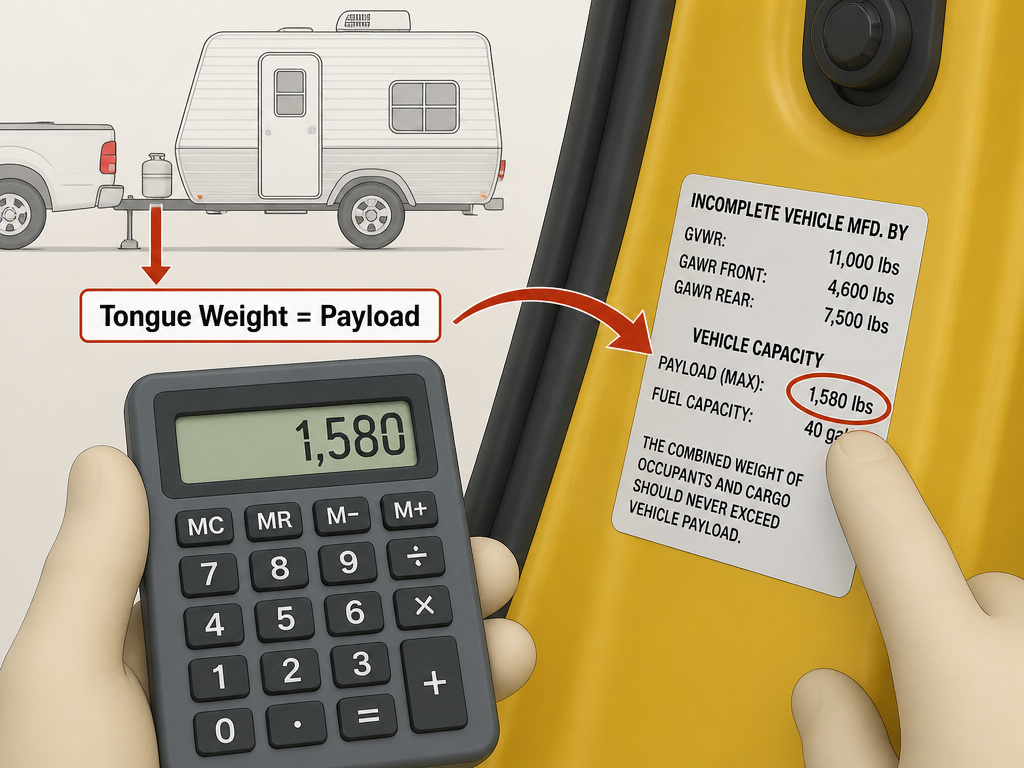 This is where most plans fall apart. The connection between trailer weight and truck capacity is the hitch ball.
Tongue weight is typically 10–15% of the trailer’s total loaded weight. A 6,000-pound camper puts 600 to 900 pounds directly onto the truck’s rear end. That weight is payload, not towing capacity. It counts against your door-sticker payload number.
Let’s run the numbers for a common half-ton truck: * Door Sticker Payload Capacity: 1,580 lbs * Tongue Weight (10% of a 7,200 lb camper): 720 lbs * Driver & Passenger: 350 lbs * Bed Cargo & Hitch: 200 lbs * Total Payload Used: 1,270 lbs * Remaining Payload: 310 lbs
You’re within the payload limit. But you have no room for a third passenger, a generator, or a cooler full of food. This is why matching the camper’s GVWR to your tow rating is only half the battle. You must run the payload math.
Where this goes sideways: Assuming a weight-distribution hitch magically increases payload. It doesn’t. A WD hitch spreads tongue weight across both truck axles (and the trailer axles) for better handling, but the total weight added to the truck is still payload. The hitch helps level the ride; it doesn’t change the scales.
When Your Camper is a Fifth Wheel
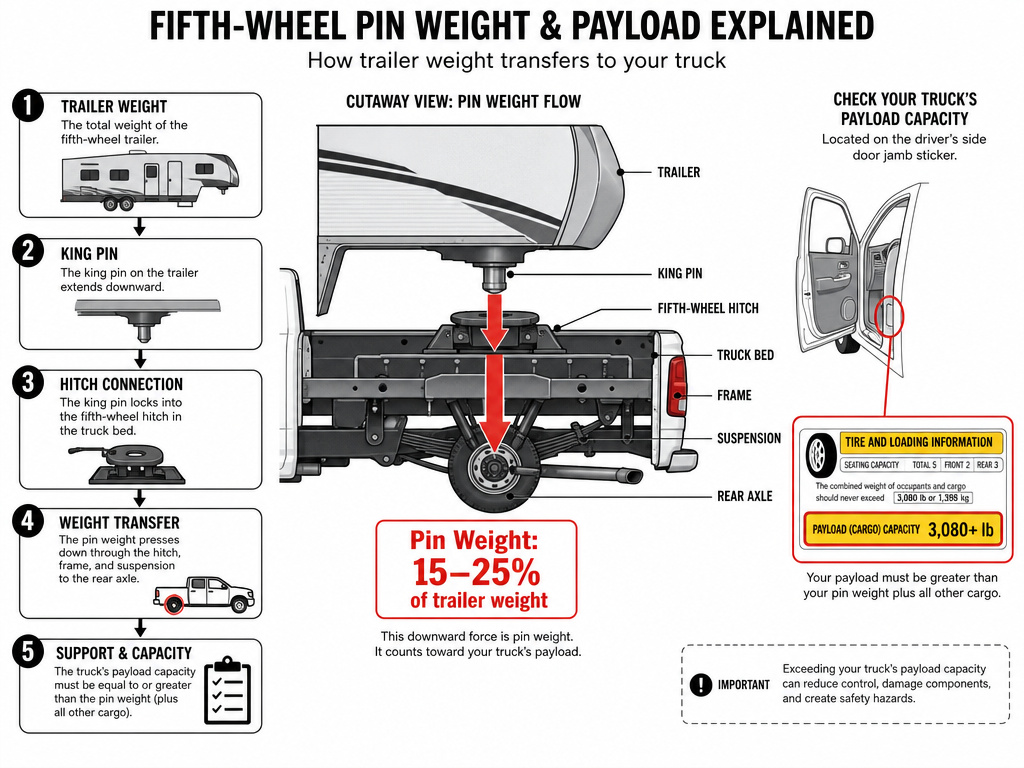 The calculations shift for a fifth-wheel trailer. The pin weight, the downward force on the truck’s bed, is higher, typically 15–25% of the loaded trailer weight. This weight is carried directly over the truck’s rear axle, which is stronger, but it consumes payload even faster.
A 10,000-pound fifth-wheel can easily have a 1,500 to 2,500-pound pin weight. This immediately disqualifies most half-ton trucks, which is why fifth wheel towing is the domain of three-quarter-ton and one-ton dualies with payload ratings of 3,000 pounds or more. The need for a robust hitch system and the right truck frame is non-negotiable.
The Hidden Limits: Altitude, Tires, and Frontal Area
Your owner’s manual contains derating clauses that most people never read. These are critical for mountain travel.
High Altitude: Ford’s manual states that for high altitude operation, the gross combined weight must be reduced by 2% per 1,000 feet starting at the 1,000-foot elevation point. Towing a 7,000-pound trailer at 7,000 feet of elevation? Derate your capacity by 12%. That 80% rule becomes a 70% rule very quickly.
Tire Capacity: Your truck’s payload and towing ratings assume tires that can carry the load. Upgrading to 10-ply tires (Load Range E) is often essential for maintaining safety margins, as they have higher weight ratings and stiffer sidewalls that resist sway. Don’t tow heavy on passenger-car tires.
Frontal Area: A tall, boxy camper acts like a sail. Ford limits trailers to 55 square feet of frontal area for vehicles equipped with the Trailer Tow Package. Exceed this, and engine cooling and stability become serious issues, even if you’re under the weight limit. Aero matters.
A Real-World Example: Matching a Truck to a Camper
Let’s take a Ford F-150 with the Max Trailer Tow Package. The window sticker boasts a 13,200 lb max towing capacity. The door jamb reveals a 1,720 lb payload capacity. The owner’s manual shows a GCWR of 17,100 lbs for this configuration.
The camper is a Winnebago Micro Minnie with a 7,200 lb GVWR. 1. Apply the 80% Rule: 80% of 13,200 is 10,560 lbs. The 7,200 lb GVWR passes easily. 2. Calculate Tongue Weight: 10% of 7,200 lbs is 720 lbs. 3. Calculate Payload Use: 720 lbs (tongue) + 350 lbs (people) + 150 lbs (hitch/cargo) = 1,220 lbs. This is under the 1,720 lb payload limit. 4. Check GCWR: Assume a loaded truck weight of 6,200 lbs (curb weight + payload used). 6,200 lbs + 7,200 lbs = 13,400 lbs total, which is under the 17,100 lb GCWR.
This match works on paper. In reality, weighing the loaded rig is the only way to be sure, as individual loading can vary by hundreds of pounds. Investing in a good weight distribution hitch is the next logical step for this setup.
Before You Connect: The Non-Negotiable Safety Checklist
Towing is an exercise in risk management. This checklist is your pre-flight routine.
Before you start: An unbalanced load causes trailer sway, which can escalate to a jackknife in seconds. Incorrect hitch height transfers weight incorrectly, overloading the rear tires. Tires at the wrong pressure overheat and can fail, especially camper tires that sit for months.
- Weigh Your Loaded Rig. Visit a CAT scale or use a portable tongue scale. Confirm you are under GVWR, GCWR, and axle ratings.
- Set Tire Pressures. Inflate both truck and trailer tires to their cold pressure maximums listed on the sidewall, not the door sticker. Check them in the morning.
- Measure and Adjust Tongue Weight. Aim for 10–15%. Use a scale. Rearrange cargo in the trailer to hit the target.
- Connect Brakes and Lights. Test every function: left turn, right turn, brake, running lights. Ensure the trailer brake controller is synced and adjusted.
- Perform a Tug Test. With the rig hitched, rock the trailer firmly. Listen and feel for any clunks or movement at the hitch, safety chains, and electrical connector.
Skip any of these, and you’re trusting luck over physics.
Frequently Asked Questions
Is towing capacity the same as payload capacity?
No. They are completely different ratings. Towing capacity is how much weight your vehicle can pull behind it. Payload capacity is how much weight it can carry inside and on top of itself, including the tongue weight of the trailer. Payload is almost always the first limit you reach.
Can I increase my vehicle’s towing capacity?
Not legally or safely. The manufacturer’s rating is based on the vehicle’s certified frame, brake, cooling, and drivetrain strength. Adding a bigger hitch or a tuner does not change the GCWR or the legal rating on your door sticker. To tow more, you need a different vehicle.
What happens if I exceed my towing capacity?
You risk catastrophic failure. The immediate dangers are overheated brakes (fade), an overheated transmission, and severe trailer sway. Long-term, you accelerate wear on every major component, engine, differential, suspension, and frame. You also likely void your warranty and could be held liable in an accident.
Do I need a weight distribution hitch?
If your trailer’s loaded tongue weight exceeds 500 pounds, or if the rear of the tow vehicle sags noticeably when hitched, you need one. A weight-distribution hitch spreads the load to improve steering control and braking. It is a critical safety device for most travel trailers.
How does a travel trailer differ from a fifth wheel for towing needs?
Travel trailer connects to a bumper hitch and imposes tongue weight on the rear of the truck. A fifth wheel connects to a hitch in the truck bed and imposes much higher pin weight directly over the rear axle. This requires a truck with a much higher payload capacity, making three-quarter-ton and one-ton trucks the standard for towing a fifth wheel.
The Bottom Line
Finding the right towing capacity starts with your camper’s GVWR and your truck’s payload rating, not the glossy brochure’s biggest number. Treat the 80% rule as your target, not a suggestion. The goal isn’t to see how much you can pull, but to ensure what you pull feels secure, stable, and doesn’t turn a weekend getaway into a roadside breakdown.
Your first upgrade should be knowledge, reading the door sticker, understanding the manual, and planning for altitude. Your second should be the right supporting gear: a proper hitch, heavy-duty tires, and a reliable brake controller. The right capacity is the one that lets you forget about the numbers and just enjoy the road.
