
How to Back Up a Travel Trailer With Confidence | Key Tips
This post contains affiliate links. As an Amazon Associate, we earn from qualifying purchases.
To back up a travel trailer, match three things: your spotter’s hand signals, the trailer’s pivot point, and the direction you turn the steering wheel with your hand placed at the bottom. Remove any sway control bar before you start, it limits your turning radius and can damage your hitch or tow vehicle frame during a tight adjustment.
That last point about the sway bar is where most guides stop. The manufacturer advice from Thor Industries is specific: the bar can get in the way. Leave it connected, and a quick correction to avoid a tree root becomes a several-hundred-dollar hitch repair. The rest is practice, but that one step is non-negotiable.
What follows is the physical logic behind every hand signal, the two maneuvers that actually work, and the maintenance items from the Winnebago owner’s manuals that keep the whole system safe while you’re learning. By the end, you’ll know why the trailer goes left when you turn the wheel right, and how to place it within six inches of where you want it.
Key Takeaways
- Remove the sway control bar before backing. It physically limits your turning radius and a sudden correction can bend the hitch or frame.
- Place your hand at the very bottom of the steering wheel. Turn the wheel in the direction you want the trailer’s rear end to go, this eliminates mental reversal.
- Your spotter must watch two gaps: the space between the trailer and obstacles, and the space between the trailer and your tow vehicle to prevent a jackknife.
- Practice the S-turn for open spaces and the Swoop for tight spots. The Swoop gets the trailer’s rear pivoting sooner, which is critical when you have limited room. Tire pressure is a safety prerequisite, not a backing tip.** Under-inflated tires on a loaded trailer are a primary cause of tire failure, per Winnebago manuals.
The Pre-Backup Checklist You Can’t Skip
You don’t start the engine first. You walk the site. This isn’t about being thorough; it’s about finding the single root or sewer cap that will high-center your axle. Look for low-hanging branches your A/C unit will hit. Check the slope of the site, a severe angle can make leveling later a nightmare, even with the best leveling blocks for travel trailers.
Before you start: A travel trailer is a blind, multi-ton object. The spotter you choose must understand hand signals, must stay in your mirror’s view at all times, and must never walk directly behind the moving trailer. If they disappear from your mirror, stop immediately.
The most overlooked item is accessory interference. If your setup uses a separate sway control bar, disconnect it. This isn’t a suggestion from a forum. Thor Industries, a major manufacturer, advises removal because the bar restricts your turning radius. During a backing maneuver, you might need to crank the wheel hard for a quick correction. With the bar attached, that force transfers into the hitch and your tow vehicle’s frame, not into turning the trailer. The result is a bent mount.
| Checklist Item | Why It Matters | Risk If Skipped |
|---|---|---|
| Walk the Site | Identifies ground hazards and overhead obstacles. | Axle damage from a hidden curb or torn roof vent from a branch. |
| Disconnect Sway Bar | Restores full turning radius to the hitch. | Binding and potential damage to hitch or tow vehicle frame. |
| Confirm Spotter Signals | Establishes a clear, silent communication protocol. | Miscommunication leads to hitting an obstacle you didn’t see. |
| Check Tire Pressure | Ensures tire sidewalls are at proper strength for the load. | Increased risk of tire blowout from overheating and flex. |
Tire pressure is a silent partner in this. The Winnebago Towables owner’s manual states under-inflated tires on a loaded vehicle are a major cause of tire failure. Your trailer is heaviest when it’s fully packed for a trip. Those travel trailer tires need the pressure listed on the sidewall, not what feels right. A soft tire folds over on itself during the slow, twisting forces of backing up, generating heat that can lead to a blowout days later on the highway.
Steering Logic: It’s Backwards, But This Trick Isn’t
The confusion is universal. You turn the steering wheel right, and the back of the trailer goes left. Trying to reason it out in the moment while your spotter is waving their arms leads to panic and over-correction. There’s a better way.
Forget “turn the wheel the opposite direction.” That’s a mental rule you have to process. Use a physical rule instead. Before you put the truck in reverse, place your dominant hand at the very bottom of the steering wheel. Now, to move the back of the trailer to the left, move your hand to the left. To move it right, move your hand right. Your hand at the six o’clock position directly mirrors the direction of the trailer’s rear end.
This works because you’ve changed the frame of reference. You’re no longer thinking about the front wheels of the truck; you’re linking your hand’s motion to the trailer’s motion. It becomes intuitive after about two practice sessions.
I spent years dreading backing my Airstream. My brain would switch off. Someone finally showed me the hand-on-bottom method, and the stress vanished. It’s not a secret, it’s just leveraging muscle memory instead of calculus.
The limitation is your pivot point. The trailer turns around its axle(s). Visualize a line extending from the center of those axles straight forward, that’s your pivot line. Anything behind that line swings in a wide arc. Anything in front of it (your tow vehicle) moves much more. This is why you need a spotter to watch the gap between the truck and trailer. It’s easy to jackknife because the truck can turn much sharper than the trailer can follow.
Master the Two Core Maneuvers
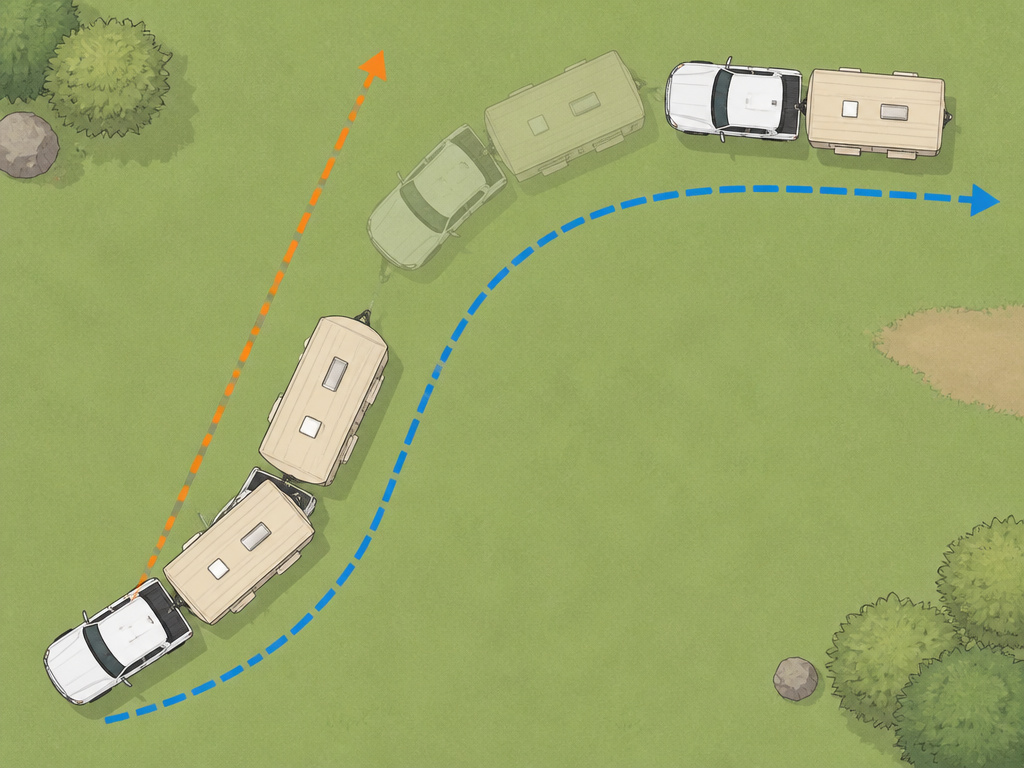
There are two proven backing techniques: the S-turn and the Swoop. You need both because campsites aren’t all the same.
The S-Turn is your foundation. It’s for relatively open spaces where you have room to set up. You start with the truck and trailer mostly straight, then turn the wheel to get the trailer angled toward the spot. As the trailer begins to move in, you straighten the wheel and then turn it the other way to straighten the trailer out. It creates a gentle “S” path. The goal is controlled, incremental adjustment.
The Swoop is for tight spots or when you need to get the trailer’s rear end pivoting quickly. You begin with the truck already at an angle to the trailer, you “swoop” the tow vehicle out in the opposite direction first. This aggressively angles the trailer toward your target from the very start. It’s more efficient but requires more confidence and a good feel for where your trailer’s tail is swinging.
| Maneuver | Best For | Key Move | Common Mistake |
|---|---|---|---|
| S-Turn | Open areas, long driveways, practice lots. | Small, alternating steering inputs to walk the trailer in. | Over-steering, which creates a zig-zag and requires constant correction. |
| Swoop | Tight campsites, angled parking, getting around an obstacle. | Setting the initial angle with a pronounced “swoop” of the tow vehicle. | Starting the swoop too late, which puts the trailer’s rear too close to an adjacent obstacle. |
Why do you need both? A 30-foot trailer in a wooded site with a tight turn off the road has no room for the setup of an S-turn. You need the Swoop to get the trailer pointed into the lane immediately. Conversely, using the Swoop in a wide-open field is unnecessary and harder to control precisely. Match the maneuver to the space.
Your Spotter is Your Second Set of Eyes, Not a Narrator
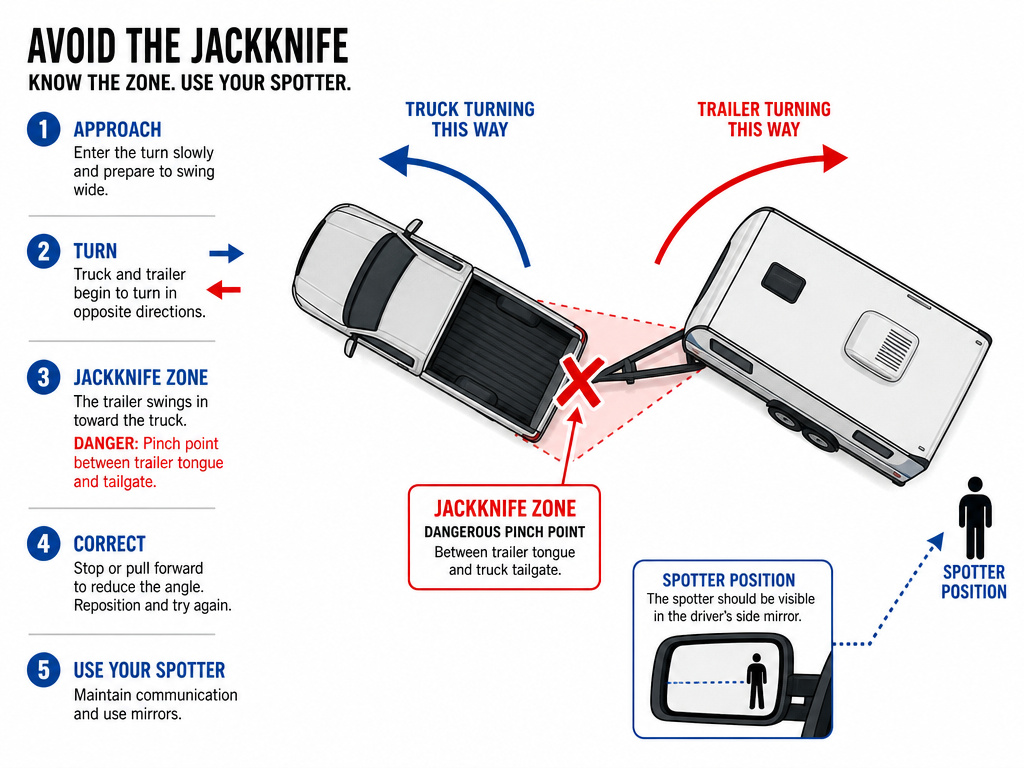
A good spotter is calm, uses clear gestures, and stays put. A bad spotter runs around, shouts, and causes more confusion than they prevent. Establish a simple signal set before you move an inch: a flat hand pushing forward means “keep coming straight back.” A sweeping motion toward the driver’s side means “trailer needs to go that way.” A crossed-arm “X” means “STOP NOW.”
Where this goes sideways: The spotter only watches the trailer’s corner nearing a tree. They forget to monitor the gap between the trailer tongue and the truck’s bumper. You correct toward the tree, the truck turns sharper, and you hear the crunch of the trailer jackknifing into your own tailgate.
Their primary job is to watch the two blind spots you cannot see: the rear corners of the trailer and the hitch area. They must always be visible in your side mirror. If they need to check the other side, they tell you to stop, then walk around the front of the truck to the other side while you wait. They never cross behind the trailer.
Technology can help, but it doesn’t replace a spotter. A dedicated RV backup camera gives you a direct view of what’s directly behind the trailer. It’s excellent for checking distance to a final obstacle. It cannot see the trailer’s sides or the hitch pivot point. Use it as a supplement, not a substitute.
Gear That Helps (And What to Adjust Before You Back)
Your towing setup is designed for highway stability, not low-speed maneuverability. Some components need to be reconfigured for backing.
We’ve covered the sway control bar. If you have a built-in anti-sway system within your weight distribution hitch, consult its manual. Many modern systems don’t require disconnection, but some do. The principle is the same: anything that dampens side-to-side movement will also resist the sharp, slow-speed turning of backing up.
Weight distribution hitches themselves generally stay connected. Their job is to spread the tongue weight across both vehicle axles, and that’s still important. However, ensure the tension is properly set before you trip. An improperly adjusted hitch makes the trailer feel unstable and harder to control in reverse.
Once you’re parked, the gear shifts to stabilization. Wheel chocks are your first defense against the trailer rolling. Place them before you even think about unhitching. Then, use your trailer jack and those leveling blocks to get the rig stable side-to-side. A level trailer is safer, and your refrigerator will thank you.
Practice Drills That Actually Build Skill
Reading doesn’t build muscle memory. You need to hook up and go to an empty lot. Cones or even cardboard boxes are perfect, low-stakes obstacles.
Start with the straight-line back. This seems simple, but keeping a trailer moving in a straight line in reverse is the first skill to master. It teaches you minimal steering input and how to use your mirrors to track alignment.
Next, practice 90-degree parking. Set up two cones or boxes to simulate a campsite driveway. Practice both the S-turn and the Swoop to enter the space. The goal is completing the maneuver with no more than one pull-up, not speed.
Finally, simulate a tight offset. Place your “target” spot directly behind you but shifted to one side, with an “obstacle” cone on the other side you must avoid. This forces you to manage both sides of the trailer simultaneously, which is the reality of most real sites.
The entire process is slow, small movements. If the trailer isn’t moving where you want, stop. Take a breath. Pull forward a foot to reset the geometry. Trying to force it while moving almost always makes it worse. This is where patience pays in saved bodywork and embarrassment.
Frequently Asked Questions
Do I need a special license to back up a travel trailer?
No, a standard driver’s license is sufficient in all US states and Canadian provinces. The requirement is based on the combined weight of the vehicle and trailer, not the act of backing up. For most travel trailers under 10,000 lbs GVWR, your regular license covers it.
What’s the biggest mistake beginners make?
Overcorrecting. They see the trailer going off line, crank the wheel hard to fix it, and then have to crank it back the other way even harder. This creates an amplifying zig-zag. The fix is tiny steering inputs. Turn the wheel an inch or two, see how the trailer responds, then adjust again. Slow hands.
Can I back up a travel trailer by myself?
It’s possible, but not advisable for complex spots. If you’re alone, get out and look as often as you need. Use a backup camera to see directly behind. Some experienced solo RVers use walkie-talkies paired with a portable camera they place behind the trailer. It’s always higher risk than having a dedicated spotter.
Why does my trailer sometimes seem to “lock up” and not turn while backing?
This is almost always caused by a disconnected or dragging breakaway cable, a stuck trailer brake magnet, or most commonly, the sway control bar still being attached. The bar is designed to prevent lateral movement. When you try to turn sharply at low speed, it resists that movement, making the trailer feel stuck. Check those three items first.
How do I know if my tires are properly inflated for towing and backing?
The correct pressure is on the sidewall of the trailer tire itself or in the trailer’s owner’s manual, not on your vehicle’s door jamb. This is the pressure needed to carry the tire’s maximum load rating.Weigh your loaded trailer at a CAT scale, then use a tire load/inflation chart to ensure your pressure matches the actual weight on each axle. Under-inflation is the leading cause of trailer tire failure.
Before You Go
Backing a trailer is a mechanical skill, not a mystery. It breaks down into a short checklist, a physical steering trick, and two maneuvers. The sway bar comes off. Your hand goes to the bottom of the wheel. Your spotter watches two gaps, not one.
The stakes are a bent frame, a torn sidewall, or a jackknifed hitch. The reward is parking in any site you choose, under any tree you like, without a second thought. That freedom is worth the hour in an empty lot with a couple of cones. Go hook up, find some space, and make your mistakes where nothing can get hurt. The confidence comes on the second try, and it never really leaves.
