
Universal 5th Wheel Hitches? The 4 Non-Negotiable Match Points
This post contains affiliate links. As an Amazon Associate, we earn from qualifying purchases.
No, 5th wheel hitches are not universal. Compatibility hinges on matching four specific things: your truck’s bed size and mounting system, the hitch’s Gross Trailer Weight and pin weight ratings, and your trailer’s SAE 2-inch king pin. A mismatch in any one of these areas can lead to a trailer that won’t hook up, a truck cab that gets smashed, or a catastrophic failure on the road.
That answer is short because the problem is simple. The consequences are not. A hitch rated for 16,000 pounds on a 22,000-pound trailer doesn’t just “work harder.” The locking jaw deforms under the overload, the trailer separates on a downhill grade, and you have seconds before the rig is in the ditch. The ratings are ceilings, not suggestions.
What follows is a walk through the four non-negotiable match points, the specific maintenance numbers that keep a hitched trailer hitched, and the exact math for short-bed truck owners who are one tight turn away from a very expensive sound.
Key Takeaways
- Truck bed length dictates hitch type. Short beds (under 8 feet) usually need a sliding hitch or an extended pin box; the Blue Ox clearance formula tells you exactly how much.
- Mounting systems are not interchangeable. Universal in-bed rails work across brands, but OEM puck systems are truck-model specific and limit your hitch choices.
- The hitch rating must meet or exceed your trailer’s Gross Vehicle Weight Rating (GVWR). The pin weight rating is equally critical and is typically 15-25% of the GVWR.
- King pins are standardized, but adapters exist. The SAE 2-inch king pin is the rule, but specialty pin boxes (Reese Sidewinder) may require a hitch lockout kit.
- Maintenance is not optional. The CURT A25 requires re-torquing its pivot bolts after the first 500 miles and every 1,000 miles thereafter. Skip it, and the hitch loosens.
The 4 Critical Match Points That Decide Compatibility
Forget universal. Think of your hitch as a custom-fitted component in a three-part system: truck, hitch, trailer. All three must agree on the specs.
A fifth wheel hitch’s weight rating must be at, or above, the GVWR of your trailer for you to tow safely. This isn’t a margin for error; it’s the load limit before the steel fatigues and the locking mechanism fails. PullRite Owner’s Manual
1. Truck Bed Size & Clearance Math
This is where most compatibility checks start and where many owners get the math wrong. A long-bed truck (8 feet) provides enough clearance between the cab and the trailer during turns for a fixed hitch. A short bed does not.
The rule of thumb is simple, but the manufacturer math is precise. Demco states the distance from the back of the truck cab to the center of the rear axle should be about 4 inches greater than half the trailer’s width. Blue Ox provides the full equation: Truck Clearance (cab to axle) minus Camper Clearance (half width minus king pin offset) must equal a positive number.
| Truck Bed Type | Minimum Hitch Requirement | Risk If Ignored |
|---|---|---|
| Long Bed (8ft+) | Fixed-position hitch | None for clearance; still must match weight. |
| Short Bed (<8ft) | Sliding hitch (e.g., Reese Kwik-Slide) OR extended pin box (min. 13″) | Trailer impacts truck cab on tight turns, damaging both. |
| Short Bed with Slider | Properly adjusted sliding mechanism | Binding and failure to slide when needed, leading to impact. |
The Reese Kwik-Slide exists specifically for this scenario. It’s not an upgrade; it’s a required piece of geometry for short-bed pickups attempting low-speed, non-highway maneuvers.
2. Mounting System: Rails vs. OEM Pucks
You have two main paths for bolting the hitch to your truck: universal bed rails or a factory-installed puck system.
Universal Bed Rails are often called “industry-standard rails.” Brands like Blue Ox design their hitches, like the BXR2410, to attach to these rails. The rails themselves are somewhat universal, but the hitch brackets that clamp onto them are model-specific. This system offers the widest choice of best fifth wheel hitches across manufacturers.
OEM Puck Systems are the opposite. Found in newer Ford, GM, and Ram trucks with a factory tow package, these are precise, model-specific sockets. A hitch designed for a Ford puck system, like the PullRite #1600 OE Series Super 5th, will not fit a GM truck’s puck layout. The convenience of a no-drill installation trades off against a narrower selection of compatible hitch models.
Common mistake: Assuming a hitch advertised for “OEM systems” fits all trucks. It fits one brand’s system, maybe only for specific model years.
3. Weight Ratings: GTW, Pin Weight, and Your Truck’s Limits
This is the non-negotiable numbers game. Three ratings must align: 1. Hitch Gross Trailer Weight (GTW): The maximum weight the hitch is rated to pull. 2. Hitch Pin Weight Rating: The maximum downward force the hitch can handle. 3. Your Truck’s Ratings: The lower of your vehicle’s GCWR (Gross Combined Weight Rating) and its payload capacity.
The hitch rating is the first gate. The PullRite #1500 is rated for 18,000 lbs GTW and 4,500 lbs pin weight. The #1600 handles 25,000 lbs GTW and 6,250 lbs pin weight. Your trailer’s GVWR must be at or below the GTW. The pin weight—typically 15-25% of the GVWR—must be at or below the hitch’s pin weight rating.
But here’s the layer most miss: your truck’s payload capacity is the final bottleneck. You can have a hitch rated for 25,000 lbs, but if your truck’s payload capacity is 3,000 lbs and your pin weight is 3,500 lbs, you’re overloaded before you add a passenger. This is why choosing the right truck for towing a fifth wheel is a prerequisite, not a separate decision.
4. King Pin Compatibility: The SAE Standard & The Exceptions
The physical connection is a 2-inch diameter king pin on the trailer engaging the locking jaws of the hitch. The Society of Automotive Engineers (SAE) standardizes this as the SAE 2-inch king pin. Demco, Reese, CURT, and PullRite all design for this standard.
The exception is specialty pin boxes designed to increase turning clearance or reduce chucking. The Reese Sidewinder and Reese Revolution pin boxes shift the pivot point. Hitches like the Blue Ox BXR2410 explicitly warn against using them without a BXR9005 Rotaflex Lockout Kit. The lockout kit disables the hitch’s pivot to prevent a dangerous binding condition. If your trailer has one of these, compatibility just got more complex and more critical.
What Happens When You Get It Wrong?
Mismatches don’t always announce themselves during installation. Some failures wait for the worst moment.
Overloading the Hitch Rating: This isn’t a matter of strained performance. The locking jaws on a hitch are heat-treated to a specific load. Exceed it, and the metal can fatigue and crack. The failure mode is the jaw snapping open under dynamic load, resulting in immediate trailer separation. The PullRite manual’s warning is a physical prediction, not legal cover.
Ignoring Short-Bed Clearance: The sound of a trailer corner crushing your truck cab is distinctive. It’s a grinding, cracking noise followed by an immediate lock-up of the rig. The damage repair involves both vehicle bodywork and trailer front-cap repair. The Reese Kwik-Slide or a 13-inch extended pin box exists to make this sound impossible.
Neglecting Torque Specs and Lubrication: Hitches are not install-and-forget. They live in a dirty, high-vibration environment. Bolts loosen.
The CURT A25 manual gives exact numbers: its 14mm hex pilot bolts need 100 foot-pounds of torque, re-checked after the first 500 miles and every 1,000 miles after. The 16mm pivot bolts need 200 +/- 25 foot-pounds. Skip this schedule, and the hitch assembly develops play. That play translates into a frightening “clunk” on every start and stop, and eventually, accelerated wear on the pivot points that can lead to a loss of structural integrity.
Your Hitch Maintenance Schedule (Based on OEM Manuals)
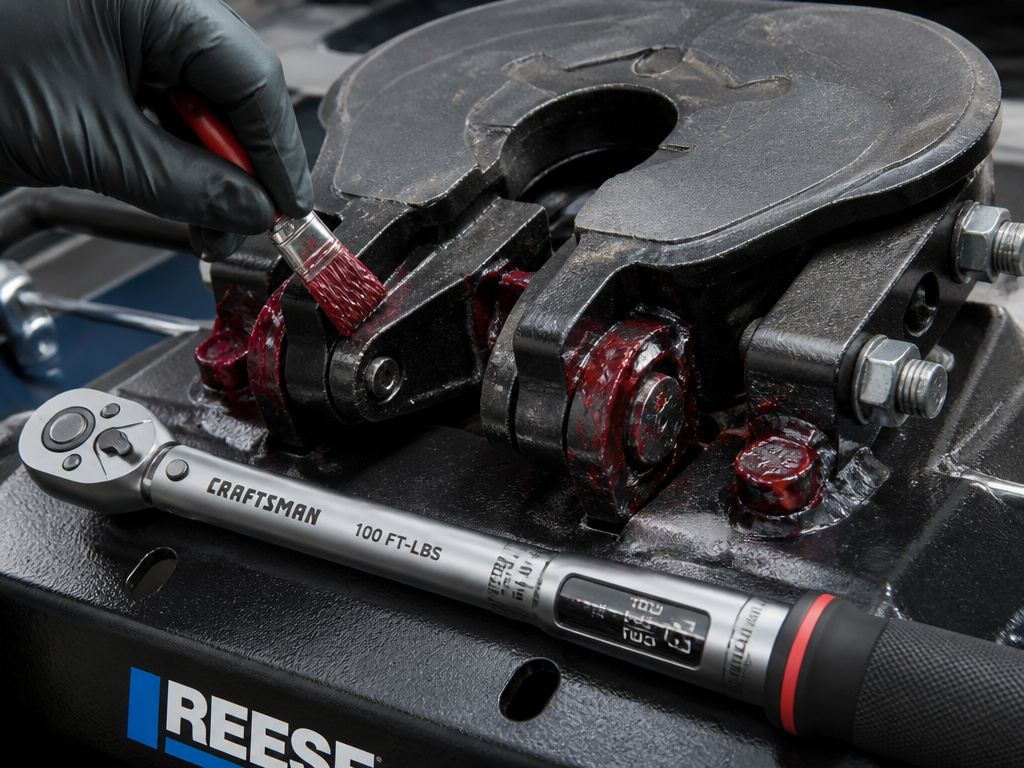
Maintenance is not about longevity. It’s about predictable, safe operation. Here’s the consensus from the OEM manuals.
| Component | Action | Frequency | Product (per OEM) | Consequence of Skip |
|---|---|---|---|---|
| Pivot Bolts & Locking Jaws | Lubricate | Before each use, every 1,000 miles | Axle grease / WD-40 for storage | Jaw seizes, preventing lock/unlock; pivot binds. |
| Mounting Hardware | Re-torque | After first 500 mi, then every 1,000 mi | Torque wrench to spec (e.g., 100 ft-lbs) | Hitch develops play, causing clunking and wear. |
| Skid Plate & Moving Parts | Inspect & Clean | Annually or before storage | Degreaser, inspect for cracks | Grime accelerates wear, hides stress fractures. |
| Entire Assembly | Rust Protection | Before long-term storage | Light coat of rust inhibitor | Surface rust pits metal, weakening components. |
Where this goes sideways: Assuming a “maintenance-free” hitch. Every OEM manual has a lubrication and torque schedule. The CURT A25’s 1,000-mile re-torque interval is because the bedding-in process of powder coating and metal settles under load. That settling loosens bolts.
Storage matters too. The PullRite manual advises lubricating the fifth wheel plate with WD-40 and covering the assembly to prevent rust during storage. A seized hitch from winter corrosion is a frustrating start to the season.
Sliding Hitches, Pin Box Extensions, and Adapters: The Fixes for “No”
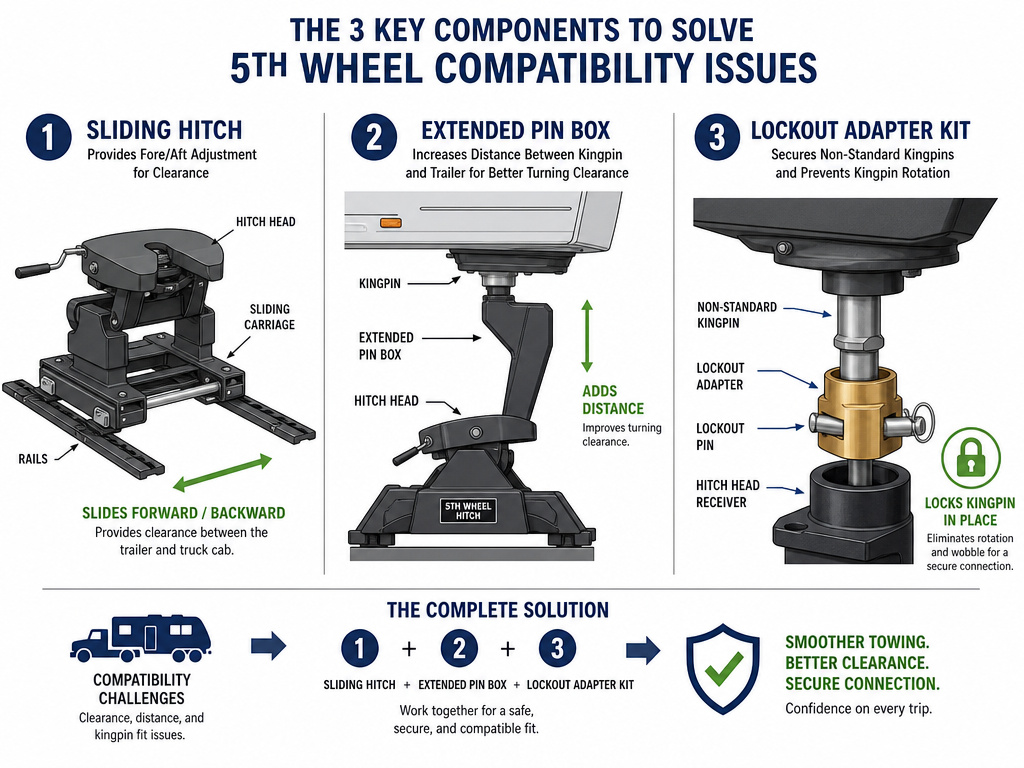
When the answer to universal compatibility is “no,” these are the tools that bridge the gap.
Sliding Hitches: Models like the Reese Kwik-Slide (Part #30048) physically move the hitch head rearward during tight turns to provide the clearance a short bed lacks. They are mechanically complex—another set of rails and locks—and add weight. They are the definitive solution for short-bed trucks without an extended pin box.
Extended Pin Boxes: A simpler, trailer-side solution. Demco recommends a minimum 13-inch extension for short beds. This moves the trailer’s pivot point back, increasing the arc clearance. It changes the towing a fifth wheel dynamics slightly, often for the better by reducing chucking.
King Pin Adapters and Lockout Kits: For non-standard pin boxes. The Blue Ox BXR9005 Rotaflex Lockout Kit is a required safety component. It’s not an accessory; it’s what makes the combination legally and physically compatible.
The takeaway is that the aftermarket provides solutions for almost every mismatch. But you must know the mismatch exists first. Guessing here is how you buy a hitch twice.
Frequently Asked Questions
Are all 5th wheel hitch rails universal?
The rails themselves often follow an industry-standard width (like 20” wide x 22” front-to-back for ISR tabs). However, the hitch head’s mounting brackets that clamp onto those rails are brand and model-specific. You cannot assume a CURT head will lock onto a Reese base rail without verifying the bracket design.
Can I use a 5th wheel hitch in a truck without a prep package?
Yes, but it requires a more involved installation. You’ll need a universal bed rail system, which involves drilling into the truck bed for mounting. This is a permanent modification. Trucks with factory OEM puck systems avoid this drilling but limit your hitch choices to models designed for that specific puck layout.
My trailer has a gooseneck coupler. Is that the same as a 5th wheel?
No. A gooseneck coupler uses a ball in the truck bed, while a 5th wheel uses a king pin and locking jaws. They are completely different hitch system types. Adapters exist to mount a 5th wheel hitch on a gooseneck ball, but they introduce additional pivot points and height, which can affect stability and clearance.
How do I find my trailer’s pin weight?
The most accurate method is to take your loaded trailer (as you would travel) to a truck scale. Weigh the entire trailer (GVWR), then weigh the trailer with only the king pin supported on a separate scale. The second weight is your actual pin weight. Do not rely solely on the trailer manufacturer’s dry pin weight; it doesn’t account for your cargo distribution.
Is a more expensive hitch always better?
Not always. “Better” means matching your specific truck and trailer specs. A 25,000-pound capacity PullRite #1600 is overkill and unnecessarily heavy for a half-ton truck towing a 10,000-pound trailer. The right hitch is the one that matches your required towing capacity with a small safety margin, fits your mounting system, and suits your budget for features like sliding mechanisms or air-ride.
The Bottom Line
Fifth wheel hitches are not universal, but the system is knowable. It breaks down to four verified numbers: truck bed length, hitch GTW and pin weight ratings, and the king pin spec. Get those right, and the installation is straightforward. Get one wrong, and you’re solving for a problem that shouldn’t exist.
Start with your trailer’s GVWR and pin weight. That dictates the minimum hitch ratings. Then measure your truck bed and check for a puck system—that tells you the hitch type and mounting style. The rest is execution: following the torque specs, adhering to the lubrication schedule, and using a sliding hitch or extended pin box if your geometry demands it.
The goal isn’t just a hitch that fits. It’s a connection that disappears into the background, letting you focus on the road ahead, confident that the rig behind you is as solid as the numbers on the page.
