
Tow Easier? The Real Truth About 5th Wheels & Pin Weight
This post contains affiliate links. As an Amazon Associate, we earn from qualifying purchases.
Yes, a fifth-wheel is easier to tow than a travel trailer because its hitch sits over the truck’s rear axle, not behind the bumper. This pivot-point geometry kills sway, improves turning, and transfers wind force into lateral grip. The critical catch is pin weight: 15-25% of the trailer’s loaded weight bears down directly on your truck’s bed, making payload capacity, not just tow rating, the binding constraint for safe towing.
That axle-forward pivot is the whole game. It converts a long trailer from a pendulum behind you into a balanced extension of the truck itself. The handling difference isn’t subtle; it’s the reason a 40-foot fifth-wheel feels planted at 70 mph while a 30-foot travel trailer can start a white-knuckle oscillation at 65.
What follows is the breakdown of why the physics work, the four weight ratings you must check (and where to find them on your truck), and the single miscalculation that sends new owners back to the dealership with a broken budget.
Key Takeaways
- Payload is king. Your truck’s door-jamb payload rating must cover the pin weight (15-25% of trailer GVWR) plus passengers, cargo, and the hitch itself. Exceeding it is illegal and dangerous.
- Stability has a number. Per the SAE J2807 standard, a fifth-wheel’s pivot point over the axle raises the sway threshold by 10-15 mph compared to an equivalent travel trailer.
- The whole system is only as strong as its weakest link. A hitch rated for 24,000 lbs paired with a ball rated for 18,000 lbs means your rig’s max rating is 18,000 lbs.
- Weigh everything. A CAT Scale weigh-in ($14) is the only way to know your true axle loads and combined weight before a long trip.
- Short beds need a plan. Trucks with beds under 6.5 feet risk the trailer cap hitting the cab during sharp turns; a sliding hitch or offset plate is often required.
The Physics Behind the Stability
Forget marketing claims. The ease of towing a fifth-wheel is a mechanical fact dictated by hitch placement.
A travel trailer connects at a ball hitch 4 to 5 feet behind the truck’s rear axle. This creates a long lever arm. When a crosswind hits the side of the trailer, it pushes against that lever, trying to pivot the truck. This is the “wagging” or sway you feel. The trailer’s mass is swinging your truck’s tail.
A fifth-wheel’s hitch sits directly over or slightly ahead of the rear axle. This forward pivot point shortens the lever arm to nearly zero. Wind force is transferred down into the truck’s rear axle as lateral pressure, which the tires convert to grip. The trailer can’t easily pivot the truck because it’s essentially sitting on top of it.
This architecture delivers three concrete advantages you feel in the driver’s seat.
First, sway resistance multiplies. According to engineering analysis of the SAE J2807 towing standard, the oscillation modes that destabilize a travel trailer around 65 mph often don’t affect a fifth-wheel until 75-80 mph under similar wind conditions. The rig simply doesn’t have the mechanical freedom to start that pendulum swing.
Second, the turning radius shrinks. Because the pivot point is near the truck’s center, the trailer cuts inside the truck’s turn path. You can make sharper turns without the trailer’s tires jumping a curb. Backing up is also more intuitive; the trailer follows the truck’s bed more directly, with less of the exaggerated oversteer that plagues travel trailer newbies.
Third, braking feels more balanced. With more weight borne directly over the truck’s drive wheels, there’s less chance of the trailer pushing the lighter rear end of the truck around during hard stops. The weight distribution is simply more natural.
| Handling Metric | Fifth-Wheel (Over-Axle Hitch) | Travel Trailer (Bumper Hitch) |
|---|---|---|
| Primary Sway Cause | Lateral wind force on trailer sides. | Lever-arm pivot behind truck axle. |
| Typical Sway Threshold | 75-80 mph in 25 mph crosswind. | 65 mph in 25 mph crosswind. |
| Turning Behavior | Trailer cuts inside truck’s path. | Trailer swings wide outside truck’s path. |
| Weight Distribution | Pin weight (15-25%) on truck bed. | Tongue weight (10-15%) on rear bumper. |
The Four Weight Ratings You Must Verify
Ease of towing means nothing if you’re overloaded. Safety and legality hinge on four specific numbers. Exceed any one, and you’re risking component failure, poor handling, and denied insurance claims after an accident.
1. Gross Vehicle Weight Rating (GVWR) – The Truck’s Limit.
This is the maximum your truck can weigh: itself, fuel, passengers, cargo, and the pin weight from the trailer. Find it on the driver’s side door jamb sticker. This is your truck’s absolute ceiling.
2. Gross Combined Weight Rating (GCWR) – The Total Limit.
This is the maximum allowed weight of your fully loaded truck AND fully loaded trailer combined. You won’t find this on the door jamb. It’s in your truck’s owner’s manual or towing guide. This number often surprises owners who only look at tow capacity.
3. Gross Vehicle Weight Rating (GVWR) – The Trailer’s Limit.
This is the maximum your fifth-wheel can weigh when fully loaded with gear, water, and propane. It’s on the trailer’s VIN tag, usually inside a front storage compartment or on the frame near the pin box. Your trailer’s actual pin weight is a percentage of this loaded weight.
4. Pin Weight Rating – The Hitch’s Limit.
This is the maximum downward force your hitch and truck bed can support. For a fifth-wheel hitch like the PullRite OEX Series, this is a 6,000 lb vertical load weight. Your truck’s payload capacity (also on the door jamb) must be higher than this pin weight plus everything else you add.
Where this goes sideways: Assuming your truck’s advertised “max tow” rating is the only number that matters. That rating assumes a bare-bones truck with just a driver and full fuel. Add a passenger, a B&W Companion fifth-wheel hitch, and a weekend’s worth of gear, and you’ve eaten hundreds of pounds into your payload long before you hook up the trailer.
The only way to know you’re legal is to visit a CAT Scale at a truck stop. Weigh your loaded truck alone, then weigh the hooked-up rig. The scale ticket shows your individual axle weights. Compare them to your GAWR (Gross Axle Weight Rating, also on the door jamb) and your GVWR/GCWR.
Pin Weight vs. Payload: The #1 Buyer Mistake
This is the most common, most expensive error in fifth-wheel ownership. People match the trailer’s weight to their truck’s towing capacity and think they’re done.
The binding constraint is almost always payload capacity, not towing capacity.
Here’s the brutal math from a real-world example on PickRV: A three-quarter-ton truck might be rated to tow 18,000 lbs. Its door-jamb payload rating, however, might only be 2,800 lbs. A 14,000 lb fifth-wheel has a pin weight between 2,100 and 3,500 lbs (15-25%). Add a 200 lb hitch, two 180 lb adults, and 400 lbs of firewood and tools in the bed. You’ve blown past your payload limit by over 500 lbs before the trailer even moves.
Common mistake: Shopping for a fifth-wheel by tow rating alone. The truck’s payload rating is the real gatekeeper. Verify it on the yellow sticker inside the driver’s door before you ever set foot in an RV dealership.
Pin weight is the downward force the trailer exerts on the hitch. It’s not a suggestion; it’s a physical load that counts directly against your truck’s payload.
Payload capacity is the truck’s ability to carry that weight inside or upon itself, passengers, cargo, and pin weight.
The rule is simple: (Pin Weight + Passengers + Cargo + Hitch Weight) ≤ Truck’s Payload Capacity.
If this math doesn’t work, you need a heavier truck. A one-ton (3500-series) pickup is the standard for a reason, it’s built with a stronger frame, stiffer suspension, and a higher payload rating specifically for this kind of concentrated bed load.
The Hitch & Hardware Reality
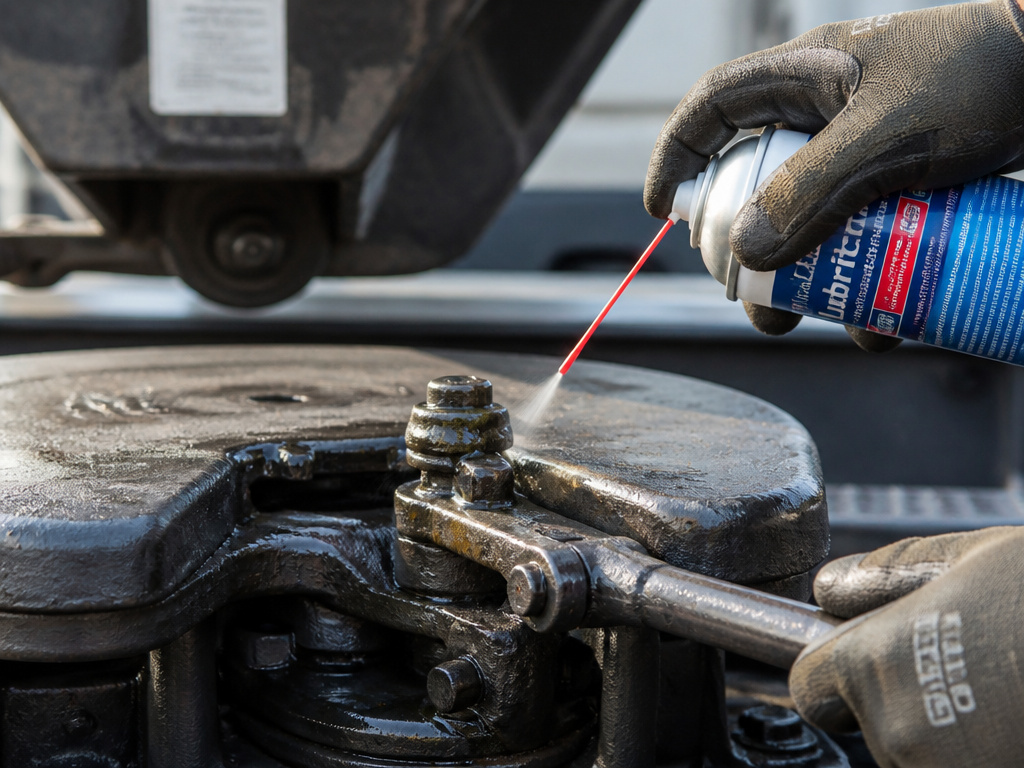
Your fifth-wheel hitch is a wear item that requires maintenance and correct specification. It’s also the linchpin that makes the good towing physics possible.
Not All Hitches Are Equal.
A B&W Companion is the benchmark for reliability and a clean, removable design. A PullRite Super 5th offers a single-point attachment system that some find easier to connect. Cheap, underbuilt hitches from big-box stores can flex, crack, or fail under the cyclical stress of towing. This is not a component to cheap out on.
The “Weakest Link” Rule.
The PullRite manual states it clearly: “The lowest rating of any one component in the system becomes the rating of the entire system.” If your hitch is rated for 24,000 lbs but your truck’s receiver or the hitch’s mounting hardware is only rated for 18,000 lbs, your system is now an 18,000-lb system. Every component must be matched.
Short-Bed Trucks Need Special Attention.
If your truck has a bed shorter than 6.5 feet (a “short bed”), the front cap of the fifth-wheel can strike the back of your truck cab during very sharp turns. The solution isn’t to avoid turning, it’s to use a sliding hitch or an offset hitch plate. These allow the hitch to move rearward several inches during tight maneuvers, creating the necessary clearance. The PullRite SuperGlide is built for this, but even fixed hitches like the OEX have offset settings.
Lubrication is Non-Negotiable.
Hitch manuals specify lubricating the king pin and latch mechanism before each trip. Use a light lubricant spray like WD-40 or a dry graphite spray on the locking parts. A dry hitch seizes, grinds, and makes connecting or disconnecting a fight. A seized latch can also fail to lock properly, a catastrophic risk on the road.
When a Fifth-Wheel is Not the Easier Choice
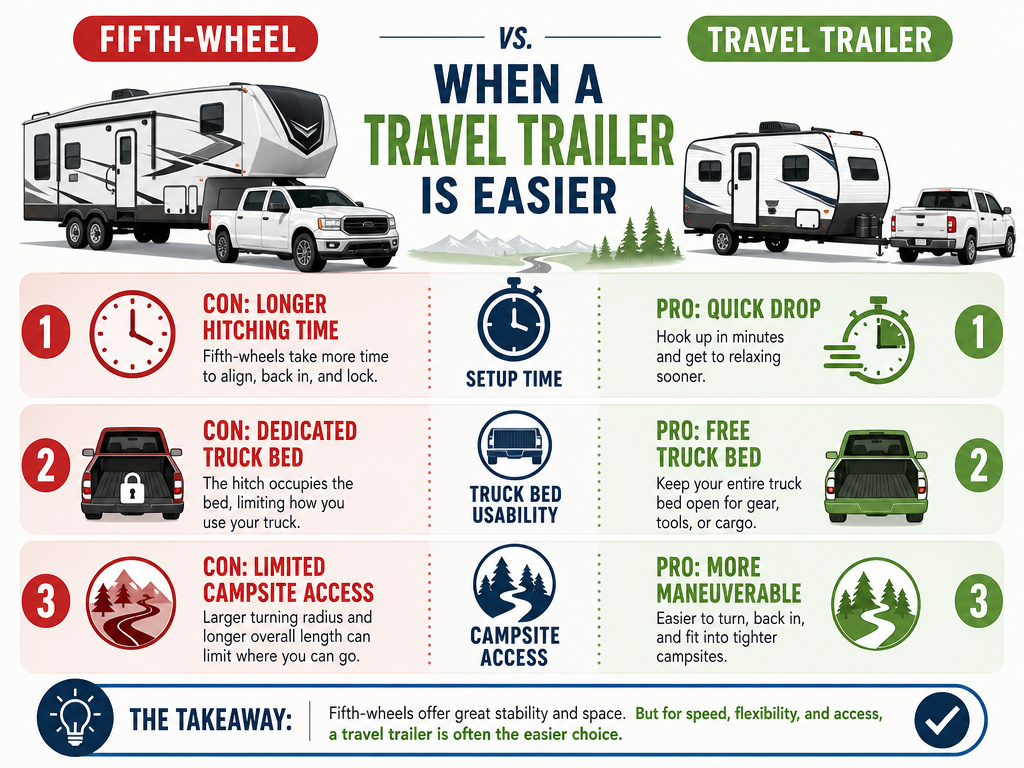
For all their towing advantages, fifth-wheels have real drawbacks that can make a travel trailer the “easier” choice for a specific lifestyle.
Maneuverability Off-Road.
A fifth-wheel is long, tall, and heavy. Getting into tight, tree-lined national park campsites or navigating winding mountain roads requires careful planning. Many scenic park loops have hard length limits of 35 feet. Your 40-foot fifth-wheel plus 22-foot truck won’t fit. A shorter travel trailer pulled by an SUV has far more access.
The Hitching/Unhitching Routine.
Dropping a fifth-wheel takes 15-20 minutes: position the truck, lower the trailer jacks, disconnect cables, release the latch, and drive out. It’s a process. If you’re moving campsites every day, this gets old fast. A travel trailer can be dropped in half the time.
The Truck Commitment.
Your pickup is permanently dedicated to towing. You can’t use the bed for hauling mulch or motorcycles unless you first remove the heavy hitch, a two-person job. A travel trailer leaves your truck free for other truck duties.
The 80% Rule.
Many experienced RVers adhere to an unofficial 80% rule: keep your trailer’s loaded weight at or below 80% of your truck’s maximum tow rating. This provides a buffer for elevation, heat, and unexpected cargo. If following this rule pushes you into a heavier, more expensive truck than you want, a lighter travel trailer may be the pragmatic “easier” choice.
| Scenario | Easier Choice | Why |
|---|---|---|
| Frequent, multi-stop road trips. | Travel Trailer | Faster to hitch/unhitch, more campsite access. |
| Full-time living in one park for months. | Fifth-Wheel | Superior space, comfort, and stability when parked. |
| Towing with a half-ton truck. | Travel Trailer | Most half-tons lack the payload for a safe fifth-wheel pin weight. |
| Traveling to remote, off-grid locations. | Travel Trailer (or smaller toy hauler) | Better clearance and maneuverability on rough roads. |
| Wanting to use your truck bed for other purposes. | Travel Trailer | No permanent hitch occupying the bed. |
Frequently Asked Questions
Do I need a special license to tow a fifth-wheel?
In 47 U.S. States, a standard driver’s license is sufficient if the combined Gross Vehicle Weight Rating (GVWR) of your truck and trailer is under 26,000 lbs. Six states (CA, CT, MD, MI, NV, PA) have additional requirements for longer combinations or heavier weights, often requiring a non-commercial Class B license. Always check your specific state’s DOT regulations.
Can a half-ton truck like an F-150 tow a fifth-wheel?
Sometimes, but rarely well. A half-ton truck with a max-tow package and a long bed might handle a very lightweight fifth-wheel (under 9,000 lbs GVWR). The problem is almost always payload. The pin weight of even a small fifth-wheel can consume most of a half-ton’s payload, leaving no room for passengers or gear. For safe, long-term towing, a three-quarter-ton or one-ton truck is the realistic starting point.
Do fifth-wheels require a weight distribution hitch?
No. The over-axle hitch design naturally distributes weight to the truck’s front and rear axles. Fifth-wheels use a dedicated fifth-wheel hitch, not a weight-distribution system. Travel trailers over 5,000 lbs, however, almost always need a weight distribution hitch like an Equal-i-zer to restore proper steering and braking balance.
How do I know if my truck and fifth-wheel are compatible?
Work backward from your truck’s door-jamb sticker. Note your payload capacity. Subtract the weight of all passengers, cargo you always carry, and your hitch. The remainder is the pin weight you can handle. Then, find a fifth-wheel whose loaded pin weight (15-25% of its GVWR) is at or below that number. Finally, verify that the combined weight is under your truck’s GCWR. A CAT Scale weigh-in is the final, essential proof.
What’s the biggest maintenance item for a fifth-wheel hitch?
Lubrication. The king pin, latch mechanism, and any moving parts on the hitch itself must be kept clean and lightly lubricated. The PullRite manual recommends a dry graphite spray or WD-40 for the latch and a light coating of wet lubricant on the king pin before each trip. A neglected hitch will corrode, bind, and eventually fail to lock securely.
The Bottom Line
A fifth-wheel is mechanically easier to tow, more stable, more controllable, and more confidence-inspiring at highway speeds. That advantage, however, isn’t free. It comes with a non-negotiable requirement: a truck built to handle the concentrated load of 15-25% of the trailer’s weight directly on its bed.
The ease you feel behind the wheel is a direct result of correct matching. Get the match wrong, overload your payload, and you’ve traded sway for a different kind of danger: broken springs, worn brakes, and unpredictable handling. The answer isn’t just in the hitch design; it’s on that yellow sticker inside your driver’s door. Start there, and you’ll earn every bit of that smoother towing experience.
