
Why Do Bike Tires Go Flat When Not in Use? | 3 Key Causes
This post contains affiliate links. As an Amazon Associate, we earn from qualifying purchases.
Bike tires go flat when not in use because air molecules slowly permeate through the rubber casing, a normal process called permeation, and because stored weight deforms the tire into flat spots. Rapid pressure loss over weeks signals a problem: a failing valve, dried sealant, or environmental damage from ozone or chemicals, which can crack sidewalls within days.
That’s the physics answer. The maintenance answer is the gap between what you think is happening and what actually eats your tires. A tubeless system in good condition will lose 2–5 psi over 24 hours, a documented spec from tubeless manufacturers. Losing 15 psi overnight means your sealant has dried into boogers or your rim tape is wrinkled, not that the tire is “bad.”
What follows is the breakdown of those three failure paths, permeation, deformation, and degradation, and the exact storage moves that pull a tire back from each one. By the end you’ll know whether to top it off, patch it, or replace it, and why manufacturers like Continental say to replace tires after three years regardless of mileage.
Key Takeaways
- Permeation, air slipping through rubber, causes a normal 2–5 psi daily drop. Faster loss points to valve or sealant failure.
- Flat spots become permanent after six months of static weight, per Yokohama’s technical bulletin. Hanging the wheel prevents this.
- Ozone from transformers or electric motors cracks sidewalls irreversibly within days, not years, if levels exceed 0.08 ppm.
- Tubeless sealant settles and hardens when static, locking the tire into a deflated shape. Remove sealant for storage over a month.
- Manufacturer lifespans are strict: Continental says 3 years, Michelin says 10 years from manufacture date, irrespective of use.
The 3 Physical Reasons Bike Tires Lose Air Sitting Still
Forget the idea of a perfect seal. A tire is a dynamic system, and when it sits, three processes work against it. The first is boring and universal. The second warps the shape. The third destroys the material.
Permeation is air migrating through the rubber polymer itself. The molecules find paths between the long chains. This is why a brand-new, perfectly sealed tire will still lose pressure. For tubeless setups, the benchmark is 2–5 psi per day. That number comes from industry testing of casing porosity. If your tire loses more, the problem isn’t the rubber, it’s one of the seals.
A tubeless system in good condition will lose 2–5 psi over 24 hours through normal porosity of the rubber casing. Anything beyond ~5 psi per day means at least one of the seals has degraded.
Flat spotting is the permanent deformation of the carcass under continuous load. The weight of the bike, focused on one spot on the tire, compresses the rubber and underlying fabric. Yokohama’s data says spots from short-term storage usually disappear after a 25-mile ride. But if the bike isn’t moved for six or more months, the spot sets. The tire will thump with every rotation, and no amount of inflation will round it out.
Dry rot and ozone cracking attack the rubber compounds directly. This isn’t about age; it’s about environment. Michelin warns that a new tire parked next to a transformer can show irreversible sidewall cracking in just a few days. Ozone, a molecule more reactive than oxygen, splits the polymer chains. Yokohama sets the threshold at 0.08 ppm. An old fridge motor in your garage can exceed that.
| Failure Mode | Primary Cause | Timeline to Damage | Visible Sign |
|---|---|---|---|
| Permeation | Air migration through rubber casing | 2–5 psi loss per day (normal) | Slow pressure drop, no visible issue |
| Flat Spot | Continuous static load on tire | Permanent after 6 months of immobility | Visible flat section, rhythmic thumping while rolling |
| Ozone Cracking | Exposure to ozone-generating sources (motors, transformers) | Irreversible cracks can form in days | Fine cracks on sidewall, often following a pattern |
The table separates the slow leak from the structural fail. Permeation you top off. A flat spot or ozone cracks mean the tire is done.
Where Your Storage Space Is Actually Hurting Your Tires
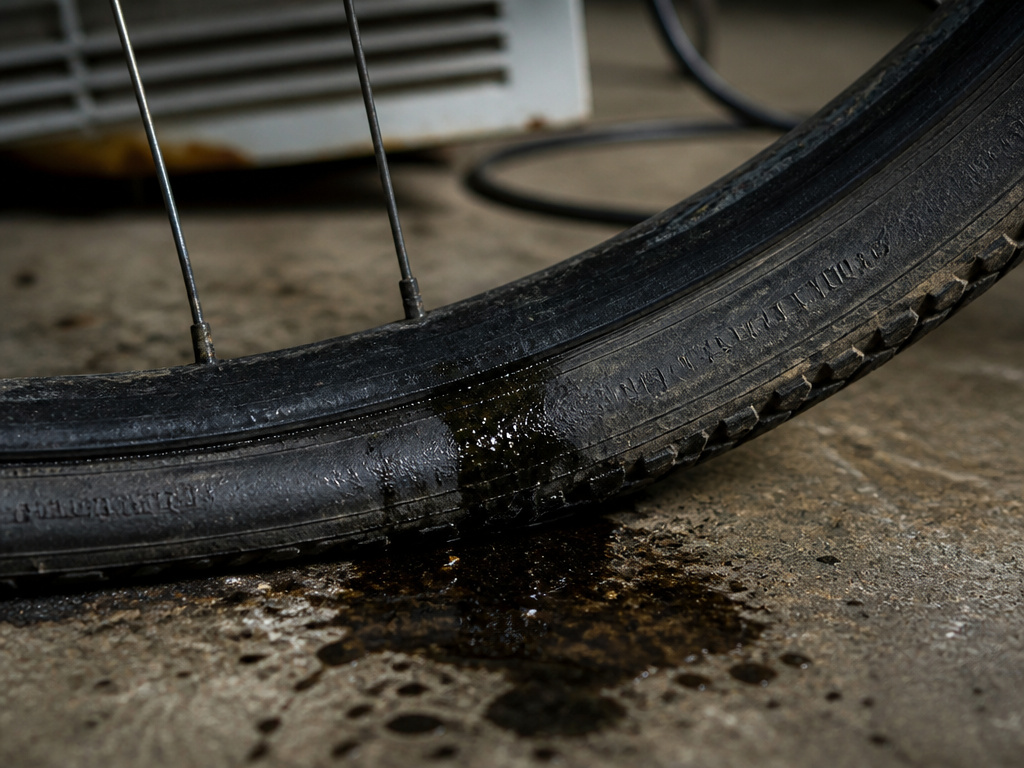
Garages and sheds are tire killers. The threats aren’t dramatic, they’re steady, ambient, and most riders never connect them to the cracking sidewall they see a year later.
Ozone is the silent one. It comes from electric motors, fans, compressors, dehumidifiers, and high-voltage equipment like transformers. The molecule attacks rubber at the molecular level, and the damage is cumulative and irreversible. The 0.08 ppm limit Yokohama cites isn’t a guess; it’s the level below which cracking progression slows to a crawl. Store your bike near a workshop air compressor, and you’re bathing the tires in crack fuel.
Heat-absorbent surfaces turn a cool floor into a hot plate. Yokohama specifically warns against black asphalt or highly reflective surfaces. The heat accelerates oxidation, making the rubber brittle. It doesn’t need to be scorching; a steady few degrees above ambient does the work over months.
Chemical exposure seems obvious, but the sources aren’t. Continental’s manual says to avoid solvents like acetone, benzine, and thinner. That includes common garage drips, fuel, oil, brake cleaner, even some tire shines. The chemicals plasticize the rubber, softening it until it can’t hold shape under pressure.
Where this goes sideways: Storing a bike on its tires in a garage with an old freezer. The motor pumps out ozone, the concrete floor draws heat, and a spilled oil patch seeps into the bottom tire. Two years later, both tires are cracked and won’t hold 30 psi for a week.
The fix is spatial. Get the tires off the ground, away from motors, and onto a shelf. If you can’t, flip the bike. The frame is a sacrificial barrier.
How to Store Bike Tires Without Ruining Them
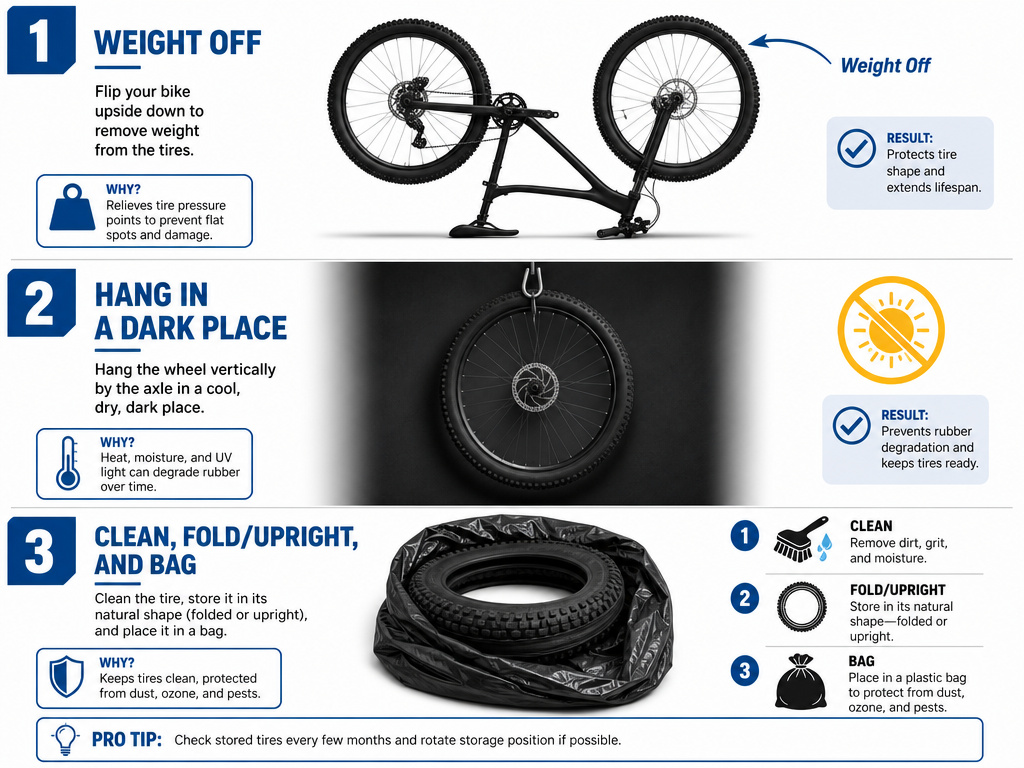
Storage isn’t about finding space. It’s about interrupting the damage processes above. The goal is to eliminate pressure, load, and exposure.
For wheels left on the bike: Flip it. Resting on the handlebars and saddle takes all weight off the tires. If you can’t flip it, inflate to the correct pressure and check monthly. This isn’t for the long term, think a month or two over winter.
For wheels taken off the bike: Hang them vertically by the spokes or axle in a cool, dark place. Do not stack them horizontally under weight. Hanging removes the load that causes flat spots and lets air circulate evenly around the tire.
For tires removed from rims (long-term storage):
- Clean the tire with soapy water. No solvents.
- For folding bead tires (most high-end road tires), fold them as they came in the box. Michelin says this is fine.
- For rigid bead tires (many MTB and commuter tires), do not fold. Store them upright or hung over a bar to avoid creasing.
- Keep them in a black plastic bag to block light. Light, especially UV, is a powerful oxidizer.
The tubeless rule is absolute: Remove the sealant. If you’re storing for more than a month, break the bead and pour out the liquid. Sealant settles at the bottom. As the tire loses air, it deflates at that settled spot, letting air in. The sealant then hardens into a solid mass. Michelin notes this coagulation is irreversible; you’ll be prying rubber boogers out with a tire lever next season.
The Manufacturer Timelines Everyone Ignores (Until They Blow)
Your tire’s lifespan isn’t set by tread wear. It’s set by calendar time and environmental scores you can’t see.
Continental’s 3-year rule is the strictest: replace tires, inner tubes, and rim strips after three years, irrespective of mileage. Their rationale is material aging. The rubber loses elasticity, the fabric cords fatigue, and the bond between layers weakens. This is for safety, not marketing.
Michelin’s 10-year ceiling runs from the manufacture date stamped on the sidewall. They acknowledge aging depends on storage. A tire in a perfect basement might pass ten years. One near an ozone source might fail in three.
Yokohama’s 5-year inspection rule is for seasonal vehicles, but the logic applies. When a tire reaches five years in age, an annual professional inspection is recommended. They’re looking for the internal cracking that precedes a blowout, the kind you can’t see from the outside.
These aren’t suggestions. They’re the result of ASTM fatigue testing and real-world failure analysis. Ignoring them means riding on time bombs where the tread still looks new.
| Brand | Replacement Interval | Key Condition | Rationale |
|---|---|---|---|
| Continental | 3 years | Any mileage, any condition | Material aging of rubber, fabric, and bonding agents |
| Michelin | 10 years | From date of manufacture | Progressive compound degradation, highly dependent on storage |
| Yokohama | 5+ years | Annual inspection after 5th year | Internal cracking risk increases regardless of tread depth |
The takeaway: write the purchase date on the sidewall with a paint pen. When it hits three years, start planning the swap.
Bikes in Storage: The Seasonal Vehicle Protocol
A bike sitting for six months is a seasonal vehicle in miniature. The rules from Yokohama’s RV and boat trailer bulletin apply directly.
Block it or overinflate it. The gold standard is to get the weight off the tires. Use a bike stand that holds the frame, not the wheels. If you can’t, increase tire pressure by 25% over your normal riding pressure. This counters the gradual permeation loss and keeps the casing round.
Move it quarterly. Every three months, roll the bike forward a few feet. This rotates the flat spot risk zone. It also redistributes tubeless sealant if you didn’t remove it.
Cover it, opaquely. If the bike is stored outdoors, use a cover that blocks all light. Sunlight is the primary source of surface ozone and UV radiation, both of which crack rubber. A blue tarp is better than nothing, but a black, woven cover is best.
The pre-ride check is non-negotiable. Before that first spring ride, inspect for cracks, set pressure to the correct riding level (not the storage level), and for tubeless tires, ensure sealant is sloshing liquid. If it hardened, you must dismount, clean, and refill.
Common mistake: Storing a mountain bike with sealant all winter, then wondering why it wobbles on the first trail. The sealant pooled, the tire took a set, and the flat spot is now baked into the casing.
For road bikes with latex tubes, the advice shifts. Latex permeates air much faster than butyl. Expect to reinflate every week or two even in storage. That’s normal, not a leak.
Frequently Asked Questions
Is it bad to let bike tires go completely flat?
Yes, if they stay flat under load. The bike’s weight presses the rim into the flat tire, pinching the tube and potentially cracking the tire casing. If you can’t keep air in it, remove the wheel from the bike.
How long can bike tires sit before they are damaged?
Damage starts immediately but becomes permanent at different thresholds. Flat spots set after about six months of immobility. Ozone cracking can begin within days in a bad environment. For practical purposes, check pressure monthly and never leave a bike unmoved on its tires for more than a season.
Can you fix a tire that has dry rot or sidewall cracks?
No. Cracks mean the structural integrity of the casing is compromised. The tire can fail catastrophically under pressure. Replace it immediately.
Do tubeless tires lose air faster when sitting?
They can, but not because of the tubeless design itself. Tubeless systems have more sealing points, bead, tape, valve, any of which can fail. The rubber casing loses air at the same 2–5 psi daily rate. The common culprit is dried-out sealant, which stops sealing the micro-leaks it’s meant to handle.
Should you release air from bike tires for winter storage?
Manufacturers are split. Yokohama recommends deflating mounted tires to 50% of normal pressure to reduce strain on the sidewalls. Continental says to keep them inflated. The safest method is to remove the weight from the tires entirely by hanging the bike or wheels. If you must leave them inflated, check pressure monthly.
The Bottom Line
Bike tires going flat isn’t a mystery, it’s chemistry and physics winning a slow war. Permeation is normal. Everything else is a fight against environment and time.
Store them off the ground, away from motors and chemicals. Respect the manufacturer’s calendar, not just the tread depth. For tubeless, either ride monthly or remove the sealant. The difference between a tire that lasts three years and one that lasts ten is a cool, dark shelf versus a garage floor next to the water heater.
Your next move: check the date code on your current tires. If it’s older than three years, start researching a fresh set of puncture-resistant tires. The ride will be smoother, and the worry will be gone.
