
What’s the Difference Between Disc Brakes and Rim Brakes?
This post contains affiliate links. As an Amazon Associate, we earn from qualifying purchases.
Disc brakes use a separate steel rotor at the wheel’s hub and caliper-mounted pads, offering powerful, consistent stopping. Rim brakes use pads that squeeze the wheel’s rim itself, a lighter, simpler system prone to wet-weather fade and rim wear.
The core difference isn’t just about where the friction happens. It changes what you feel at the lever, how often you’re adjusting things, and what the bike itself is built to withstand. A long, steep descent is where the gap between the two systems becomes a physical sensation you can’t ignore.
What follows is the real-world breakdown of disc versus rim brakes. It covers the physics that give disc brakes their power, the maintenance burden that comes with it, and the simple fact that rim brakes are still the right answer for a lot of riders.
Key Takeaways
- Disc brakes consistently outperform rim brakes in wet conditions, on long descents, and for heavy loads by dissipating heat away from the tire and rim.
- A modern aluminum rim under rim brakes may last only 2,000 miles in gritty conditions; disc brake rotors are replaceable without rebuilding the wheel.
- Hydraulic disc systems offer superior modulation but require specific tools and fluid to bleed; rim brake adjustment often needs just a hex wrench and fresh pads.
- Professional teams like Team Sky documented “teething issues” with early disc systems, including problematic pad-to-rotor clearances that caused persistent rubbing.
- Your local terrain dictates the choice as much as the tech. Riders in flat, dry regions get minimal benefit from disc brakes over well-maintained rim systems.
How the Mechanisms Differ: A Physical Explanation
Look at the business end of your bike. For rim brakes, the braking surface is the wheel’s rim itself. Pads in a caliper or V-brake squeeze this surface. Disc brakes move the action to a steel rotor mounted at the wheel’s hub, clamped by a separate caliper.
Mechanical Overview: Rim brakes convert kinetic energy into heat directly at the wheel rim, a large surface area that dissipates heat well in normal use. Disc brakes transfer that heat to a dedicated rotor, isolating it from the tire and allowing the system to run hotter without compromising the wheel’s integrity.
This isolation is the why-layer behind disc brake dominance in mountain biking and loaded touring. On a long descent, repeated braking heats the rim. An aluminum rim can handle this, but the heat can soften tire glue or even overpressurize the tube. With disc brakes, the rotor glows red-hot while the rim and tire stay cool. That’s more than a neat trick; it’s a safety feature for sustained braking.
The force itself travels differently, too. A rim brake pulls a cable to close a caliper. Stretching cables and gummed-up housings dull the feel. Hydraulic disc brakes push fluid through a sealed line. All your lever effort transfers directly to the piston, which is why they offer better modulation, the fine control over braking force. Cable-actuated disc brakes exist, but they inherit the cable’s friction losses, landing somewhere between hydraulic disc power and good rim brake performance.
The Riding Conditions Where Each System Wins
Your local roads and trails decide this. Disc brakes are not an automatic upgrade; they solve specific problems you might not have.
Disc brakes win when water, mud, or long hills are part of your routine. The rotor sheds water instantly, and the pad wipes it clean. Rim brakes need a revolution or two to wipe the rim dry before they bite. That half-second lag is real. For loaded touring, commuting in all weather, or mountain biking, the consistent power of discs changes how you ride. You brake later and with more confidence.
Rim brakes are perfectly sufficient for fair-weather riding on flatter terrain. If you live somewhere like South Africa, where long, wet descents are rare, a set of well-adjusted caliper brakes is all you need. They’re lighter, cheaper, and mechanically straightforward. The V-brake variant, common on hybrids, offers even more power for cable-actuated systems but can struggle with clearance in thick mud.
The difference becomes stark under load. Sheldon Brown’s archives note that a tandem with rim brakes risks tire blowouts on long descents. The heat has nowhere to go. A drum brake or disc brake is recommended as a drag brake for that very reason, it can dissipate the heat without cooking the rim. This principle extends to any heavy bike, like a commuter with panniers.
Where this goes sideways: Assuming disc brakes are always better. For a casual rider on smooth, dry pavement, the complexity and cost offer little return. I’ve seen riders invest in a disc-brake bike only to spend more time adjusting caliper alignment than they ever spent tuning their old rim brakes.
| Condition | Disc Brake Performance | Rim Brake Performance |
|---|---|---|
| Wet Roads / Trails | Consistent, near-instant bite | Lag of 1-2 wheel rotations to wipe rim dry |
| Long, Steep Descent | Sustained power; rotor heats, rim stays cool | Power fades as rim heats; risk of tire/tube failure |
| Muddy Trails | Rotor clears mud; pad contamination risk | Mud packs between pad and rim, grinding both |
| Dry, Flat Pavement | Overkill; power is unused | More than adequate; lighter and simpler |
| Heavy Load (Touring/Cargo) | Essential for heat management and control | Risk of rim overheating and brake fade within miles |
The Maintenance and Longevity Trade-Off
One system is easier to fix on the roadside. The other demands more from your home workshop but asks for it less often.
Rim brake maintenance is about pad alignment, cable tension, and rim surface. You need a hex wrench, maybe some sandpaper, and new pads. The whole process is visible and logical. The wear item is the rim itself. In sandy or gritty conditions, an aluminum rim might last only a couple of thousand miles. When it’s worn, you’re rebuilding a wheel, a bigger job.
Disc brakes swap that rim wear for rotor and pad wear. Rotors are cheap and replaceable with a few bolts. The catch is the system’s sensitivity. A bent rotor, even slightly, causes rubbing. Contamination from chain lube or road oil on the rotor ruins the pad’s bite, often requiring replacement of both. The hydraulic system needs periodic bleeding to remove air, which demands specific mineral oil or DOT fluid, a bleed kit, and patience.
Common mistake: Touching a disc rotor with bare fingers after cleaning. The oils from your skin contaminate the surface. Use isopropyl alcohol and handle rotors by the edges only.
Here’s the tool comparison:
- Rim Brake Tune-Up Kit: Hex wrenches (4mm, 5mm), cable cutter, new brake pads, maybe a third-hand tool. Total cost is low. You can learn this in an afternoon.
- Disc Brake Bleed Kit: Specific to your brake brand (Shimano vs. SRAM), bleed funnel, syringes, mineral oil or DOT fluid, rotor truing tool, torque wrench. The investment is higher, and the procedure is less forgiving of error.
For the home mechanic who enjoys tinkering, disc brakes offer a deep well of fine-tuning. For someone who wants to ride, not wrench, rim brakes are a clear advantage. The caveat is that a well-set-up hydraulic disc brake can go thousands of miles between bleeds, while rim brakes need regular cable tension checks as pads wear.
The Professional Perspective: What Happened When Discs Went Pro
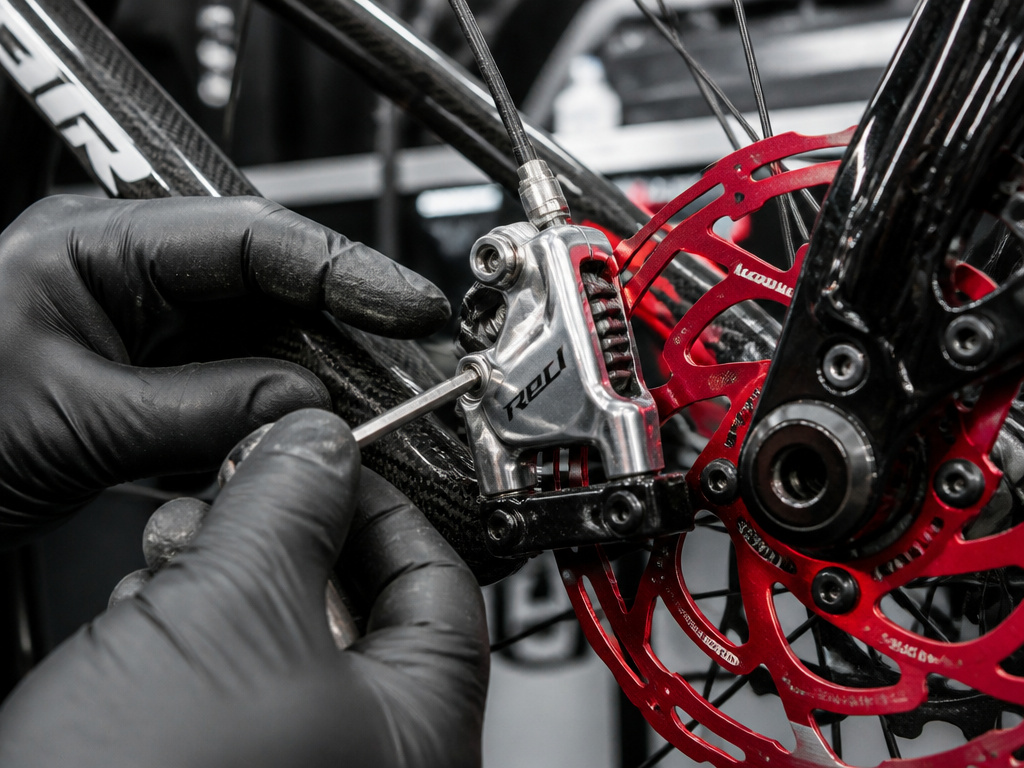
The peloton’s shift to disc brakes wasn’t seamless. The UCI legalized them across the sport in 2017 after testing. Top teams, however, dragged their feet. Mechanics at Team Sky called the transition a “nightmare” due to “teething issues.” Riders like Chris Froome struggled with persistent rubbing from the tight clearances.
“The clearances between the rotor and pads had a minimum tolerance, which caused several issues for us. Chris would come in from training and say his brakes were rubbing. It wasn’t a refinement issue at the rider level; it was in the system itself.”
That minute clearance manufacturers boast about, like the 10% more clearance claimed for Shimano 105, is a double-edged sword. It reduces drag but leaves little margin for rotor flex or pad wear before noise starts. This is a real-world problem that filters down to consumer bikes. The pro’s solution was constant mechanic attention, something a weekend rider doesn’t have.
The move was inevitable, though. Cervélo built its last rim-brake road bike in 2018. By 2022, rim brakes vanished from WorldTour road bikes. The reasons were performance-based: safer descents in rain, the ability to use more aerodynamic carbon rims (since the rim isn’t a braking surface), and consistent lever feel. For time-trial bikes, disc brakes ended a era of notoriously weak and finicky rim brake configurations.
Making Your Choice: A Direct Comparison
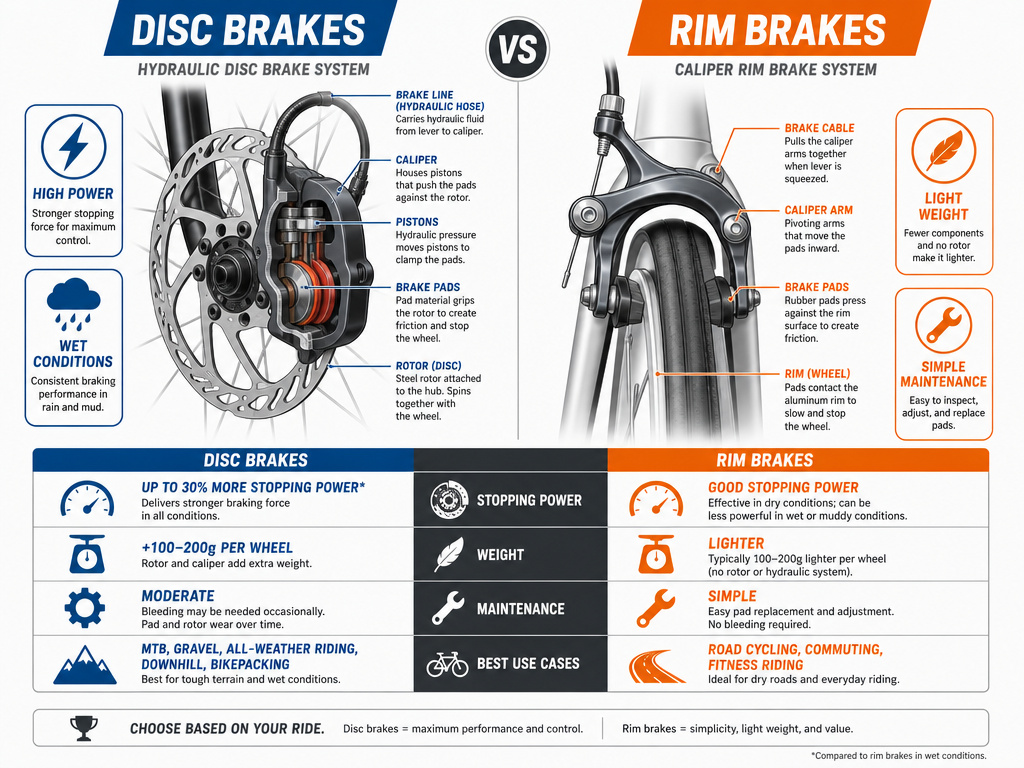
This isn’t about which is objectively better. It’s about which is better for your bike, your riding, and your tolerance for maintenance. Let’s compare them head-to-head.
Disc Brakes are the default for new mountain bikes, gravel bikes, and most performance road bikes. The hydraulic disc brake is the gold standard for feel and power. You’ll pay more upfront and in maintenance complexity. The reward is braking that works the same on mile one of a downpour as it does on a dry day, and control that lets you descend with confidence rather than caution. If you’re looking at best mountain bike brakes, the conversation starts and ends with hydraulic discs.
Rim Brakes remain the choice for lightweight road bikes, budget-friendly hybrids, and casual riders. The caliper brake is a masterpiece of simple efficiency. Your total bike weight is lower, your wallet is heavier, and a mid-ride adjustment is a five-minute affair with a multi-tool. For many, that’s the perfect trade-off. As one rider in our research put it, “One less thing to have to muck around with (or pay for!). I’ll see my days out on rim brakes.”
| Aspect | Disc Brake (Hydraulic) | Rim Brake (Caliper) |
|---|---|---|
| Stopping Power | Very high; consistent in all conditions | Good; significantly reduced when wet or on long descents |
| Modulation | Excellent; fine control over braking force | Good; can feel grabby or vague depending on cable condition |
| Weight | Heavier (rotor, caliper, fluid) | Lighter |
| Maintenance | Complex bleeding, rotor alignment, pad/rotor contamination | Simple pad and cable adjustments, rim wear monitoring |
| Wheel Compatibility | Requires disc-specific hub and frame mounts | Universal; works with any standard rim |
| Best For | Mountain biking, wet/gravel riding, touring, performance road | Dry road riding, budget builds, lightweight racing, casual use |
The Upgrade Question and Compatibility Reality
Can you put disc brakes on a rim-brake bike? Almost never. The frame and fork lack the reinforced mounting points needed to handle the different forces. You’d need a new wheelset, too. The cost quickly surpasses that of a new, disc-ready bike.
Upgrading within a system is common, though. Swapping to higher-quality rim brake calipers or moving from direct-pull V-brakes to a hydraulic rim system like the Magura H series can improve feel. On the disc side, moving from cable-actuated to hydraulic disc brakes is a transformative upgrade for any bike that already has disc mounts. Our guide on the best hydraulic brakes walks through that decision.
The real upgrade path is your next bike purchase. If your riding has outgrown your rim brakes, maybe you’ve started seeking out hills or riding in all weather, your next bike should have discs. If your current setup works fine, save your money. The tech will still be there when you’re ready.
Frequently Asked Questions
Are disc brakes really worth the extra money?
They are if your riding demands them. For mountain bikers, year-round commuters, or anyone who rides in hills, the consistent power and control justify the cost. For a flat-land, fair-weather rider, a quality rim brake bike is a smarter financial and mechanical choice.
How long do disc brake rotors last?
Rotor lasts through multiple sets of pads, often thousands of miles. Wear is slow unless contaminated or subjected to extreme heat. The real limit is often bending from impacts or rock strikes, not wearing thin.
Why are my disc brakes squealing?
Squeal usually means contamination (oil, lubricant) on the rotor or pads, or vibration from pads that aren’t fully seated. Sometimes, a light sanding of the pads and cleaning the rotor with isopropyl alcohol fixes it. If not, new pads are the next step.
Can I convert my rim brake bike to disc brakes?
It’s not practical. The frame and fork need specific, reinforced mounts to handle the braking torque. A bike designed for rim brakes lacks these. You’d need a new frame, fork, and wheelset, essentially a new bike.
Do rim brakes ruin your wheels?
They wear down the braking surface of the rim over time. In clean conditions, an aluminum rim can last for years. In gritty, wet conditions (like gritty winter roads), the abrasive wear can eat through a rim in a season or two of heavy riding.
Which is safer, disc or rim brakes?
Disc brakes are generally safer in adverse conditions where consistent braking is critical, like wet weather or on descents. Their main safety advantage is predictability. Rim brakes are safe when properly maintained and used within their design limits, dry or moderately wet conditions without sustained heavy braking.
Before You Go
Disc brakes deliver relentless, weather-proof stopping power at the cost of mechanical complexity. Rim brakes offer elegant simplicity and lightness, trading away performance when the roads are wet or the hills are long.
Your local terrain is the final judge. Match the system to the ground you cover. For most all-around riding, especially if it involves anything beyond dry pavement, modern hydraulic disc brakes are the answer. For a dedicated fair-weather road bike or a budget build, a well-chosen rim brake system is far from obsolete.
Choose based on the rides you actually do, not the spec sheet you wish you had.
