
Finding the Best Electric Scooter for Hills and Climbing
This post contains affiliate links. As an Amazon Associate, we earn from qualifying purchases.
The best electric scooter for hills is one rated for a 24% maximum incline, powered by a motor of at least 1100W peak output, and equipped with large, tubeless pneumatic tires for traction. This combination overcomes gravity on sustained climbs without overheating the motor or draining the battery in minutes.
That 24% figure isn’t marketing. It’s the tested grade a scooter with a 75kg rider must ascend from a 15km/h start and exit above 6km/h, per the manufacturer’s own standardized climb test. Scooters that list a lower percentage will bog down or stall on the same hill. The motor’s peak wattage delivers the initial torque, but the continuous power and battery management decide whether you make it to the top on the first try or walk the rest of the way.
What follows is the breakdown of the three non-negotiable specs, a direct comparison of the scooter types that meet them, and the real-world trade-offs between hill-climbing power and everything else you need from a daily ride.
Key Takeaways
- 24% max incline is the benchmark. Any scooter rated below this will struggle on common urban hills. This is a standardized test result, not an estimate.
- Peak power is for launch; continuous power is for the climb. A 1200W motor that overheats in 90 seconds is worse than a cooler-running 1000W motor.
- Tubeless pneumatic tires are mandatory. Their larger contact patch and ability to deform over bumps provide the grip that solid or smaller tires lack on an incline.
- Your weight plus the scooter’s weight equals the load the motor must push. Exceeding the scooter weight capacity by even 10kg can cut your effective climb grade by a third.
- Dual-motor (2WD) scooters like the Segway GT3 Pro dominate steep grades but sacrifice portability and legality for on-road use in many areas.
The Three Non-Negotiable Specs for Hills
Forget top speed. On a hill, three other specifications become the only numbers that matter. If a product page buries these, move on.
The maximum incline grade, expressed as a percentage, is determined by a standardized test: a 75kg load, 70% battery, ascending a 10-meter ramp from 15km/h, and exiting above 6km/h. It is a pass/fail metric for sustained climb capability.
1. Maximum Incline: The 24% Floor
A 24% grade means the scooter rises 24 meters vertically for every 100 meters traveled horizontally. It’s steep. Most city hills fall between 15% and 20%. A scooter rated for 24% gives you a necessary buffer.
Why is buffer critical? Because the rating assumes a 75kg rider, a specific battery level, and a smooth ramp. Add a backpack, a lower battery, wind, or a rough road surface, and your effective grade increases. A scooter at its limit will slow to a crawl, overheat the motor, and drain the battery at an alarming rate. The Ninebot F3 Pro E and Xiaomi Electric Scooter 6 Max both list a 24% max incline in their official specs, making them baseline candidates for hilly commutes.
Scooters for steep hills need more than 24%. Performance models like the DUALTRON X LIMITED claim around a 70% (35-degree) grade, but that comes with a massive weight and power trade-off.
2. Motor Power: Peak vs. Continuous and Why Drive System Matters
Motor power is advertised as a peak figure (e.g., 1200W). This is the burst power available for a few seconds to get you moving. The nominal or continuous power (e.g., 550W) is what the motor can sustain without overheating.
For hills, you need high continuous power. A long climb is a continuous load. This is where the difference between hub motor and belt drive scooter designs becomes relevant. Most commuter scooters use a single rear hub motor. It’s efficient but can overheat on long climbs because the heat is trapped inside the wheel. High-performance scooters often use dual hub motors or a belt-drive system that allows for better cooling.
A single 1100W rear-drive motor, like in the Xiaomi 6 Max, is sufficient for a 24% grade with a rider at or near the weight limit. For anything steeper or for heavier riders, you start looking at dual-motor setups. The Segway GT3 Pro uses two motors for a two-wheel drive system that simply powers through inclines.
| Motor Configuration | Best For | Risk on Long Hills |
|---|---|---|
| Single Rear Hub Motor (e.g., NAVEE N65i) | Daily commutes with moderate hills. | Overheating, reduced power (thermal throttling) after 1-2 minutes of continuous climb. |
| Dual Hub Motors (2WD) (e.g., Segway GT3 Pro) | Steep, sustained inclines and off-road terrain. | High battery drain, significant weight penalty, often not street-legal. |
| Belt-Drive Motor | Smooth power delivery and better cooling. | More maintenance (belt replacements), less common in hill-focused models. |
3. Tires and Traction: The Contact Patch is Everything
You can have all the power in the world, but if the tires slip, you’re going nowhere. This is where scooters for hilly terrain separate themselves.
Large, tubeless pneumatic tires are non-negotiable. The Xiaomi 6 Max uses 12-inch tubeless tires, and the Ninebot F3 Pro E uses 10-inch versions. Compared to solid tires or smaller 8-inch air-filled tires, they offer a crucial advantage: a larger contact patch. More rubber on the road means more grip. The air cushion also absorbs bumps, keeping the tire planted where a solid tire would bounce and lose traction.
Traction Control System (TCS) is a valuable electronic aid. It detects wheel slip and momentarily reduces motor power to regain grip. It’s especially useful on wet leaves, gravel, or painted road markings on a hill. The Ninebot F3 Pro E and Xiaomi 6 Max both feature TCS.
Head-to-Head: Commuter vs. Performance vs. Beast
Your choice depends on whether you’re navigating San Francisco daily, tackling a single steep path to campus, or riding off-road trails.
The Capable Commuter: Xiaomi Electric Scooter 6 Max
This is the default pick for most people with hills. It hits the 24% grade with its 1100W peak motor, uses those critical 12-inch tubeless tires, and includes TCS. The wider deck and improved suspension over previous models make the climb more stable. Its IPX6 water resistance rating means a sudden shower won’t end your ride.
The trade-off is weight. At over 25kg, it’s not a scooter you’ll carry up a flight of stairs daily. But for a rider under 100kg needing reliable hill performance from a scooter for commuters, it’s the balanced choice. Check current reviews on Amazon for the latest feedback on its real-world climb performance.
The Dedicated Hill Specialist: Ninebot F3 Pro E
Segway’s offering is a direct competitor with a similar 24% grade and 1200W peak motor. It differentiates with a focus on stability tech like its SegRide system and a slightly different suspension setup. The 10-inch self-sealing tubeless tires are a highlight, drastically reducing puncture anxiety.
Where it potentially edges out the Xiaomi for hills is in its optional battery. A second battery can be mounted, which doesn’t increase power but fights the number one side-effect of climbing: range anxiety. Climbing murders your range on a single charge. Having that extra capacity is a legitimate advantage for longer, hillier routes.
The Overkill Beast: Segway GT3 Pro & DUALTRON X LIMITED
These are not for casual commuters. The Segway GT3 Pro is a dual-motor, two-wheel-drive machine with a price and weight to match. The DUALTRON X LIMITED takes it further, claiming a 70% climb grade. They exist to answer the question of scooters for steep hills without compromise.
The compromise is everything else. They weigh 40kg to 80kg. They are often not legal for use on public roads due to their high top speed. They are expensive. They are for enthusiasts with a specific need, like off-road trail climbing or private property with extreme terrain. For 99% of riders asking about hills, this category is fascinating but impractical.
Where this goes sideways: Choosing a scooter based on peak power alone. A lightweight scooter with a 1200W motor might climb well once, but its small battery will be drained in 10 minutes, and the motor could overheat on the second attempt. Sustained power requires robust battery and motor cooling.
The Supporting Cast: Brakes, Battery, and Weight
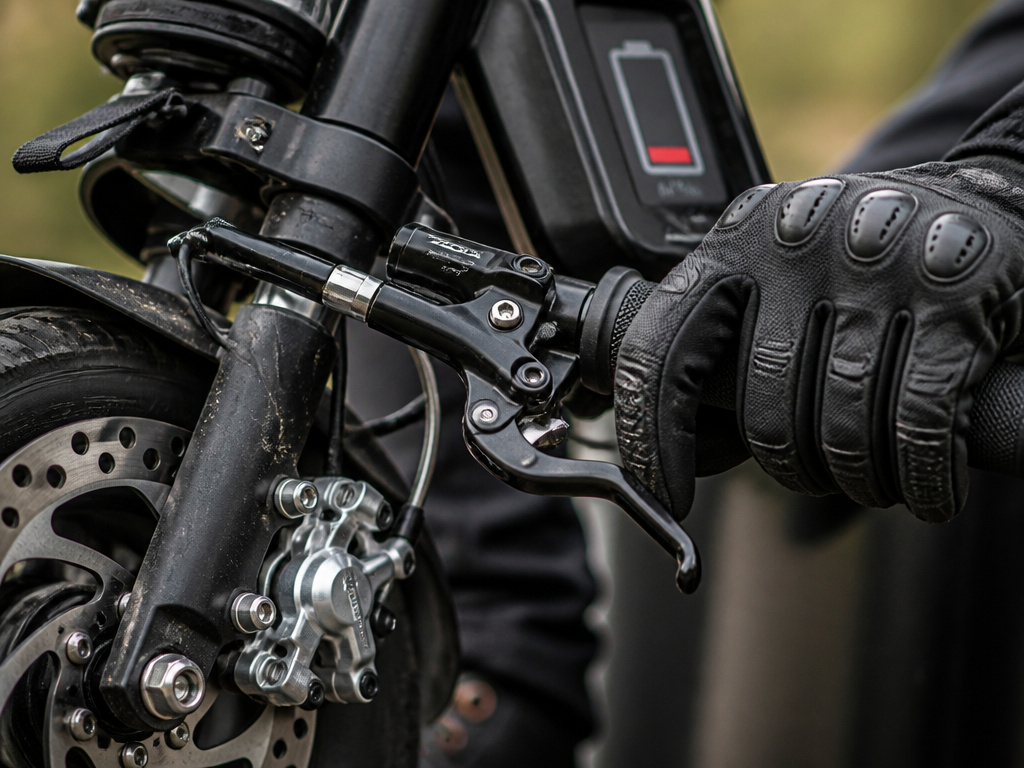 Hill climbing is only half the equation. You also need to stop, have enough battery to get home, and not exceed the scooter’s limits.
Braking Systems: Going Down is Harder
Descending a hill stresses brakes more than climbing stresses the motor. Regenerative braking helps by converting some energy back into battery power and providing engine braking, but it’s not enough alone.
Front and rear disc brakes are the standard for hill-capable scooters. Hydraulic disc brakes, like on the Ninebot F3 Pro E, offer more consistent performance with less hand fatigue than mechanical discs. Never rely on a single brake or a drum brake for repeated steep descents; they fade.
Battery and Range: The Climb Tax
Assume your advertised electric scooter range will be halved in a hilly area. Climbing requires immense energy. A scooter rated for 70km on flat ground might deliver 35km in a city with hills. This makes battery capacity (measured in Wh, like 477Wh or 468Wh) critical. Larger numbers are better.
Battery Management Systems (BMS) are also vital. They protect the battery from overcurrent during the high draw of a climb. A good BMS is what prevents damage from the constant strain hill riding imposes.
The Weight Equation: Rider + Scooter
Every scooter has a maximum weight. This is the absolute limit for safe operation of the brakes, frame, and motor. Exceeding it isn’t just unsafe; it directly cripples hill performance. The motor must move the total mass of the scooter plus the rider.
If you weigh 100kg and the scooter weighs 25kg, the motor is pushing 125kg. A scooter tested for a 24% grade with a 75kg rider will not achieve that grade with 125kg of load. It might only manage a 15% grade. Always buy a scooter with a weight limit well above your body weight.
Before You Start: The Hill-Climbing Ritual
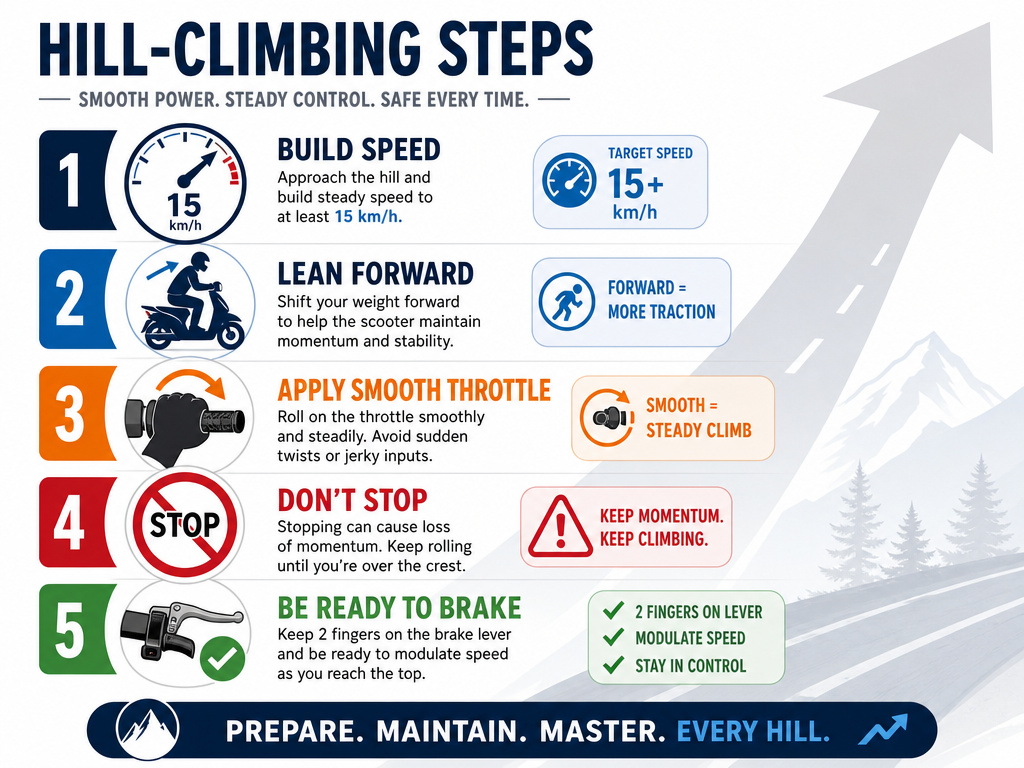 Hill riding demands a specific technique. Doing it wrong wastes power and risks a stall.
- Approach with speed. Don’t hit the base of the hill at a crawl. Use the flat approach to build momentum to at least 10-15 km/h.
- Shift your weight forward. Lean toward the handlebars. This keeps the front wheel planted and prevents the scooter from “wheelie-ing” or losing traction on the rear drive wheel.
- Apply throttle smoothly. Jam the throttle and you might spin the tire or trigger the BMS to cut power. A smooth, steady increase is more effective.
- Don’t stop. If you stall mid-hill, restarting is difficult and dangerous. If you must stop, dismount and walk it.
- Test your brakes at the top. Before descending, ensure your brakes are responding fully. Start slow.
Frequently Asked Questions
What makes an electric scooter good for hills?
Three things: a motor with high continuous power (not just peak), a maximum incline rating of at least 24% from a standardized test, and large tubeless pneumatic tires for grip. Electronics like Traction Control (TCS) help but are secondary to these mechanical specs.
Is a dual-motor scooter necessary for hills?
For extreme hills or off-road use, yes. For typical urban hills with grades up to 20-24%, a powerful single-motor scooter like the Xiaomi 6 Max or Ninebot F3 Pro E is sufficient and more practical. Dual-motor scooters are heavier, less portable, and often exceed legal power limits for road use.
How much does hill climbing reduce my scooter’s range?
Plan for a 40-50% reduction. Climbing is the most energy-intensive thing your scooter does. If your flat-ground range is 40km, expect 20-25km in a consistently hilly area. This makes choosing a model with a larger battery capacity essential.
Can I modify my scooter to be better at hills?
Not safely or effectively. Increasing power via software hacks can overheat the motor and void the BMS, causing a fire risk. The motor, battery, and controller are a matched system. The only safe “mod” is ensuring your tires are properly inflated for maximum traction.
Are heavier scooters better for hills?
Not necessarily. A heavier scooter has more mass for the motor to move up the hill, which hurts performance. The weight should come from a larger battery and a robust frame, not poor design. What matters is the power-to-weight ratio.
The Bottom Line
Stop looking at glossy pictures and start looking at spec sheets. The best electric scooter for hills for you is the one whose minimum tested incline rating exceeds the grades on your route, whose motor power is sustained and not just peak, and whose tires can actually grip the surface. For most, that’s a commuter-focused model like the Xiaomi Electric Scooter 6 Max. It delivers the 24% grade, the right tires, and the essential safety features without becoming a 40kg monster.
For that one brutal hill that defines your commute, nothing beats the raw power of a dual-motor scooter, but you pay for it in every other aspect of daily use. Match the machine to the specific incline, not the fantasy. Your battery life and your own patience depend on it.
