
Managing Nissan Rogue Maintenance & Important Recall Notices
This post contains affiliate links. As an Amazon Associate, we earn from qualifying purchases.
You maintain a Nissan Rogue by adhering to a strict schedule for fluid changes, filter replacements, and proactive recall checks, with particular vigilance around the 1.5L KR15DDT turbo engine’s oil system and cooling. The 2026 NHTSA recall for bearing seizure, tied to oil temperature degradation, makes using the correct 0W-20 SP oil and timely oil changes more than a recommendation; it’s a preventative measure against a documented failure mode.
That recall, affecting over 300,000 Rogues from the 2023-2025 model years, changes the context of routine upkeep. It’s not just about keeping the warranty valid anymore. It’s about mitigating a known, specific risk that can lead to a sudden loss of motive power. The maintenance schedule is your primary defense, and the recall bulletins are your playbook for addressing flaws the factory missed.
What follows is a breakdown of the critical components, their service intervals, the fluids that must meet Nissan’s exact specifications, and how to verify if your vehicle is part of an active safety campaign. This is the information you need to keep a modern, complex crossover like the Rogue reliable for the long haul.
Key Takeaways
- The KR15DDT 1.5L turbo engine requires Genuine Nissan 0W-20 SP oil or an equivalent synthetic GF-6A SP oil; using the wrong oil voids warranty and exacerbates the oil-temperature issues cited in the 2026 bearing seizure recall.
- Check for open recalls immediately using your VIN at the NHTSA website; the 2026 recall (26V080) mandates an ECM reprogram and inspection, a one-hour dealer visit that could prevent catastrophic engine failure.
- CVT fluid is non-negotiable: Only Genuine Nissan CVT Fluid NS-3 or its direct equivalent should be used. Mixing or substituting other fluids guarantees transmission damage.
- Coolant service is specific: Use only Nissan Blue Long Life Antifreeze mixed with distilled water. The system requires a precise bleeding procedure to avoid air pockets that cause overheating.
- Maintenance is component-driven: Don’t just follow a mileage schedule; reference the Nissan component lookup for your specific model year to address items like the in-cabin microfilter, brake fluid, and differential oil.
The KR15DDT Engine’s Maintenance Non-Negotiables
The heart of the modern Rogue is its three-cylinder, 1.5-liter variable compression turbo engine, codenamed KR15DDT. This isn’t a simple powerplant. Its complexity demands precision in upkeep, a fact underscored by a federal investigation.
The part nobody mentions: Using any engine oil other than a synthetic 0W-20 that meets the API SP and GF-6A specifications directly contradicts the remedy for NHTSA recall 26V080. The recall identifies high oil temperature degrading lubrication as a cause of bearing seizure. The wrong oil breaks down faster under those temperatures.
The mandated oil is Genuine Nissan Motor Oil 0W-20 SP. If that’s unavailable, the fallback is any synthetic 0W-20 GF-6A SP motor oil. The “SP” and “GF-6A” are not marketing labels. They certify the oil contains the specific additive packages, anti-wear, detergents, friction modifiers, that the engine’s variable compression mechanism and turbocharger require. Using a generic 0W-20 that doesn’t carry these certifications is a gamble with the NHTSA recall report on engine lubrication as your evidence.
Oil change intervals follow the standard severe-service schedule for most owners: every 5,000 miles or six months. This is especially critical for this engine. The oil filter must also be a Genuine Nissan part or a direct equivalent that meets their specification. A cheap filter might not have the correct bypass valve pressure or filtration efficiency, allowing contaminants to circulate and accelerate wear.
The cooling system is equally specific. It’s filled from the factory with a 50/50 mix of Nissan Blue Long Life Antifreeze and water. When you need to top up or perform a flush, you must use the same blue coolant mixed with distilled or demineralized water. Introducing green coolant, universal “mix-with-anything” formulas, or tap water introduces minerals and incompatible corrosion inhibitors. The result is gradual scaling and electrolytic corrosion that the system’s aluminum components can’t withstand.
Component Service Intervals: What Needs Attention and When
Nissan provides a component-by-component maintenance schedule, which is more useful than a simple mileage chart. It acknowledges that parts wear at different rates. Your driving habits, city versus highway, towing, extreme climates, will determine which column you follow.
This table breaks down the key components and their typical service intervals under normal driving conditions. Treat “normal” as mostly highway miles with minimal idling. If your driving is stop-and-go, in dusty areas, or involves frequent short trips, move everything to the “severe” schedule, which typically halves these intervals.
| Component | Service Action | Typical Interval (Normal Use) |
|---|---|---|
| Engine Oil & Filter | Drain & Refill with 0W-20 SP oil | 5,000 – 7,500 miles |
| CVT Transmission Fluid | Drain & Refill with NS-3 fluid | 60,000 miles |
| Engine Air Filter | Replacement | 15,000 – 30,000 miles |
| In-Cabin Microfilter | Replacement | 15,000 – 20,000 miles |
| Brake Fluid | Flush & Replace DOT 3 fluid | 2 years / 30,000 miles |
| Spark Plugs | Replacement | 105,000 miles |
| Engine Coolant | First replacement | 120,000 miles / 10 years |
| Differential Oil (AWD) | Drain & Refill 75W-90 GL-5 | 30,000 miles |
| Transfer Case Coupling Oil | Drain & Refill (if equipped) | 30,000 miles |
The in-cabin microfilter is a common oversight. Clogged with pollen and dust, it strains the blower motor and reduces HVAC efficiency. It’s a fifteen-minute, no-tools job on most Rogues, accessed behind the glove box. Changing it annually improves air quality and system performance.
For the all-wheel-drive system, the differential and coupling oil are critical. These are separate from the transmission. Neglecting them leads to whining noises, increased fuel consumption, and eventual mechanical failure. The coupling oil, in particular, ensures the rear wheels engage smoothly when slip is detected.
Recalls and Technical Service Bulletins: Your Proactive Checklist
Owning a modern vehicle means software is as important as hardware. Recalls (safety-related) and Technical Service Bulletins (TSBs, for common repairs) are how manufacturers address issues after the car leaves the factory. For the Nissan Rogue, several are particularly consequential.
The most critical is NHTSA Recall 26V080, submitted in February 2026. It affects 2023-2025 Rogues with the KR15DDT engine built between October 2022 and November 2024. The defect: increased engine oil temperature degrading lubrication, leading to bearing seizure. The remedy involves a dealer reprogramming the Engine Control Module (ECM), checking for Diagnostic Trouble Codes (DTCs), and a test drive. In some cases, the engine may need replacement. This service is free and takes about an hour, but an engine swap can take up to fifteen hours.
Where this goes sideways: Ignoring a recall notice because the car “seems fine.” Bearing failures progress over time, often with audible knocking or a check engine light as warning. Waiting for these symptoms, after the recall has been issued, could leave you stranded with a seized engine.
Another known issue is captured in TSB EC25-012 (NTB25-064), for 2024-2025 Rogues. It addresses a check engine light (MIL) with codes P05D8 and P05D9 stored. The cause is often a severed wiring harness at the crankcase ventilation valve under the engine cover. The fix may require a new connector kit. This isn’t a recall, but a known repair procedure dealers follow under warranty.
Earlier models have their own bulletins. The 2021 Rogue had a campaign (PC791) for inspecting and reseating the fuel pump feed tube. The 2022 Rogue had a fuel tank replacement campaign (PC887). The 2023 Rogue had a campaign for front seat belt pre-tensioner replacement.
How to check: Always search your Vehicle Identification Number (VIN) on the NHTSA website. Do not rely solely on mailed notices, as they can be missed if you’re not the original owner.
The Transmission, Brakes, and Fluids Specification Lock
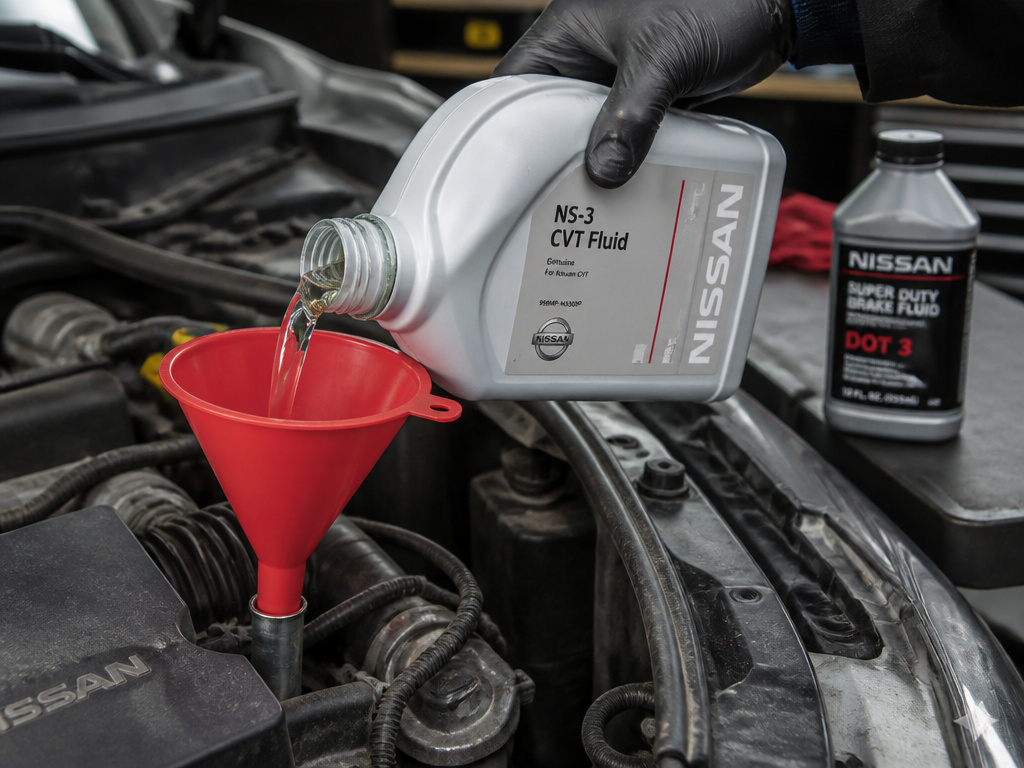 The Rogue’s Continuously Variable Transmission (CVT) is a point of sensitivity. Its performance and longevity are tied to one thing: using the correct fluid. The specification is Genuine NISSAN CVT Fluid NS-3 or its direct equivalent.
Mixing in other fluids, even other Nissan CVT fluids or universal CVT fluids, is a guaranteed path to shuddering, slipping, and failure. The fluid’s friction properties are engineered for the specific metal-on-metal belt and pulley interface. The drain-and-fill interval is around 60,000 miles, but if you do towing or aggressive driving, consider 30,000 miles. There is no “lifetime” fluid.
The brake system uses DOT 3 fluid, such as Nissan Super Heavy Duty Brake Fluid. This fluid is hygroscopic, it absorbs moisture from the air over time. That lowers its boiling point. In heavy braking, the heat can cause the fluid to boil, creating vapor bubbles in the lines and causing a sudden, spongy brake pedal. Flushing it every two years is cheap insurance.
Power steering, if not electric, and other lubrication points will use specific fluids listed in your manual. The principle is universal: use what Nissan specifies. Aftermarket parts and fluids can be excellent, but they must meet or exceed the OEM specification, not just claim compatibility.
Interior and Exterior Preservation
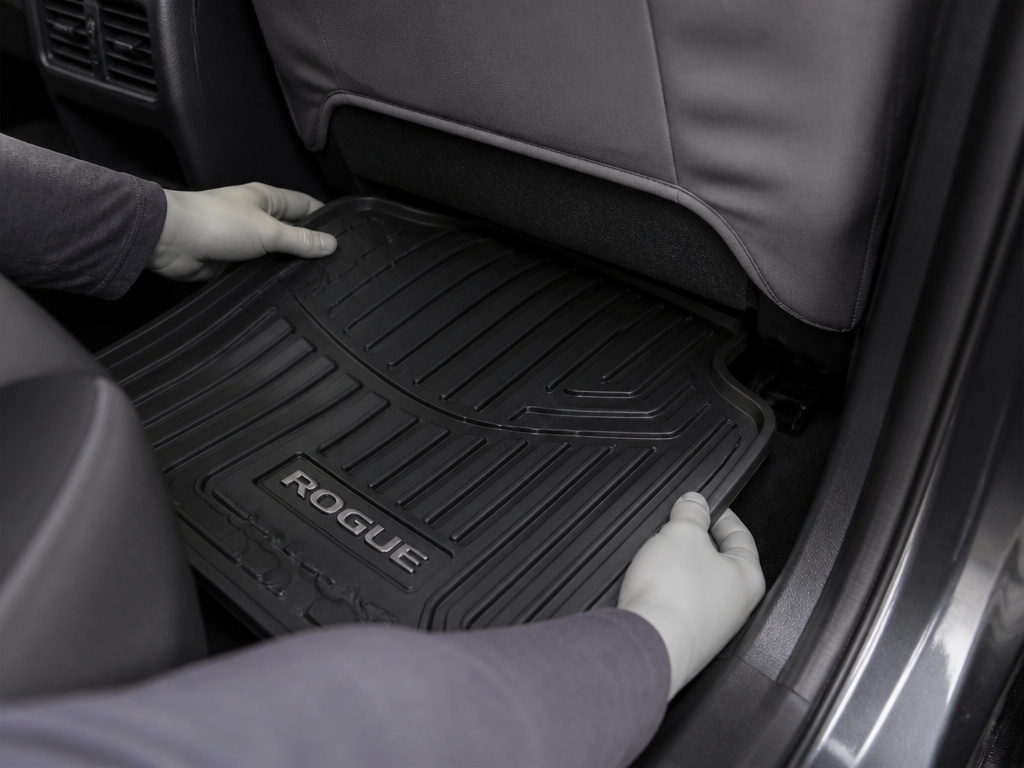 Maintenance isn’t only under the hood. Protecting your investment means caring for the interior and exterior. This is where quality accessories pay off.
High-quality Nissan Rogue floor mats are essential. All-weather rubber mats contain spills, mud, and salt, preventing permanent stains and corrosion on the carpet beneath. They’re easier to clean than carpeted mats, just pull them out and hose them off. Similarly, a good set of protective seat covers shields the original upholstery from sun damage, pet claws, and everyday wear, preserving resale value. These are especially useful if you have a family or use the Rogue for outdoor activities.
Exterior care is straightforward: regular washing to remove road salt and grime, and periodic waxing to protect the clear coat. Pay attention to the windshield wipers; streaking reduces visibility and is easily fixed with new blades. Also, check the Nissan Rogue battery every fall before winter. A weak battery struggles in the cold, and modern vehicles with many electronic modules are intolerant of low voltage.
Troubleshooting Common Issues and Next Steps
When something goes wrong, start with the simplest explanation. Many problems trace back to maintenance items.
A rough idle or loss of power could be a clogged engine air filter or old spark plugs. A musty smell from the vents is almost always a dirty in-cabin microfilter. Grinding noises from the front during turns might indicate worn brake pads or a failing wheel bearing.
For check engine lights, don’t panic. The first step is to have the codes read, often for free at an auto parts store. A code like P05D8 points directly to the PCV system wiring issue described in the NHTSA technical service bulletin. This gives you specific, actionable information before visiting a mechanic.
If you hear a rhythmic knocking from the engine, especially when cold, and you own a 2023-2025 model, stop driving. This is a primary symptom of the bearing issue in the active recall. Have the vehicle towed to a Nissan dealer for evaluation.
Your next step should be to gather your VIN and run it through the NHTSA recall checker. Then, review your service records against the component interval table. Schedule any overdue maintenance, prioritizing engine oil, filters, and brake fluid. Finally, consider investing in protective accessories like all-weather mats and seat covers to preserve the cabin. This proactive approach turns you from a passive owner into an informed custodian, which is what a vehicle as complex as the Nissan Rogue requires.
Frequently Asked Questions
What is the most important maintenance item for a 2025 Nissan Rogue?
The single most critical item is using the exact correct engine oil: Genuine Nissan 0W-20 SP or an equivalent synthetic 0W-20 GF-6A SP oil. This is directly tied to the engine’s longevity and is a central part of addressing the known bearing seizure risk identified in NHTSA recall 26V080. An incorrect oil accelerates the very degradation process the recall aims to fix.
How often should the CVT fluid be changed in a Nissan Rogue?
Nissan’s official schedule often cites a “lifetime” fill, but this is under ideal conditions. For real-world driving, a drain-and-fill with Genuine Nissan CVT Fluid NS-3 every 60,000 miles is a safe interval. If you frequently tow, drive in mountainous terrain, or in stop-and-go traffic, consider doing it every 30,000 miles. Never flush a CVT; only drain and refill.
My check engine light is on with codes P05D8/P05D9. What should I do?
These codes relate to the crankcase ventilation system. The first step is to check the NHTSA technical service bulletin for your model year. A common fault is a severed wiring harness under the engine cover. This is a known issue dealers are familiar with. Schedule a diagnostic with a Nissan service center, as the repair may be covered under warranty and involves a specific connector kit.
Are Nissan Rogue maintenance costs high?
Compared to some non-turbo competitors, costs can be higher due to the specific synthetic fluids required (0W-20 oil, NS-3 CVT fluid) and the complexity of the turbocharged KR15DDT engine. However, adhering strictly to the schedule prevents far more expensive repairs down the line, like transmission or engine replacement. Proactive maintenance is your best cost-control strategy.
How do I know if my Nissan Rogue has an open recall?
Visit the National Highway Traffic Safety Administration (NHTSA) website and enter your 17-character Vehicle Identification Number (VIN). This will show all unremedied recalls applicable to your vehicle. You can also contact any Nissan dealership with your VIN for them to check. Do this regularly, as new recalls like the 2021 Nissan recall campaign bulletin for the fuel pump can be issued years after purchase.
Can I use aftermarket parts for Nissan Rogue maintenance?
Yes, but with a major caveat: the part must meet or exceed Nissan’s original equipment specifications. This is especially true for filters and fluids. For example, an oil filter must have the correct bypass valve rating. For peace of mind and warranty protection, many owners stick with Genuine Nissan parts for core engine and transmission components, while using trusted aftermarket brands for items like car floor mats or wiper blades.
The Bottom Line
Maintaining a Nissan Rogue is an exercise in precision. Its advanced KR15DDT engine and CVT transmission deliver efficiency and performance but demand exact fluids and timely service. The published maintenance schedule is your foundation, but the real-world context is set by federal recall bulletins that highlight specific failure modes.
Your ownership strategy should be threefold: adhere religiously to the fluid and filter specifications, proactively check for and address open recalls, and use the component service table as a living checklist. This isn’t just about preventing repairs; it’s about ensuring the safety and reliability of a vehicle whose complexity leaves little room for error. Start with your VIN check today, it’s the most important ten minutes you’ll spend as an owner.
