
How to Register an ATV for Road Use: State-by-State Guide
This post contains affiliate links. As an Amazon Associate, we earn from qualifying purchases.
To register an ATV for road use, you must first confirm your state allows it, then meet its specific definition for a registrable vehicle, equip it with mandated safety gear, obtain a title, and finally apply for the correct registration type at your local DMV or DNR office. The definition, based on weight, width, and manufacture date, is the gatekeeper; failing it means you cannot legally register the machine for road use at all.
That definition is not universal. Wisconsin draws the line at 900 pounds and 50 inches. Georgia cares about the year 2000 and a 350-pound payload. Get the definition wrong, and the rest of the process is irrelevant. Your machine becomes a permanent off-road toy.
What follows is a state-by-state breakdown of those definitions, the exact equipment lists, the penalty clocks that start ticking the day you buy, and the one form almost everyone forgets. By the end, you’ll know whether your ATV can even be registered, what it needs to pass inspection, and how to avoid the fines that pile up while you’re figuring it out.
Key Takeaways
- Your ATV must fit your state’s legal definition (often under 900–1500 lbs, under 50–65″ wide) to be eligible for any road registration.
- Titling penalties start fast. Washington gives you 15 days, Missouri hits you with a $25 fee on day 31, and it escalates from there.
- “Public use registration” is the key phrase for riding on roads and trails; “private use” registration locks you to your own land.
- Mandatory equipment almost always includes a horn, mirror(s), headlights, taillights, brake lights, and a slow-moving vehicle emblem.
- The bill of sale and manufacturer’s certificate of origin (MCO) are non-negotiable documents; lose them and you’re in for a lengthy replacement process.
Why State Definitions Matter More Than Your ATV’s Brand
You cannot register a “vehicle.” You register a vehicle that fits your state’s statutory description of an ATV, UTV, or Multipurpose Off-Highway Vehicle (MPOHV). This is the first and most common point of failure.
Wisconsin law ss 340.01(2g) defines an ATV as having a net weight of 900 pounds or less and being originally manufactured with a width of 50 inches or less. Go over either number, and your machine might qualify as a UTV, or not at all. Georgia’s DOR states only MPOHVs manufactured after January 1, 2000, with a minimum payload of 350 lbs, can be registered for county roads.
Common mistake: Assuming your 2023 Can-Am Defender, which is over 50 inches wide, can be registered as an ATV. In Wisconsin, it must be registered under the UTV definition, which has different equipment requirements.
If your machine doesn’t fit the definition, the DMV will reject your application outright. The brand brochure doesn’t matter. Your personal use case doesn’t matter. The law’s tape measure and scale are the final judges.
The 5-Step Road Registration Process
This is the core sequence. Skip a step, and you’ll loop back, often after paying a penalty.
Step 1: Verify Eligibility & Obtain a Title
Before spending a dime on lights or mirrors, confirm your ATV is titlable in your state. This requires the Manufacturer’s Certificate of Origin (MCO) or a previous title if you’re the second owner. The title is the proof of ownership the state needs to create a registration.
In Washington, you have 15 days after purchase to submit a title application before penalty fees apply. Missouri imposes a $25 penalty on the 31st day after purchase, increasing by $25 every 30 days up to $200. This clock starts the moment you drive off the lot, not when you decide to register.
Step 2: Equip the ATV to Meet State Road-Use Standards
This is where you spend money and time. Standards are not suggestions. A missing mirror is a ticket; a missing brake light is a rejection.
| Required Equipment | Typical State Mandate | Consequence If Missing |
|---|---|---|
| Headlight & Taillight | On during operation, DOT-approved | Vehicle fails inspection; illegal to operate at night/dusk |
| Brake Light | Separate from taillight, activated by brake pedal | Rejection at safety inspection; major road safety hazard |
| Horn | Audible from 200 feet | Equipment violation ticket |
| Mirror(s) | At least one rear-view, often left-side | Field citation; limits road legality |
| Slow-Moving Vehicle Emblem | Orange triangle centered on rear | Ticket for improper equipment; required for speeds < 25 mph |
| Tires | DOT-approved for highway use | Wearing non-DOT tires on road is illegal and voids insurance |
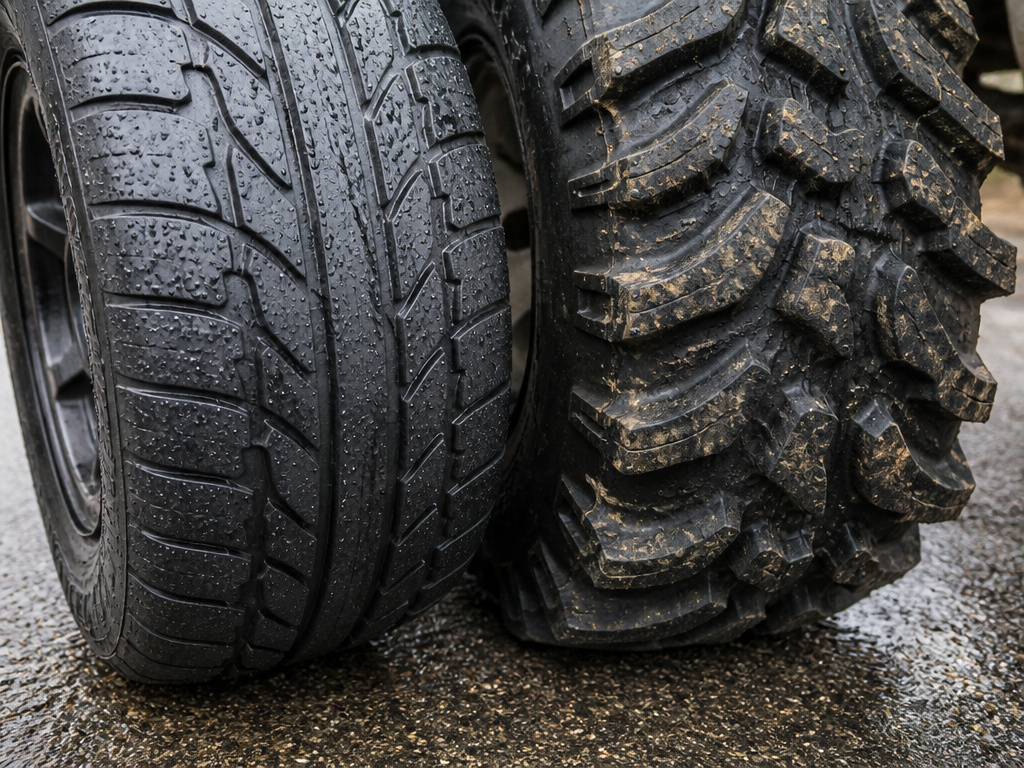
Where this goes sideways: Using standard off-road tires on pavement. They lack the DOT stamp, wear quickly, and offer less wet-weather traction. A trooper spotting “NOT FOR HIGHWAY USE” on the sidewall is an easy probable-cause stop.
Step 3: Pass a Safety Inspection (If Required)
Some states, like Washington for modified off-road motorcycles, require a certified inspector to sign off. They verify all equipment is correctly installed and functional. You’ll get a signed form, keep it with your application packet. Skipping this where required means your paperwork is incomplete.
Step 4: Complete the Correct Application Forms
You need the specific form for your vehicle type. Using a standard automobile title application for an ATV causes desk-level delays.
- Title Application (MV-1 or equivalent): For establishing ownership.
- Registration Application for ATV/UTV: Often a separate form (e.g., Wisconsin’s Form 9400-376).
- Vehicle Identification Number (VIN) Inspection Form: Sometimes required for out-of-state vehicles.
- Bill of Sale: To prove purchase price for tax calculation.
- Odometer Disclosure: For vehicles under 10 years old.
Gather originals and copies. The DMV will keep the originals of state forms.
Step 5: Submit Paperwork and Fees at the Designated Agency
Your destination isn’t always the DMV. In Wisconsin, the Department of Natural Resources (DNR) handles ATV registrations. In Georgia, it’s the Department of Revenue. Go to the wrong building, and they’ll send you away.
Fees are not trivial. Wisconsin charges $30 for a first-time public use registration, valid for two years. There are also title fees, sales tax, and possibly local county taxes. Pay with a check, money order, or credit card if accepted.
Common State-Specific Hurdles (And How to Clear Them)
The devil is in your state’s particular details. Here are the frequent tripwires.
The Width and Weight Trap: Your machine’s specs are in the manual. Compare them to your state’s legal definitions before you buy. A popular sport ATV like a Yamaha Raptor 700 fits. A massive heavy-duty utility ATV might not.
The “Public Use” vs. “Private Use” Registration Choice: This is critical. Public use registration lets you operate on designated trails, routes, and roads. Private use (agricultural or non-agricultural) restricts you to your own property. If you think you might ever ride on a public trail, get the public use registration upfront. Converting later is more paperwork.
The License Plate Specification: It’s not just a plate. Wisconsin’s DNR mandates a rear plate for public use vehicles: white material, minimum 4″ height and 7.5″ width, with black letters 1.5″ high. A homemade plate that doesn’t meet these specs is non-compliant.
Out-of-State Registration: If your ATV is already registered in another state, you must re-register it in your new state of residence. Temporary permits, like West Virginia’s 14-day online registration for out-of-state vehicles, exist for transition periods.
Equipment Deep Dive: What “Street Legal” Actually Means
 Beyond the basic list, certain gear choices affect safety and compliance more than others.
Lighting: You need more than just a light bar. Proper ATV lights for road use must be DOT-approved, have a dedicated brake circuit, and include turn signals if required by state law. Off-road-only light bars often lack the correct beam pattern and can blind oncoming traffic.
Tires: This is a major investment. True DOT-approved ATV tires for mixed use have a different rubber compound and tread pattern. They handle pavement heat better and provide predictable on-road manners. Running aggressive mud tires on asphalt wears them out in a single season and is dangerously slick in the rain.
Mirrors and Horns: A mirror must give a usable, vibration-free view of the road behind. A horn must be reliably loud. Cheap aftermarket versions often fail these simple tests within months.
The Paperwork Trail: Documents You Cannot Lose
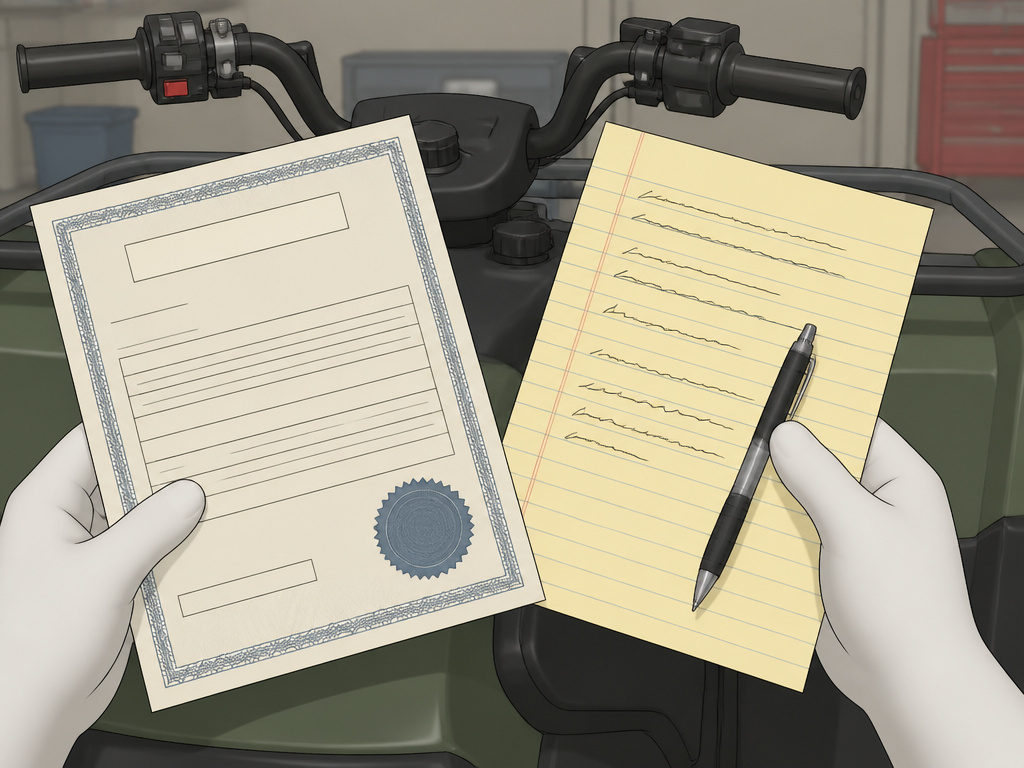 Your application hinges on two pieces of paper you get only once.
- Manufacturer’s Certificate of Origin (MCO): The “birth certificate” from the factory. The dealer gives this to you upon purchase. Lose it, and you must contact the manufacturer for a duplicate, a process that can take weeks.
- Bill of Sale: It establishes the purchase price for tax purposes and includes seller/buyer info, VIN, and date. A handwritten bill of sale is often acceptable for private-party purchases, but it must be detailed.
Without these, you cannot prove ownership or value. Keep them in a fireproof safe until submission, and send copies, not originals, unless explicitly required.
Frequently Asked Questions
Can I make any ATV street legal?
No. If the ATV does not meet your state’s legal definition for weight, width, or type (ATV vs. UTV vs. MPOHV), you cannot register it for road use, regardless of the equipment you add. The definition is the first filter.
How long does the registration process take?
If you walk in with complete, correct paperwork, title issuance can take 4-6 weeks. Registration decals and plates may be issued on the spot or mailed within 21 days. Incomplete paperwork resets the clock. Wisconsin DNR provides a 21-day temporary operating receipt for online renewals.
Do I need insurance for a road-registered ATV?
Yes. Operating any motor vehicle on a public road requires, at minimum, liability insurance. Your auto insurer may offer an ATV policy or an endorsement. Proof of insurance is rarely required for registration but is mandatory for operation and will be requested during a traffic stop.
Can I drive my road-registered ATV on the highway?
Almost never on interstates or controlled-access highways. Most states that allow road use restrict ATVs to county roads, rural highways with speed limits at or below 35-45 mph, and only for direct routes to trails or your property. Always check the specific state ATV road use rules.
What happens if I get pulled over without proper registration?
You will receive citations for operating an unregistered vehicle and likely for lacking insurance. Fines can be several hundred dollars. The officer can impound the ATV, leaving you to pay tow and storage fees on top of everything else. It is far cheaper to do the registration correctly from the start.
The Bottom Line
Registering an ATV for the road is a bureaucracy-heavy but navigable process. Success depends on three things: knowing your state’s exact definition, methodically collecting the right documents, and installing compliant equipment. The largest mistake is assuming your ATV qualifies, verify the width and weight first. Then, beat the title penalty clock in your state by acting within the first 15 days. Finally, choose “public use registration” if there’s any chance you’ll leave your own property. The process is a test of patience, but the reward, legal access to backroads and trails, is worth the hassle.
