
How Long do Motorcycle Batteries Last? The Hidden OEM Rule
This post contains affiliate links. As an Amazon Associate, we earn from qualifying purchases.
Motorcycle batteries last an average of 3 to 5 years, but that average is built from three distinct chemistries: flooded lead-acid (2-3 years), Absorbent Glass Mat (AGM) (3-5 years), and lithium-iron-phosphate (LiFePO4) (5-10 years). The real lifespan is decided by three hard limits: the battery’s inherent self-discharge rate, the parasitic drain of your bike’s electronics, and a single voltage threshold, below 12.5 volts, where permanent damage begins.
That 12.The 5-volt line is the voltage at which sulfate crystals start welding themselves to the lead plates inside AGM and flooded batteries, a process called sulfation that cuts capacity permanently. A battery can cross that line in under a month on a modern bike with an alarm system, which is why the factory service manuals for brands like Honda and Ducati specify charging every two weeks, not “when you remember.”
What follows is the breakdown of the numbers printed in the OEM technical service bulletins, the specific charger models they call out, and the physical failure modes that turn a simple voltage drop into a dead battery by spring.
Key Takeaways
- Voltage is the only early warning. A resting voltage below 12.5V means your battery is actively degrading. Charge it immediately or replace it.
- Your charger is a matched tool. Using a lead-acid charger on a lithium battery destroys it. Approved models like the Ducati 69929011AZ for lithium or the Indian Motorcycle BatteryMINDer 2012 AGM for AGM exist for a reason.
- Heat kills, cold reveals. Summer heat accelerates internal corrosion unseen. The weakened battery then fails to turn a cold, stiff engine come winter.
- Warranties have a short clock. Ducati’s internal data shows manufacturing faults appear within the first 3 months of the warranty period. A failure after that is almost always a maintenance issue.
- Auto-feed trimmers die from line choice. Using line under 0.080 inches in diameter on a bump-feed head burns out the auto-feed motor’s clutch plates in weeks, not seasons.
The 3 Main Battery Chemistries (and Their Real-World Timelines)
Forget the one-size-fits-all answer. Your battery’s lifespan is locked in by its internal chemistry from day one. Each type has a different failure mode and a predictable aging curve.
Flooded Lead-Acid (Wet Cell) – 2 to 3 Years
These are the oldest design, with liquid electrolyte sloshing between lead plates. They require checking and topping off with distilled water, a step most owners skip. The liquid evaporates faster in heat, exposing the plates. Those plates sulfate, corrode, and shed material. The Honda CBR1000RR service manual is blunt: performance deteriorates after 2-3 years even under normal use. They’re cheap upfront but the shortest-lived.
AGM (Absorbent Glass Mat) – 3 to 5 Years
This is the default for most modern bikes. The acid is suspended in a fiberglass mat, making it spill-proof and vibration-resistant. They are sealed and maintenance-free. The trade-off is sensitivity to deep discharges. Let an AGM battery sit below 12.5V, and the sulfation that forms is harder to reverse. Indian Motorcycle’s manual states the nominal voltage for a fully charged battery is 12.8V, and it must be charged the moment it hits 12.5V.
Lithium-Ion (LiFePO4) – 5 to 10 Years
Lithium-iron-phosphate batteries are the new standard for high-performance and adventure bikes. They’re incredibly light and have a very low self-discharge rate. Their lifespan is longer, but their rules are absolute. A Ducati technical bulletin for its HJT7B-FPZ-SC lithium battery states charge voltage must never exceed 14.5V, and a battery that drops to 8V or less is dead, it must be replaced, not charged.
| Battery Type | Average Lifespan | Critical Failure Mode | When to Intervene |
|---|---|---|---|
| Flooded Lead-Acid | 2 – 3 years | Plate corrosion, water loss | Voltage below 12.4V, visible low electrolyte |
| AGM (Sealed) | 3 – 5 years | Sulfation from deep discharge | Voltage at or below 12.5V |
| Lithium-Ion (LiFePO4) | 5 – 10 years | Cell damage from over-voltage or under-voltage | Voltage at or below 8.0V |
A battery that reads 12.5 volts on a multimeter is not “mostly charged.” It’s at the cliff’s edge. AGM and lead-acid batteries begin irreversible sulfation at this voltage, losing between 5-10% of their total capacity permanently. Charge it that day, or by next month the starter will sound sluggish.
What Actually Kills a Motorcycle Battery
It’s not time. It’s specific chemical and physical reactions triggered by rider habits and environment. Here are the four biggest killers.
Parasitic Drain: The Silent Vampire
Modern bikes are never truly off. An alarm, a clock, an ECU memory circuit, they all draw a tiny amount of current, day and night. This “parasitic drain” might only be 2-5 milliamps, but it adds up. The Honda manual pegs maximum acceptable current leakage at 2.0 mA. A bike with an aftermarket alarm can draw ten times that. Leave it for a month, and a healthy 12.8V battery can easily be dragged down to 11.5V, deep into the damage zone.
Vibration: The Physical Destroyer
Motorcycles shake. That vibration can physically crack the internal connections between a battery’s cells or shake active material loose from the plates. Once that material settles at the bottom, it’s lost capacity forever. This is why AGM batteries, with their tightly packed mats, outperform flooded types in longevity on dual-sport or cruiser models.
Temperature Cycles: Heat Bakes, Cold Tests
High temperatures accelerate chemical reactions inside the battery. It speeds up self-discharge and corrodes the positive plates. You won’t notice this degradation in July. But come a 40°F morning, that same battery now has to work much harder to crank a stiff engine. The heat weakened it; the cold exposes the weakness.
Improper Charging: The Well-Meaning Murder
Using the wrong charger is a fast track to a dead battery. A lead-acid charger applies a voltage profile that will overcharge and destroy a lithium battery. Conversely, a lithium-specific charger may not fully charge an AGM battery. Kawasaki’s technical bulletin explicitly warns against using lead-acid chargers on lithium packs, citing permanent damage.
Voltage is Your Early Warning System
A multimeter is the single most important diagnostic tool you can own. The numbers don’t lie. Here’s what they mean, with all values measured on a resting battery (ignition off, disconnected for an hour).
12.8V – 13.2V: Full Health
This is your target. A fresh, fully charged battery will settle in this range. The Honda CBR1000RR manual lists 13.0 – 13.2V as the fully charged range at 68°F.
12.5V: The Action Threshold
This is the most important number in this article. Indian Motorcycle’s directive is clear: “If the battery voltage falls below 12.5V, it should be charged immediately.” This isn’t about convenience; it’s about preventing the onset of permanent sulfation.
12.0V – 12.4V: Deep Discharge / Damage
The battery is severely depleted. Starting the bike is unlikely. Every hour spent in this state causes more sulfation. The BMW TSB for new motorcycles states that a lead-acid battery reading below 12.0V requires replacement within three days.
Below 8.0V (Lithium Only): Total Failure
For lithium-ion batteries like the Ducati HJT7B-FPZ, this is a point of no return. The Ducati bulletin is absolute: “Lithium-Ion batteries with voltage <= 8 Volts should never be charged and must be replaced.” Attempting to charge a lithium battery this low can cause a thermal event.
The Charger You Use Decides Everything

A charger is a matched tool for a specific chemical reaction. Getting this wrong doesn’t just charge slowly, it ruins the battery.
Smart Chargers / Maintainers
These are the only type you should consider. They apply bulk, absorption, and float stages, then switch to a maintenance mode that counters self-discharge. For AGM batteries, the Indian Motorcycle BatteryMINDer 2012 AGM – 2 AMP is the factory-specified tool. For lithium, the Ducati-approved charger part no. 69929011AZ is designed to stay within the strict 14.5V ceiling.
Trickle Chargers (The Old Danger)
A basic trickle charger applies a constant, low current. It has no brain. If left connected indefinitely, it will eventually overcharge and cook the battery, boiling off electrolyte in flooded cells or damaging the plates in AGMs.
Jump Starters & Boost Mode
A portable jump starter is for emergency starts only. Using its “boost” or “charge” mode as a regular charger is a gamble. These devices often use aggressive charging curves to deliver fast power, which can stress a battery’s chemistry if used repeatedly.
Where this goes sideways: Using a car charger on a motorcycle battery. Even on a low setting, a 10-amp car charger can overwhelm a small 8.6Ah motorcycle battery, causing the internal plates to warp and short. The Honda manual specifies a “Normal” charge rate of 0.9A for their battery, that’s less than one-tenth the common car charger output.
How to Test Your Battery’s True Health
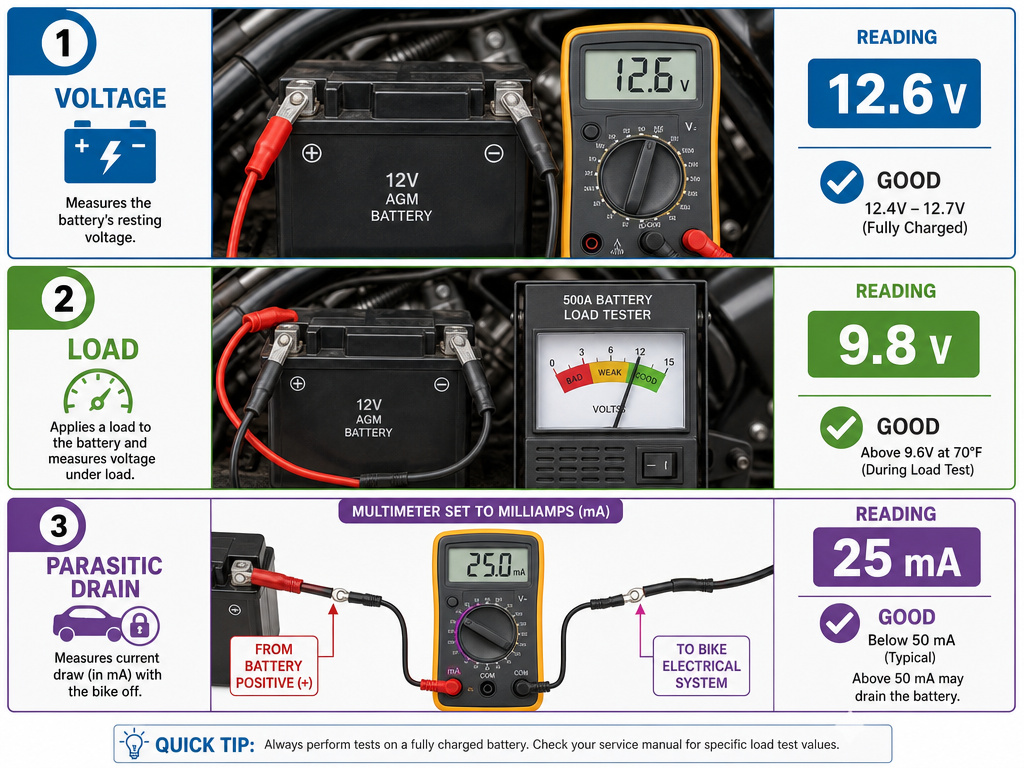
A simple voltage check is a snapshot, not a full physical. To know if your battery can handle another season, you need a load test.
The Multimeter Voltage Test (Quick Check)
- Turn the motorcycle completely off.
- Let it sit for at least one hour to allow surface charge to dissipate.
- Connect the multimeter leads to the battery terminals (red to positive, black to negative).
- A reading at or above 12.5V means it’s worth charging. Below 12.5V, you need to investigate further.
The Load Test (The Real Answer)
This test simulates the massive current draw of the starter motor. You’ll need a dedicated load tester or a multimeter with a “min/max” function. 1. Ensure the battery is fully charged. 2. Connect the load tester according to its instructions. 3. Apply a load equal to half the battery’s Cold Cranking Amp (CCA) rating for 15 seconds. 4. A healthy battery will maintain voltage above 9.6V. If the voltage drops sharply below this, the battery cannot deliver current under load and must be replaced.
Testing for Parasitic Drain
This explains why a battery goes dead sitting. 1. Fully charge the battery. 2. With the bike off, disconnect the negative battery cable. 3. Set your multimeter to the milliamps (mA) scale. 4. Connect the multimeter between the negative battery terminal and the disconnected negative cable. You are now the circuit. 5. A normal reading should be under 50 mA (0.05A). The Honda spec is a max of 2 mA. Anything over 100 mA (0.1A) is draining your battery in days, not weeks.
Extending Your Battery’s Lifespan: The Non-Negotiable Routine
This is about doing three specific things at the right time.
For Active Riding Season:
- Ride Long Enough: A 20-minute commute may not fully recharge the battery used to start the bike. Aim for rides longer than 30 minutes regularly.
- Check Voltage Monthly: A quick multimeter check after a long ride tells you if your charging system is working. Should be 13.5V to 14.5V while the bike is running.
For Storage (Weeks to Months):
- Connect a Maintainer: This is the single most effective action. A smart maintainer like the CTEK CT5 POWERSPORT keeps the battery at optimal voltage, preventing sulfation. The Ducati bulletin mandates charging stored lithium batteries every 3 months.
- Disconnect the Battery: If you can’t use a maintainer, disconnect the negative terminal. This stops parasitic drain cold.
- Store It Cool and Charged: Take the battery indoors if possible. A cool garage at 50°F is better than a freezing shed. Store it fully charged.
The Hard Reset for a Neglected AGM Battery
If an AGM battery is deeply discharged (below 10V), some smart chargers with a “recovery” mode might save it. The Indian Motorcycle manual describes a jump-start method: connect the dead battery in parallel with a good, charged battery, then connect the smart charger to both. This can trick the charger into recognizing the dead battery and beginning a charge cycle.
Frequently Asked Questions
Can a motorcycle battery last 10 years?
Lithium-iron-phosphate (LiFePO4) motorcycle battery can potentially last up to 10 years with perfect maintenance, meaning it never experiences deep discharge, over-voltage, or extreme heat. For lead-acid or AGM batteries, hitting 10 years is exceptionally rare and usually indicates extremely light use and ideal storage conditions.
How often should I start my motorcycle to keep the battery charged?
Starting the motorcycle without riding it is worse than leaving it alone. A start draws a huge amount of current, and idling for a few minutes does not replenish it. You leave the battery in a deeper state of discharge than before. If you can’t ride it, put it on a maintainer.
What are the signs my motorcycle battery is dying?
The first sign is slow cranking, the starter sounds lazy. Next, you might notice dim lights when the key is on. The final sign is a rapid clicking sound when you press the starter with no engine turnover. By this point, the battery is often too weak to recover.
Is it OK to use a car battery charger on my motorcycle?
No. Car battery chargers deliver too much current, even on low settings. They can overheat and warp the thin plates inside a smaller motorcycle battery. Always use a charger designed for powersport or motorcycle batteries, with an output typically between 0.8A and 2.0A.
Does a new motorcycle battery come fully charged?
Sometimes, but not reliably. Many come “dry-charged” or with a partial charge to preserve shelf life. A 2018 BMW Technical Service Bulletin instructs dealers to charge any new lead-acid battery reading above 12.0V and note the date. If it reads below 12.0V, they must install a new one. Always charge a new battery fully with the correct smart charger before installation.
Before You Go
The lifespan printed on the battery box is a best-case scenario, run in a lab. Your garage is not a lab. The difference comes down to vigilance over one number, 12.5 volts, and the discipline to act when you see it.
Get a multimeter. Check your battery’s resting voltage once a month. If you ride infrequently, buy a smart maintainer matched to your battery type; it pays for itself by sparing you one replacement. And when it’s time for a new battery, remember that investing in the right chemistry for your riding habits beats chasing the longest number on the sticker. For most riders putting on regular miles, a quality AGM battery from a brand like Yuasa, paired with a CTEK motorcycle battery charger between rides, is the combination that delivers years of dependable starts without overcomplicating the process.
