How Ford Automotive Manufacturers Define Quality & Build Trucks
This post contains affiliate links. As an Amazon Associate, we earn from qualifying purchases.
Ford automotive manufacturers operate within a tightly controlled global system defined by the IATF 16949 quality standard and Ford’s own Customer-Specific Requirements (CSR). This framework governs everything from supplier audits to assembly line processes, aiming to prevent defects. When failures occur, like the 2025 brake line recall on Expeditions, the system triggers formal investigations and corrective actions documented in NHTSA filings.
That framework is the invisible architecture behind every vehicle. It is a documented, auditable process with real teeth, which serves as a promise of quality. A supplier that misses a key metric can lose its certification within days.
What follows is a look inside that system: the standards that bind it, the specific failure modes that break through, and how the corrective machinery swings into action. You’ll see how a bent brake tube in Kentucky ties directly to a global quality manual.
Key Takeaways
- Ford’s manufacturing quality is governed by the IATF 16949 standard, supplemented by Ford’s own Customer-Specific Requirements (CSR) that all direct suppliers must meet.
- The Q1 Revocation process can suspend a supplier’s certification within five days of a major quality failure, demonstrating the system’s enforcement power.
- Recent NHTSA recalls, like 25V-314 for brake line contact on Expeditions, show how assembly process flaws become safety issues with documented root causes.
- Corrective actions follow the 8D (Eight Disciplines) problem-solving method, requiring a root cause analysis and containment plan within 48 hours of a quality reject.
- Motorcraft branded fluids and parts are the factory-specification consumables designed for this engineered system, from MERCON LV ATF to WSS-M97B57-A2 coolant.
The Ford Manufacturing Ecosystem
Forget the image of Henry Ford’s single moving line. Modern Ford automotive manufacturers work inside a networked web of thousands of companies, all held to a common playbook. The core rulebook is IATF 16949.
This is a non-negotiable certification required for any company making production parts for Ford or Lincoln. The standard covers the entire quality management system, from design and development to production and service.
IATF 16949:2016 and Ford’s accompanying Customer-Specific Requirements define the fundamental quality system requirements for organizations where automotive customer-specified parts, for production and/or service, are manufactured.
Ford’s own layer of rules, the CSR, sits on top. It dictates how often suppliers get audited, how they must handle software in products, and crucially, how they must manage their own sub-tier suppliers. If a sub-tier supplier isn’t IATF certified, Ford can demand they comply with minimum quality requirements anyway.
The system is managed globally through five IATF Oversight Offices. Your Ford F-150‘s frame might come from a plant audited by the IAOB in the US, while its transmission valves are checked by VDA-QMC in Germany.
What Quality Standards Do Ford Automotive Manufacturers Follow?
The standards focus on prevention. They require documented processes for everything: how to calibrate a torque wrench, how to track a batch of steel, how to handle a customer complaint. The goal is to eliminate variation.
A key tool is Production Part Approval Process (PPAP). Before any part goes into volume production, the supplier must prove to Ford that their manufacturing process can make it consistently within spec. This involves statistical data, material certifications, and sample parts.
| Standard / Requirement | Governs | Consequence of Non-Compliance |
|---|---|---|
| IATF 16949:2016 | Overall Quality Management System | Loss of certification; cannot supply Ford directly. |
| Ford Customer-Specific Requirements (CSR) | Ford-specific processes (e.g., 8D reporting, Q1 status) | Q1 Revocation; immediate business suspension. |
| PPAP (Production Part Approval Process) | Approval of individual parts for production | Part shipment rejection; production line stoppage. |
| IMDS (International Material Data System) | Material composition and reporting | Non-compliance with global environmental regulations (REACH, ELV). |
This isn’t paperwork for its own sake. A missing material certificate in IMDS can halt shipments across Europe. A failed PPAP means the assembly line doesn’t get its parts.
When Quality Fails: Recalls and Corrective Action
The system is designed to catch errors, but some slip through. When they do, the response is structured and severe. The most visible result is a safety recall, filed with the National Highway Traffic Safety Administration (NHTSA).
Two recent recalls show the mechanism in action. Both stem from assembly process errors, not supplier part defects.
Recall 25V-314 (May 2025): Bent Brake Lines
This recall affected approximately 273,789 Ford Expedition and Lincoln Navigator SUVs. The official NHTSA safety recall report states the root cause: “The front brake line may have been bent during the engine installation process at Ford’s final assembly plant.”
The brake line could contact the engine air cleaner outlet pipe. Over time, this contact could wear through the line, causing a leak. A leak leads to longer pedal travel and reduced braking power. The fix is an inspection and, if needed, replacement of the brake line and/or the outlet pipe to ensure proper clearance.
Recall 25E05 (March 2026): Emissions Control
This emissions recall involved a faulty Canister Purge Valve (CPV) and required PCM reprogramming. The NHTSA technical service bulletin for the campaign is explicit: even if a customer previously had a related service program (24N07) performed, they still need 25E05 to ensure the latest hardware and software are in place.
Where this goes sideways: Ignoring an emissions recall notice. While not a safety-of-drive issue, failing to get the update can lead to a vehicle failing state emissions testing, resulting in registration holds.
The 8D Report and Q1 Revocation
When Ford finds a defective part at a plant, the clock starts. The supplier has 24 hours to respond and 48 hours to implement containment and deliver the first steps of an 8D report.
The 8D is a formal problem-solving methodology. D0 is the symptom and emergency response. D1 is putting a team together. D2 defines the problem. D3 is interim containment, sorting bad parts from good. The supplier has 15 calendar days to deliver root cause and corrective action plans.
If the failure is severe, it triggers Q1 Revocation. Q1 is Ford’s highest supplier quality award. Losing it is a crisis.
According to the IATF Ford CSR document, a site placed in Q1 Revocation must notify its certification body within five working days. The certification body must then place the supplier on immediate suspension. This action constitutes a freeze on their certified status until the problem is resolved to Ford’s satisfaction.
Engineering and Specifications: What “Ford Recommended” Really Means
The output of this manufacturing system is a set of precise engineering specifications. When an owner’s manual says to use Motorcraft MERCON LV ATF, that fluid is specified because its friction characteristics and viscosity are matched to the 6F35 or 6F50 transmission’s clutches and valves.
Using the wrong fluid can cause delayed shifts, clutch shudder, or premature wear. The same goes for engine oil, coolant, and differential fluid.
| System | Example Specification | Purpose of the Spec |
|---|---|---|
| Engine Oil | Motorcraft SAE 5W-30 (WSS-M2C946-A) | Ensures correct viscosity for turbocharger bearing lubrication and fuel economy. |
| Automatic Transmission Fluid | Motorcraft MERCON LV ATF (XT-10-QLV) | Matches the friction profile for the transmission’s specific clutch plate material. |
| Coolant | Motorcraft Yellow Prediluted (WSS-M97B57-A2) | Formulated to prevent corrosion of the aluminum alloys used in modern EcoBoost engines. |
| Rear Differential | Motorcraft SAE 80W-90 (WSP-M2C197-A) | Provides the necessary extreme-pressure protection for the hypoid gears. |
These specs are the endpoint of thousands of hours of testing. The WSS-M97B57-A2 coolant, for instance, is designed to handle the heat and pressure of a twin-turbo 3.5L EcoBoost. A generic “universal” coolant might not protect the aluminum heater core tubes or the plastic thermostat housing over 150,000 miles.
This is why F-150 maintenance guides stress using the right oil. The wrong weight can affect variable valve timing performance and fuel economy.
The Role of Suppliers and Aftermarket Support
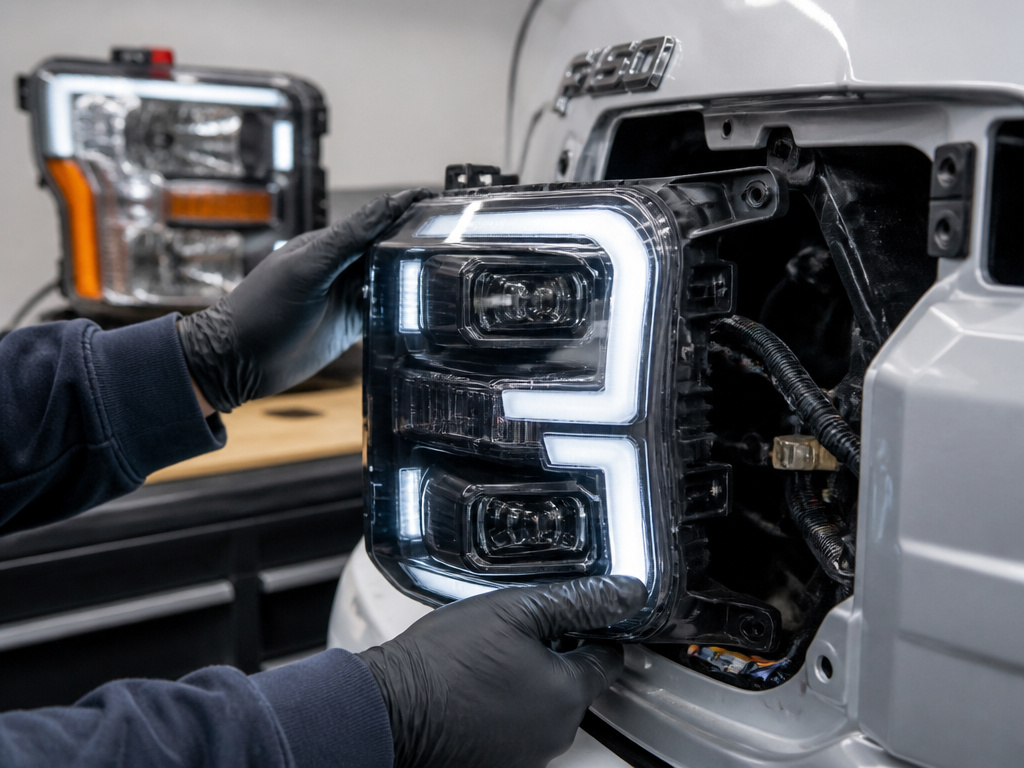
Ford doesn’t make every single part. They rely on a tiered supplier network. Tier 1 suppliers deliver complete systems (like a dashboard or a headlight assembly) directly to the assembly plant. Those Tier 1s manage their own Tier 2 and Tier 3 suppliers for individual components.
This is where the CSR’s rules for sub-tier supplier management kick in. Ford reserves the right to audit down the chain. The quality of a window switch, therefore, is as much a part of the system as the quality of the engine block.
The aftermarket world exists outside this controlled system. A company making LED headlights for an F-150 doesn’t need IATF certification. They do, however, need to ensure their product doesn’t cause electromagnetic interference with the truck’s CAN bus network or create a beam pattern that blinds oncoming drivers.
Common mistake: Assuming all aftermarket parts are equal to OEM. A cheap copy of a shock absorber might fit, but its valving won’t match the factory ride and handling tune, leading to a bouncy or harsh drive.
The best aftermarket companies reverse-engineer both the fit and the function. They understand that a tonneau cover for an aluminum-bed F-150 needs a different clamping system than one for a steel bed.They know that seat covers for a model with side-impact airbags must have specially designed seams that won’t impede deployment.
Ford’s Manufacturing Philosophy in Action: Model Case Studies
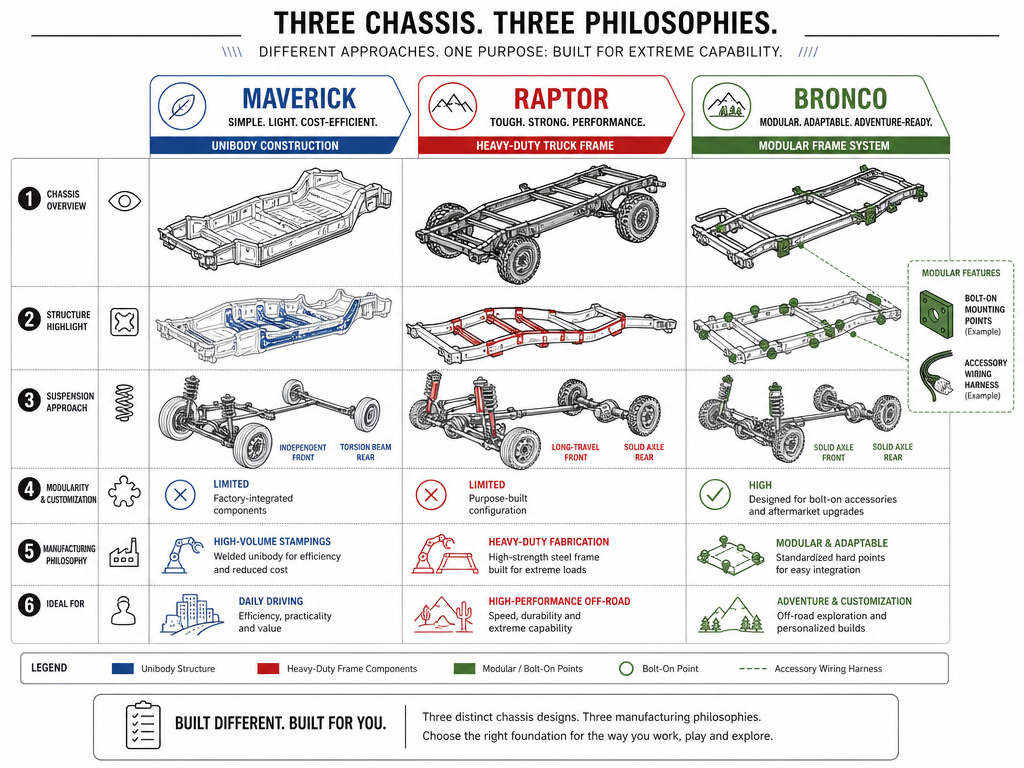
You can see the priorities of the system reflected in different vehicles. Compare the Ford Maverick to the Ford Raptor.
The Maverick is an exercise in value-driven, global platform efficiency. It uses a proven drivetrain (the 2.0L EcoBoost or hybrid system) in a unibody platform shared with the Bronco Sport. The manufacturing focus is on cost control, part commonality, and high volume quality.
The F-150 Raptor is a low-volume, performance-focused variant. Its manufacturing involves more hand-assembly, specialized parts like reinforced control arms and Fox Live Valve shocks, and a more rigorous validation process for off-road durability. The quality checks here are about extreme performance, not just basic function.
The Ford Bronco, meanwhile, had to be engineered for easy modification, a core part of its brand promise. This meant designing wiring harnesses with pre-planned accessory circuits and creating body mounts that could accept bolt-on rock rails without drilling. The manufacturing system had to accommodate this flexibility without compromising the vehicle’s structural integrity or safety.
These case studies show that “Ford quality” is a system adaptable to different goals, such as affordability, extreme performance, or owner customization.
Frequently Asked Questions
What is IATF 16949 and why does it matter for my Ford?
IATF 16949 is the international quality management standard for the automotive industry. It matters because every direct supplier of production parts to Ford must be certified to it. This certification means the supplier has documented, repeatable processes designed to prevent defects. It’s the baseline assurance that the parts going into your vehicle were made consistently and correctly.
How can I check if my Ford has an open recall?
The simplest way is to visit the NHTSA recalls website (nhtsa.gov/recalls) and enter your 17-character Vehicle Identification Number (VIN). Your Ford dealer can also check the OASIS database. Owners of affected vehicles should also receive a mailed notice from Ford Motor Company, but the VIN check is the most reliable method.
Is using Motorcraft parts really necessary?
For fluids and critical wear items, yes. Motorcraft is Ford’s own brand, and those products are formulated to meet the exact engineering specifications (like WSS-M2C946-A for oil) set by Ford’s engineers. Using the correct spec fluid ensures longevity and performance. For non-critical items like floor mats or a bug deflector, the brand is less important than fit and quality.
What does “Q1 Revocation” mean for a supplier?
Q1 Revocation is Ford’s most severe quality penalty for a supplier. It means Ford has revoked that supplier’s top-quality award status due to a major failure. The supplier must notify its IATF certification body within five days, and the certifier must suspend the supplier’s IATF 16949 certification. This effectively halts their ability to ship new parts to Ford until the issue is resolved and the status is restored, a process that can take months and cost millions.
Why do some recalls seem to happen years after a vehicle is built?
Recalls often originate from field data. It might take months or years for a rare but consistent pattern of failures to emerge from customer complaints and dealer repair orders. Once a trend is spotted, Ford opens an investigation to determine the root cause, like the bent brake line during engine installation. Engineering a fix, sourcing parts, and coordinating with NHTSA to announce the recall adds more time to the process.
The Bottom Line
Ford automotive manufacturers operate in a world of documented standards and severe consequences. The IATF 16949 system and Ford’s CSR create a framework aimed at building consistency into every Ford Escape and Super Duty.
When that system stumbles, the results are public and detailed in NHTSA filings. These recalls aren’t signs of a broken company but evidence of a corrective system working as designed, identifying failures, forcing root-cause analysis, and mandating fixes.
Your role as an owner is to understand this ecosystem. It explains why factory-spec fluids matter, how to interpret a recall notice, and what lies behind the badge on the grille. The vehicle in your driveway is the physical endpoint of a vast, regulated, and constantly auditing manufacturing network.
