
Do I Need Tire Chains for Lake Tahoe | Caltrans Rule Test
This post contains affiliate links. As an Amazon Associate, we earn from qualifying purchases.
You need tire chains for Lake Tahoe whenever Caltrans posts “Chains Required” signs. The requirement applies to all vehicles, including 4WD/AWD, unless you have specific snow tires and meet the exact weight and control level (R-1 or R-2). You must stop at the checkpoint or face a CHP citation.
This isn’t a suggestion. It’s the enforcement point. Caltrans reserves the right to turn you around if your setup doesn’t meet the precise criteria in the California Vehicle Code. The signs aren’t advisory—they’re the line you cross with a fine.
What follows: the three-tiered control system (R-1, R-2, R-3), the legal definition of a snow tire, and the one spec that decides whether your all-weather tires count. We’ll also cover what happens at a checkpoint, how to prep, and where Nevada’s rules diverge from California’s.
Key Takeaways
- Carry chains regardless of your vehicle. Even 4WD/AWD with snow tires must have a set in the vehicle to proceed through any chain control area.
- Snow tires need an M+S marking and 6/32″ tread. An “all-season” label is not enough. The 6/32-inch minimum is a legal threshold, not a recommendation.
- R-2 is the most common control for passenger vehicles. At R-2, only 4WD/AWD with snow tires on all four wheels can skip installation; everyone else must chain up.
- Speed limits drop to 25–30 mph with chains. Driving faster risks breaking the chains and damaging your vehicle.
- Check QuickMap.dot.ca.gov before you leave. Road conditions and control levels change hourly during a storm.
What Do the R-1, R-2, and R-3 Signs Mean?
The signs use a coded system. Missing the code means you install chains you didn’t need to, or worse, you try to proceed without them and get turned back at the checkpoint.
R-1: Chains required on all vehicles except passenger vehicles and light-duty trucks under 6,000 pounds gross weight with snow tires on at least two drive wheels. All vehicles towing trailers must have chains on one drive axle.
R-1 is the lightest control. If you drive a sedan, SUV, or pickup under 6,000 pounds GVWR and have proper snow tires on your drive wheels, you can drive through without installing chains. You must still carry them. The moment you add a trailer, the rule changes—you must install chains on one drive axle of the tow vehicle.
R-2: Chains required on all vehicles except four-wheel/all-wheel drive vehicles with snow-tread tires on all four wheels.
This is the control you’ll see most often heading to Tahoe. The exemption is narrow: only 4WD/AWD vehicles with four certified snow tires can proceed without installing chains. Two-wheel-drive vehicles? Install chains. A 4WD vehicle with all-season tires? Install chains. The vehicle must also be under 6,500 pounds gross weight. If you meet the exemption, you still must carry chains.
R-3: Chains required on all vehicles, no exceptions.
Caltrans will usually close the highway before declaring R-3. If you see this sign, the road is in severe condition and every single vehicle must have chains mounted to proceed. There are no tire-based exemptions.
| Control Level | Who Must Install Chains? | Who Can Skip Installation (Must Still Carry Chains)? |
|---|---|---|
| R-1 | Vehicles over 6,000 lbs, all vehicles towing trailers | Passenger vehicles/trucks under 6,000 lbs with snow tires on drive wheels |
| R-2 | All 2WD vehicles, 4WD/AWD without four snow tires | 4WD/AWD under 6,500 lbs with four snow tires |
| R-3 | All vehicles, no exceptions | No one |
The short version: R-1 asks for snow tires on drive wheels. R-2 demands snow tires on all four wheels plus 4WD/AWD. R-3 means everyone chains up.
The Snow Tire Loophole (and Its Exact Limits)
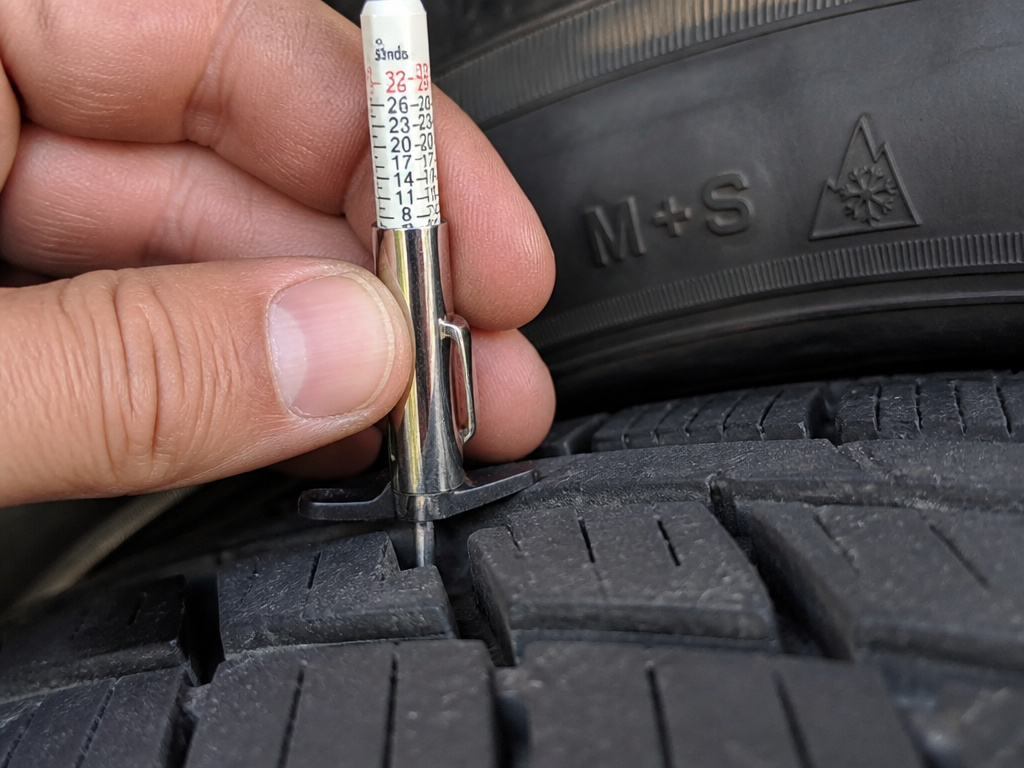
A snow tire isn’t just any tire you run in winter. The California Vehicle Code has a specific definition, and Caltrans officers know it.
First, the sidewall must be stamped with “M+S,” “M/S,” “MS,” or “MUD AND SNOW.” This is a manufacturer designation for a mud-and-snow tread pattern. Many all-season tires carry this marking, which is where the confusion starts.
Second, the tread depth must be at least 6/32 of an inch. This is the minimum legal tread depth for mud and snow tires per Caltrans’s own published chain requirements. Worn tires below this depth do not qualify, even with the M+S symbol. A tire gauge is the only way to know for sure.
An “all-weather” or “all-terrain” label does not automatically mean the tire meets the CVC definition. Studded snow tires are legal in California from November 1 to April 30, but they are not considered tire traction devices. You cannot use studded tires in place of chains when controls are in effect.
Common mistake: Assuming newish all-season tires with M+S marking are “snow tires.” Without 6/32-inch tread, they fail the legal test at the checkpoint.
The Legal Definition of “Chains” Isn’t What You Think
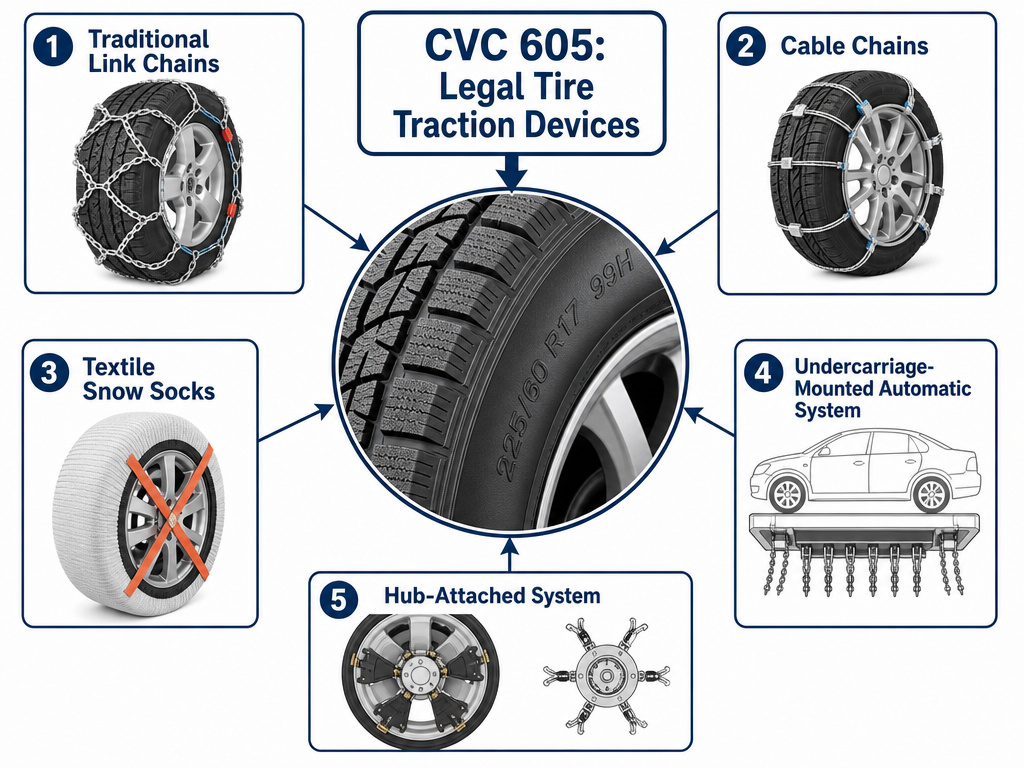
When Caltrans says “chains,” they don’t just mean old-school link chains. The term is shorthand for any tire traction device that meets California Vehicle Code (CVC) Section 605.
The code defines these devices as mechanisms “capable of improving vehicle traction, braking and cornering ability upon snow or ice-covered surfaces.” This includes: – Conventional link-type chains – Cable chains – Textile snow chains (like the Spikes Spider) – Automatic Tire Chains (ATDs) mounted under commercial vehicles – Wheel hub-attached chain systems
Cable chains and other less conventional devices are legal in California. However, these may be restricted at times due to local conditions and are not as effective as link-type chain under severe conditions at higher elevations and steep grades.
The practical takeaway? Your vehicle manufacturer may warn against using link chains because of tight wheel-well clearance. Cable chains or a textile alternative might be your only legal option. You can find specific recommendations in our guide to the best chains for snow and ice. Always check your owner’s manual first.
What Happens at a Chain Control Checkpoint
You’ll see the first “Chains Required” sign. About a mile later, there’s a final checkpoint, often staffed by Caltrans personnel or the California Highway Patrol (CHP). This is the enforcement point.
If your vehicle matches the exemption for the current control level (R-1 or R-2), you can drive through after a visual inspection. If you need to install chains, you must pull over completely off the roadway before the checkpoint. Do not stop in a traffic lane.
Chain installers are independent, licensed contractors. They are not Caltrans employees. If you use one, get a receipt and write their badge number on it. They are not allowed to sell or rent chains to you.
Once chained, the speed limit is 25 or 30 mph. Exceed that, and you risk breaking the chains, throwing a cable into your wheel well, or getting pulled over. When you see “End Chain Control” signs, drive past them to a safe pull-off area to remove the chains.
The part nobody mentions: CHP can cite you for not having chains if you slide off the road within a chain control area, even if you weren’t stopped at a checkpoint. The requirement is to carry them when signs are posted.
How to Prepare: A Checklist for Tahoe Winter Travel
Don’t wait for the storm to think about this. Preparation happens in your driveway.
- Verify Your Tires. Check for the M+S marking. Measure tread depth with a gauge. If it’s at or near 6/32″, plan on needing chains.
- Buy the Right Chains. Match them to your exact tire size. Practice installing them once in your driveway. A pair of durable metal tire chains for traction is a reliable choice for most trucks and SUVs. For cars with limited clearance, snow chains for passenger cars often use cable or textile designs.
- Pack a Kit. Include heavy gloves, a waterproof mat or tarp to kneel on, a flashlight or headlamp, and tire-changing tools. It’s dark, wet, and cold at the side of I-80.
- Check Conditions Immediately Before Leaving. Use the Caltrans QuickMap or call the Caltrans Highway Information Network (CHIN) at 1-800-427-ROAD (7623). Conditions can change from “no controls” to “R-2” in under an hour.
- Have a Contingency Plan. If chains are required and you don’t have them, or won’t install them, you will be turned around. Know where you can wait out the storm safely.
Where this goes sideways: Trying to install chains for the first time in a blizzard, on the shoulder, with traffic spraying slush on you. You’ll fumble with frozen fingers for 45 minutes. Do the dry run at home.
The Nevada Side: Slightly Different Rules
When traveling to North Lake Tahoe via I-80 or to the Carson Valley via US-50, you cross into Nevada. The Nevada Department of Transportation (NDOT) uses a similar but distinct system.
On key routes like State Route 431 (Mount Rose Highway) or US-50 between Glenbrook and Carson City, NDOT imposes traction requirements. During these controls, only the following are allowed: – Four-wheel or all-wheel drive vehicles with snow tires on all wheels. – Vehicles with approved tire traction devices (chains) on the drive wheels.
Notice the difference? Nevada’s rule doesn’t have a weight-based exemption like California’s R-1. It’s a simpler, more restrictive filter: either you have 4WD/AWD with snow tires, or you have chains installed. There’s no “carry but not install” option for 2WD vehicles with snow tires during an active control.
Always check NDOT’s road conditions if your route crosses the state line. The rules change where the pavement does.
Frequently Asked Questions
Do I need chains if I have 4WD?
You need to carry chains whenever you enter a chain control area in California, regardless of your drivetrain. Whether you must install them depends on the control level (R-1 or R-2) and if you have four qualifying snow tires.
Are cable chains OK for Lake Tahoe?
Yes, cable chains are legal in California if they meet CVC Section 605. However, they are less durable than traditional link chains and may not be permitted during severe conditions on steep grades like Donner Pass. For peace of mind, many drivers opt for traditional snow tire chains.
What is the fine for not having chains?
The California Highway Patrol (CHP) can issue a citation. While the fine amount varies, the greater cost is being ordered to turn around. You may have to drive back down the mountain to the nearest town to purchase chains, if they’re even still in stock.
Can I use my all-season tires?
You can use them, but they do not qualify for any exemption from chain installation unless they have the M+S marking and at least 6/32-inch tread depth. At an R-2 control, you will need to install chains.
Where are chains most commonly required around Tahoe?
The primary corridors are I-80 over Donner Pass (between Sacramento and Reno) and US-50 over Echo Summit (between Lake Tahoe and Sacramento). Chains can also be required on State Route 89 around the lake and on State Route 267 (Northstar/Truckee route).
The Bottom Line
Driving to Lake Tahoe in winter means planning for chain controls. Assume you will need them. Buy the correct set for your vehicle, practice putting them on, and stow them with a winter kit in your trunk.
The law is specific: “Chains Required” means exactly that. Your modern all-wheel-drive system is impressive, but it doesn’t override the posted sign. The only way to know if you can skip installation is to understand the R-1 and R-2 exemptions down to the letter—the tire marking, the tread depth, the vehicle weight, and the trailer clause.
Before you go, make your last stop QuickMap.dot.ca.gov. That real-time map is the single most reliable tool between you and a smooth arrival. Everything else is just preparation for what it shows.
