
Do Rental Cars Have Snow Tires? A Guide to Laws and Booking
This post contains affiliate links. As an Amazon Associate, we earn from qualifying purchases.
Car rentals do not have dedicated snow tires as standard equipment. Fleets run all-season tires marked M+S (Mud and Snow), which meet minimum legal requirements in many states but offer poor performance in severe winter conditions. In regions with strict traction laws like Colorado or Japan, you may find winter-equipped vehicles, but they are never guaranteed through traditional agencies.
The difference between an M+S all-season tire and a true Three-Peak Mountain Snowflake (3PMSF) winter tire is a physical gap in rubber compound and tread design, not a marketing label. That gap decides whether you stop on an icy mountain pass or slide through it.
What follows: the specific state laws that create exceptions, the one rental model that reliably delivers winter tires, and the inspection you must perform at the counter before driving a single mile.
Key Takeaways
- Rental fleets default to cost-effective all-season (M+S) tires. True snow tires are a logistical and financial burden for companies, costing $800-$1,200 per set.
- The Colorado Traction Law is the benchmark: during active enforcement, you need 3PMSF tires, chains, OR a 4WD/AWD vehicle with M+S tires boasting at least 3/16-inch of tread.
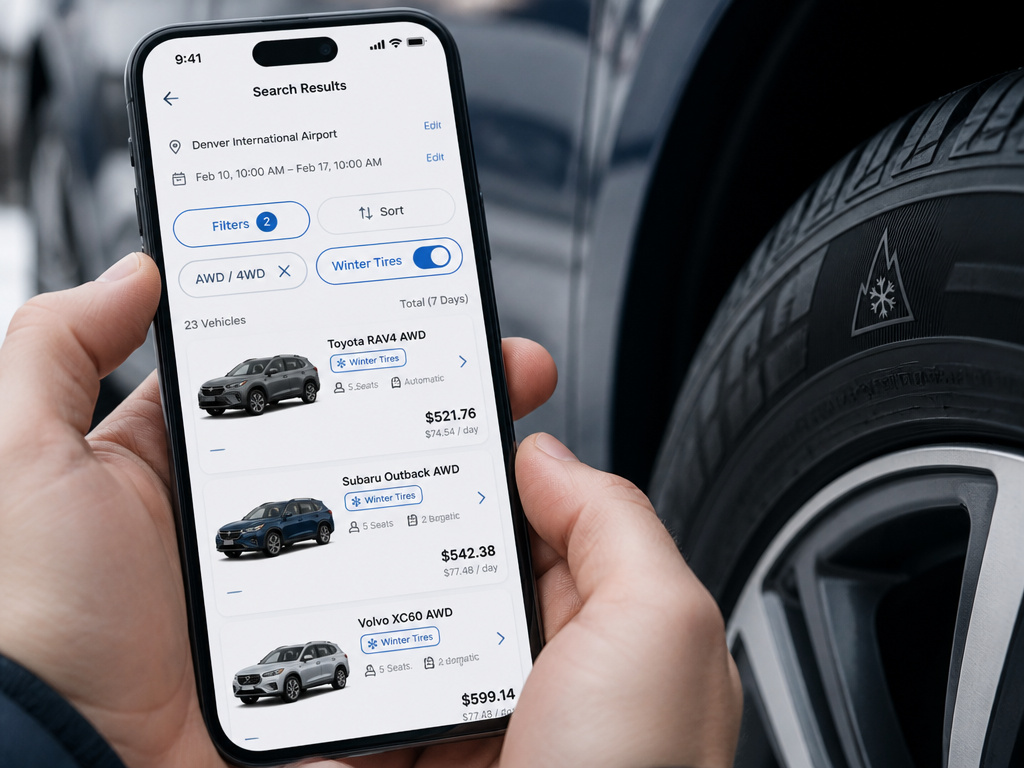
- Peer-to-peer apps like Turo are the only reliable way to “rent” snow tires, using their “Winter Tires” filter to book from private owners who equip their vehicles properly.
- In Japan, chain-regulated roads mandated by the Ministry of Land, Infrastructure, Transport and Tourism require chains even on vehicles with snow tires. Rental companies do not provide chains.
- Always inspect tread depth and look for the 3PMSF symbol on the sidewall at pickup. Reject the vehicle if the tread is visibly worn or you see no severe-service snow rating.
The Short Answer: No, With Exceptions
Standard rental car fleets across the U.S., Europe, and other major markets are equipped with M+S (Mud and Snow) rated all-season tires. These tires meet broad, minimum legal requirements for winter driving in most jurisdictions but are not true winter tires. The higher-performance 3PMSF (Three-Peak Mountain Snowflake) symbol indicates a tire tested for severe snow service, a standard rarely found on traditional rental vehicles.
You will not book a standard economy car from Hertz or Enterprise and find Bridgestone Blizzak WS90s mounted on it. The economics are prohibitive. A set of four quality winter tires runs $600 to $1,200. Storing, mounting, and balancing them seasonally across a fleet of thousands of vehicles is a nightmare of labor and warehouse space. The tires also wear rapidly on dry pavement, adding maintenance costs.
Rental companies solve this by standardization. An all-season tire works in Texas in July and Colorado in December. It works poorly in the latter case, but it works well enough to avoid breaking most laws—which is the rental company’s primary concern, not optimal safety.
Where this goes sideways: You book an SUV for a ski trip, assuming the “all-wheel drive” badge covers traction. AWD helps you move forward. It does nothing to help you stop or turn on ice. That’s entirely on the tires. An AWD vehicle on bald all-seasons is a four-wheeled sled.
Why Rental Companies Avoid Snow Tires (The Logistics)
The resistance isn’t a conspiracy. It’s simple math and liability.
First, the capital outlay is massive. Multiply that $800 tire set across a modest fleet of 500 cars, and you’ve tied up $400,000 in seasonal equipment that sits idle for half the year. Then you need a facility to store 2,000 tires, a crew to perform the seasonal swap, and a system to track which tires go on which car. The profit margin on a $40-a-day rental evaporates.
Second, winter tires are soft. Their special rubber compound, designed to stay pliable below 45°F, wears down quickly on warm, dry asphalt. A rental car that logs highway miles between storms would shred its winter tires in a single season. Companies would be replacing them constantly.
Finally, there’s the liability knot. If a company guarantees snow tires and a customer has an accident, is it the driver’s fault or the tire’s? By providing the lowest-common-denominator M+S tire, the company meets the letter of the law in most places and transfers the risk-assessment burden to you, the renter.
Common mistake: Believing a “winterization package” from a major agency includes snow tires. These packages typically contain an ice scraper, a brush, and maybe cold-weather windshield fluid. The tires remain the standard all-season set.
This is why the traditional rental model fails winter drivers. Your safety is a variable cost they’ve designed out of the system.
How to Actually Get a Rental with Snow Tires
You have two proven paths, and only one is reliable.
The Traditional Agency Gambit: Some major companies, notably Hertz, offer “Winter Certified” or similar programs in specific high-demand regions like Colorado, Utah, or the European Alps. Availability is razor-thin, often limited to certain SUV classes, and never guaranteed at booking. You must call the specific rental location directly, sometimes repeatedly, to confirm. Even then, “winter-ready” may mean all-season tires with deeper tread, not true 3PMSF rubber.
The Peer-to-Peer Guarantee: This is the shortcut. Platforms like Turo (the Airbnb for cars) have a built-in “Winter Tires” filter. Owners who list their personal vehicles often equip them properly for their local climate. You can search this filter in any city and see exactly which cars have winter tires, often with photos of the tire sidewall as proof. You’re renting from an individual who has a vested interest in their own vehicle’s safety and performance. It’s the only method that turns snow tires from a hopeful request into a bookable feature.
| Rental Method | Snow Tire Chance | Key Action Required | Best For |
|---|---|---|---|
| Major Agency (Hertz, Enterprise) | Very Low | Call branch directly; insist on 3PMSF verification. | Those with corporate travel contracts or points. |
| Peer-to-Peer (Turo) | Guaranteed (via filter) | Use “Winter Tires” filter during search. | Leisure travelers, ski trips, anyone prioritizing guaranteed traction. |
| Local / Regional Rental Outlet | Variable (Higher in mountain towns) | Research online reviews; call to confirm tire brand/model. | Travelers picking up directly in a mountain resort area. |
The Turo filter removes the guesswork. You select the feature, you book the car that has it. The entire cumbersome process of pleading with an agency counter agent disappears.
State-by-State & International Law: When “No” Becomes “Must”
This is where the rubber meets the legally mandated road. Some jurisdictions force the issue.
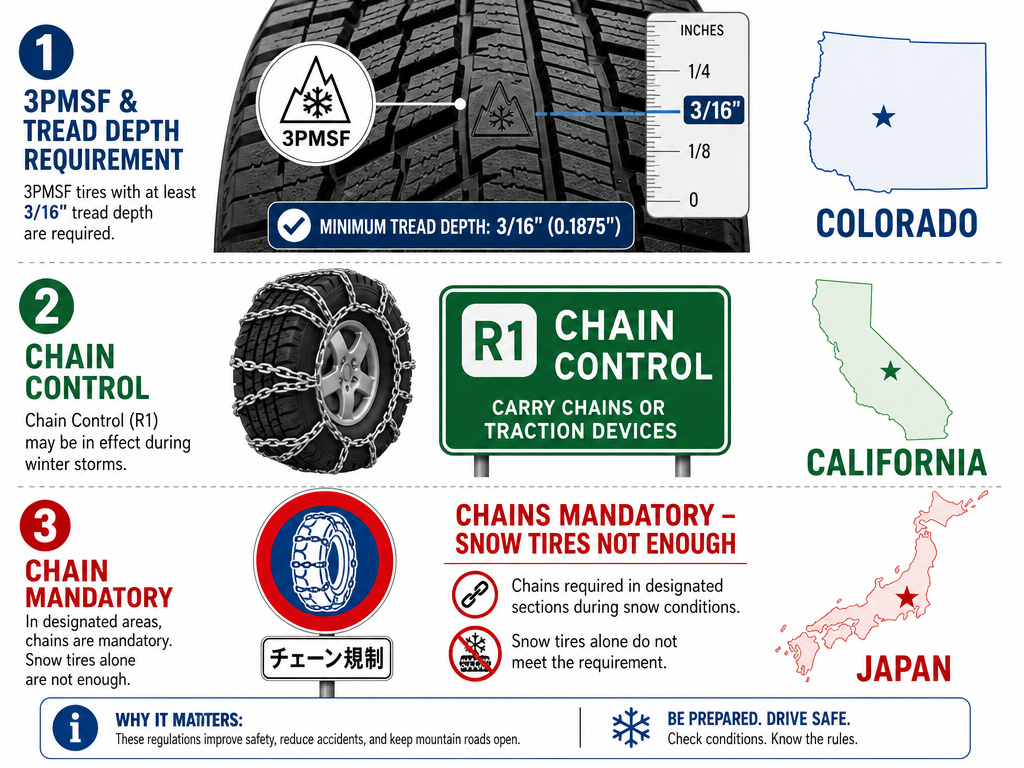
Colorado’s Traction Law is the most famous and specific. When active (typically September through May on I-70 and other mountain corridors), every passenger vehicle must have one of three things: 1. 3PMSF-rated tires. 2. Tire chains or an approved alternative. 3. 4WD/AWD with M+S-rated tires that have at least 3/16-inch of tread depth.
The part nobody mentions: That 3/16-inch tread depth is critical. A renter in Denver once rejected an SUV because its all-season tires, while M+S marked, were too worn to be legal. You must check this yourself with a quarter or a tread depth gauge.
California operates on a chain-control system (R1, R2, R3). While winter tires aren’t mandated, chain controls often require them. Under an R1 control, you can proceed without chains if you have snow tires on your drive wheels. Since rental fleets rarely have true snow tires, you’ll likely need chains. Most rental agreements restrict or forbid chain use due to potential damage.
Japan presents a unique, stricter case. The Ministry of Land, Infrastructure, Transport and Tourism designates “chain-regulated sections” on dangerous mountain passes.
Specific warning with consequence: On these roads, snow tires alone are not sufficient for passage. Chains are mandatory. Avis Japan explicitly states they do not provide chain rental services. You must purchase and fit your own.
The takeaway is that legality is a local game. Relying on the rental company to keep you compliant is a risk. You must know the law where you’re driving.
The 60-Second Tire Inspection You Must Do at Pickup
Do not sign the rental agreement until you complete this walkaround. Your safety and legal standing depend on it.
- Find the Tire Sidewall. Walk to any tire, squat down, and look at the rubber between the wheel and the tread.
- Look for the 3PMSF Symbol. This is a three-peak mountain with a snowflake inside it. This is your goal. If you see it, you have a true severe-service winter tire.
- Note the M+S Marking. If you see “M+S” (Mud and Snow) but no 3PMSF, you have standard all-season tires. This is the default and most likely outcome.
- Check Tread Depth Visibly. Use a quarter. Insert it into the tread groove with Washington’s head facing down. If the top of his head is visible, the tread is dangerously low—below 4/32-inch. For Colorado’s law, you need 3/16-inch (which is 4.5/32-inch). If it looks bald, it is.
- Check Tire Pressure. A soft tire is a dangerous tire, especially in cold weather. Ensure the TPMS light isn’t on and the tires look properly inflated.
If the tires are worn or clearly not suited for your planned route (a rear-wheel-drive sedan with summer tires in a December blizzard), go back inside and request a different vehicle. Be polite but firm. Your contract is not final until you drive off the lot.
What to Do When Snow Tires Aren’t an Option
If you’re stuck with an all-season-tire rental, your strategy shifts from prevention to risk management.
- Carry Traction Devices. Purchase auto socks or lightweight cable chains that are approved for your specific tire size. Practice putting them on in your driveway at home. Stow them in the trunk. They are your legal and physical get-out-of-jail card.
- Adjust Your Driving Immediately. Increase following distance to 8-10 seconds. Brake early, gently, and progressively. Accelerate slowly to avoid wheel spin. Turns should be gradual arcs, not sharp corners.
- Pack a Winter Emergency Kit. Include a heavy blanket, gloves, a flashlight, a small shovel, and non-perishable snacks. A charged battery pack for your phone is essential.
- Know When to Stop. The most advanced technology in the world is the “OFF” switch on the ignition. If conditions deteriorate beyond the capability of your equipment, find a safe place to wait out the storm.
A front-wheel-drive car with solid all-season tires and a cautious driver is often safer than an overconfident driver in an AWD SUV on summer rubber. The driver is always the most important safety feature.
Frequently Asked Questions
Can I request snow tires when I book a rental car?
You can request them, but traditional agencies like Hertz or Enterprise cannot guarantee them. Availability depends on the specific branch, vehicle class, and season. Your request is often just a note in the reservation, not a binding commitment. Always verify by calling the rental location a day before pickup.
Are all-season tires the same as snow tires?
No. All-season tires with an M+S marking are a compromise design for varied conditions. True snow tires (with the 3PMSF symbol) use a softer rubber compound that stays flexible in freezing temperatures and has a tread pattern specifically designed to pack with snow (snow-on-snow traction). The stopping distance difference on ice can be more than 30%.
Does AWD or 4WD mean I don’t need snow tires?
No. All-wheel drive only helps you accelerate and move forward. It provides zero benefit for braking or cornering on slick surfaces. Stopping and turning are entirely dependent on tire traction. An AWD vehicle on poor tires is just as likely to slide off the road as a two-wheel-drive car.
Can I rent snow tires and put them on my rental car?
Virtually impossible. No major tire shop rents standalone snow tires due to the high labor costs of mounting, balancing, and liability. Rental agreements also strictly prohibit modifying the vehicle, which includes changing the tires. Violating this can void your insurance and result in significant fees.
Are rental cars in Colorado required to have snow tires?
No, rental companies are not required to provide them. However, you as the driver are required to comply with the Colorado Traction Law when it is active. The rental company’s obligation is typically just to inform you of the law. It is your responsibility to ensure the vehicle you accept is equipped to meet the legal standard.
Before You Go
Assume your rental car has the minimum legal tire for winter: an all-season M+S model. Your job is to upgrade from that assumption, either by securing a proper vehicle through a peer-to-peer service or by adapting your plans and equipment to the reality of limited traction.
The law in places like Colorado and Japan is specific for a reason—tires are the single most important factor for winter safety. Don’t delegate that decision to a rental company’s logistics spreadsheet. Check the sidewall, know the local rules, and carry your own traction aids. The right preparation turns a stressful mountain drive into a confident journey.
