
Can You Fill a Car Tire with a Bicycle Pump? Honest Answer
This post contains affiliate links. As an Amazon Associate, we earn from qualifying purchases.
Yes, you can fill a car tire with a bicycle pump, but the physical reality is brutal. It requires a compatible Schrader valve connection, a high-volume floor pump, and 400 to 800 strenuous strokes to go from flat to a drivable 32 PSI. A miniature hand pump will likely overheat and fail before the job is done.
The 400-stroke figure isn’t a guess. It’s the math of moving 1,500 cubic inches of air with a tool designed for a fraction of that volume. This is a battle of displacement, not just pressure. Your success hinges on the pump in your hands and the condition of the tire on the rim.
What follows is a breakdown of the three variables that decide if you’ll succeed or just exhaust yourself: pump type, valve compatibility, and tire condition. We’ll also look at the tools that make this a five-minute job instead of a half-hour workout.
Key Takeaways
- A high-volume bicycle floor pump is the only manual option with a chance; a mini hand pump will overheat and fail.
- Valve compatibility is non-negotiable. Car tires use Schrader valves; many bike pumps are for Presta valves and need a secure, screw-on adapter.
- This is only for topping off a slightly soft tire or a true roadside emergency. A completely flat tire often indicates a puncture or bead issue that air won’t fix.
- Expect 15 to 30 minutes of vigorous pumping for one tire. It’s a cardiovascular workout with real risk of overheating the pump’s internal seals.
- For anything more than a rare top-off, a dedicated portable tire inflator is a smarter, safer investment.
The Brutal Physics: Volume vs. Pressure
Car tires need moderate pressure but an enormous volume of air. A standard tire holds between 1,000 and 1,500 cubic inches. A bicycle floor pump might move 50 cubic inches per stroke. The math is simple and punishing.
Inflating a standard car tire from flat to 32 PSI typically requires 400 to 800 strokes of a high-volume floor pump.
This is why pump type isn’t a suggestion—it’s the deciding factor. A professional track pump with a wide barrel and long stroke is your only viable manual tool. The small, handheld emergency pump tucked under your bike seat moves maybe 15 cubic inches per stroke. Using it on a car tire could demand over 3,000 strokes, which is physically impossible before the pump’s rubber seals melt from friction heat.
Where this goes sideways: Using a mini-pump on a car tire. The internal heat buildup cracks the plastic barrel or melts the washer seal within the first few hundred strokes, leaving you with a broken pump and a still-flat tire.
The Valve Compatibility Problem You Can’t Ignore
Your pump must connect to the tire. This sounds obvious, but it’s the most common point of failure.
Car tires universally use Schrader valves. They’re the short, stout valves with a spring-loaded pin in the center. Many bicycles, especially road and performance bikes, use Presta valves. They’re thinner, have a threaded tip, and require a different pump head.
| Valve Type | Common Use | Pump Head Requirement |
|---|---|---|
| Schrader | Cars, many mountain bikes | Standard “press-fit” or screw-on head. |
| Presta | Road bikes, high-performance bikes | Smaller opening; often requires a dedicated head or adapter. |
If your bike pump is designed for Presta valves, it will not seal on a Schrader valve. Air will hiss out around the connection. You need a dual-head pump or a screw-on adapter. Crucially, the adapter must lock securely. A loose, press-fit connection will blow off the valve stem once the tire pressure climbs past 10 PSI, wasting all your effort.
Is Your Tire Even a Candidate for a Pump?
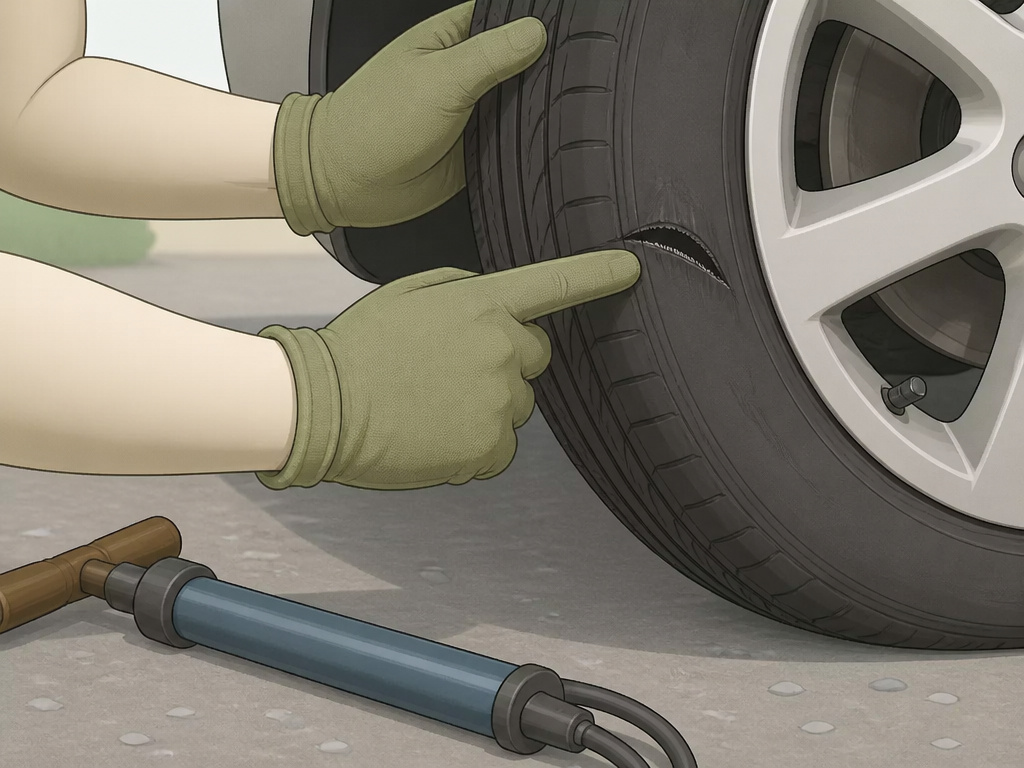
A bicycle pump adds air. It does not repair damage. Before you start pumping, you must inspect the tire.
Pump it:
- A tire that’s slightly soft from overnight temperature drop.
- A tire that has slowly lost pressure over weeks.
Do not pump it:
- A completely flat tire (sitting on the rim). This indicates a major leak, puncture, or a bead that has separated from the wheel. Adding air is unsafe and futile.
- A tire with visible damage: sidewall bulges, large cuts, gashes, or embedded nails/screws.
- A tire that won’t hold air for more than a few minutes. This is a repair job, not an inflation job.
Before you start: You’ll be on the roadside for 20-30 minutes. Park on a level, stable surface away from traffic. Use your hazard lights. Wear a reflective vest if you have one. If you feel dizzy or short of breath from exertion, stop immediately.
How Long Does It Really Take? A Realistic Timeline
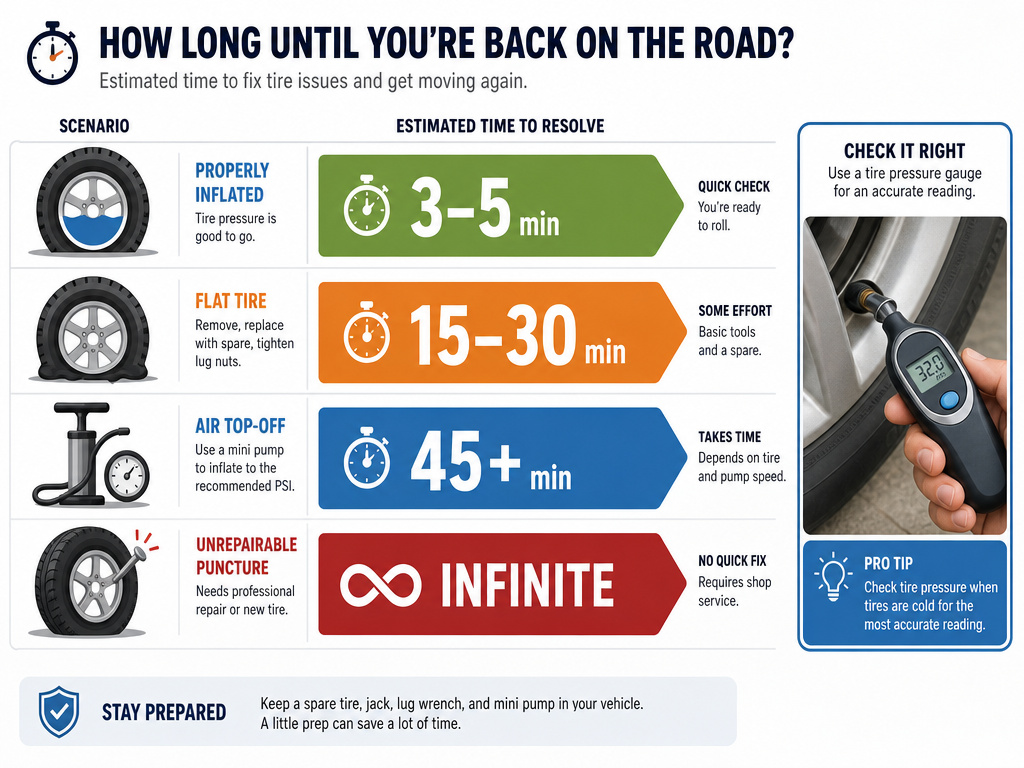
Forget the online claims of “1-2 minutes.” That’s for topping off a tire that’s 5 PSI low, not resurrecting a flat.
Here’s a realistic breakdown based on pump type and starting pressure:
| Scenario | Pump Type | Estimated Time & Effort |
|---|---|---|
| Topping off from 28 PSI to 35 PSI | Floor Pump | 3-5 minutes, moderate effort. |
| Inflating from 0 PSI to 32 PSI | Floor Pump | 15-30 minutes, vigorous, continuous effort. |
| Inflating from 0 PSI to 32 PSI | Mini Hand Pump | 45+ minutes (theoretical), pump will likely fail from overheating first. |
| Inflating a completely flat tire with a puncture | Any Pump | Infinite. You will fail. |
The process is monotonous. Attach the pump head securely. Use your body weight, pushing down with your core and legs on the downstroke to be efficient. Pause every few minutes to feel the pump barrel. If it’s hot to the touch, let it cool. You’re protecting the internal seals.
The part nobody mentions: Your accuracy will suffer. Manual pumping makes it easy to overinflate. You must stop every few minutes to check pressure with a standalone tire pressure gauge. Do not trust the gauge on the pump if it has one.
The Smart Alternative: Tools Built for the Job
A bicycle pump is a workaround. For reliable, safe inflation, you need a tool designed for a car tire’s volume. This isn’t about convenience; it’s about having a solution that works when you’re stranded.
Your real choices are: 1. Portable Air Compressor (12V Plug-in): The gold standard for roadside use. Plugs into your car’s cigarette lighter. A good model, like a Viair 88P, will inflate a full-size tire from flat to proper pressure in under 10 minutes. It’s a one-time purchase that lasts for years. 2. Cordless Tire Inflator: Battery-powered pumps are incredibly convenient for topping off tires at home or in a parking lot. They’re less powerful than 12V compressors for a full flat but perfect for maintenance. 3. Gas Station Air Pump: The classic solution. It’s often cheap or free, but you need to drive there on a soft tire, and the gauges are frequently inaccurate.
Common mistake: Buying the cheapest inflator you can find. A $20 unit often lacks the duty cycle to fill a full tire without overheating and shutting down. Invest in a quality portable air compressor with a metal motor housing and clear amp ratings.
For most drivers, a capable 12V air pump stored in the trunk is the perfect balance of cost, reliability, and power. It turns a crisis into a minor delay.
Frequently Asked Questions
Can a bike pump damage a car tire?
No, not if used correctly. The tire doesn’t care where the air comes from. The risk is to the pump itself from overheating, or to you from overexertion or inaccurate inflation.
What’s the difference between a floor pump and a hand pump?
Floor pump (or track pump) stands on the ground, uses a long handle and wide barrel to move a large volume of air per stroke. A hand pump is small, portable, and designed for emergency bike repairs. Its low volume makes it nearly useless for car tires.
I only have a Presta valve bike pump. What can I do?
You need a secure, screw-on Schrader valve adapter. Slide it onto the Presta valve thread, then attach your pump head. Test the connection at low pressure first to ensure it doesn’t pop off. A loose adapter makes the task impossible.
Is it safe to drive on a tire I’ve just hand-pumped?
Only if you’ve reached a safe, specified pressure (check your door jamb sticker or owner’s manual). Do not drive on a visibly underinflated or overinflated tire. Hand-pumped air is no different from compressor air once it’s in the tire—if the pressure is correct, it’s safe. However, treat it as a temporary fix and verify pressure with a accurate gauge at your earliest opportunity, as recommended in the Institute for Environmental Research and Education guide on tire safety.
What should I look for in a portable inflator?
Focus on duty cycle (how long it can run), PSI range (should exceed 50 PSI), and air volume (CFM or liters/minute). A higher amp rating for 12V models means more power. For cordless models, battery life and recharge time are key. Avoid units with solely plastic construction around the motor.
The Bottom Line
You can fill a car tire with a bicycle pump. You’ll also question your life choices halfway through. It’s a last-resort survival skill for a roadside bind, not a practical maintenance strategy.
The takeaway is simple. Keep a quality tire pressure gauge in your glove box. For peace of mind, invest in a dedicated tire inflator. It’s the difference between a 30-minute workout on the shoulder and a 5-minute solution that gets you safely back on the road. Your future self, who isn’t drenched in sweat and nursing sore shoulders, will thank you.
