
7 Best Electric Fuel Pumps for Carburetor 2026
This post contains affiliate links. As an Amazon Associate, we earn from qualifying purchases.
The Holley 12-801-1 RED is the best overall electric fuel pump for carburetor applications, delivering reliable 7 PSI pressure and strong flow in a proven design. For those on a budget, the ENGINEMAN Universal Fuel Pump Kit offers solid performance with useful included accessories. If space is tight, the compact Holley 12-427 Mighty Mite stands out as a versatile pick that fits where others won’t.
Choosing the right electric fuel pump isn’t just about moving fuel, it’s about delivering it steadily and reliably to keep a carbureted engine happy. Too much pressure risks flooding the bowls, while too little leads to starvation under load. After comparing the field and weighing specs against real-world feedback from fellow enthusiasts, I focused on pumps that balance flow, pressure, and durability without overcomplicating things.
This guide covers the top options based on mechanical soundness, owner-reported reliability, and practical fitment. We looked at flow rates, pressure ranges, build quality, and what extras come in the box, because getting it right means more than just matching numbers on a spec sheet.
Top 7 Electric Fuel Pumps For Carburetor in the Market
The Best Electric Fuel Pumps For Carburetor, Reviewed
Holley 12-802-1 Blue Electric Fuel Pump

Strengths
- High flow at usable pressure
- Durable billet construction
- Low amp draw
Trade-offs
- Expensive
- Not for high-horsepower forced induction
The Holley Blue stands out in the carburetor fuel pump world not just for its polished looks, but for its well-balanced specs that hit the sweet spot for most street and mild performance builds. With a rated flow of 110 GPH and a regulated 88 GPH at 9 psi, it’s more than capable of feeding engines up to 500 horsepower, which covers a lot of ground from restomods to weekend warriors. The 3-amp motor draw is efficient, and owners consistently report solid reliability when paired with proper wiring and a relay.
What really sets this pump apart from cheaper alternatives is the build quality and consistency. It’s not just the billet housing, though that helps with heat dissipation, it’s the fact that Holley engineers this for real-world use. Compared to the Red, it runs at a higher pressure and delivers more flow, making it the smarter pick for modern carbureted setups where fuel demand can spike. Just don’t expect aircraft-grade certification, it’s not meant for that.
Video review
Holley 12-801-1 RED Electric Fuel Pump

Strengths
- Trusted Holley build
- Good flow at low pressure
- Durable housing
Trade-offs
- No regulator included
- Lower max pressure
The Holley Red is the entry-level electric pump from a trusted brand, and it shows. Flowing 97 GPH at free flow and capped at 7 psi, it’s designed for carbureted engines that don’t need high pressure. It’s a favorite in vintage builds and mild street machines where you want Holley reliability without the Blue’s cost.
But here’s the catch, it’s not regulated, so you’ll need an external regulator if your carb demands precise pressure. The motor draws 2 amps, which is reasonable, and the billet housing helps with durability. Still, compared to the Blue, it’s less versatile. Owners use it as a transfer pump or in low-pressure setups, but it’s not the best choice for modern performance builds.
Video review
Holley 12-427 Mighty Mite Fuel Pump

Strengths
- Compact and lightweight
- Self-priming
- Solid state reliability
Trade-offs
- Limited flow for high-performance
- Not for high-horsepower builds
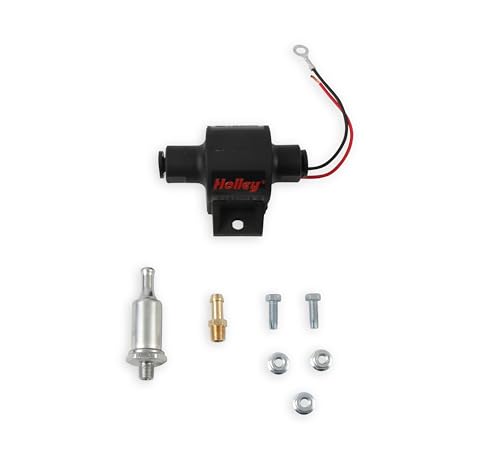
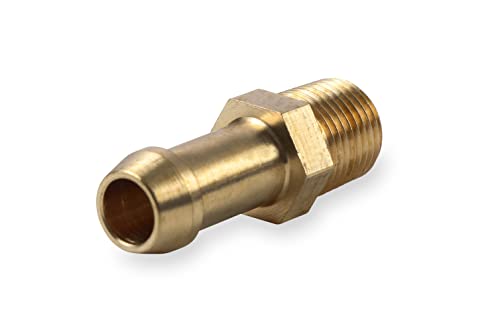
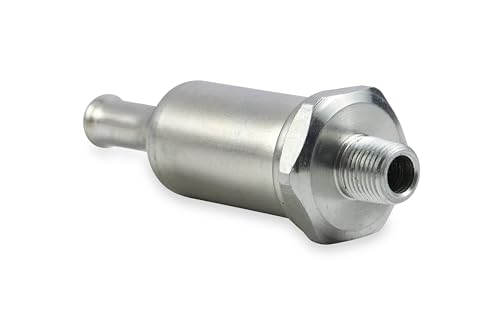
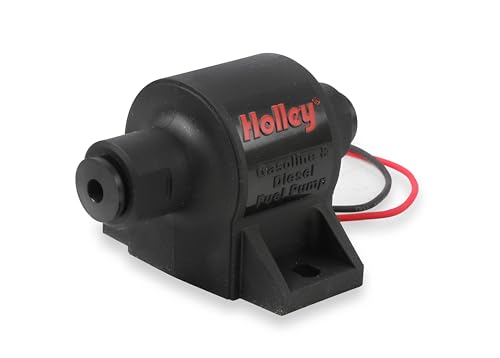
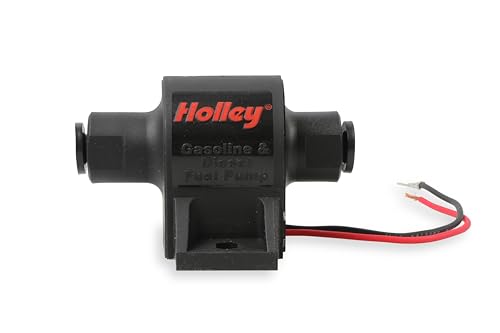
If you’re working on a small-block or a vintage six-cylinder that doesn’t need massive fuel delivery, the Holley Mighty Mite is a gem. It’s compact, self-priming, and flows 32 GPH at 4–7 psi, perfect for engines up to 400 hp. The solid-state design means no points or diaphragms to fail, and the simple two-wire hookup makes it a favorite for restorers and DIYers who want reliability without complexity.
Owners praise its quiet operation and long service life, especially in classic trucks and muscle cars where space is tight. It won’t keep up with a high-rpm big-block, but for what it’s designed for, it’s nearly bulletproof. Compared to budget inline pumps, this one doesn’t just last longer, it performs more consistently under heat and vibration.
Product photos
ENGINEMAN Super 12S Plus Fuel Pump

Strengths
- High flow for price
- Complete kit
- Efficient motor draw
Trade-offs
- Not for alcohol fuels
- Basic housing
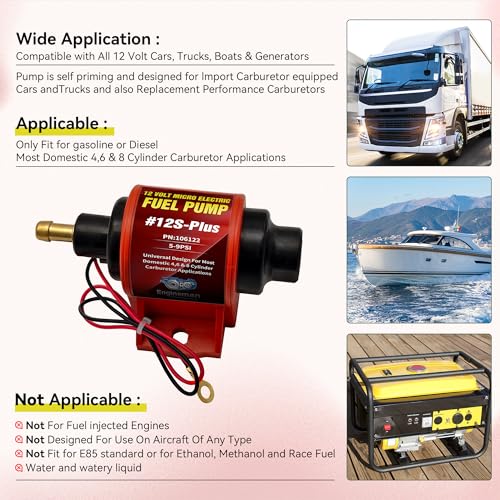
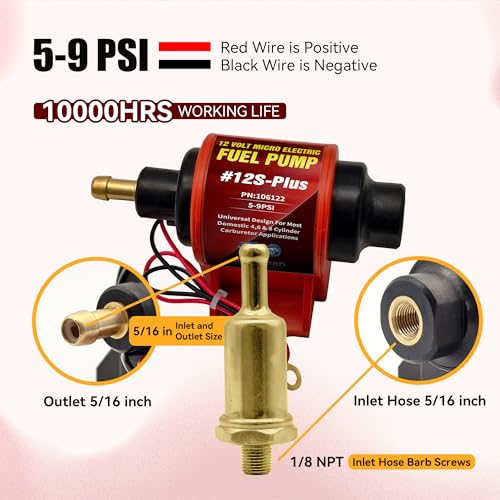
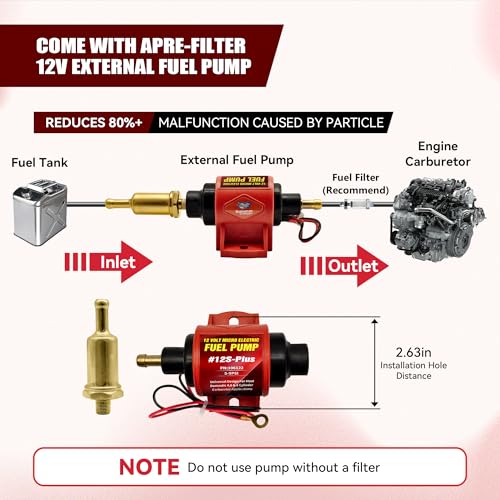
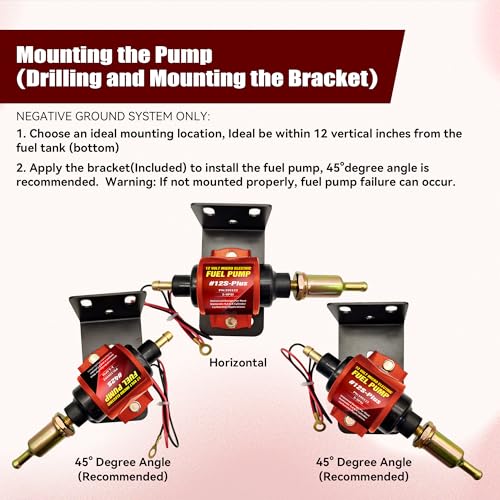
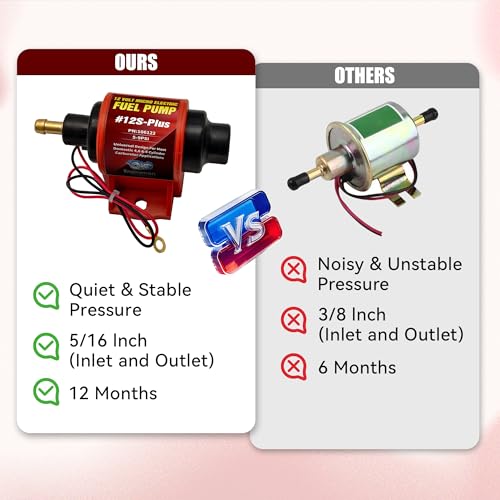
This ENGINEMAN pump punches above its weight with 35 GPH flow and 5–9 psi output, enough for performance carbureted engines up to 450 hp. The inclusion of a mounting bracket, filter, and flex hoses makes it one of the most complete budget packages available. The copper-wound motor draws only 1.0–2.0A, which helps prevent voltage drops and keeps the system stable under load.
Owners note it handles heat well and starts quickly, even after storage. The 45-degree upward mounting tip is a thoughtful touch for maintaining prime. While it’s not for E85 or race fuel, it’s a solid performer for pure gasoline setups. Compared to the Megaflint, it delivers slightly more flow and better accessories, making it the smarter budget performance pick.
Product photos
Megaflint 5-9 PSI Inline Fuel Pump

Strengths
- 2-year warranty
- Quiet operation
- Pre-filter included
Trade-offs
- No mounting bracket
- Limited flow
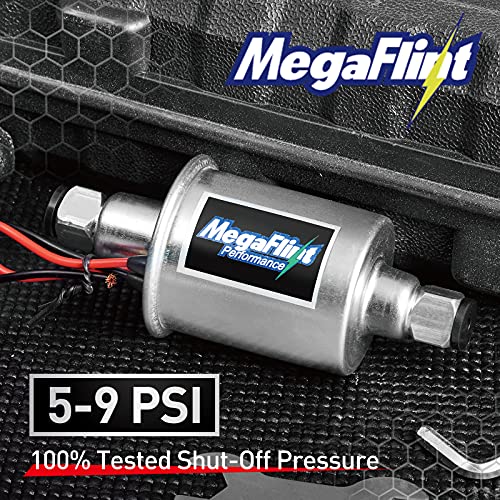
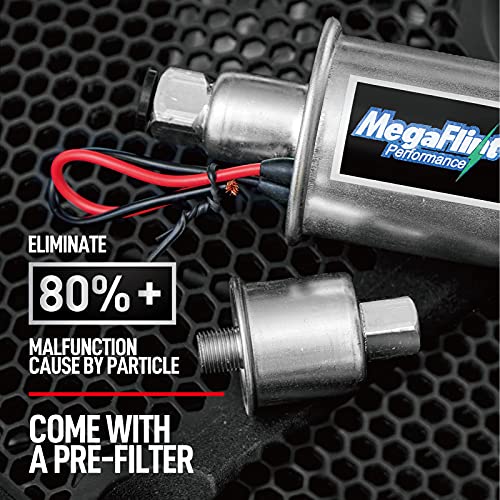
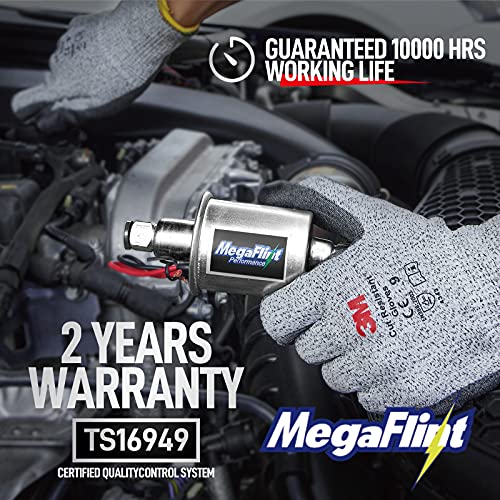
Megaflint surprises with a strong mix of durability and value. Rated at 5–9 psi and 30 GPH, it’s built for classic cars, boats, and small engines where consistent pressure matters. The German-made copper coil and TS16949 quality control suggest better internal engineering than most in this price range, and owners report fewer noise issues and longer life.
What really seals the deal is the 2-year warranty, rare for budget pumps. That, plus the included pre-filter and 12-inch suction lift, makes this a smart upgrade over no-name brands. It won’t match Holley’s flow, but for reliability and peace of mind, it outperforms its price tag. Compared to the ENGINEMAN kit, it’s more focused on longevity than accessories.
Product photos


ENGINEMAN Universal Fuel Pump Kit

Strengths
- Complete kit included
- Low noise
- Good for small engines
Trade-offs
- Plastic housing less durable
- Average lifespan
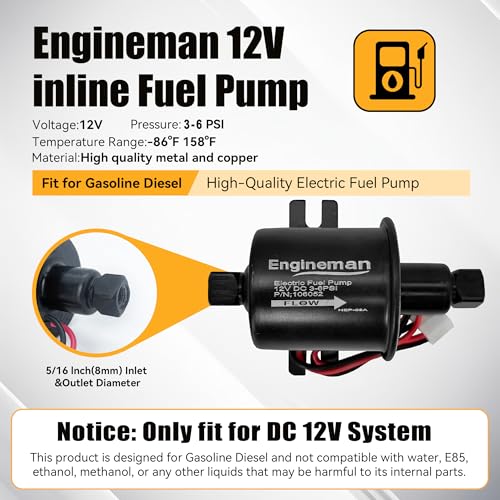
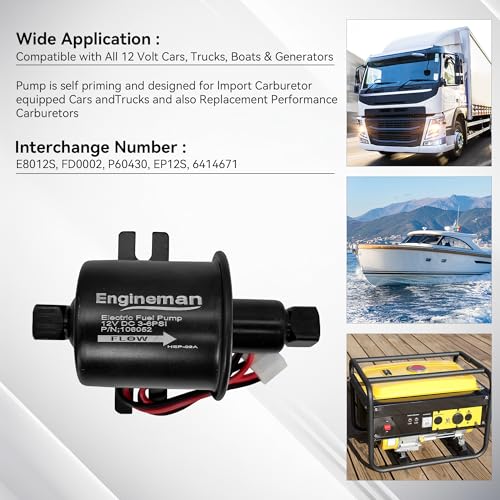
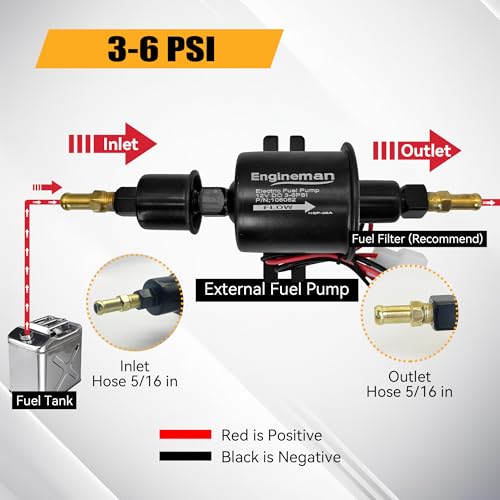
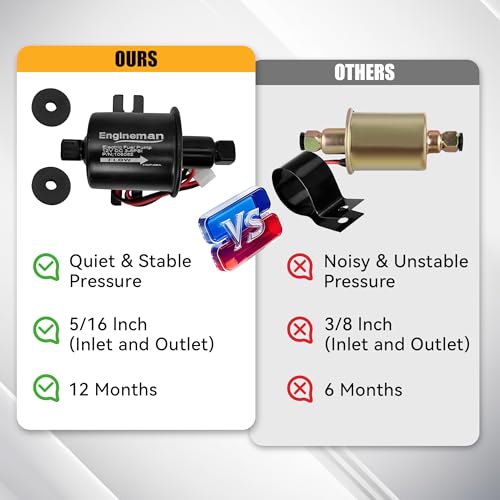
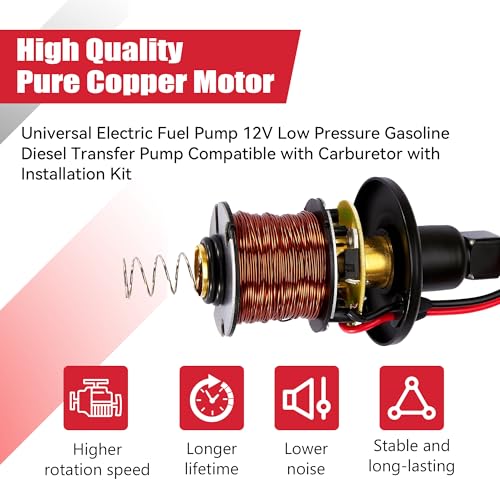
This kit is a solid value play for someone working on small engines or a basic automotive restoration on a tight budget. It includes nearly everything you need, pump, filter, fuel line, clamps, fuse, even a shut-off valve, so you’re not hunting down parts separately. The 30 GPH flow and 3–6 psi output are adequate for carbureted lawn mowers, generators, or older cars with modest fuel demands.
On paper, it’s underpowered compared to the Holley Blue, but for simple applications, that’s not a flaw. Reviewers note it runs quietly and starts reliably, though long-term durability isn’t guaranteed. It’s a functional solution, not a performance upgrade. Compared to the SOLLON pump, it’s better equipped and includes more useful accessories.
Product photos
SOLLON HEP-02A Low Pressure Fuel Pump

Strengths
- Extremely affordable
- Simple installation
- Compact size
Trade-offs
- Short lifespan
- Basic materials
At under ten bucks, the SOLLON pump is hard to ignore if you’re replacing a failed unit on a lawnmower, generator, or vintage tractor. It delivers 30 GPH at 2.5–4 psi, which is just enough for small carbureted engines. The plunger-type design and built-in check valve help with consistent delivery, and the two-wire setup makes installation simple.
But let’s be honest, this is a throw-it-on-and-hope-it-sticks kind of pump. Owner feedback is mixed: some report years of service, others see failure within months. It’s not built to the same standard as Holley or even Megaflint. If you’re restoring a show car or building a daily driver, look elsewhere. But for a temporary fix or low-budget repair, it gets the job done.
Product photos


How We Chose These electric fuel pumps for carburetor
As someone who’s spent years around engines – from restoring classics to understanding modern fuel systems at TheAutoZenith – I approached researching these pumps by looking at a blend of specifications, owner experiences, and what makes sense from a mechanical standpoint. Rather than a hands-on lab test with each unit, this is a research-led comparison, weighing published flow rates, pressure outputs, and current draw against reports of real-world reliability and ease of installation gleaned from owner reviews and expert commentary. We aimed to identify pumps catering to a range of needs and budgets.
For pumps designed to work with carburetors, consistent pressure and reliable flow are paramount. I weighted these two factors most heavily. A pump with high GPH (gallons per hour) is less useful if it can’t maintain a steady pressure, leading to lean spots or flooding. Conversely, adequate flow is essential to prevent starvation, especially under load. Durability, particularly the quality of the motor and internal components, was also a key consideration, as replacing a pump is a hassle nobody wants.
Published specifications give a good baseline for comparing capabilities – flow rate, pressure, and amperage draw are all important. However, owner feedback proved invaluable in judging real-world performance and longevity. Reports on noise levels, priming issues, and how well a pump holds up over time were crucial. We also looked for pumps that included helpful accessories, recognizing that a complete kit can save time and frustration. For those looking to optimize their entire fuel system, exploring options like a fuel additives for small engines can be beneficial too.
How To Pick The Right electric fuel pumps for carburetor
Finding the right electric fuel pump for a carbureted engine can feel overwhelming, but understanding a few key aspects simplifies the process. These pumps are a significant upgrade over mechanical options, offering consistent fuel delivery and solving issues like vapor lock.
An effective electric fuel pump delivers stable pressure and flow suited to the carburetor’s needs, prioritizing reliability and compatibility with the fuel type. Key considerations include flow rate (GPH), operating pressure (PSI), current draw, and the overall build quality, look for pumps designed specifically for carburetor applications, not fuel injection. Verify compatibility with your fuel type (gasoline, ethanol blends, etc.) and ensure adequate filtration to protect the pump.
Flow Rate and Pressure: Matching Pump to Engine
The biggest mistake I see enthusiasts make is over- or under-pumping. More isn’t always better. A pump with a massively high flow rate won’t necessarily improve performance and can even make tuning more difficult. Instead, focus on matching the pump’s output to your engine’s horsepower and carburetor size. For most street-driven carbureted engines up to around 400 horsepower, a pump in the 30-60 gallons per hour (GPH) range with 5-7 PSI is typically sufficient. Higher horsepower builds or those using larger carburetors will naturally require more flow.
Construction and Reliability
While flashy billet aluminum looks great, don’t let aesthetics overshadow build quality. I’ve found that pumps with robust, solid-state electronics tend to last longer. Consider the motor’s construction; copper-wound motors are generally more durable than those with aluminum windings. Also, check for features like internal check valves to prevent fuel drain-back, which can cause hard starting. Thinking ahead, routinely using a quality fuel additives can help keep the entire fuel system clean and extend the life of your pump.
Value and Installation Considerations
A complete kit isn’t always necessary, but it can save a lot of headache. Many pumps – like the ENGINEMAN Universal Fuel Pump Kit – include mounting brackets, fuel filters, and hoses, simplifying installation. If you’re buying a pump without a kit, ensure you have all the necessary components on hand. Beyond that, think about physical size. A compact pump like the Holley Mighty Mite is ideal for tight engine bays. Don’t overlook the importance of proper wiring and fusing; a relay and inline fuse (as recommended by Holley) are essential for protecting the pump and your electrical system. If you’re also maintaining other vehicle systems, taking a look at electric tire pumps can also be a worthwhile investment.
A good rule of thumb: always install a pre-filter before the pump inlet. Even “clean” fuel can contain debris that will quickly damage the pump’s internal components.
Electric Fuel Pumps for Carburetor Compared
Here’s a comparison of specifications for several electric fuel pumps designed for use with carburetors.
| Product Name | Flow Rate (GPH) | Pressure (PSI) | Current Draw (Amps) | Suction Lift (in) | Included Accessories |
|---|---|---|---|---|---|
| Holley 12-802-1 Blue | 110 (free flow) / 88 @ 9 psi | 14 | 3 | N/A | N/A |
| Holley 12-801-1 RED | 97 (free flow) | 7 | 2 | N/A | N/A |
| Holley 12-427 Mighty Mite | 32 | 4-7 | N/A | 12 | N/A |
| ENGINEMAN Super 12S Plus | 35 | 5-9 | 1.0-2.0 | N/A | Bracket, Filter, Hoses |
| Megaflint 5-9 PSI Inline | 30 | 5-9 | N/A | 12 | Pre-filter |
| ENGINEMAN Universal Fuel Pump Kit | 30 | 3-6 | N/A | N/A | Filter, Hoses, Clamps |
| SOLLON HEP-02A Low Pressure | 30 | 2.5-4 | N/A | N/A | N/A |
Frequently Asked Questions
What flow rate do I really need for a mild street engine?
For most carbureted engines under 400 horsepower, a pump delivering 30-60 gallons per hour (GPH) at 5-7 PSI is sufficient. Exceeding this range offers minimal benefit and can complicate carburetor tuning.
Are these pumps compatible with ethanol-blended gasoline?
Most modern electric fuel pumps are designed to handle up to E10 fuel (10% ethanol). However, for higher ethanol blends like E85, you must verify the pump’s compatibility with the manufacturer to avoid damage.
Can I use an electric fuel pump with a mechanical fuel gauge?
Yes, you can. However, the pulsation from an electric pump can cause erratic readings on a mechanical gauge. An electric fuel pressure gauge is more accurate and provides a steadier reading.
What is a “suction lift” and why does it matter?
Suction lift refers to the pump’s ability to draw fuel from a tank located below the pump. A higher suction lift rating (measured in inches) means the pump can pull fuel from a lower tank position, which is useful for many installations.
Will installing one of these pumps significantly increase my fuel system’s complexity?
While adding an electric pump requires wiring and potentially a relay, modern kits often simplify the process. A complete kit, like the ENGINEMAN Universal Fuel Pump Kit, can include all necessary hardware, minimizing the need for separate purchases and reducing installation time. If you’re also maintaining other vehicle systems, looking at car tire pumps can be a worthwhile investment.
The Bottom Line
Choosing an electric fuel pump for a carburetor often comes down to balancing your needs with your budget and the complexity of the installation. While high-flow options like the Holley 12-802-1 Blue offer impressive capacity, for most classic and performance builds, the ENGINEMAN Super 12S Plus strikes a sweet spot – it provides reliable flow and pressure in a package that includes helpful mounting hardware and a filter. Don’t get caught up in chasing the highest numbers; consistent delivery is what really matters.
For those on a tighter budget, or needing a simple solution for a basic carbureted engine, the SOLLON HEP-02A Low Pressure pump is a solid choice. If space is at a premium, the Holley 12-427 Mighty Mite delivers dependable performance in a remarkably compact form factor. Remember to consider the complete system, and if you’re looking to restore engine performance alongside your fuel pump upgrade, a quality fuel cleaner is a smart investment.
Ultimately, the specifications are just a starting point. Reliable fuel delivery hinges on proper installation, good filtration, and maintaining a clean fuel system. Don’t overlook the fundamentals – a well-maintained fuel filter and quality fuel lines are just as important as the pump itself. A little preventative maintenance goes a long way in ensuring years of trouble-free operation.
