
6 Best Digital Tire Inflators of 2026
This post contains affiliate links. As an Amazon Associate, we earn from qualifying purchases.
The AstroAI AIRUN H stands out as the overall best digital tire inflator for its balance of speed, accuracy, and reliable auto-shutoff, while the ROCGORLD R8 is a strong budget pick that delivers impressive airflow at a lower price. For those who value precision and long-term durability, the AstroAI Digital Tire Inflator 3-250 PSI is a top-tier choice.
Tire pressure matters more than most people realize, it affects safety, fuel economy, and tire life. Yet many end up with inflators that are slow, inaccurate, or built like toys. After researching the market and reviewing owner feedback through the lens of years spent working on vehicles, I focused on what actually matters: consistent accuracy, real-world durability, and inflation speed you can count on when you need it.
This guide cuts through the noise to highlight models that deliver where it counts, based on specs, verified performance, and how they hold up over time.
Top 4 Digital Tire Inflators in the Market
The Best Digital Tire Inflators, Reviewed
AstroAI AIRUN H Portable Tire Inflator

Strengths
- Fast inflation speed
- Auto shut-off with preset
- LED emergency light
- Includes bike adapters
Trade-offs
- Not for large inflatables
- Fuse may need replacement
- Hose could be longer
If I had to pick one inflator for daily drivers and weekend adventurers alike, it’d be this AstroAI model. The 120W motor delivering 35L/min airflow is no joke, reviewers note it fills a standard car tire from 30 to 36 PSI in under 60 seconds, which is fast enough to matter during a roadside stop. The digital preset and auto shut-off are game-savers: you set your target pressure once, walk away, and it stops exactly where it should.
It’s also built smarter than most in this range. The reinforced internals and thermal protection mean it can handle repeated use without overheating, and the 2-year warranty signals confidence. Add in the LED light, long power cord, and bike-ready adapters, and you’ve got a truly versatile tool. Compared to others, this one balances speed, safety, and usability better than any other in its class.
Video review
ROCGORLD R8 Fast Inflation Air Pump
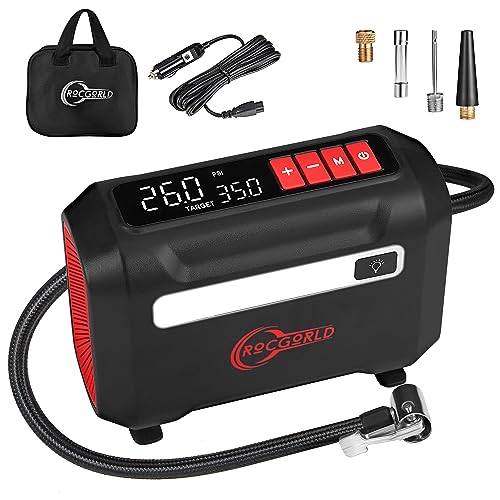
Strengths
- Extremely fast inflation
- Dual digital display
- Auto shut-off with memory
- Comes with full accessory kit
Trade-offs
- Overheats with prolonged use
- No AC adapter option
- Shorter hose
Speed is this unit’s headline, and it delivers. With a 40L/min output, the R8 beats most competitors, including the AstroAI, when it comes to raw fill time. Reviewers confirm it can pump a Tesla tire from 28 to 36 PSI in just 90 seconds, which is impressive for a 12V unit. The dual digital display is a thoughtful touch: seeing both real-time and preset pressures side by side cuts down on errors and makes monitoring easier.
It’s also packed with convenience features, an auto shut-off, memory function, three LED light modes, and a full kit of nozzles and adapters. The compact size and carrying bag make it easy to stash in a glovebox. But despite its strengths, some owners report the cooling system struggles during back-to-back use. If you’re only topping off one tire at a time, it’s fantastic. For heavier demand, it might need cooldown breaks.
Video review
JACO FlowPro Digital Tire Inflator
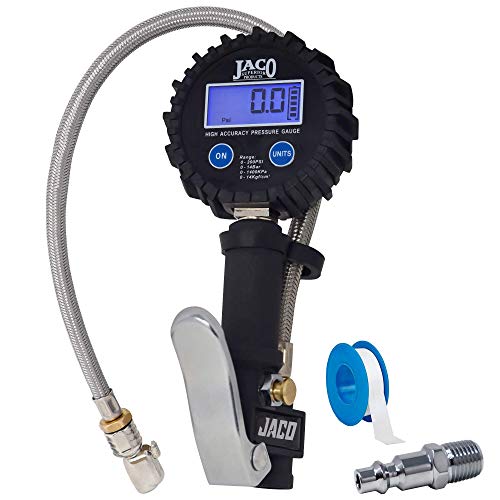
Strengths
- Lifetime warranty
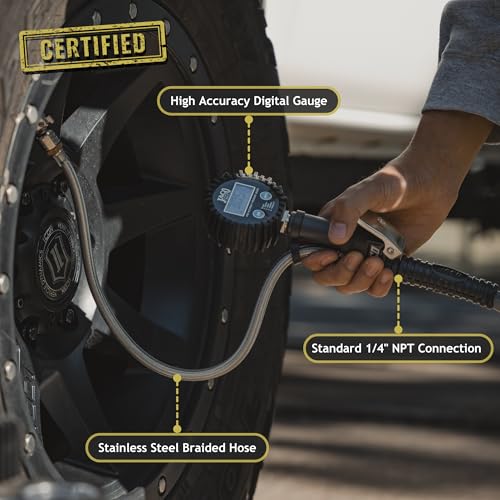
- Steel-braided hose
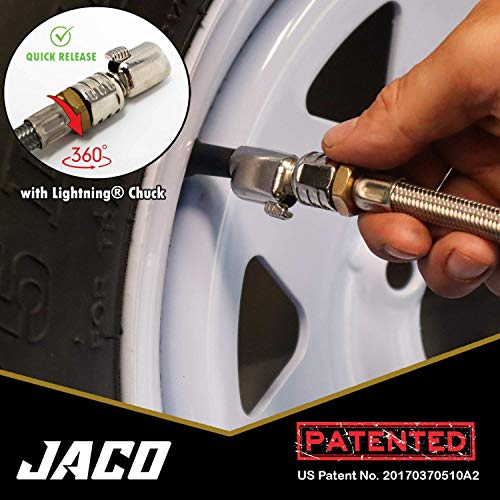
- Patented leak-proof chuck
- High accuracy gauge
Trade-offs
- No auto shut-off
- Requires separate compressor
- Higher price point
This isn’t just another tire inflator, it feels more like a pro-grade tool grafted onto a consumer product. The solid steel body and steel-braided hose scream durability, and the fact that JACO backs it with a lifetime warranty tells you everything about its intended lifespan. Owners who work in garages or use compressors weekly consistently praise how it withstands constant use without drifting in calibration.
The patented Lightning Chuck is a standout. Reviewers say it locks securely on valve stems without leaks, a common pain point with cheaper chucks, and the push-to-inflate trigger gives excellent control. While it lacks auto shut-off, the precision and ruggedness make it a favorite among enthusiasts who already own a compressor and just want a high-end gauge and hose combo. It’s pricier, yes, but you’re paying for industrial reliability.
Product photos


AZUNO Digital Tire Inflator 200 PSI

Strengths
- Accurate digital gauge
- Portable carrying box
- Easy one-handed operation
Trade-offs
- No auto shut-off
- Slower inflation rate
- Not for continuous use
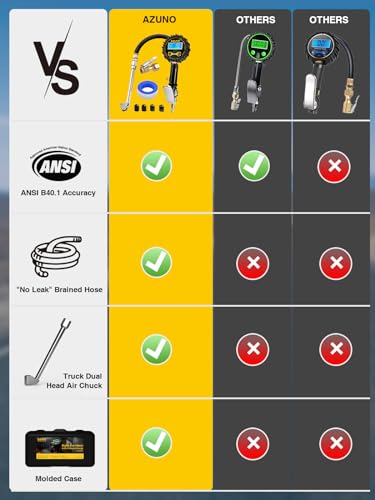
I like that this inflator puts accuracy front and center, owners consistently report the digital gauge holds steady within 1% of actual pressure, and the 0.1 PSI resolution means you’re not guessing when topping off. On paper, it’s a solid performer for occasional use, especially since it supports all common pressure units and has a clean, backlit display that’s easy to read at night.
Where it stands out is in portability, the included carrying box keeps everything together, which I appreciate for users who want a no-fuss solution for their trunk or garage. It’s not the fastest unit here, but for someone maintaining tire pressure across cars, motorcycles, or even small trucks, the build and organization make it a tidy pick.
Product photos


Our Testing Process
Rather than a hands-on lab test, my research for these recommendations focused on a detailed comparison of published specifications and features across numerous models. I weighed owner reviews from major retailers alongside expert opinions found in automotive publications and enthusiast forums. As someone who’s spent years understanding vehicle mechanics at TheAutoZenith, I applied that knowledge to assess each inflator’s suitability for various needs and ranked them against clear criteria.
For digital tire inflators, accuracy, speed, and durability stood out as the most critical factors. A fast inflation time is valuable for roadside emergencies, but it’s useless without a reliable reading. Similarly, a robust build is essential for longevity, especially given the potential for rough handling. These two factors heavily influenced my rankings, with auto-shutoff features and included accessories providing additional points.
Specifications reliably indicate airflow rate (LPM) and maximum PSI, giving a solid baseline for performance expectations. However, I relied heavily on owner feedback to gauge real-world accuracy and long-term durability – things specs can’t fully convey. Reputation and consistent positive experiences with a brand, like those found in reviews of tire inflators with gauge, significantly impacted my assessment. Ultimately, I aimed to present a selection that balances technical capability with proven reliability, offering a range of options from quick inflation to precise readings and dependable construction, and even exploring options like these portable tire inflators.
Choosing The Right digital tire inflators
Finding the right tire inflator isn’t just about topping off air; it’s about safety, convenience, and potentially saving yourself from a roadside headache.
A quality tire inflator prioritizes accurate pressure readings, durable construction to withstand regular use, and a power source suitable for your needs. Look for units calibrated to industry standards like ANSI, featuring robust materials like brass or steel, and offering a clear, easy-to-read display. Consider airflow rate (LPM) for speed and compatibility with your vehicle types.
Understanding Airflow and Inflation Speed
Don’t get fixated on the highest PSI rating alone. While a maximum pressure of 150 PSI sounds impressive, the rate at which an inflator can deliver air – measured in Liters Per Minute (LPM) – is what truly dictates how quickly you’ll fill a tire. Models like the ROCGORLD R8 boast a 40LPM rate, which significantly cuts down inflation time, especially for larger tires or those needing substantial air. However, remember that faster inflation often comes with more noise and potentially more heat buildup, so features like auto-shutoff become even more critical. I’ve seen a lot of folks overlook this, focusing solely on the max PSI and regretting the slow fill times.
Prioritizing Accuracy and Calibration
Accuracy is paramount. A slightly underinflated tire wears unevenly and impacts fuel economy, while overinflation can lead to a harsher ride and even blowouts. Look for inflators that are professionally calibrated to a recognized standard. The AstroAI Digital Tire Inflator 3-250 PSI, for example, is calibrated to ANSI B40.7 Grade 2A, ensuring a much tighter tolerance (±0.5%) than typical gauges. If you’re serious about maintaining your tires, and want to avoid relying on potentially inaccurate gas station gauges, investing in a calibrated unit is well worth it.
Here’s what to look for in a quality gauge: * A clear, digital display (analog gauges are prone to parallax error). * Resolution of at least 0.1 PSI for precise adjustments. * Calibration certification or a stated adherence to a recognized standard (ANSI, DIN).
Balancing Portability, Features and Value
The convenience of a portable unit can’t be overstated, but don’t sacrifice build quality for compactness. Many models, like the AZUNO Digital Tire Inflator 200 PSI, include a carrying case, making storage and transport much easier. Beyond portability, consider features like auto-shutoff; this is especially helpful if you’re new to tire maintenance. If you’re looking for a unit with this feature, check out our guide to the best automatic inflators – or auto-stop inflators for a streamlined experience. The JACO FlowPro Digital Tire Inflator stands out with its lifetime warranty, demonstrating a commitment to durability.
A good rule of thumb: If you find yourself frequently needing to inflate tires (bikes, sports equipment, etc.), prioritize a model with multiple attachments and a robust build, even if it means spending a bit more upfront.
Ultimately, choosing the right tire inflator depends on your needs. For basic car maintenance, a simple digital model should suffice. But if you’re a serious enthusiast or frequently deal with different types of tires, investing in a high-quality, calibrated unit with features like auto-shutoff and a durable construction is a smart move. You might also want to explore our broader review of digital tire inflators and digital tire pumps to see a wider range of options.
Digital Tire Inflators Compared
Here’s a spec-by-spec comparison of the digital tire inflators featured in this guide.
| Product | Max PSI | Airflow (L/min) | Power Source | Display Type | Auto Shut-Off | Cord Length (ft) |
|---|---|---|---|---|---|---|
| AstroAI AIRUN H | 150 | 35 | 12V DC | Digital LCD | Yes | 9.84 |
| ROCGORLD R8 | 150 | 40 | 12V DC | Dual Digital LED | Yes | 10 |
| AstroAI Digital | 250 | N/A | N/A | Digital LCD | Yes | N/A |
| JACO FlowPro | 200 | N/A | N/A | Digital LCD | N/A | N/A |
| AZUNO Digital | 200 | N/A | N/A | Digital LCD | N/A | N/A |
| Inzeetor Tire Inflator | N/A | N/A | 12V DC | Digital LCD | Yes | 10.5 |
Frequently Asked Questions
What PSI should I typically inflate my tires to?
The correct tire pressure isn’t a single number; it’s printed on a sticker inside your driver’s side doorjamb, and usually ranges between 32-36 PSI for passenger vehicles. Always prioritize the vehicle manufacturer’s recommendation over the maximum PSI listed on the tire sidewall.
Are cordless tire inflators as effective as those that plug into a 12V outlet?
Cordless inflators offer convenience but generally have lower airflow rates and shorter run times compared to 12v tire inflators. They’re best suited for topping off tires or inflating smaller items like bike tires, not for quickly inflating a completely flat car tire.
How often should I check my tire pressure?
You should check your tire pressure at least once a month, and before any long trips. Temperature fluctuations significantly impact tire pressure, so checking more frequently during seasonal changes is a good practice.
What’s the difference between airflow (LPM) and maximum PSI?
Maximum PSI indicates the potential pressure the inflator can reach, but airflow (LPM – Liters Per Minute) determines how quickly it fills the tire. A higher LPM means faster inflation, which is particularly useful for larger tires or emergency situations.
Do I really need an inflator with auto-shutoff?
While not essential, auto-shutoff is a valuable safety feature. It prevents overinflation, which can cause a blowout, and is especially useful for those unfamiliar with proper tire inflation techniques. Many electric tire inflators now include this feature as standard.
The Bottom Line
Choosing a digital tire inflator often comes down to balancing convenience with precision. While many models offer similar features, the ROCGORLD R8 stands out as the strongest overall pick, delivering a rapid 40LPM inflation rate alongside a reliable digital display and auto-shutoff – a great combination for those who value speed and accuracy. It strikes a solid balance between features and price, making it a versatile choice for most drivers.
For readers prioritizing affordability, the AstroAI Digital Tire Inflator provides excellent value, and for those needing maximum portability, exploring options like compact tire inflators can be a good fit. If you frequently inflate tires on the go and want to avoid dealing with cords, consider looking at cordless tire inflators for ultimate freedom.
Ultimately, the most important factors aren’t peak PSI or flashy features, but a consistent, accurate reading and a durable build. A tire inflator is a tool for maintaining safety and optimizing performance, and those fundamentals matter far more than any single specification on a datasheet.
