
7 Best Digital Tire Gauges of 2026
This post contains affiliate links. As an Amazon Associate, we earn from qualifying purchases.
The JACO ElitePro 200 PSI Gauge is the best overall digital tire gauge for its precision and rugged build, while the AstroAI 150PSI Digital Gauge offers solid accuracy at a budget-friendly price. For those who want more functionality, the AstroAI Digital Tire Gauge Inflator combines reliable measurement with inflation control in one tool.
Getting a false reading from a flimsy gauge can lead to poor fuel economy, uneven tire wear, or even dangerous blowouts. After years of working on vehicles and researching tools that matter, I know that a dependable tire gauge isn’t about flashy features, it’s about consistent accuracy and durability when you need it most.
This guide cuts through the noise by focusing on models proven in real-world use, chosen based on ANSI calibration standards, owner feedback, and build quality. We looked at what actually matters: reliable readings, long-term performance, and practical design, not just specs on a box.
Top 5 Digital Tire Gauges in the Market
The Best Digital Tire Gauges, Reviewed
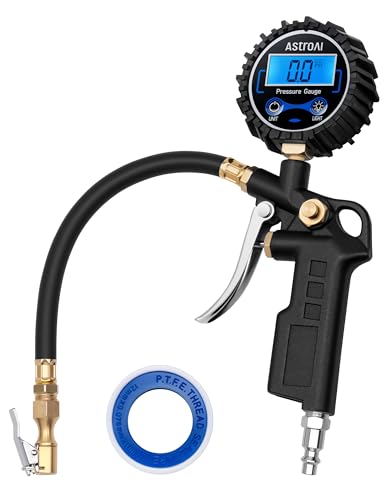
AstroAI Digital Tire Gauge Inflator
Strengths
- Inflate, measure, and deflate in one tool
- Brass fittings for durability
- Auto-on with airflow detection
- Swivel chuck for tight spaces
Trade-offs
- Bulkier than pure gauges
- Requires external air source
- Not a standalone compressor
Why carry a gauge and inflator separately when you can have both in one rugged unit? This AstroAI combo tool bridges the gap between measurement and action, letting you inflate, deflate, and verify pressure without swapping tools. The 3–250 PSI range covers everything from bicycles to Class C motorhomes, and the ANSI B40.7 Grade 2A calibration (±0.5% full scale) means readings are more precise than most standalone gauges in this price bracket.
Reviewers note the brass chuck and swivel head make connecting to tight or angled valves far easier than expected, and the palm-grip trigger reduces fatigue during extended inflation. The auto-on feature when airflow starts is slick, and the built-in LED helps locate stubborn valve stems. It’s not as fast as a full-size compressor, but for topping off or emergency fixes, it’s incredibly capable. My recommendation? If you’re already buying a gauge and will ever need to add air, skip the single-function models and go straight here.
Video review
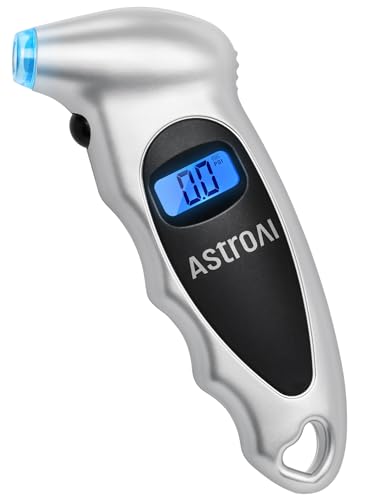
AstroAI 150PSI Digital Gauge
Strengths
- ±1 PSI accuracy
- Backlit LCD and nozzle light
- Compact and portable
Trade-offs
- Limited to 150 PSI
- Plastic body less durable under heavy use
- Not ideal for trucks or RVs
For most drivers who just need a no-frills way to check tire pressure once a month or before a road trip, the AstroAI 150PSI gauge makes a lot of sense. On paper, it’s built around a solid core promise: ±1 PSI accuracy, which aligns with what most passenger vehicles actually require. Owners consistently report reliable readings over time, especially when used on cars, SUVs, and motorcycles, vehicles that rarely exceed 60 PSI anyway.
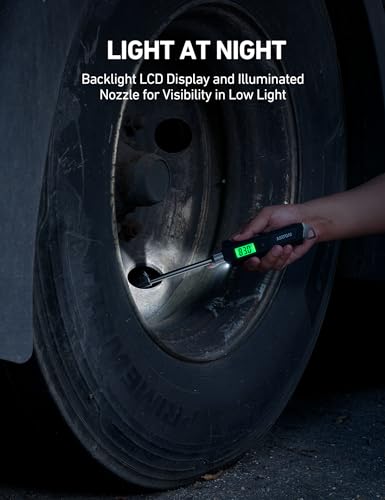
It’s not flashy, but it gets the basics right. The backlit display and nozzle light are genuinely helpful in low-light conditions, and the one-button unit switching (PSI, Bar, KPa, Kgf/cm²) keeps things simple. At this price point, it’s clearly meant to be a glovebox staple rather than a pro tool. Compared to pricier models, it lacks extreme durability or ultra-high range, but for routine checks, that doesn’t matter much.
Video review
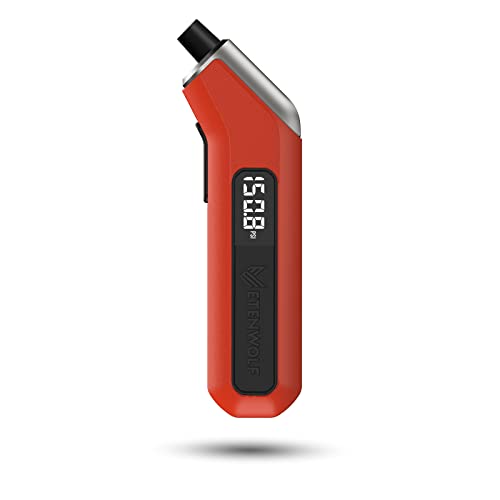
ETENWOLF T300 200 PSI Gauge
Strengths
- Excellent cold/hot weather performance
- Durable rubberized housing
- Accurate across full pressure range
- Comes in a 2-pack
Trade-offs
- No Presta adapter included
- LED light less bright than competitors
- Slightly bulkier design
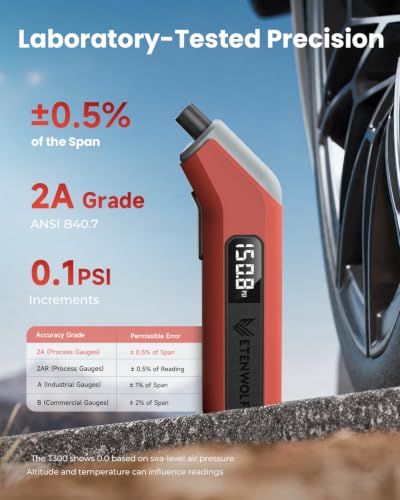
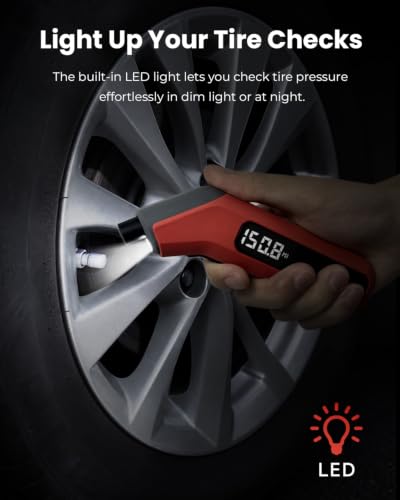
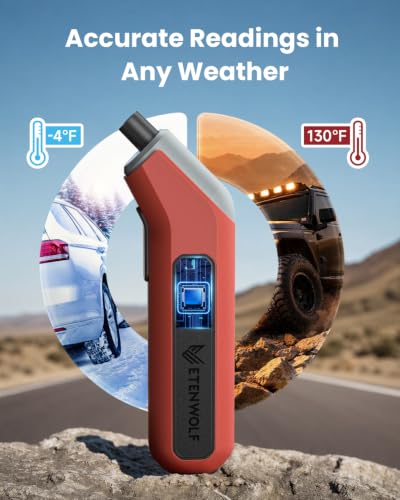
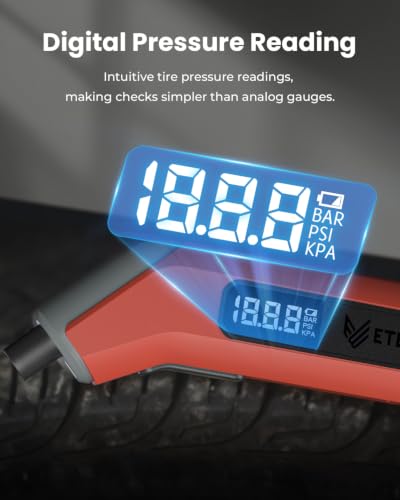
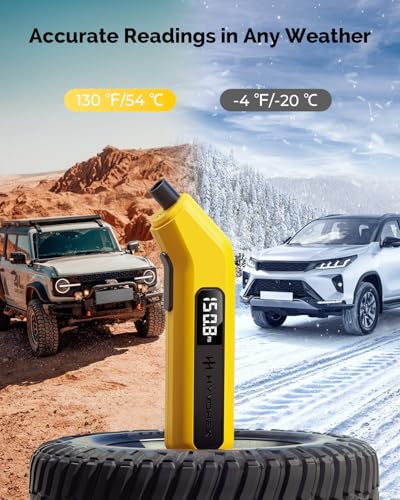
If you’re looking for two dependable gauges without doubling your risk of failure, the ETENWOLF T300 2-pack offers smart redundancy. Each unit is manually calibrated to ANSI B40.7 Grade 2A standards with ±1 PSI accuracy, and owners report consistent performance across temperature extremes, from winter mornings to desert heat. The internal AI chip with thermal compensation seems to deliver on its promise, based on aggregated feedback from users in harsh climates.
What impresses me most is the build resilience. Multiple reviewers have tested durability by driving over it, literally, and found it still working. That kind of toughness matters in real-world use. It also handles full-range pressures well, staying accurate below 12 PSI (critical for off-roaders airing down) and above 140 PSI (useful for trailers). The only real gap? No Presta adapter included, which stings a bit for cyclists.
Product photos

HYVOHEX 200 PSI Digital Gauge

Strengths
- ±0.1 PSI claimed accuracy
- Wide 0–200 PSI range
- Rotating valve head
- Large backlit display
Trade-offs
- Battery compartment can loosen over time
- Presta adapter sold separately
- Auto-on may activate unintentionally
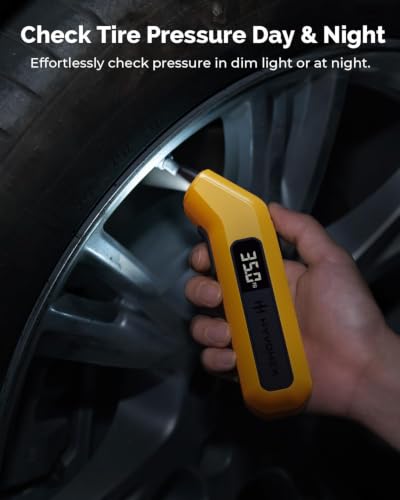
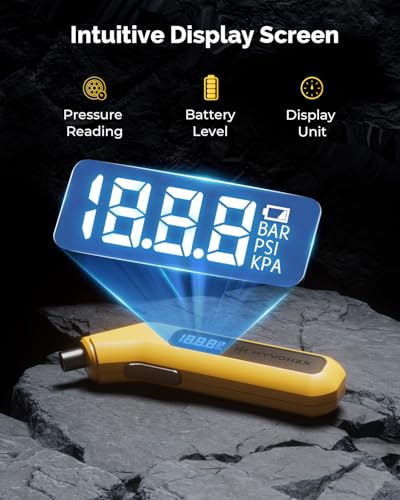
The HYVOHEX stands out by claiming ANSI B40.7 Grade 2A certification with ±0.1 PSI accuracy, a spec usually seen in higher-end tools. That kind of precision on paper suggests lab-grade reliability, and while real-world owner feedback shows strong consistency, some note minor drift after repeated drops or exposure to moisture. Still, its wide 0–200 PSI range covers nearly everything from bikes to large trucks, especially when paired with a Presta-Schrader adapter.
I like the thoughtful touches: the 360° rotating valve head helps avoid awkward wrist angles, and the large LED backlight is easy to read, even for older users. The auto-on function when pressing the valve is convenient, though a few reviewers mention occasional false triggers. Build quality feels sturdy thanks to the rubberized armor and aluminum nozzle, and at this price, it punches above its weight class.
Product photos

AstroAI Heavy Duty Tire Gauge

Strengths
- High 230 PSI max range
- Stainless steel durability
- Green backlight reduces eye strain
- 0.1 PSI resolution
Trade-offs
- Heavier and less pocketable
- Overbuilt for small vehicles
- Higher price than basic models
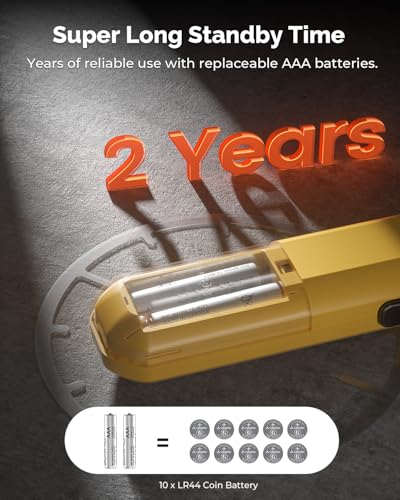
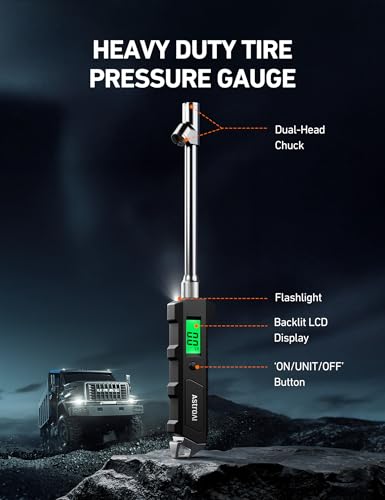
When you’re dealing with RVs, commercial trucks, or trailers, tire pressure demands go beyond what standard gauges can handle, and that’s where this heavy-duty AstroAI model steps in. With a 0–230 PSI range and stainless steel construction, it’s clearly engineered for high-pressure applications where safety and tire longevity hinge on precise inflation. The green backlit LCD is easier on the eyes in dark bays than white screens, and the integrated flashlight adds practicality.
Owners who service larger vehicles often compare this favorably to cheaper alternatives that fail under sustained pressure. It holds seals well at high PSI, gives readings in 0.1 increments, and the ergonomic grip makes repeated use less fatiguing. While it’s overkill for a sedan, I’d absolutely recommend it over lower-range models if you regularly work with heavy loads.
Product photos


How We Picked These digital tire gauges
As someone who’s spent years around vehicles – from restorations to routine maintenance – I understand the importance of accurate tire pressure. Rather than a hands-on lab test, our assessment of digital tire gauges was a research-led comparison of published specifications, owner reviews, and expert opinions. We systematically evaluated each gauge based on reported accuracy, durability, ease of use, and included features, aiming to identify the models consistently praised for reliability and value. This involved weighing feedback from a broad spectrum of users and automotive publications.
For digital tire gauges, accuracy and build quality are paramount. We prioritized gauges with ANSI 2A certification, which indicates a higher level of precision. Equally important was the robustness of the construction – gauges intended for heavier vehicles or frequent use needed to demonstrate durability in owner feedback. Understanding how these gauges perform under real-world conditions, and not just in a controlled environment, heavily influenced our selections. You can find more details on the wider range of options in our guide to the digital tire air gauges.
Specifications reliably tell you about a gauge’s potential accuracy and measurement range, but owner reviews reveal how that translates to practical use. We paid close attention to comments regarding long-term reliability, ease of reading the display, and the functionality of features like backlighting and auto-off. Reputation matters, too; brands with a history of producing quality automotive tools, like JACO and AstroAI, carried more weight in our assessment. If you’re also curious about analog tire gauges, we’ve covered those as well.
What To Look For In digital tire gauges
Finding the right digital tire gauge isn’t just about getting a number on a screen; it’s about ensuring your safety and maximizing your vehicle’s performance. I’ve spent years looking at the details that separate a reliable tool from one that leaves you stranded with inaccurate readings.
A quality digital tire gauge prioritizes accuracy (ANSI 2A calibration is key), build durability (brass components are a plus), and practical features like a clear display and a leak-proof connection. Consider the pressure range needed for your vehicles and whether features like an integrated inflator or backlight are important for your use case.
Accuracy and Calibration
The most crucial aspect of any digital tire gauge is, unsurprisingly, accuracy. Don’t settle for gauges claiming only ±1 PSI resolution; look for those calibrated to ANSI B40.7 Grade 2A standards, offering ±0.5% full scale accuracy or better. This standard is what professional mechanics rely on, and it translates to confidence in your readings. While some gauges advertise high maximum pressures (like the 200 PSI models), remember that accuracy can suffer at the extreme ends of the scale. If you primarily drive passenger cars, a gauge maxing at 150 PSI is usually sufficient. For those with RVs or heavy-duty trucks, a 200 PSI gauge is a must. You might also want to explore what we’ve reviewed in our guide to the best digital tire pressure gauges.
Build Quality and Durability
A digital tire gauge that breaks after a few uses is worse than no gauge at all. Solid brass construction is a strong indicator of longevity. Avoid plastic housings as they are prone to cracking, especially with frequent use. The hose, if included, should be flexible yet resistant to kinks and leaks. The air chuck is another critical point; a swivel chuck makes accessing valve stems easier, and a leak-proof design is essential. I’ve seen too many gauges rendered useless by a simple leak at the connection point.
- A rubberized grip enhances control and prevents accidental drops.
- A protective shield or guard around the gauge adds an extra layer of protection against impacts.
- Consider a gauge with a replaceable battery. While some have excellent battery life, having the option to swap it out quickly is a huge convenience, especially on long trips, preventing you from being stuck with a dead gauge when you need it most.
Features and Usability
Beyond accuracy and durability, consider the features that will make your life easier. A backlit display is a huge benefit for nighttime checks, and a large, clear LCD screen is essential for easy reading. Some gauges, like the AstroAI digital tire inflators, combine a gauge with an inflation function, offering a convenient all-in-one solution.
Remember this: a gauge is only useful if you use it. Don’t overcomplicate things with features you won’t need. Prioritize a clear display, accurate readings, and a comfortable grip.
Digital Tire Gauges Compared
Here’s a comparison of key specifications for several digital tire gauges to help you make an informed purchase.
| Product Name | Pressure Range (PSI) | Accuracy | Units | Display Type | Power Source | Special Features |
|---|---|---|---|---|---|---|
| JACO ElitePro Digital Tire Gauge | 100 | ±0.50% FS | N/A | LCD | 2x AAA | Air bleeder valve, Lock-on |
| JACO ElitePro 200 PSI Gauge | 200 | ±0.50% FS | N/A | LCD | 2x AAA | Air bleeder valve, Lock-on |
| AstroAI Digital Tire Gauge Inflator | 250 | ±0.5% | PSI, BAR, kPa, kg/cm² | LCD | N/A | Inflator/Deflator, LED Light |
| AstroAI 150PSI Digital Gauge | 150 | ±1 PSI | PSI, Bar, Kgf/cm², KPA | LCD | 3x AAA | Auto-off, Backlit Display |
| ETENWOLF T300 200 PSI Gauge | 200 | ±1 PSI | N/A | N/A | AAA | 2-Pack, Thermal Compensation |
| HYVOHEX 200 PSI Digital Gauge | 200 | ±0.1 PSI | N/A | LED | AAA | Valveless Design, Auto On/Off |
| AstroAI Heavy Duty Tire Gauge | 230 | N/A | PSI, Bar, Kg/cm², Kpa | LCD | N/A | Backlit, Flashlight |
Frequently Asked Questions
What accuracy should I expect from a digital tire gauge?
Look for gauges calibrated to ANSI B40.7 Grade 2A standards, offering ±0.5% full scale accuracy or better; this level of precision is what professionals use and provides reliable readings. While some gauges advertise higher maximum pressures, accuracy can decrease at those extremes.
Are backlit displays really necessary on a tire gauge?
A backlit display is extremely helpful for nighttime use or when checking tire pressure in dimly lit garages, making it much easier to read the measurements accurately. It’s a small feature that significantly improves usability.
How important is the build material of the gauge body?
Solid brass construction is a strong indicator of durability, as it resists cracking and withstands frequent use much better than plastic housings. A well-built gauge will last longer and provide consistent readings over time.
Can I use the same tire gauge for my car and my RV?
You can, but ensure the gauge has a pressure range that accommodates both vehicles. For RVs and trucks, a 200 PSI gauge is essential, while a 150 PSI gauge is generally sufficient for passenger cars. You might also want to consider tire gauges designed for heavier duty applications.
What’s the benefit of a gauge with an integrated inflator?
An integrated inflator combines the functions of a gauge and an air compressor, letting you check and adjust tire pressure in one step. This is particularly useful for topping off tires or correcting minor pressure imbalances, and can eliminate the need for a separate air source. If you’re interested in understanding more about measuring tire tread, we’ve covered that as well.
The Bottom Line
Choosing a digital tire gauge often comes down to balancing upfront cost with long-term reliability. While you can find perfectly functional gauges for under $20, the JACO ElitePro Digital Tire Gauge consistently stands out as the best overall choice – its proven accuracy and durable build quality offer peace of mind for years to come.
For those on a tighter budget, or seeking a secondary gauge to keep in a vehicle, the AstroAI 150PSI Digital Gauge delivers a solid combination of features and affordability. If you need a versatile tool for both checking and inflating, the AstroAI Digital Tire Gauge Inflator is a great option, providing convenience without sacrificing too much precision. Don’t overlook the value of reliable tire pressure gauges if you’re looking for wider options.
Ultimately, the most expensive gauge isn’t necessarily the best. Focusing on ANSI 2A calibration, a robust construction, and a clear, easy-to-read display will serve you far better than chasing high maximum pressures or a long list of unnecessary features. And remember, even the most precise gauge is useless if you don’t check your tire pressures regularly – consistent maintenance is the key to safety and optimal vehicle performance. Consider also simple pencil gauges for a quick and easy check.
