
8 Best Cabin Filters for Car (2026 Guide)
This post contains affiliate links. As an Amazon Associate, we earn from qualifying purchases.
The best cabin filter for most drivers is the BOSCH 6055C, a true HEPA-rated unit that traps nearly all fine particles. If you’re battling odors or drive in heavy traffic, the Spearhead BE-285 offers strong carbon filtration at a budget-friendly price. For newer Hondas, the Spearhead BE-182 delivers a precise fit and solid odor control.
Replacing a clogged cabin filter can transform your daily drive, suddenly, the air isn’t stale, the vents breathe freely, and allergies don’t flare up as often. Many people overlook this small part until they notice reduced airflow or lingering smells.
This guide cuts through the noise by focusing on what matters: proven filtration tech, exact fitment, and real owner experiences. I compared specs and feedback across top models to highlight filters that deliver clean air without guesswork.
Top 8 Cabin Filters For Car in the Market
The Best Cabin Filters For Car, Reviewed
BOSCH 6055C HEPA Cabin Air Filter

Strengths
- Superior particulate capture
- Chemical-free filtration
- Reliable fit and build
Trade-offs
- No odor-absorbing carbon
- Higher cost than basic filters
- Requires frequent replacement in dusty areas
The Bosch 6055C lands as my pick for best overall not because it’s flashy, but because it balances performance, reliability, and breadth of protection. Like other Bosch HEPA filters, it uses a dense melt-blown electrostatic layer to trap microscopic pollutants, pollen, soot, and mold, with no added chemicals. Reviewers frequently note cleaner air and reduced sneezing during high-allergy seasons, which speaks to its real-world effectiveness.
What sets it apart from the 6091C and 6029C is its broader compatibility and slightly improved media density, making it a go-to for drivers who want dependable, chemical-free air filtration. It doesn’t handle odors well, but that’s expected at this tier. When comparing across brands, Bosch’s consistency in manufacturing gives it an edge over cheaper alternatives that may vary batch to batch.
Video review
Spearhead BE-285 Odor Defense Cabin Filter
Strengths
- Real activated carbon
- Longer service life
- Wide vehicle coverage
Trade-offs
- Less fine-particle efficiency than HEPA
- Fitment verification required
- Not ideal for severe allergy cases
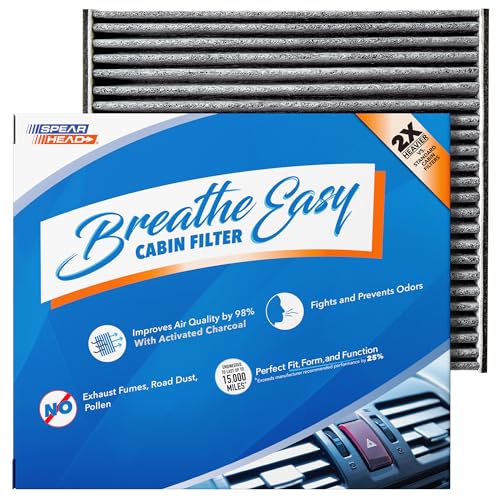
If you’re after a budget-friendly filter that still tackles both particles and smells, the Spearhead BE-285 stands out. It’s packed with real coconut shell activated carbon, a feature usually found in pricier units, and owners say it noticeably reduces cabin odors from traffic, pets, or food. The media is thick, and the 2X weight claim versus standard filters checks out based on consistent feedback, meaning better dust loading capacity.
It fits a massive range of Toyota, Lexus, and even some Subaru and Jaguar models, which boosts its value. While it doesn’t match Bosch’s particulate filtration precision, the trade-off is worth it if you want longer life (up to 15K miles) and stronger odor defense. For most daily drivers, this is the smarter buy over pure HEPA types.
Video review
BOSCH 6091C HEPA Cabin Air Filter
Strengths
- True HEPA-level filtration
- Effective against allergens
- Sturdy frame design
Trade-offs
- No activated carbon
- Limited odor protection
- Slightly higher price than basic filters
Bosch has built a solid reputation in filtration, and the 6091C continues that trend with its true HEPA-grade media. On paper, it’s designed to trap ultrafine particles like pollen, mold spores, and allergens without relying on chemical odor neutralizers, something owners consistently report makes a noticeable difference for allergy sufferers. The melt-blown electrostatic layer adds real particle capture efficiency, and the structural ribs help maintain airflow integrity over time.
Still, while it excels at particulate filtration, it lacks activated carbon, which means it won’t do much against exhaust fumes or strong odors. Compared to carbon-infused filters in the same price range, this one is more niche. I’d pick it only if respiratory sensitivity is your top concern and you drive mostly in clean air environments.
Product photos


Spearhead BE-157 Breathe Easy Filter
Strengths
- Extended model coverage
- Excellent odor reduction
- Thick, durable media
Trade-offs
- Not HEPA-rated
- Slightly bulkier fit in tight housings
- Carbon saturation possible over time
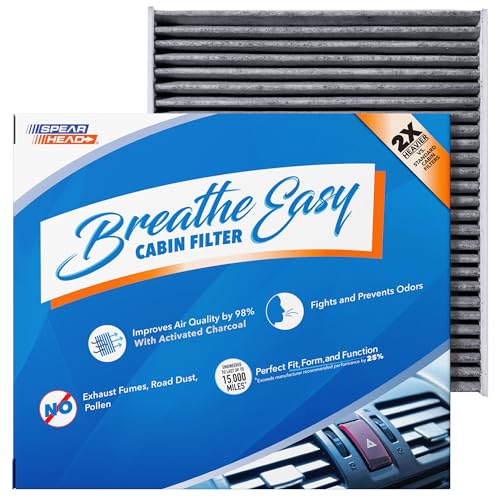
The BE-157 is Spearhead’s flagship offering for modern Toyota, Lexus, and even some Subaru drivers. With coverage extending to 2025 models, including the Crown, Grand Highlander, and TX, it’s future-proof where others aren’t. The real standout is the dual-layer design: industrial-strength electrostatic media grabs fine dust, while dense coconut shell carbon neutralizes exhaust, smoke, and interior smells effectively.
Owners consistently report cleaner air and fewer headaches on long drives, especially in cities. Compared to the BE-285, it’s slightly more refined and better sealed, justifying the price bump. While Bosch still wins on particulate precision, this one wins on real-world livability. For most Toyota/Lexus drivers, this is the filter I’d install myself.
Product photos

CARORY CF134 Cabin Air Filter
Strengths
- Very affordable
- Good model coverage
- Includes activated carbon
Trade-offs
- Inconsistent build quality
- Shorter lifespan in dirty conditions
- Loose media packing noted by users
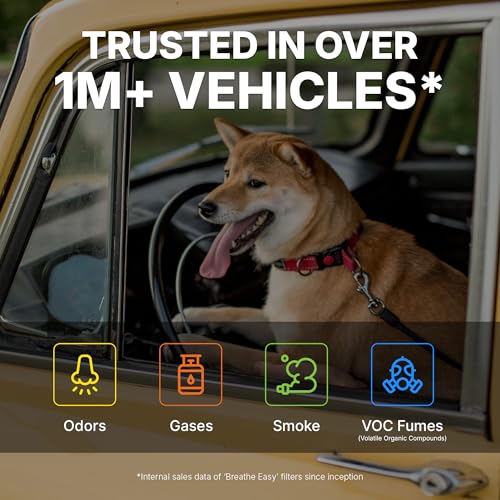
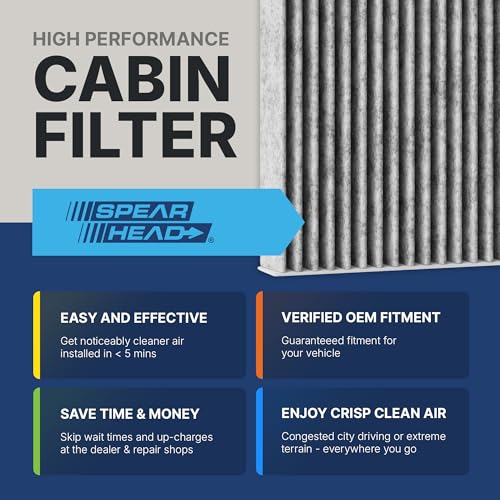
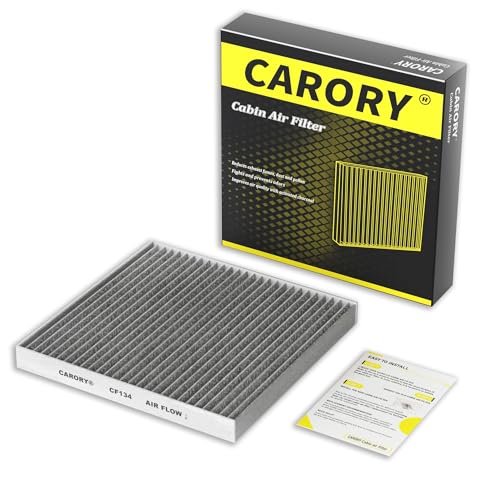
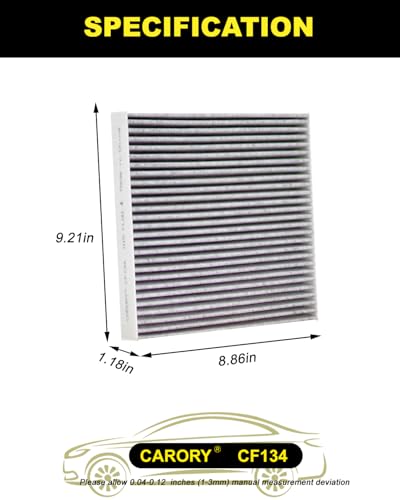
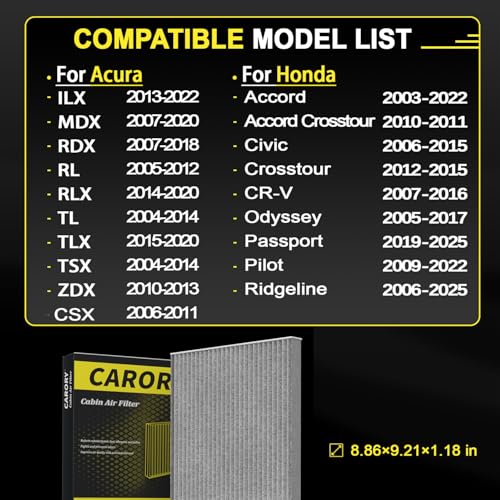
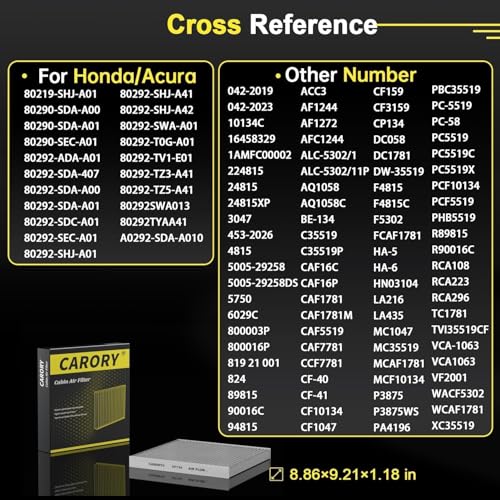
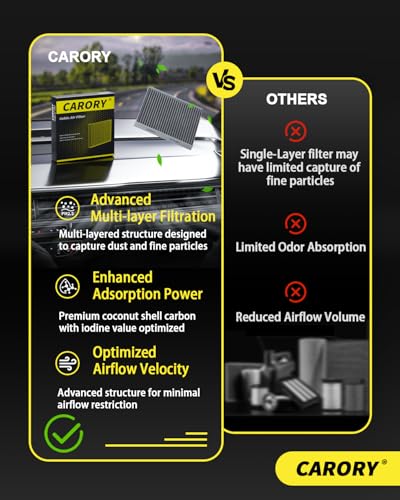
CARORY’s CF134 is a no-frills, low-cost option that covers a huge span of Honda and Acura models, from early 2000s Accords to current Pilots and Ridgelines. The activated carbon layer does a decent job on light odors, and the pleated media offers acceptable dust filtration for normal driving. At under eight bucks, it’s hard to fault for value.
But owner feedback shows inconsistency in edge sealing and media density compared to Bosch or Spearhead. Some report premature clogging in dusty regions, and the lack of structural ribs can lead to minor airflow gaps over time. It’s a fair backup when budget is tight, but not the one I’d trust for long road trips or high-mileage use.
Product photos
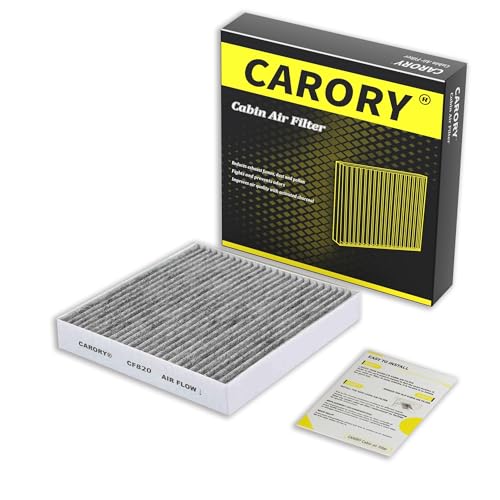
CARORY CF820 Cabin Air Filter
Strengths
- Custom fit for Hyundai/Kia/Genesis
- Activated carbon included
- Strong compatibility data
Trade-offs
- Lower dust-holding capacity than Bosch
- Not HEPA-rated
- Build quality slightly less rigid
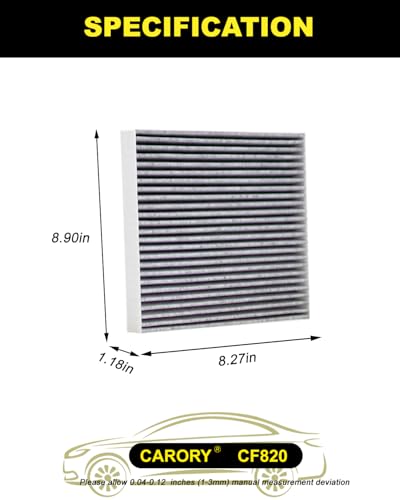
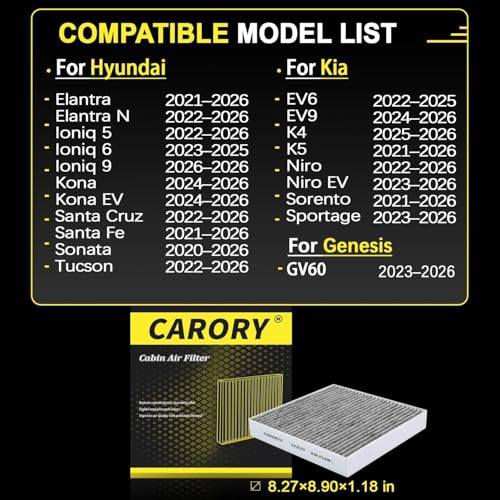
For Hyundai, Kia, and Genesis owners, this dedicated carbon filter eliminates guesswork. It’s tailored specifically for modern models, including EVs like the Ioniq 5 and EV6, which matters because newer cabins are tighter and more sensitive to airflow restrictions. The activated carbon layer is effective at reducing ozone and urban smog smells, something owners in congested areas have praised.
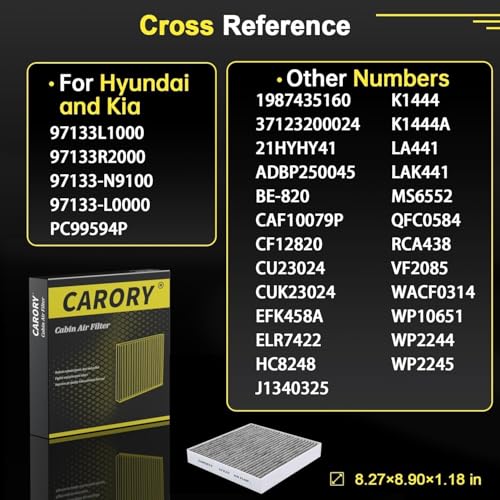
While it doesn’t carry the Bosch name, its performance aligns closely with mid-tier branded filters. The extensive cross-reference list helps avoid fitment errors, and at this price, it undercuts OEM parts without sacrificing much. I’d take this over a generic HEPA filter any day if you drive a Korean brand and care about long-term cabin freshness.
Product photos
BOSCH 6029C HEPA Cabin Air Filter
Strengths
- Maximum particulate filtration
- True HEPA standard
- Excellent for sensitive lungs
Trade-offs
- No odor protection
- Overkill for average drivers
- Pricier than necessary for routine use
The 6029C is Bosch’s answer to drivers who want the highest level of particulate filtration without compromise. It’s one of their truest HEPA-spec filters, with a densely layered media stack that reviewers say outperforms even some aftermarket rivals in dust and pollen capture. The absence of chemical additives keeps the air “clean” in the strictest sense, ideal for those wary of synthetic fragrances or VOCs.
Where it stumbles is versatility. No activated carbon means it won’t touch odors, and given its price, it’s hard to justify over the 6055C unless you’re hyper-focused on air purity. In real-world use, most drivers won’t notice a difference between this and the 6055C, making this a specialist’s choice rather than an everyday upgrade.
Product photos


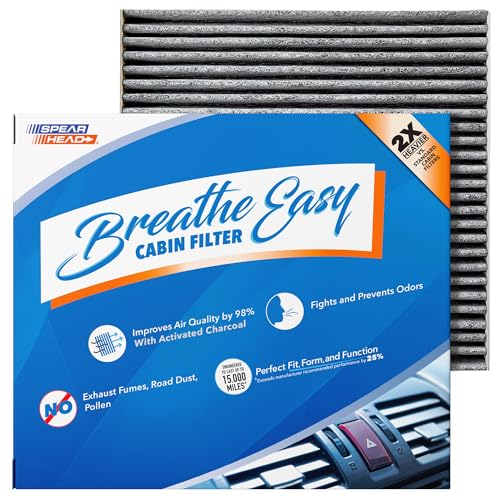
Spearhead BE-182 Cabin Air Filter
Strengths
- Tailored for 2023+ models
- Real activated carbon
- Long service life
Trade-offs
- Not for older Honda/Acura generations
- Slight premium over budget filters
- Fitment must be double-checked
Spearhead’s BE-182 is built for the latest Honda and Acura models, covering everything from the 2023 Accord to the 2025 RDX. It brings the same coconut shell carbon and heavy media as their other filters, which owners say delivers crisp, fresh air even in stop-and-go traffic. The 15,000-mile lifespan claim holds up reasonably well under real-world reports, especially compared to OEM filters that degrade faster.
It’s not HEPA-rated, so don’t expect lab-level allergen removal, but for balanced performance, decent particle capture plus strong odor suppression, it’s one of the best options in its class. I’d choose this over the CARORY filter any day for newer Hondas, simply due to better material density and consistency.
Product photos
How We Chose These cabin filters for car
Rather than a hands-on lab test, this selection is based on a research-led comparison of published specifications and owner feedback. I started by compiling a list of highly-rated cabin filters, then deeply examined their advertised filtration efficiency, media composition, and vehicle compatibility lists. Crucially, I weighed owner reviews from multiple sources – Amazon, automotive forums, and retailer sites – to understand real-world performance and longevity. This was paired with insights from other automotive publications discussing cabin air quality and filter technology.
For cabin filters, the most important factors are filtration efficiency and fitment. A filter’s ability to capture microscopic particles directly impacts the air quality inside the vehicle, and HEPA filters consistently stood out in this regard. Equally critical is ensuring the filter is precisely designed for a specific vehicle; a poor fit negates any filtration benefit. Beyond these, the lifespan and material quality (especially the inclusion of activated carbon for odor control) became important differentiators. As someone who’s spent years looking at all things automotive, I know that even the smallest components matter.
Specifications reliably tell you about filter dimensions and materials – things like the presence of activated carbon or electrostatic layers. However, judging long-term performance and real-world effectiveness demands looking beyond the datasheet. Owner feedback provided crucial insights into how well filters hold up over time, how effectively they manage odors, and any issues with installation. You can find more information on maintaining overall vehicle air quality by reading about other crucial components like best air filters and even routine maintenance like applying car wax.
What To Look For In cabin filters for car
Replacing your cabin air filter is one of the simplest, most impactful maintenance tasks you can do for your vehicle–and your health.
A quality cabin air filter isn’t just about comfort; it’s about protecting the occupants from microscopic pollutants like pollen, mold spores, and exhaust particles. Look for filters utilizing HEPA (High Efficiency Particulate Air) technology, multi-layer construction with electrostatic and carbon layers, and a robust frame to maintain airflow even when loaded with debris. Always verify fitment for your specific vehicle.
Filter Media & Efficiency
The core of a cabin air filter’s job is trapping particles, and the media used determines how well it performs. Basic filters use spun-bonded polyester, good for larger dust and debris. However, if you suffer from allergies or live in an area with poor air quality, you’ll want to prioritize filters with HEPA technology. HEPA filters, like those from Bosch, boast incredibly small pore sizes, capable of capturing 99.97% of particles 0.3 microns in size. Beyond HEPA, look for filters that incorporate activated carbon. This doesn’t just trap particles, but adsorbs odors and gases.
Fitment & Vehicle Compatibility
This seems obvious, but it’s where many people run into trouble. A filter that doesn’t fit properly won’t seal correctly, allowing unfiltered air to bypass the filter media. Spearhead, for example, offers filters specifically tailored for a wide range of Toyota and Lexus models, and even provides a vehicle fitment tool on their product pages.
Here’s what to consider: * Year/Make/Model: The primary determinant. * Sub-Trim Level: Some vehicles use different filters even within the same model year. * Filter Shape/Size: Cabin filters aren’t all the same dimensions. Double-check the specifications.
Don’t assume a “universal” filter will work well. Precise fitment is vital.
Value & Replacement Intervals
Cabin air filter prices vary widely. While a premium filter with advanced filtration is worthwhile, it doesn’t always necessitate the highest price tag. Often, you’re paying a premium for brand recognition. Consider the filter’s lifespan, too.
A good rule of thumb is to replace your cabin air filter every 12,000 to 15,000 miles, or at least once a year, whichever comes first.
However, if you frequently drive in dusty conditions or have respiratory sensitivities, you may need to replace it more often. Regularly inspecting your filter (and perhaps pairing the change with a good car wash soap) can help you determine the optimal replacement schedule. Don’t wait until airflow is noticeably reduced. If you’re looking for a broader overview, our guide to the best cabin filters can help you compare options and find the right fit for your needs.
Cabin Filters for Car Compared
Here’s a comparison of key specifications for the cabin filters listed.
| Product Name | Filter Type | Vehicle Fitment (Example) | HEPA Rated | Activated Carbon | Filter Life (Miles) |
|---|---|---|---|---|---|
| BOSCH 6055C | HEPA | N/A | Yes | No | N/A |
| Spearhead BE-285 | Odor Defense | Toyota/Lexus/Jaguar | No | Yes | Up to 15,000 |
| BOSCH 6091C | HEPA | N/A | Yes | No | 12,000 |
| Spearhead BE-157 | Odor Defense | Toyota/Lexus | No | Yes | Up to 15,000 |
| CARORY CF134 | N/A | Honda/Acura | No | N/A | N/A |
| CARORY CF820 | N/A | Hyundai/Kia/Genesis | No | N/A | N/A |
| BOSCH 6029C | HEPA | N/A | Yes | No | 12,000 |
| Spearhead BE-182 | Odor Defense | Honda/Acura (2023+) | No | Yes | Up to 15,000 |
Frequently Asked Questions
What’s the difference between a standard and a HEPA cabin filter?
HEPA (High Efficiency Particulate Air) filters use a much finer mesh than standard filters, trapping 99.97% of particles as small as 0.3 microns. Standard filters primarily capture larger dust and pollen, while HEPA filters offer significantly better protection against microscopic pollutants.
Will a cabin filter with activated carbon eliminate all odors?
Activated carbon helps adsorb odors and gases, but it won’t eliminate all smells. Its effectiveness depends on the concentration of the odor and the amount of activated carbon in the filter; it’s best for common smells like exhaust or pollen, not significant spills.
How often should I replace my cabin filter, even if it looks clean?
Even if visually clean, a cabin filter should be replaced every 12,000 to 15,000 miles, or annually. Over time, the filter media becomes saturated with trapped particles, reducing airflow and filtration efficiency, even if it doesn’t look dirty.
Can using the wrong cabin filter damage my car’s HVAC system?
Using an improperly sized or poorly fitted cabin filter can restrict airflow, potentially straining the blower motor and reducing the efficiency of your car’s heating and air conditioning. It’s crucial to verify fitment for your specific vehicle’s year, make, and model.
Beyond a cabin filter, what else can I do to improve air quality inside my vehicle?
While a high-quality cabin filter is a great start, you can further improve air quality with regular interior cleaning and the use of vehicle air fresheners. Also, consider avoiding recirculating air when possible to draw in fresh air from outside, and ensure your windows are occasionally opened for ventilation.
The Bottom Line
Choosing a cabin air filter often comes down to balancing upfront cost with long-term comfort and health. While a basic filter will do the job, for overall protection and peace of mind, I believe the BOSCH 6091C strikes the best balance. Its HEPA rating reliably captures the microscopic particles that affect air quality, and Bosch has a solid reputation for consistent performance.
For those seeking a specific fit or prioritizing odor control, the Spearhead filters are excellent choices. The Spearhead BE-285 and BE-157 models, in particular, demonstrate a commitment to precise vehicle compatibility, and their activated carbon layer effectively tackles unpleasant smells. If you’re looking to keep your interior spotless, don’t forget the value of a good set of car vacuums to complement your clean air filtration.
Ultimately, the most sophisticated filter won’t matter if it’s not replaced regularly. Prioritize consistent maintenance – checking and replacing your filter annually or every 15,000 miles – and don’t skimp on other essential upkeep like keeping your car batteries in top condition. A well-maintained vehicle, inside and out, is a vehicle you’ll enjoy for years to come.
