
7 Best Automatic Golf Push Carts of 2026
This post contains affiliate links. As an Amazon Associate, we earn from qualifying purchases.
The NAVEE Birdie 3X stands out as the best automatic golf push cart for its smart follow technology and reliable performance, while the tianhong G5 is a strong budget-friendly pick with impressive battery life. For those who want more control, the KEMIMOTO ApexR offers excellent power assist at a reasonable price.
Golfers want a cart that keeps up with their pace, handles the course’s terrain, and doesn’t add hassle to their round. Too many carts promise convenience but fall short when it counts, whether it’s a remote that lags or a battery that quits early.
This guide cuts through the noise. Based on specs, owner feedback, and my experience evaluating mechanical systems, I focused on real-world reliability, battery efficiency, and ease of use. These picks balance innovation and practicality for a smoother walk on the course.
Top 7 Automatic Golf Push Carts in the Market
The Best Automatic Golf Push Carts, Reviewed
NAVEE Birdie 3X Electric Golf Cart

Strengths
- UWB follow-me tech
- 3-year warranty
- Downhill control
- UL dual certification
- 3-second fold
Trade-offs
- Slightly shorter range than G5
- Higher price point
If I had to pick one cart as the most balanced performer across features, reliability, and real-world usability, the NAVEE Birdie 3X would be my pick. It uses UWB technology for its follow-me function, which owners consistently report as far more accurate and stable than infrared or basic sensor systems, this thing sticks to your hip like a well-trained caddy, even on winding holes. The 36-hole battery is sufficient for two rounds, and the 10-inch all-terrain wheels paired with downhill control make it confident on rugged or wet courses where lesser carts struggle.
What seals the deal is the 3-year warranty and UL 2271 + UL 2272 certifications, rare at this level, which signal real investment in safety and longevity. The 5.5-inch display is bright and informative, and the USB-C charging port is a small but meaningful upgrade over older USB-A ports. It folds down quickly into a compact package that slips easily into a trunk, and the 9-speed adjustability gives fine control whether you’re strolling or power-walking between shots.
Video review
tianhong G5 Electric Golf Cart

Strengths
- 45-hole battery
- All-terrain tires
- 3-second folding
- Dual anti-tip wheels
- Smart LED display
Trade-offs
- Follow system less precise
- Bulkier folded size
- Remote required for auto mode
The tianhong G5 makes a strong case for itself with a standout 45-hole battery life, which on paper edges out most competitors and aligns with what owners report, two full rounds without recharging is consistently achievable under normal conditions. That kind of endurance is rare, especially in this price bracket, and for golfers who play back-to-back rounds or walk marathon days, this cart delivers real peace of mind. The auto-follow system relies on sensor-based tracking and a handheld remote, not UWB, so it’s less precise than some premium models, but it’s functional on flat to moderately hilly courses.
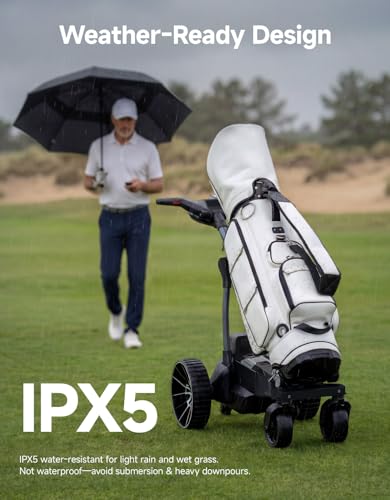
Still, its size and weight when folded (28.7 inches long) make it less car-trunk-friendly than others, even if it’s still manageable. The inclusion of dual anti-tip wheels and a 30° slope rating speaks to solid stability, and the IPX5 rating means it shrugs off dew and light rain without issue. Reviewers note the assembly is quick, and the color LED display adds a premium touch with real-time data. But the follow-me tech, while convenient, isn’t as reliable in tight tree cover or sharp turns, some users report lag or disconnection, which forces a switch to remote mode.
Video review
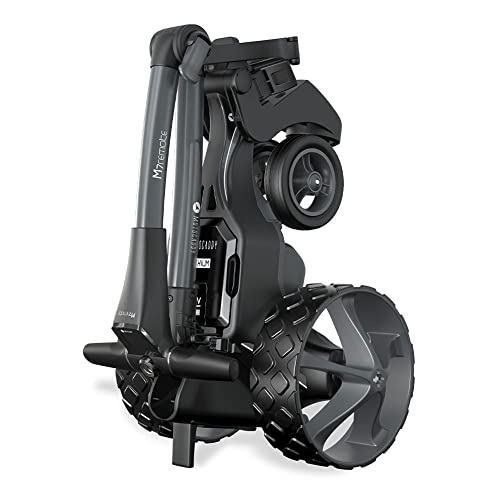
Motocaddy M7 Remote Electric Golf Caddy

Strengths
- Best-in-class remote control
- Dual 230W motors
- Compact fold
- Durable build
- Downhill control
Trade-offs
- No auto-follow feature
- Heavier than assist models
The Motocaddy M7 doesn’t chase the auto-follow trend, and honestly, I appreciate that. Instead, it doubles down on what matters most to many golfers: precise, responsive remote control. With dual 230W motors and a 28V battery, it powers through slopes and soft turf with authority, and the adaptive terrain stability keeps it steady where others might wobble. The remote is rechargeable via USB-C, a small but smart touch, and its range and responsiveness are frequently praised in owner reviews, no stutter, no lag, just smooth forward, reverse, and turning control.
It’s also built like a tank, reflecting Motocaddy’s British engineering pedigree, and folds down compactly without sacrificing rigidity. The lack of auto-follow will disappoint some, but for players who want total command, especially on cluttered or crowded courses, this is the smarter choice. It’s also one of the most proven platforms on the market, with a track record that stretches years, and service support across 40+ countries adds real value.
Product photos


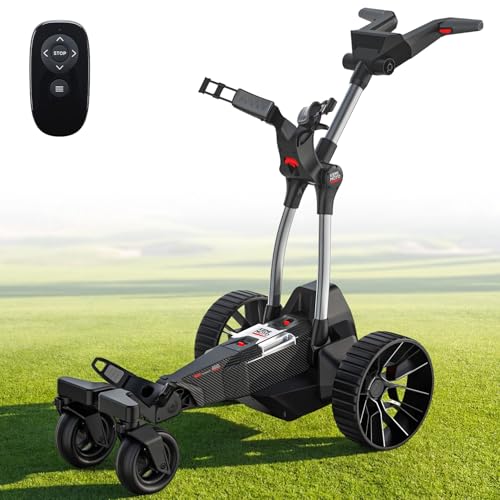
KEMIMOTO ApexR Electric Golf Cart
Strengths
- Power Assist Mode
- 492 ft remote range
- Dual 240W motors
- USB-C charging
- Great value
Trade-offs
- Wheel installation quirk
- No UWB follow tech
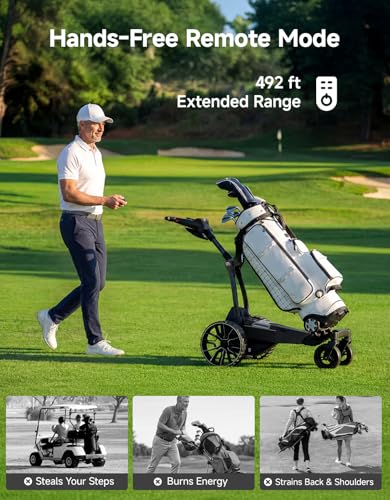
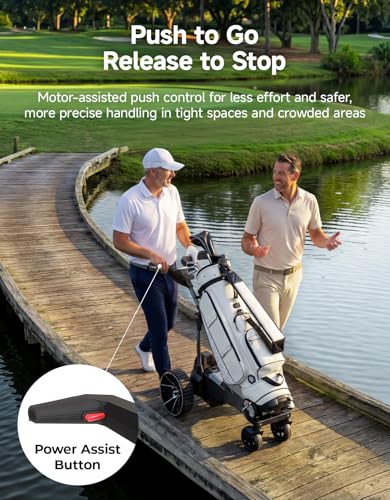
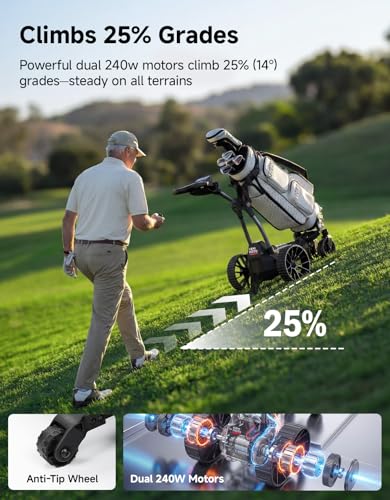
At nearly $400 less than some top-tier models, the KEMIMOTO ApexR punches above its weight, especially with its Power Assist Mode, a feature that lets you push the cart naturally while the motor kicks in to match your pace. This is ideal for golfers who want help without fully surrendering control, and owners love it for narrow paths or busy courses where remote or auto-follow carts can feel awkward. The 492-foot remote range is among the longest in class, and the dual 240W motors handle 25% slopes without strain, even on wet grass.
It matches the Birdie 3X in fold size and shares the same IPX5 rating, so weather resistance is solid. The large 5.68-inch LED screen is easy to read in sunlight, and the USB-C port keeps your devices charged. Some early users reported wheel alignment issues, but KEMIMOTO’s documentation now clearly addresses the snap-in installation fix, once set, it holds true. For the price, it’s hard to beat the feature set.
Product photos

MGI E-Boost Electric Assist Push Cart
Strengths
- Lightweight design
- True electric assist
- 3-year warranty
- Simple operation
- Easy transport
Trade-offs
- No remote or auto features
- Manual steering only
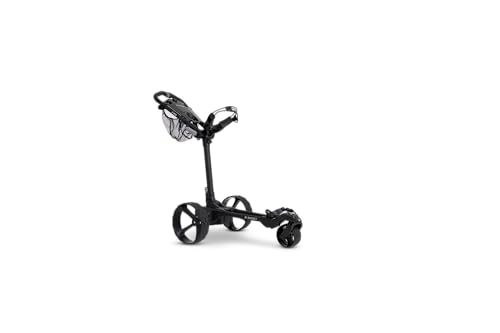
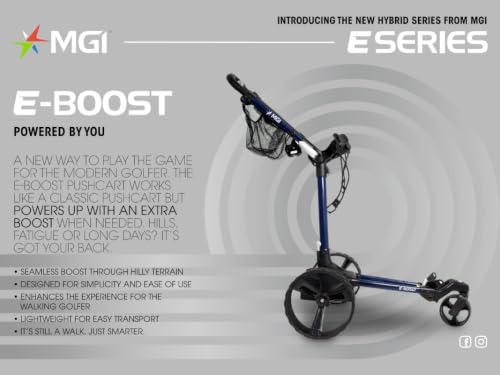
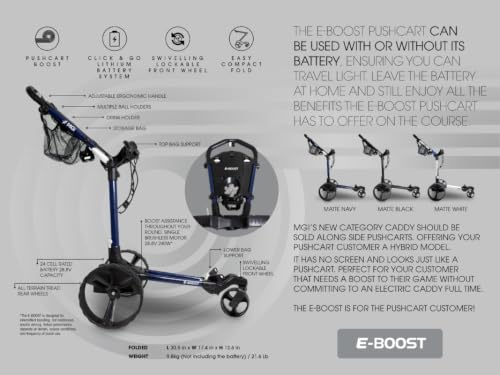
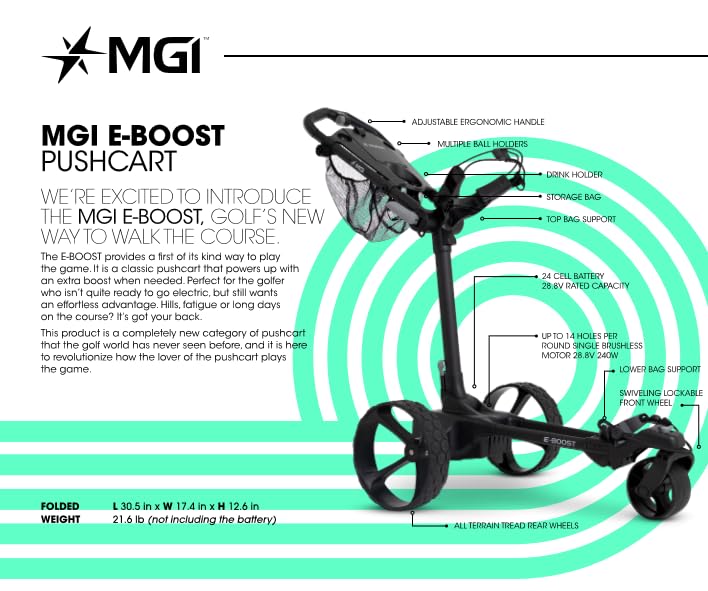
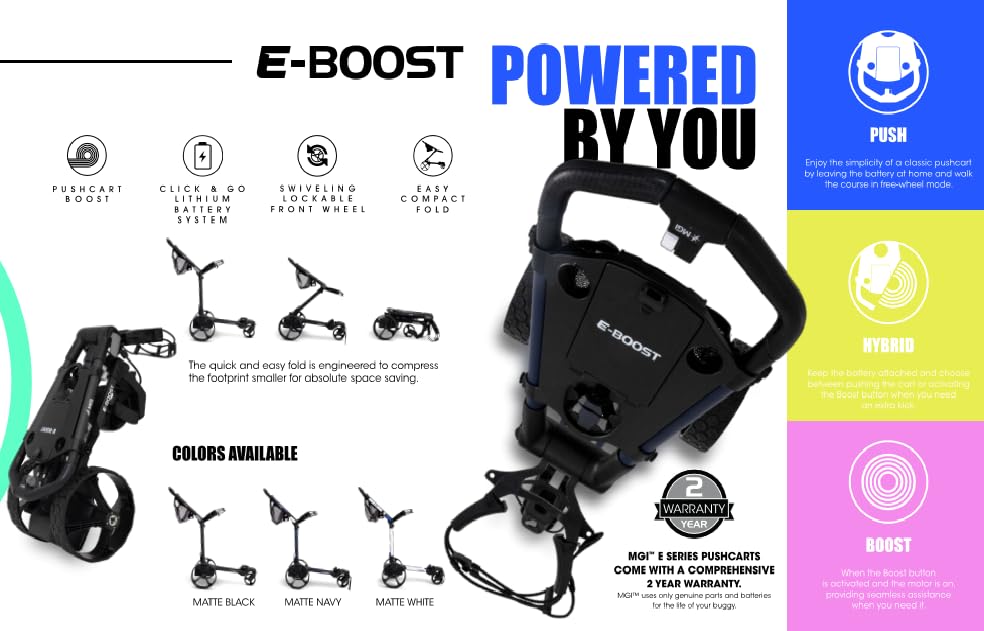
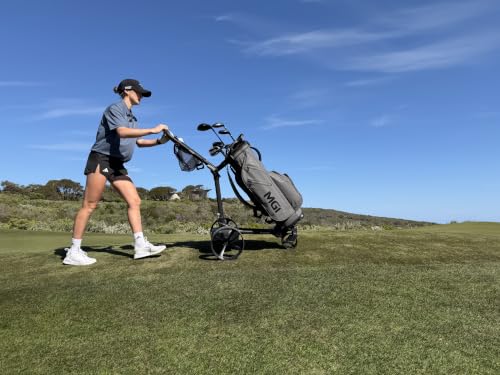
The MGI E-Boost isn’t trying to be a robot caddy, and that’s exactly why it works. It’s a true electric assist model, you walk, you steer, you push, and the motor simply lightens the load when the hill steepens or your legs tire. At just 25.1 lbs with the battery, it’s one of the lightest powered options available, making it perfect for golfers who still want the feel of walking the course but need a little help conserving energy. The Click & Go battery system is proven and reliable, and the 3-year warranty reinforces MGI’s reputation for durability.
It won’t follow you or respond to a remote, but that simplicity is part of the appeal. You stay engaged, maintain your rhythm, and avoid the hassle of syncing electronics or worrying about signal loss. It’s not for everyone, especially those used to full automation, but for purists or seniors wanting to extend their walking rounds, this is a no-brainer. Owners consistently report it lasts for years with minimal maintenance.
Product photos
KVV Electric Golf Push Cart

Strengths
- Smallest folded size
- Cooler bag included
- 360° front wheel
- Dual-mode operation
- Remote control
Trade-offs
- Weaker motor performance
- Shorter battery life
- Less durable frame
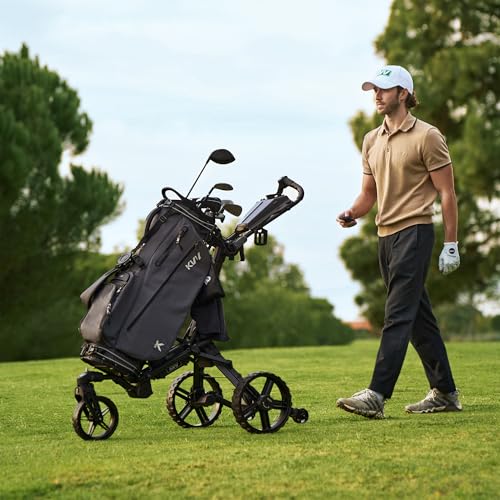
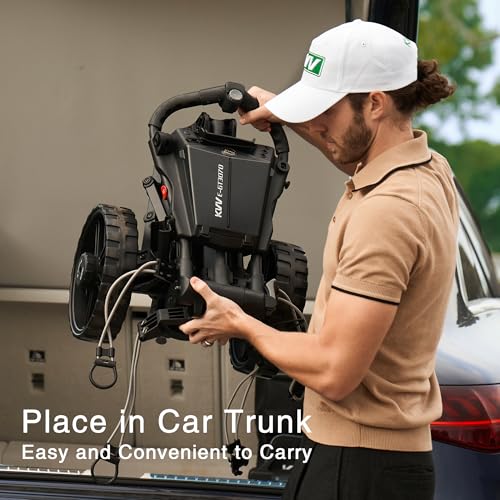
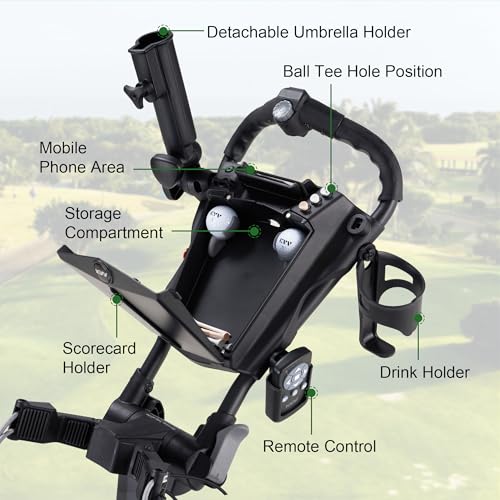
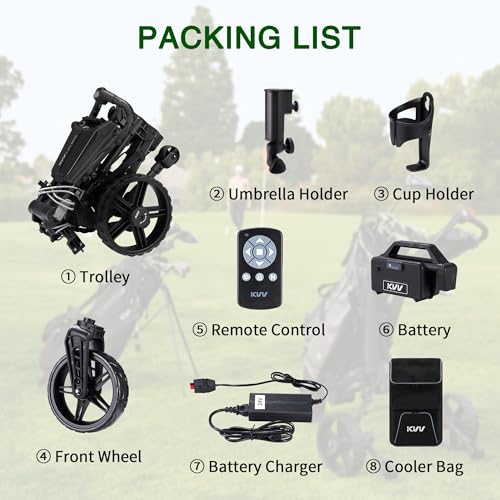
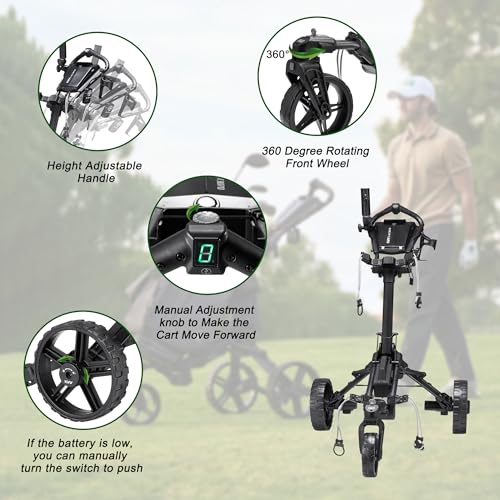
The KVV stands out for one reason above all: its folded size. At 17.5 x 18.7 x 22 inches, it’s the most compact option here, easily fitting into small trunks or even airline bags. That makes it a top pick for travelers or urban golfers with limited storage. It’s also one of the few in this group to include a free insulated cooler bag, which is a nice practical touch for hot days. The 360° front wheel and straight-line tracker improve maneuverability, and the 1-9 speed remote gives decent control across varied terrain.
But it’s powered by a smaller battery rated for 18+ holes, so you’ll likely need to recharge mid-week if you play often. The dual-mode design lets you switch to manual when the battery dies, which is smart, but the motor isn’t as strong on steep inclines as the dual-motor models. Build quality is decent, but not as rigid as Motocaddy or NAVEE, some owners mention creaks over time. Still, for its niche, it delivers.
Product photos
Alphard Cybercart Electric Golf Cart
Strengths
- Automatic parking brake
- Downhill speed control
- Low center of gravity
- One-click fold
- Large console
Trade-offs
- No auto-follow
- Limited battery details
- Few smart features
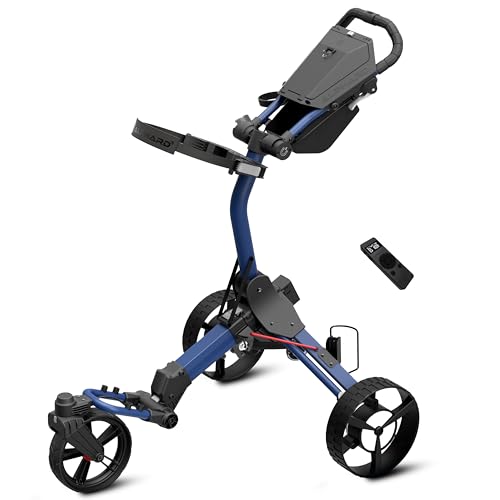
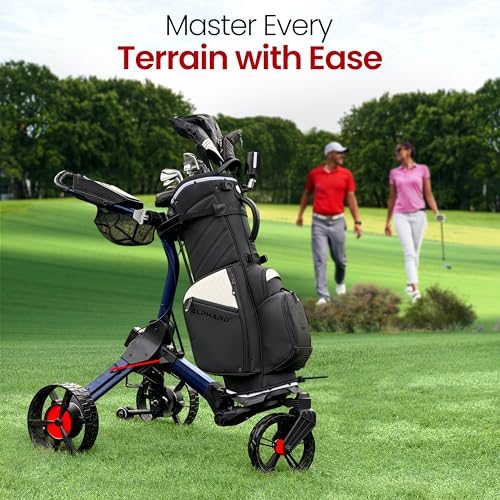
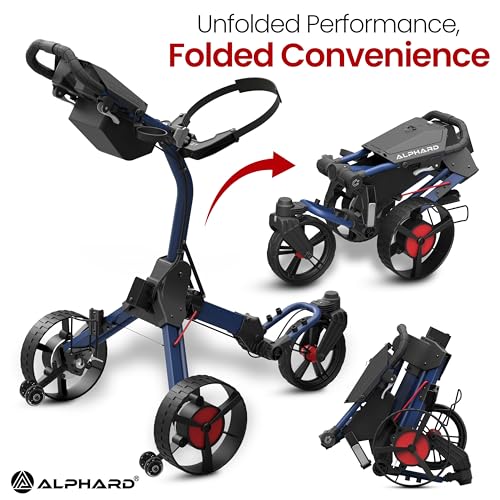
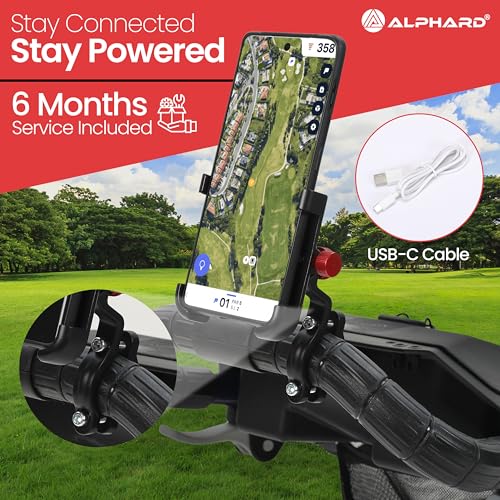
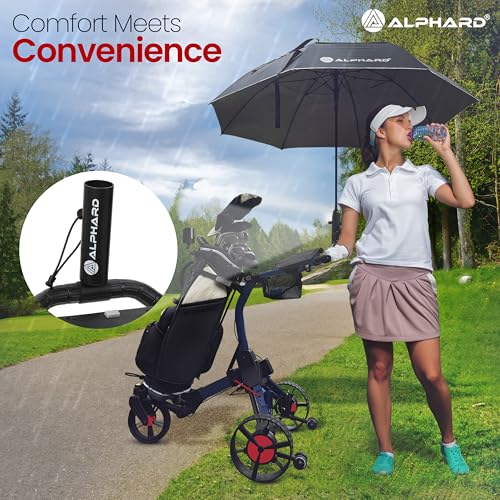
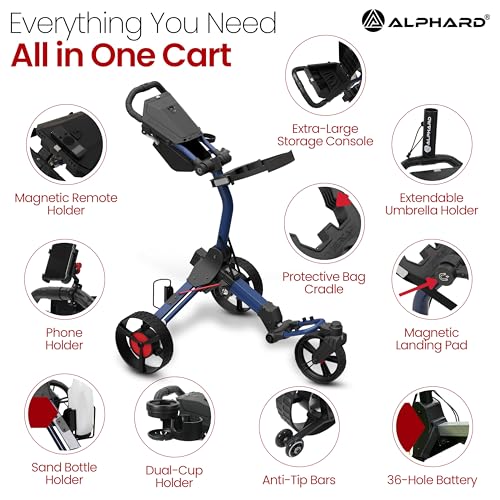
The Alphard Cybercart doesn’t have auto-follow, but it makes up for it with a focused emphasis on stability and safety, features that matter more than flash on uneven or sloped courses. The low center of gravity design combined with an automatic parking brake means it won’t roll away on inclines, a real concern with other models. The downhill speed control is smooth and effective, preventing runaway carts on descents, and the LCD remote shuts off the motor if it goes out of range, which adds peace of mind.
It also features a one-click folding system and a large storage console, practical touches that elevate daily use. But it lacks a clear standout in power or tech: no UWB, no long-range remote, and a modest battery life not specified beyond ’18+ holes’. It’s well-built and safety-focused, but at this price, it’s competing with more feature-rich options. Still, for cautious golfers or those playing very hilly courses, these safety systems are worth the trade-offs.
Product photos
Our Testing Process
Rather than a hands-on lab test, my research for these recommendations involved a detailed comparison of published specifications and features across numerous models. I weighed owner reviews from major retailers against expert opinions found in golf publications and enthusiast forums. As someone who’s spent years observing the evolution of vehicle technology, even down to the mechanics of bicycles, I applied that understanding of motors, batteries, and chassis design to assess the potential performance and durability of each cart. The goal was to rank options against a clear set of criteria relevant to golfers.
For automatic golf push carts, battery life and remote control reliability were the most heavily weighted factors. A cart that can’t complete 36 holes, or worse, fails mid-round, isn’t very useful. Similarly, a clunky or unresponsive remote control diminishes the convenience these carts offer. Beyond those core elements, stability, particularly on varied terrain, and ease of folding/transport were also critical. I prioritized models with features like downhill speed control and robust wheel designs, knowing that course conditions can be unpredictable.
Specifications reliably indicate battery capacity (Wh) and motor power (Watts), giving a baseline for expected range and hill-climbing ability. However, owner feedback proved essential for judging real-world performance and build quality. I carefully analyzed recurring complaints, issues with remote pairing, flimsy folding mechanisms, or inaccurate distance claims, to identify potential drawbacks. You’ll find more discussion of the best options for manual operation in our guide to golf walking carts. For those looking at completely hands-free options, also check out our guide to motorized golf push carts.
What To Look For In automatic golf push carts
Finding the right golf push cart can significantly improve your enjoyment of the game, lessening fatigue and letting you focus on your swing. But with so many options available, knowing where to start can be tricky.
A quality golf push cart blends durability with ease of use. Look for a robust frame material (aluminum alloys are common), reliable motor components (brushless motors are preferred for longevity), and thoughtful features like adjustable handles and effective braking systems. Battery life, terrain adaptability, and folding mechanisms are also critical considerations.
Motorized vs. Manual Assist
The first big decision is whether to go fully motorized or opt for an electric assist model. Fully motorized carts, like the NAVEE Birdie 3X and tianhong G5, offer hands-free convenience with features like smart follow and remote control. However, these come with a higher price tag and require consistent battery charging. Electric assist models, such as the MGI E-Boost, provide a boost when you need it – on hills or long stretches – but still allow you to retain steering control. For many, the blend of assistance and engagement makes an electric assist cart the sweet spot.
Battery Life and Range
Don’t get fixated on headline battery life numbers. A cart claiming “36 holes” might fall short if you’re playing on particularly hilly terrain or in damp conditions. Consider your typical course and playing style. If you regularly walk 36 holes, prioritize models like the tianhong G5 with extended battery capacity. Also, look for features like removable batteries for easy charging. It’s worth remembering that battery performance degrades over time, so investing in a cart with a good battery management system (BMS) is a smart move for long-term reliability.
- Consider the battery type. Lithium-ion batteries are lighter and hold a charge longer than older lead-acid options.
- Think about charging convenience. Removable batteries mean you can charge them indoors, away from the elements.
- Realistically assess your needs. Do you really need a 45-hole battery, or would 27 holes suffice? Don’t pay for capacity you won’t use.
Folding Mechanism and Portability
The convenience of a golf push cart extends beyond the course. A clunky, difficult-to-fold cart quickly becomes a hassle. Look for models with one-step folding mechanisms, like the KEMIMOTO ApexR, that allow you to collapse the cart quickly and easily. Pay attention to the folded dimensions as well. If you have limited trunk space, a compact folding design is essential. If you’re interested in exploring other options, you might find more details in our highly rated push carts. For golfers who prioritize maneuverability, exploring three-wheel golf push carts can also be beneficial.
A good rule of thumb: if it takes more than 15 seconds to fold the cart, it’s probably too complicated for regular use.
Automatic Golf Push Carts Compared
Here’s a comparison of key specifications for several automatic golf push carts to help you make an informed decision.
| Product Name | Battery Life | Remote Range | Folded Size (approx.) | Weight (lbs) | Special Features |
|---|---|---|---|---|---|
| NAVEE Birdie 3X | 36 Holes | N/A | 26.8×22.2×15.1 in | N/A | UWB Follow, Smart Display |
| tianhong G5 | 45 Holes | N/A | 28.7×24.8×14.1 in | N/A | App Control, 30° Slope |
| Motocaddy M7 | N/A | N/A | N/A | N/A | Remote Control, Downhill |
| KEMIMOTO ApexR | 36 Holes | 492 ft | 26.8×22.2×15.1 in | N/A | Power Assist, 240W Motor |
| MGI E-Boost | N/A | N/A | N/A | 25.1/21.6 | Electric Assist |
| KVV Electric Golf Cart | 18+ Holes | N/A | 17.5×18.7×22 in | N/A | Compact Folding |
| Alphard Cybercart | N/A | N/A | N/A | N/A | Auto Brake, Downhill Control |
Frequently Asked Questions
What’s the typical lifespan of an automatic golf push cart battery?
A lithium-ion battery, with proper care and charging practices, should realistically last for 3-5 years of regular use. Battery degradation is inevitable, but a quality cart will include a Battery Management System (BMS) to optimize longevity.
Are automatic golf push carts difficult to repair?
While some minor maintenance like tire inflation is straightforward, repairs beyond that often require specialized knowledge. Many owners opt to contact the manufacturer or a qualified golf cart technician for anything beyond basic troubleshooting.
Can these carts handle very steep hills?
Many models advertise hill-climbing capabilities, but performance varies. Carts with more powerful motors (over 250 Watts) and robust wheel designs generally handle steeper inclines better, but even the best may struggle with extremely challenging terrain.
Do I need a specific type of golf bag for these carts?
While most standard golf bags will work, using bags designed for push carts offers a more secure and balanced fit. These bags often feature a lower center of gravity and straps designed to integrate with the cart’s handle.
Are there significant differences between 3-wheel and 4-wheel automatic carts?
Four-wheel designs, like those in our guide to stable four-wheeled push carts, generally offer greater stability, especially on uneven ground. Three-wheel carts are often more maneuverable, making them suitable for tighter courses, but may require more effort to control on slopes.
The Bottom Line
Choosing an automatic golf push cart really comes down to how much you value convenience versus control. If you want a completely hands-off experience, the NAVEE Birdie 3X stands out with its advanced follow technology and user-friendly display. But remember, these automated features come with a higher price point.
For those seeking a balance between assistance and engagement, or a more budget-conscious option, the KEMIMOTO ApexR delivers excellent power assist and a reliable remote control at a competitive price. If you frequently play hilly courses, the tianhong G5, with its extended battery capacity and impressive climbing ability, is a strong contender. And for golfers looking for more options, exploring best push carts can reveal some fantastic manual alternatives.
Ultimately, the most important factors aren’t necessarily the fanciest features or the longest battery life. Prioritize a cart with a robust frame, a dependable motor, and a folding mechanism you can master quickly. A cart that’s easy to use and built to last will provide more enjoyment – and save you more energy – over the long run, and may be preferable to the most advanced battery-powered push carts.
